
Saturday, 27 April 2013

How to pass the Bechdel test and why it is IMPORTANT at all


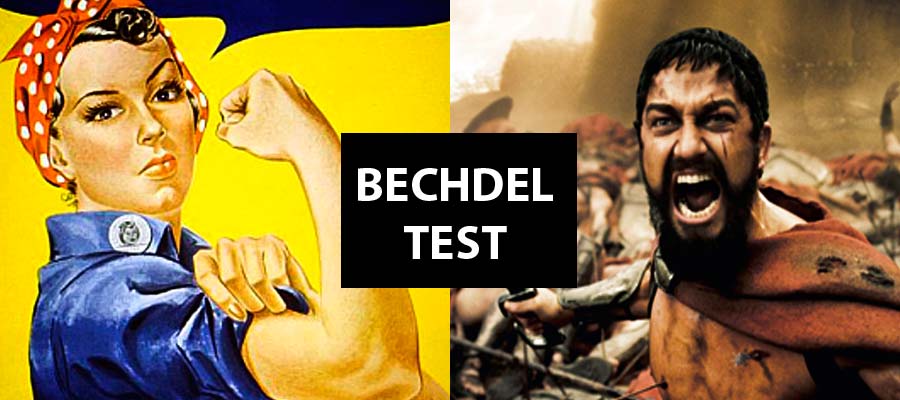
The Bechdel test or Bechdel/Wallace test was developed by Liz Wallace and became widely known after Alison Bechdel featured it in her comic Dykes to Watch Out For.

The Bechdel test is a test of female characterisation in movies. Passing the Bechdel test requires that the movie (or media):

  • has at least two women characters;
  • who talk to each other at some point;
  • about something other than a man or men

Of course passing or failing the test is not an ironclad guarantee of well-rounded, feminist, characterisation or a great, interesting movie; however it is indicative of the problems of token women characters that are plaguing the film industry. A vast amount of geeky media fails the test although you have to admit the criteria cannot be called exorbitant. Just a minute or two of small talk between two chicks, no guys mentioned - is it such a big deal? Is it?

Now, I am really not a proponent of limiting yourself to shows/movies that pass the test; if you did so you'd be cutting out a lot of otherwise-worthy entertainment. Indeed I admit a fair number of top-notch works have legitimate reasons for including no women (e.g. The Name of the Rose, a not exactly great movie but based on a brilliant book by Umberto Eco which was set in a medieval monastery), or with no conversations at all, or having only one or two characters.

A movie can easily pass the Bechdel Test and still be incredibly misogynistic. Conversely, it's also possible for a story to fail the test and still be strongly feminist in other ways, and there's nothing necessarily wrong with that. What's a problem is that it becomes a pattern — when so many movies fail the test, while very few show male characters whose lives seem to revolve around women, that says uncomfortable things about the way Hollywood handles gender. There are also lesser-known variations of the rule, such as the Race Bechdel Test, in which two characters of colour talk about anything other than the white leads and the Reverse Bechdel Test, with the roles of men and women swapped.

Now you might be surprised if you consult the list of famous films that failed the original test miserably.

1. Run Lola Run
2-4. The Entire Lord of the Rings Trilogy
5-7. The Original Star Wars Trilogy
8. Avatar
9. Harry Potter and the Deathly Hallows: Part II
10. The Social Network
11. Matrix
12. Inception
13. Eternal Sunshine of the Spotless Mind
14.Shrek
15. Princess Bride
16. Sex and the City
17. The Avengers
18. The Hunt for Red October

Quite a list, isn't it? If you want to know more or if you want to check whether your fav movie would pass the test without actually rewatching it, please visit http://bechdeltest.com/ where movies are listed and assessed properly. You can comment there as well. :)


Some people MIGHT get twitchy at the idea that more female protagonists would be a positive step in cinema. Shouldn't cinema be just about art and good films telling interesting stories? No, it shouldn't -  here’s a few reasons why I think the Bechdel test is important, and what it can tell you:

1. You don’t notice it until you have it pointed out…

…and then you can’t stop. It’s amazing how the relative absence of women in film is so normal, so acceptable and so widely spread it can barely be noticed.

Think about it this way – how weird would a reverse Bechdel world be? Most movies only have one male character and if he gets any dialogue at all with a rare second male character, it will inevitably be about women. Challenge of the day: have you ever seen that film? Think, and think hard, and if you come up with a title please comment. If you can name one, what kind of film is it? Is it making a point, or aimed at a particular demographic – or is the lack of testosterone entirely by accident, because no one is paying attention.

2. “Women aren’t interesting enough to deserve more time in a movie...”

…is a very short-sighted fallacy. While cinema can’t – shouldn’t – rebuild the world as an equal-opportunities utopia, a great many test-failing stories seem to arise through laziness and ignorance. This can’t be simply pigeonholed as a “feminist issue”. If you’re only telling stories about men, you’re ignoring 50% of the ideas, thoughts, and experiences in the world. That’s a whole lot of movies not being made. Not a big deal, really?

3. It demonstrates the lack of good, strong female protagonists so the lack of good, strong female models

And, connected to that...

4. Film shapes popular culture and popular perception of male and female gender far more efficiently than school, any piece of legislation or government policy.

If you think the way women are treated nowadays matters and should be improved/changed you simply cannot neglect such a powerful tool as pop culture entertainment. As much as film is a product of a culture where women are dull accessories with nothing to say or do, it reproduces this culture. If you learn most of your information about a world outside your so-called comfortable, contemporary  existence through cinema how are you to know how realistic say City of God or Das Boot is? But when you happen to discuss street kids or submarine operators, those vivid images come to your mind. If you want to change the way men perceive and treat women start with the entertainment. 

5. It says a lot about the industry and the world we live in.

Why is it so difficult for a movie to pass such a simple test? Is it because most scriptwriters, directors and producers are male? And therefore inclined to write from their personal experience?  Even assuming they’ve managed to name two women, perhaps their understanding of what women are interested in is limited? I am inclined to think this must be the case. Maybe women are traditionally a rarer cinema-going demographic precisely because of a lack of realistic women on screen? Why would Hollywood willingly shut off a source of income otherwise?


If you are a writer or a scriptwriter: do you have two well-developed female characters in your books/scripts ? Are they important enough to the plot that they need to meet and talk? Do they have enough to say beyond just discussing the men in their lives? It’s cheating to stick in a token scene just to pass – their contribution must be as real and measurable as the men in your scenario. Is it worth the effort though? I think 'yes' every time I hear or watch news about home violence, worse treatment of women at work, physical, sexual and psychological abuse of women and related issues. If something can be done, let's do it damnit.


Sources:

Friday, 26 April 2013

Review: Rome 03: The Eagle of the Twelfth by M.C. Scott

Book info:
Form: hardback
Genre: historical fiction (ancient Roman Empire)
Target audience: adults

Synopsis:

Demalion of Macedon accompanies Sebastos Panthera, a Roman spy, to Parthia but their mission is soon concluded. Then he is made to join the Twelfth Legion, notorious for its ill fortune, always facing the harshest of postings, the toughest of campaigns, the most vicious of opponents. Additionally, the Legion is also given a very bad, inexperienced commander - a politician not a soldier.

However, amid all of the violence and savagery of his life as a legionary, Demalion realizes he has discovered a vocation - as a soldier and a leader of men. He is made a centurion and has come to love the Twelfth and all the bloody-minded, dark-hearted soldiers he calls his brothers. One of them, a young, beautiful Greek called Heraclides with a nickname of Tears, becomes even somebody closer than that.

When Demalion thinks he has found a place in the world, all that he cares about is ripped from him. First his Legion is defeated by the Parthians due to the supreme ignorance and ineptitude of his commander - they have to retreat in shame, just happy to be alive. Then they are ordered to quench the brutal Judaean uprising and  the Hebrew army inflicts humiliating defeat upon the legion - not only decimating their ranks, but taking away their soul, the eagle, the symbol of their pride and identity.

There is one final chance to save the legion's honour - to steal back the eagle. To do that, Demalion and his fellow legionary scout called Horgias must go undercover into Jerusalem, into the very heart of their enemy - where discovery will mean the worst of deaths. Will they survive a mission which resembles very closely a suicide?

What I liked:

I haven't read a good historical fiction set in the times of Roman Empire for a long time so when awesome Mel from Mel's Random Reviews sent me this one I was overjoyed. It is  the thrid and final installment of a series but you can read it as a standalone without any problems. I found it original and interesting mainly because it depicts Roman wars with Parthia, a relatively less known campaing which took place in the first century A.D. during the reign of Nero. Well, I suppose most of people have heard of Nero, his poems and antics which led to the burning of Rome and persecution of first Christians, but few heard about his wars.

Parthia roughly corresponds to the western half of Khorasan region in northeastern Iran. It bordered Media on the west, Hyrcania on the north west, Margiana on the north east, and Aria on the south east. I really enjoyed the fact that it was a completely new setting, as far from Rome and Nero's corrupt court as it could only be.

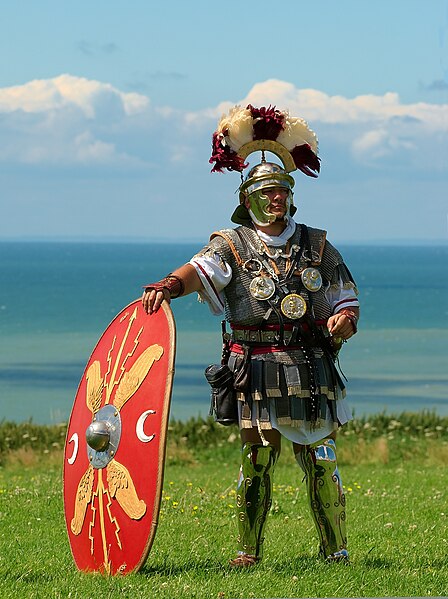
A centurion of Roman army
Most of the action is described directly from Demalions’s perspective and there is a real sense that he is right in the midst of these frenetic, bloody encounters. I was really surprised when I found out that the author is actually a woman - Scott perfectly captures the chaos of each engagement as well as the emotions that a soldier must have experienced. Demalion's attitudes toward constant training and bloodshed evolve and he becomes far more comfortable on the battlefield. The initial fear of being in a life threatening situation never disappears but he also learns the raw elation of surviving. After a while he feels most alive when surrounded by chaos of the battle and death.The relationships between soldiers are tight and any losses are horrible.

I also liked very much the character of Sebastos Abdes Pantera, also called the Leopard. He was a spy extraordinaire who never revealed more than he should about himself and his missions, often surprising poor Demalion and not always in a good way but also arousing grudging respect. I really regretted we weren't shown the whole world from his POV at least once. In fact I would be perfectly happy if Pantera was given a series on his own. For him I might read the first two parts which, as far as I know, tell his previous adventures as a spy and pupil of Seneca.

What I didn't like:

The whole novel is set among the Roman soldiers; I certainly understand that there weren't many places for women in such a company but really in this book there is only ONE female character, Hypatia, introduced very late, in the second part of the book, and never properly presented, acting as a prop. I am really disappointed. 

Apart from that I wish I could find out more about the final fate of Pantera.

Final verdict:

If you like really good historical fiction books I recommend you this one. It captures not just the epic scale of Rome’s legions, but its core, its heart, its very essence;  it strives to show what made the men behind the armour tick. It is also a page-turning military history but notably without women.

Thursday, 25 April 2013

Rameau's Review Archive: Unclaimed (Turner #2) Courtney Milan

Rameau's ramblings: This will be listed under second opinions, but technically this is the first opinion and the review that got Anachronist reading historical romance. Go me!

Originally posted on Goodreads September 20th 2011.

Synopsis: 
Her only hope for survival...
Handsome, wealthy and respected, Sir Mark Turner is the most sought-after bachelor in all of London and he's known far and wide for his irreproachable character. But behind his virtuous reputation lies a passionate nature he keeps carefully in check...until he meets the beautiful Jessica Farleigh, the woman he's waited for all his life.
Is to ruin the man she loves...
But Jessica is a courtesan, not the genteel lady Sir Mark believes. Desperate to be free of a life she despises, she seizes her chance when Mark's enemies make her an offer she can't refuse--seduce Mark and tarnish his good name, and a princely sum will be hers. Yet as she comes to know the man she's sworn to destroy, Jessica will be forced to choose between the future she needs and the love she knows is impossible.


Unclaimed (Turner, #2)Unclaimed by Courtney Milan

Why should you read this?

Because it's a historical romance of two people coming together and surpassing social and personal obstacles. You need more convincing do you?

Let's see. There's a virgin, there's a seduction, and there's a defamation that'll separate the two lovers. Not sold yet?

Well, he's the one with an untarnished reputation and virtue to protect, and she's the experienced lover who'll teach him to know better.

That did it, oh, good. Just in case...

Sir Mark has written a book about chastity and to his disbelief it's taken a life of its own. He's become the darling of the public and an unwilling role model for men in search of new challenges. He's also become the target of envy and resentment. Someone wants to see Sir Mark's good name in the gutter and they're willing to pay for it.

Enters Jessica, the experienced courtesan who longs for freedom. She doesn't want to sell her body to survive anymore. All she needs is enough money to break free and make a quiet life of her own far away from the city. She grabs the opportunity with both hands and prepares for one last tryst.

Sir Mark is immediately attracted to the mysterious widow Jessica pretends to be, but he's not ready to succumb to her charms quite so easily. After all he's battled his yearnings for nearly thirty years and there have been other temptations. Nothing quite like this though.

What follows is a delicious tale of two people circling and trying to outsmart each other. It's a seduction in the best sense of the word. It's a seduction of the mind as well as the body and the erotica is far from gratuitous. It's actually earned.

It isn't until near the end when the reader has all but abandoned hope for Sir Mark and Jessica that they do come together and admit the extent of their feelings for each other. After all, there's more than love involved; there's respect and dignity to consider.

Milan's writing is solid as she slowly guides the couple together. She takes her time introducing the characters and explaining just what makes them so unique especially considering the setting. Milan doesn't skirt around sex scenes, because she's afraid to write them, she simply ensures they fit in with the plot - questionable word choices and all.

Yes, an actual plot in a romance novel, can you imagine? So, what are you waiting for? Go, read, and enjoy the slow burn.

I received a copy of this book from the publisher through NetGalley.


Wednesday, 24 April 2013

Review: Sins and Needles (The Artists Trilogy 01) by Karina Halle


Synopsis


Some children get Lego blocks and Barbie dolls to play with, some get locks and skeleton keys. And scars. Ellie Watt has never known another life – just that of con scams and stealing. Her parents, a set of almost model white trash grifters, taught her how to break and enter and cheat before she was taught to read and write and then they left her to fend for herself. Small wonder she cannot trust anybody, always ready to pull a fast one. Small wonder she lives and breathes illegal tending to dangerous. Small wonder she never stays long in one place. Small wonder she takes drugs to calm her nerves. Will it ever end?

After another not quite successful scam, involving an aggressive Ukrainian looking for a virgin bride on the Internet, Ellie flees to her home town, Palm Valley. She is broke, desperate, tired and she hopes for a fresh start; she finds poverty, an uncle with financial troubles, unwilling to take her in, and an old high school friend she once betrayed – Camden McQueen. Camden, previously a goth freak now a surprisingly hunky man with a sternum ring and great musculature, is a local tattoo artist and a musician – successful and apparently rather well-heeled. Ellie finds out that he is also still quite taken with her and she can recognize a meal ticket opportunity when it presents itself. They catch up on the latest news, date, and have sex; then Ellie decides to rob him – if somebody is keeping a safe full of money at home and showing it to people with such a reputation as hers he is begging for it, right?

The robbery proves to be one of her bigger mistakes. Camden has always understood Ellie better than anybody and seen through her clearly. Now, as he catches her red-handed, the burgling attempt properly recorded, he holds her life and future in his hands. What will he make her do?
What I liked:

I admit it – I have a thing for flawed heroines and Ellie is the right mixture of bad-ass cool and disarming vulnerability - a great character with a distinct voice and a good story to tell. Despite her many, many flaws and problems you want to give her your support and a second chance after a while because let’s face it, she is not a completely heartless b***h, not really. The fact that the narration jumps in time forward and backward, showing the glimpses of Ellie’s childhood, elicits further  sympathy for the main lead and once you feel for her, everything jumps into place and is swinging.

The pace of narration was vigorous and dynamic enough to keep me interested, the narrative voice of Ellie – quite believable. Overall it was a very pleasant, light read but for the ending…

What I didn't like:

Let me start with a quote:

„Fuck, Ellie. I’ve never hated being so right in all my life. You’re a con artist. A liar. A thief. An unredeemable soul. You can’t be reformed. You can’t be saved. You’ll die trying to make the world pay for what it did to you. And you’ll die alone.” 

Those are the words of an angry, bitter Camden, tricked by lovely Ellie one time too often. Completely understandable from his POV. Still, before the book ends he forgives her completely. He says:

"I hate you, Ellie Watt," he whispered, lips coming closer to mine, "because I still love you after all these years.”


I found that change of heart a bit too swift but the series has just begun so I might change my mind as well. Or not. It is always a problem with dysfunctional relationship - you must be very careful not to cross certain lines. For example your flawed characters cannot be redeemed too quickly or they lose the 'reality' gloss. Which is very bad for any fictional character which wants to stay believable and interesting.

Connected to that train of thought (and being rather vague in order not to spoil anything): once upon a time Ellie's parents made a crucial mistake and she had to pay for it very dearly. Then Ellie makes the same crucial mistake and...she will have to pay for it very dearly. Is she really supposed to be an intelligent con artist, as presented at the beginning? Yes, I know, the series is in progress and all that jazz...I'll have to wait and see.

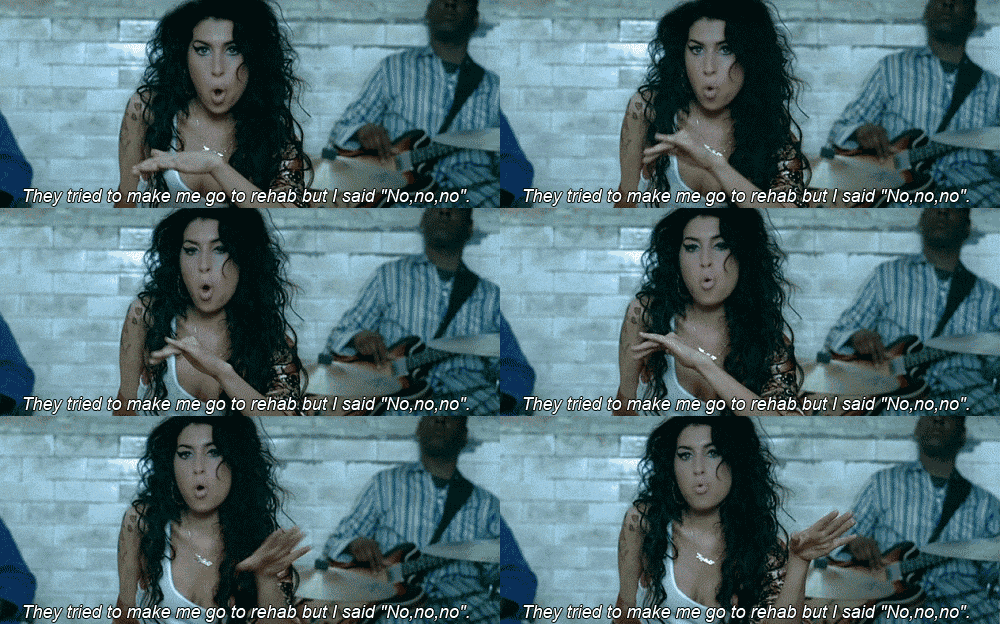
...and then I died at 28, ha ha.


Finally you should be warned that the book ends with one big cliffhanger. If you don’t like such tricks then wait a bit – the second part is bound to be released this year and you’ll be able to sate your curiosity.

Final verdict:

A nice beginning of a new series which might or might not continue in an interesting way. I just hope the second part won’t end with a cliffhanger and will explain some stupid decisions taken by Ellie in her past.

Tuesday, 23 April 2013

Rameau's Review Archive: The Corn Maiden and Other Nightmares by Joyce Carol Oates

Rameau's ramblings: This was the first Joyce Carol Oates novel I ever read.

First posted on Goodreads November 6th 2011.

Synopsis:
Marissa is a beautiful, sweet, but slow 11-year-old. Judah, an older girl from the same school, has led Marissa to a secluded basement. Remaining an unaware hostage for days, Marissa grows weak as Judah prepares to sacrifice her to the Indian legend, the Corn Maiden. 
 

The Corn Maiden and Other NightmaresThe Corn Maiden and Other Nightmares by Joyce Carol Oates


First of all, if you don't like nightmares and don't want to be scared and repulsed by the horrors ordinary people do, don't read this. Since I'm one of the slightly skewed people who enjoy reading about the darker side of the human nature, I actually enjoyed the book and most of the short stories within.

I got lost in the pain and desperation Marissa's mother felt when she found her daughter missing and her world unravelling under the scrutiny of the authorities and the public. I felt the confusion as the innocent teacher agreed to help the police only to find himself in the centre of a witch-hunt. And I even found a sliver of understanding and the pity for the kidnapper.

All this happened within the first short story and more was to come with the others thanks to Oates' writing. She managed to keep me turning the pages even when I was annoyed with her choices both for the characters and the effective writing. Somehow Oates managed to make third limited past tense seem more immediate and gripping than most authors manage with first person present tense.

The Corn Maiden and Other Nightmares is an acquired taste, and since this is my first encounter with Joyce Carol Oates' work, I can only assume the same goes for the rest of her work. It's going to take a while for me to explore this theory further though.

I received an Advanced Readers Copy from the publisher through NetGalley.


View all my reviews

Monday, 22 April 2013

Review: Children of Scarabaeus (Scarabeus #2) by Sara Creasy


Synopsis:
The crib is everywhere . . .

Edie Sha'nim believes she and her bodyguard lover, Finn, could find refuge from the tyranny of the Crib empire by fleeing to the Fringe worlds. But Edie's extraordinary cypherteck ability to manipulate the ecology of evolving planets makes her far too valuable for the empire to lose. Recaptured and forced to cooperate--or else she will watch Finn die--Edie is shocked to discover the Crib's new breed of cypherteck: children. She cannot stand by while the oppressors enslave the innocent, nor can she resist the lure of Scarabaeus, the first world she tried to save, when researchers discover what appears to be an evolving intelligence.

But escape--for Edie, for Finn, and for the exploited young--will require the ultimate sacrifice . . . and a shocking act of rebellion.


This didn’t start how I imagined it would. The confusion could have been avoided had I read the blurb for the second book, but I didn’t and I had a expectations of where Edie and Finn were going. They took a small detour to two different planets instead. Not that this is a bad thing but I had hoped to see more of the Fringe, which we never got to do.

The book starts with Edie and Finn on the run. They need to find the neuroxin, a kind of toxin that keeps Edie alive. After ensuring her continued existence, Edie, Finn, and Cat head towards the Fringe. They’re captured relatively quickly and brought back to Natesa who is still fixated on using Edie to further her own goals. Only she’s not using Edie alone. There are other children, talented like Edie, being manipulated to do their duty to Crib Colonial Unit. There’s politics, there’s human suffering, and there’s foreign intelligence. What more could you ask for?

This isn’t a trilogy, this is a story told in two parts. And just like the Song, the Children of Scarabaeus starts slowly. The first forty and fifty pages weren’t the problem for me, the struggle came later when Creasy decided to deepen the characterisations and relationships. For a while it felt incongruous with the rest of the story as logical as the development was. Instead of talking to each other, both Edie and Finn kept their secrets until it was too late to say anything. But then, luckily, the plot took over and the adventure continued.

Edie returns to Scarabaeus to finish what she started years ago and to save a handful of lives on the side. She and Finn talk, and disagree, but neither is a match for the planet. We get to see another side of Scarabaeus, barren but just as deadly as the megabiosis of the first book was.

In some ways the world building in the Scarabaues books seems superficial, but I love the subtlety of it. It feels like the books only scratched the surface of a bigger world, and not only because we never get to see the Fringe worlds. I want more of everything. More of CCU, Fringe, politics, and war. Sadly, I don’t know if I ever get it.

Friday, 19 April 2013

Review: Dare You To by Katie McGarry


I got the ARC of this novel from the publisher via Netgalley free of charge – thank you very much! Of course that fact didn’t influence my review in any way.

Synopsis:

Beth Risk is…a risky girl. Small wonder – she lives with a mother addicted to drugs who constantly chooses bad guys and never hesitates to bring them home. The acquaintance with Beth means only one thing: shame and troubles. The girl herself seems to follow the steps of her only parent - she has already slept with different guys who dumped her in no time. She drinks  and smokes pot. What’s more, Beth feels responsible for her mom and sometimes intervenes when a particularly nasty boyfriend  hurts her. She seems unaware that it should be completely the other way round – mothers are here to protect their kids. Dysfunctional doesn’t even starts to cover their relationship.

One night Ryan Stone tries to pick Beth up in a Taco Bell joint. It was a dare between him and his buddies – chat that strange chick up, although she has ‘mean’ written all over her face, and make her give you her name and phone number. Ryan loses and he hates losing so he decides to try and try again – especially when Beth moves to his home town and happens to be related to one of local baseball heroes, Scott Risk.

Ryan is a high school baseball star – an excellent player, a boy from a good family every father would like to greet as his daughter’s boyfriend. When he falls for Beth, though, he meets a wall of distrust and worry. Will he be able to overcome it? Will Beth allow him to do so?

What I liked:

I am very happy to inform you that, in my humble opinion the second part was better than Pushing the Limits. Firstly I liked its heroine, Beth, far more than Echo - she was more edgy, more conflicted and dark. Secondly I liked the pacing – especially the fact that the romance between Beth and Ryan developed slowly and we were given the opportunity to know them before they actually hooked up.

I also liked how the feelings between Beth and Ryan influenced their lives – especially Ryan’s family life, not so perfect as it seemed at the very beginning.

What I didn’t like:

Firstly I might repeat my main grievance from the previous book: the chapters narrated by Ryan sometimes read as narrated by a girl. Not by Beth, fortunately, but by a girl nevertheless. They were better than Noah’s chapters from the previous part but still not persuasive enough.

The author kept Beth’s silent admirer and companion, Isaiah, from the first book and created something almost like a love triangle. Keeping him was fine, love triangle – not so much. That ‘almost’ word saved the novel but honestly, how many times a girl must say ‘I love you like a FRIEND’ so the boy gets the message? Especially that from the sneak peek included at the end of the ARC I know Isaiah is going to have a book on his own and he is going to fall in love with a different girl. How it is supposed to work? No idea.

Some fragments of the novel felt a bit overlong – I admit I did skim over such scenes as girls’ bonding and adjusting to new school or arguing with friends over some trust issues or baseball-speak of Ryan.
I mentioned earlier that I liked Beth…yes I did, most of the time. Still there were moments when she felt too clean and almost too innocent for such an experienced character.

Final verdict:

A nice YA romance (sic!) which I requested on a whim and started reading without expecting anything good at all. It proved to be quite decently written, with interesting characterization and characters which made sense. I hope the third part will be even better although I am not a big Isaiah fan.