
Showing posts with label historical fiction. Show all posts

Friday, 30 August 2013

Review: Remarkable Creatures by Tracy Chevalier

Synopsis (from Goodreads):

In 1810, a sister and brother uncover the fossilized skull of an unknown animal in the cliffs on the south coast of England. With its long snout and prominent teeth, it might be a crocodile – except that it has a huge, bulbous eye and a body with far more parts than your ordinary crock.

Remarkable Creatures is the story of Mary Anning, who has a talent for finding fossils, and whose discovery of ancient marine reptiles such as that ichthyosaur shakes the scientific community and leads to new ways of thinking about the creation of the world.

Working in an arena dominated by middle-class men, however, Mary finds herself out of step with her working-class background. In danger of being an outcast in her community, she takes solace in an unlikely friendship with Elizabeth Philpot, a prickly London spinster with her own passion for fossils.
Autograph letter concerning the discovery of p...
Autograph letter concerning the discovery of plesiosaurus, from Mary Anning. (Photo credit: Wikipedia)

The strong bond between Mary and Elizabeth sees them through struggles with poverty, rivalry and ostracism, as well as the physical dangers of their chosen obsession. It reminds us that friendship can outlast storms and landslides, anger and jealousy.

My impressions:

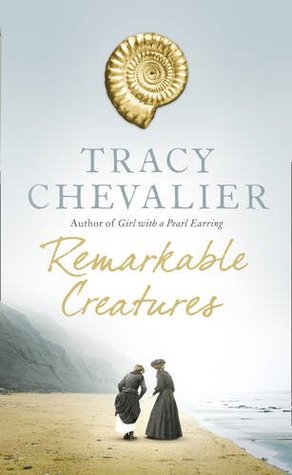
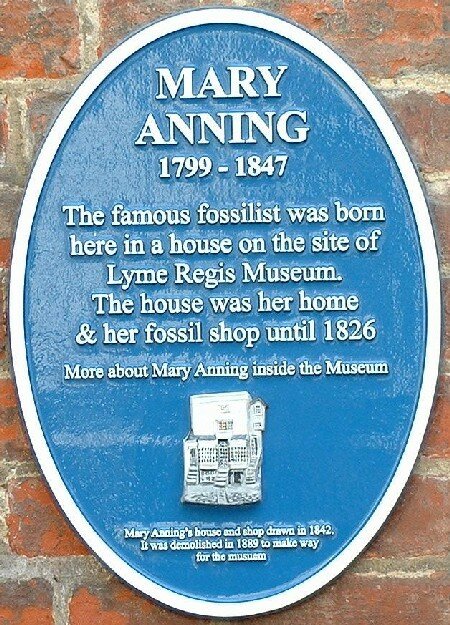
I took this one with me to the sea. I expected quite a lot from this book. I had every right to do so. After all we owe our knowledge of ammonites, bivalves, plesiosaurs,  and other aquatic beasts of the era to these remarkable women, both historical figures, who hunted for and preserved fossils along England's Dorset coast. Mary Anning was  more productive of the two as it was she who found the major specimens but it does not minimize the better-off Miss Philpot's many contributions, both emotional and financial, to the process. Overall those were two female fossil hunters in the early 1800s whose contributions to paleontology couldn't have been overlooked even by an extermely paternalistic society.  


As you delve into the book you realize how ground breaking the events of the novel were. If there were creatures buried in the earth that no longer lived on land that meant that God had made a mistake or created something not completely good! Or that Genesis as they knew it didn't make sense - if God made Heaven and Earth first and the animals after, how could there be animals buried in the earth? And for an uneducated, working class girl to be right in the center of all of this discovery, in an educated man's world, was equally surprising.

However, it was a slight disappointment, this one.  As it was presented, it was perhaps a solid, well-made entertainment, about a subject most of us have never given a lot of thought to, but nothing exceptional. 

Partially I blame the narration. The first person voice is perhaps ok but two first person accounts of two different women, more than two decades apart and coming from different walks of life, should have been as different as chalk and cheese, right? Only they weren't. From time to time you are gently reminded that Mary is a daughter of a simple carpenter from a small town near the sea - mainly when she remembers to butcher one sentence out of three or says 'verteberry' instead of 'vertebrae' -but it was too little. Personally I felt that, whereas the narrative voice of Elizabeth came quite naturally to the author, that of the Mary was overshadowed by the older, more mature and better educated Miss Philpot. In fact I suppose a third person limited narration would work much better, at least in my case. It didn't help that there were too few scenes showing the incredible interaction that must have been established between those two; instead we are given a love affair between both of them and Colonel Birch, a man who first preys on their skills and exploits their infatuation in order to gather a nice collection of fossils and then does something rather out of character, (I won't spoil you here), unbearably altruistic and completely spurious, at least in my view. 

The setting "Remarkable Creatures" is in the English town of Lyme Regis in the early 19th century.  You might remember this quiet resort village from Jane Austen's "Persuasion". I was rather happy to revisit it, especially that here Ms. Chevalier managed to present both sides of that town, that of a joyful summer resort full of happy holidaymakers and of a winter hell hole where it is difficult to earn your living and suffer cold weather, rather well.

Final verdict:

I wanted to read a story about fossil hunting which triggered the tension between religion and science and challenged biased attitudes towards women. I was given a story of female friendship, rivalires and the woes and tribulations of being a spinster told through the lens of fossil hunting. It wasn't very bad but it wasn't  brilliant either. The best part of the book in my opinion was the author's historical note at the end, telling us more about the later fates of her characters- rather remarkable in a negative way, isn't it? Meh, nuff said.



Enhanced by Zemanta

Friday, 26 April 2013

Review: Rome 03: The Eagle of the Twelfth by M.C. Scott

Book info:
Form: hardback
Genre: historical fiction (ancient Roman Empire)
Target audience: adults

Synopsis:

Demalion of Macedon accompanies Sebastos Panthera, a Roman spy, to Parthia but their mission is soon concluded. Then he is made to join the Twelfth Legion, notorious for its ill fortune, always facing the harshest of postings, the toughest of campaigns, the most vicious of opponents. Additionally, the Legion is also given a very bad, inexperienced commander - a politician not a soldier.

However, amid all of the violence and savagery of his life as a legionary, Demalion realizes he has discovered a vocation - as a soldier and a leader of men. He is made a centurion and has come to love the Twelfth and all the bloody-minded, dark-hearted soldiers he calls his brothers. One of them, a young, beautiful Greek called Heraclides with a nickname of Tears, becomes even somebody closer than that.

When Demalion thinks he has found a place in the world, all that he cares about is ripped from him. First his Legion is defeated by the Parthians due to the supreme ignorance and ineptitude of his commander - they have to retreat in shame, just happy to be alive. Then they are ordered to quench the brutal Judaean uprising and  the Hebrew army inflicts humiliating defeat upon the legion - not only decimating their ranks, but taking away their soul, the eagle, the symbol of their pride and identity.

There is one final chance to save the legion's honour - to steal back the eagle. To do that, Demalion and his fellow legionary scout called Horgias must go undercover into Jerusalem, into the very heart of their enemy - where discovery will mean the worst of deaths. Will they survive a mission which resembles very closely a suicide?

What I liked:

I haven't read a good historical fiction set in the times of Roman Empire for a long time so when awesome Mel from Mel's Random Reviews sent me this one I was overjoyed. It is  the thrid and final installment of a series but you can read it as a standalone without any problems. I found it original and interesting mainly because it depicts Roman wars with Parthia, a relatively less known campaing which took place in the first century A.D. during the reign of Nero. Well, I suppose most of people have heard of Nero, his poems and antics which led to the burning of Rome and persecution of first Christians, but few heard about his wars.

Parthia roughly corresponds to the western half of Khorasan region in northeastern Iran. It bordered Media on the west, Hyrcania on the north west, Margiana on the north east, and Aria on the south east. I really enjoyed the fact that it was a completely new setting, as far from Rome and Nero's corrupt court as it could only be.

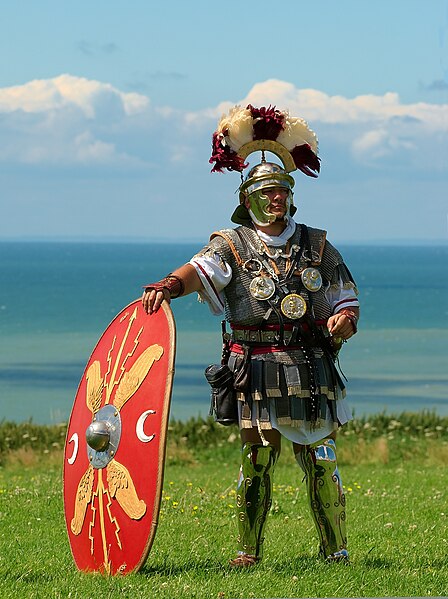
A centurion of Roman army
Most of the action is described directly from Demalions’s perspective and there is a real sense that he is right in the midst of these frenetic, bloody encounters. I was really surprised when I found out that the author is actually a woman - Scott perfectly captures the chaos of each engagement as well as the emotions that a soldier must have experienced. Demalion's attitudes toward constant training and bloodshed evolve and he becomes far more comfortable on the battlefield. The initial fear of being in a life threatening situation never disappears but he also learns the raw elation of surviving. After a while he feels most alive when surrounded by chaos of the battle and death.The relationships between soldiers are tight and any losses are horrible.

I also liked very much the character of Sebastos Abdes Pantera, also called the Leopard. He was a spy extraordinaire who never revealed more than he should about himself and his missions, often surprising poor Demalion and not always in a good way but also arousing grudging respect. I really regretted we weren't shown the whole world from his POV at least once. In fact I would be perfectly happy if Pantera was given a series on his own. For him I might read the first two parts which, as far as I know, tell his previous adventures as a spy and pupil of Seneca.

What I didn't like:

The whole novel is set among the Roman soldiers; I certainly understand that there weren't many places for women in such a company but really in this book there is only ONE female character, Hypatia, introduced very late, in the second part of the book, and never properly presented, acting as a prop. I am really disappointed. 

Apart from that I wish I could find out more about the final fate of Pantera.

Final verdict:

If you like really good historical fiction books I recommend you this one. It captures not just the epic scale of Rome’s legions, but its core, its heart, its very essence;  it strives to show what made the men behind the armour tick. It is also a page-turning military history but notably without women.

Saturday, 17 November 2012

Review: The Daughter of Time (Inspector Alan Grant 05) by Josephine Tey

Book info:
Genre: historical crime story
Target audience: pretty much everybody interested in history
Form: paperback, 220 pages


Synopsis (from Goodreads): 

 In one of Tey's bestselling mystery novels ever, Scotland Yard Inspector Alan Grant, immobile in his hospital bed, is intrigued by a portrait of Richard III. Could such a sensitive face actually belong to one of history's most heinous villains—a king who killed his brother's children to secure his crown? Grant determines to find out once and for all what kind of man Richard was and who in fact killed the princes in the tower.

 What I liked: 

Yorkist king Richard III grew up at Middleham....
Yorkist king Richard III grew up at Middleham. "Middleham Castle". RichardIII.com . . Retrieved 2007-10-24 . (Photo credit: Wikipedia)
 This novel deals with Richard III and all the various permutations of the Yorkist, Lancastrian and Tudor factions in late medieval England. I wanted to read it for a really long time but I couldn’t find a decent copy. What can be said… this book could have been as boring as your average history lesson but it isn’t, mainly because it is written in a very compelling way. Ms Tey (a pseudonym of Elizabeth Mackintosh) certainly knew how to keep the attention of her readers while presenting convoluted schemes of the royal palace and a police inspector trying to kill the time while recovering in hospital because of a leg injury.

 While dying of boredom Alan Grant is presented with a portrait of England's King Richard III (reigned 1483-1485) and comes to the conclusion that a man so genteel-looking couldn't possibly be the ruthless murderer Shakespeare made him out to be because 'villains don't suffer, and that face is full of the most dreadful pain' (judge for yourself here). Certainly Shakespeare made Richard III into a character who we love to loathe. An ugly hunchback, sneaky, rotten to the core, Shakespeare's Richard is the seducer of widows, the betrayer of loyal friends and the killer of the young princes in the Tower of London. Was the bard right or maybe it was just convenient for him to paint Richard the blackest of black?

 Intrigued, Grant starts reading books concerning the appropriate period – from middle grade textbooks, full of pictures, simplifications and doodles drawn by bored pupils, to serious positions appropriate for university scholars. He is also helped by a young, rich history enthusiast from America, Brent Carradine, on a scholarship to study at the British Museum, who does more complicated source research. They findings are impressive and inspiring – I admit that after finishing The Daughter of Time, I spent several hours on line googling the authors and historians Tey mentions in her book, looking at different portraits of Richard III and his family. I gather it was the best thing about the book itself: it made me curious and inspired, it taught me a lot while entertaining. I love such books to no end.

 What I didn’t like: 

 It was a lovely book but hardly flawless. Though there are arguments, with which I agree wholeheartedly (and no, never believe a word of a historian, Ms Tey is here absolutely right), the main hook of her novel--that the most famous surviving portrait of Richard III shows the face of a man who could not possibly kill defenceless children of his brother--is flawed to say the least of it. Every portrait ever made has been the portrait of not one person, but at least two--of the sitter and of the artist--and the practice of reading a person's character through their portrait is an interesting one, though it must always be seen as very dubious if not completely futile from the psychological point of view.

There have been mass murderers whose faces were kind, innocent and fresh. There have been (and will always be) innocent people, such types who wouldn’t hurt a fly, who look as if they were born in a prison and released only because the guards were afraid for their lives. No serious policeman can trust their own judgment when it comes to assessing faces. I presented one such example in my essay Beautiful Beast.

 Apart from that I think the book could have done with slightly more individualized and characteristic dialogue, but really, that's a minor complaint.

 Final verdict:

 Despite its shortcomings it is a story I would recommend to every history nerd, especially if you like the War of Roses period and criminal riddles solved with great sense of humour. I am not surprised this book was voted number 4 out of 100 best mysteries of all time by Mystery Writers of America (www.mysterywriters.org) . If you want to read the history of Richard III presented from a less fictional perspective I recommend “Historic Doubts on the Life and Reign of King Richard the Third by Horace Walpole.

ETA: The latest news on Richard III: http://www.telegraph.co.uk/history/9681019/Scientists-to-reconstruct-Richard-IIIs-face.html
Enhanced by Zemanta

Monday, 23 April 2012

Review: Quicksilver by Neal Stephenson (The Baroque Cycle 01)


Book info:
Form: e-book, Kindle format
Genre: historical ficition, sci-fi
Target audience: adults


Synopsis:


The story opens in 1713 when Daniel Waterhouse, a former Puritan and natural philosopher (as scientists were then called) living in the Massachusetts Bay Colony, finds himself invited back to England, where a dispute has arisen between Newton and Leibniz over exactly who developed calculus. Yes, he is that Dr Daniel Waterhouse who has founded "The Massachusetts Bay Colony Institute of Technologickal Arts" (or, as it is known today, MIT). As Daniel undertakes his voyage, leaving his wife and son behind, we go back forty years to his youth, when, as a student, he watched his classmate Isaac Newton develop into an obsessive and eccentric genius. Newton is so absorbed by his work (mathematics, light, even alchemy, an idea still taken seriously then, you name it) that he would neglect food and proper sleep if it weren't for Daniel's care. Daniel practically serves as the young genius's butler during their school days although it was supposed to be the other way round (Daniel, as a richer student, had a right to employ poorer boys, called sizars, as his personal servants). This section takes first 340 pages give or take.
Then we move into "King of the Vagabonds," which shifts the novel's focus from the lives of English high society to society's dregs. Jack Shaftoe is the vagabond of the title, an orphan whose earliest career involved dangling from the legs of men sentenced to hang in order to quicken their deaths. As an adult he wanders the continent, eventually falling in with an army battling the Turks at Vienna. Here he rescues Eliza, who had been sold as a concubine to a Turkish prince. Jack and Eliza travel together for a time, until they reach Amsterdam. Here, Eliza proves to have a strong mind for business and money management, and she remains in Amsterdam — quickly turning into a European financial center thanks to the Dutch East India Company — while Jack (who is slowly losing his mind from syphilis) continues to France.


Portrait of Gottfried Leibniz (1646-1716), Ger...
Portrait of Gottfried Leibniz (1646-1716), German philosopher (Photo credit: Wikipedia)
The final section of the book, "Odalisque," brings Daniel's and Eliza's story threads together. Daniel has re-established contact with Newton, whose studies are veering away from the purely scientific into the metaphysical following his completion of the Principia Mathematica, while on the continent Leibniz has finally published his calculus. Eliza's reputation as a financial wizard, meanwhile, has brought her into contact with some of the most powerful people from Holland, England, and France. She finds herself ensconced at Versailles, managing the finances of virtually everyone there, which gives her unprecedented contact with people who would ordinarily be off limits to one of her lowborn class. Meanwhile, she has become a confidant first of the Duke of Monmouth (whose rebellion in England against James II fails miserably), then of William of Orange (whose succeeds), and of Leibniz, to whom she writes of her escapades in cipher.

What I liked:

I felt this first part tried to capture one of the pivotal periods not merely in European history, but one which ultimately shaped the course of the modern world as we know it. 17th century as a period cannot and shouldn't be underestimated. In the field of science, there were Newton's discoveries, as well as the first formal instance of politics and science going hand in hand with the Royal Society. The financial markets of Europe at this time set the stage for the stock exchanges that propelled economies the world over today. I found myself gasping several times when I rediscovered such obvious truths here. It was a mental challenge but also something truly enjoyable. What were Renaissance alchemists but hackers, rooting around in and trying to reprogram systems of matter? Modern cryptanalysts and programmers have their intellectual roots, too, in work done by wigged mathematicians of centuries past. The idea of a modern computer was most probably invented by Leibniz. The learned discourses of Waterhouse, Newton, Leibniz, Hooke et al contains the germs, sometimes even the clear outlines, of future scientific discoveries. Daniel refers to "a kind of net-work of information", a long time before the OED's first record of such a figurative use of "net-work" (by Coleridge in 1816, talking about property). One letter from Leibniz more or less invents Einsteinian special relativity and implies the celebrated equation e=mc2; elsewhere someone proposes gravitation as the distortion of spacetime avant la lettre; and there is a buried joke about the improbability of anyone ever believing in the idea of particles which we now know as neutrinos.I am not surprised this book was awarded 2004 Arthur C. Clarke Award. Stephenson’s prose I found very fluid and readable even when he described difficult topics; his gift can draw the reader in and can even make those knotty scientific and mathematical theories palatable.
 
His novel offers up a wide range of characters, all of them deserving a separate book, like Isaac Newton, Gottfried Wilhelm von Leibniz, Robert Hooke, John Wilkins, Samuel Pepys, Christiaan Huygens, the Duke of Monmouth, Benjamin Franklin, and Louis XIV himself. All of them in Stephenson's hands become living, breathing, remarkable men, not merely the kinds of stuffy cardboard portraits so often found in historical novels. You hardly know who to look first at and who to like best. It is a feast rarely found in other novels.
Isaac Newton Dansk: Sir Isaac Newton Français ...
 Sir Isaac Newton. (Photo credit: Wikipedia)

As a backdrop to the birth of modern science, Stephenson presents the House of Stuart and its
 courtiers. Drake Waterhouse, Daniel’s father, is killed by Charles II himself, and Daniel makes the acquaintance of a number of future courtiers while attending Cambridge. They are colourful fellows, interesting to read about but also ones you would run from as fast as you could if you met them in real life.
It seems that the main character of the book is the Quicksilver, a mysterious substance which can represent several ideas. It’s one of symbols of alchemy, which is slowly being replaced by verifiable science; but it is also a symbol of Mercury, the messenger, who in the guise of the mysterious Enoch Root passes messages between members of the nascent scientific community in America, England and on the European continent. 


Finally the sense of humour. I loved it when great men in English politics and science, normally fighting brutally with each other (Newton and Hooke would become bitter enemies) confided in Daniel, helping to guide his career to greater heights just because they perceived him as a harmless nonentity among true giants.  If you like clever palace intrigue and the unique style of wit that only emerges from Britain you will be in seventh heaven. Usually I laugh that hard only while watching the better episodes of  Black Adder or Monty Python. Remember, laughter is good for your health.

What I didn’t like:


A replica of Newton's second reflecting telesc...
A replica of Newton's second reflecting telescope of 1672 presented to the Royal Society. (Photo credit: Wikipedia)
As any 900 page work of historical fiction this is a daunting, demanding book. Long, twisted, with several POVs and the narration switching from first person present to third person past in no time. No, it is not for everyone. There were parts which I found boring like the early history of European banking and coin-minting. It's probably not possible for a book so long to go its whole length without a few longueurs or to keep you entertained the whole time. Well, I managed to finish it and I didn’t regret doing so but it’s up to every reader to determine whether the good parts are worth persevering. The answer will depend to some extent on the reader's taste in historical fiction. Those who prefer it straight and full of anachronisms might balk at Stephenson's  attitude and laissez-faire when it comes to sticking to the historical accuracy. Characters and the narrator often knowingly use modern slang (at one point Charles II is called "a foreign-policy slut"), and there are numerous little contemporary jokes such as a reference to "canal rage" in Venice - gondoliers are increasingly involved in violent altercations, which some take to be "a symptom of the excessively rapid pace of change in the modern world" - or when Enoch Root offers a Grantham apothecary a cup of tea, which the latter considers "inoffensive enough, but I don't think Englishmen will ever take to anything so outlandish" (in fact I  LOVED that scene but I know some people might frown).

Final verdict (short and sweet):


After a break I will read the rest. For sure. I loved it, despite some boring parts and the fact that it was a very long novel. While reading such books you feel your brain cells rejoicing and multiplying. For the sheer effort of writing something so long and so good I proclaim it to be...


Enhanced by Zemanta

Monday, 12 March 2012

Review: The Traitor in the Tunnel (The Agency #03) by Y.S. Lee


Form: e-book, Kindle format
Genre: historical fiction
Target audience: YA


Synopsis:

Mary Quinn, now a fully fledged operative of the all-female secret Agency, is placed in the Buckingham Palace as a domestic servant to find who has been stealing different trinkets from one of the Queen Victoria’s parlours. If the task sounds easy, rest assured with Mary no assignment is as easy as it looks. When one of the Prince of Wales’s irresponsible young friends is killed in disgraceful circumstances Mary is, surprise, surprise, among few people to know the truth behind that incidents. Should the Queen hush things up or allow justice to take its course? Mary’s interest in this private matter soon becomes deeply personal: the alleged killer, a drug-addicted Chinese sailor, shares a name with her long-lost father. Could it be the same person?
Meanwhile, James Easton’s engineering firm is repairing the sewers beneath Buckingham Palace. Trouble is, there’s a tunnel that’s not on the plans. Its purpose is unclear but it seems to be very much in use. These overlapping puzzles offer a perfect opportunity for Mary and James to work together again… if they can still trust one another. This is Mary’s most personal case yet and she has everything to lose and plenty to gain.

What I liked:

This is one of few YA series that I really appreciate. Usually my main complaint is that the books are too short – I am that smitten. The writing style of Ms. Lee is highly readable, I swallowed this book in less than 24 hours. The pace of narration was great, neither too quick, not too slow, everything happening in the right order.

Of course the biggest asset was Mary Quinn herself. She’s never been one of these ‘too-stupid-to-live’ insipid girls and she’s grown up a lot. Now she faces several personal issues, trying to defeat demons of her past unleashed by a man whose name is the same as that of her long-lost Lascar father. She also falls more and more for James, still being unsure what his reaction might be when he finds out all her secrets. Last time he flinched hearing about Mary’s sad childhood and thievery – what will he say now?

Fortunately James Easton has changed too and for better – he is less sanctimonious, less prickly, more cooperative and eager to kiss Mary every opportunity he has. Their romance comes to a rather happy conclusion at the end but, hopefully, it is still not the end of their common adventures. They can't marry - not yet anyway and Mary has great plans for the future – with the silent support of the Queen Victoria they even seem realistic!

Finally this is also one of those historical series which has never made me wonder whether the author did her research job. It is very obvious she did. Victorian London, presented here, sounds real and plausible – perhaps some sights and smells would be difficult to tolerate but you would like to visit nevertheless. I am also glad that, in spite of the fact these books are clearly YA, the author never patronizes her readers, mentioning even delicate issues in an honest way. In the previous novel Mary had a small but significant chamber pot problem (how to relieve yourself when you are pretending to be a man and another man is present in the room?); in this one she is even pushed further as one of the villains tries to make her prostitute herself.


The cover art I find nice and appropriate.

What I didn’t like:

I must admit the main criminal puzzle was a little bit less intricate than usual, although still it featured an interesting twist or two. Also the baddies weren’t as interesting as previously. Fortunately the character development of the main heroine overshadowed these slight shortcomings. Oh and the book was too short of course. ;)

Final verdict:

A great novel for light recreational reading which can make you happy and bouncy – it is a YA position but  neither syrupy sweet nor depressing! If only there were more such books...


Friday, 17 February 2012

Review: The Whipping Club by Deborah Henry


I got a digital copy of this book from NetGalleyI haven't been compensated for writing my review in any way and the fact that the book came free of charge didn't influence me either.   

Book info:
form: e-book, e-pub
target audience: adults
genre: historical fiction with social issues
pages: 345

Synopsis:

Marian McKeever and Ben Ellis are not typical young couple in 1957 Dublin, Ireland; she’s a Catholic teacher and he’s a Jewish journalist at the beginning of his career. They are very much in love with each other and plan to marry but their families object. Then Marian gets pregnant; she intends to tell Ben while eating a diner with his family but the same night Ben’s father has a stroke and dies. Believing that she has to  protect her future with Ben who, mourning for his father, is clearly not ready for a shotgun marriage, Marian feels she must deal with that problem on her own.

Her uncle, a Catholic priest called Father Brennan, recommends that Marian goes to the Castleboro Mother Baby Home, a kind of shelter for unwed pregnant women. He doesn’t tell her that it is an institution where “sins are purged” via abuse; i.e., pregnant girls are forced to mow the lawn by pulling grass on their hands and knees. After the birth Marian is told that her newborn son, Adrian, will be adopted by an American family so she leaves the baby with the sisters and pays the adoption fee. It proves to be a grave mistake.

A decade later, Ben and Marian, now wed, raise their ten-year-old daughter, Johanna. After a while the nurse who delivered Adrian pays Marian a visit. She tells her that her son wasn’t adopted at all - he is kept in a notorious Catholic orphanage, not far from Dublin. Marian, feeling horrible pangs of conscience, decides to do everything to bring Adrian home and reunite her family. She starts by confronting her husband - telling him about her first pregnancy ordeal. So begins a labyrinthine journey through red tape as the couple fight to regain their firstborn child. Ultimately, 12-year-old Adrian is placed in the Surtane Industrial School for Boys, which is rife with brutality and sexual abuse, mainly at the hands of “Christian Brother Ryder” and his minions. Will his parents manage to help him? 

What I liked:

This novel is set against the political backdrop of postwar Ireland but echoing the painful lessons of the Jewish Holocaust, and I found such a setting rather interesting.  Mrs. Henry has a great narrative voice, very pleasant to read; she can keep you interested even when she is telling you about an ordinary family life. The plot of this book was far from simple, though - it is  a wrenching drama with suspense elements, spanning a decade or so, interweaving the stories of several characters, some of them pretty dramatic like that of an inmate-friend of Adrian, Peter.

Horrible villains like Brother Ryder are balanced with compassionate characters, such as a timid nurse from the Mother Baby Home. Father Brennan I found actually the most interesting personage here – he definitely deepens into a three-dimensional character, facing the atrocities committed in the name of his religion and struggling to do what is right.

I’ve never been a member of a book club but I suppose this novel would be a perfect position to discuss with others. It deals with highly controversial issues: the role of religion in a society, the nature of sin, guilt, redemption and what happens when good people remain passive and  silent.


What I didn’t like:

I must admit the ending seemed a bit rushed to me. I also chuckled a lot reading about those ‘horrible’ Upper Silesian mines where our young hero wanted to hide for a year or two to escape from the Irish Industrial School system. Well, certainly no mine is safe or nice to work in, take it from a miner’s daughter, but there are far worse places… like orphanages.

I am also not fond of the title itself (yes, I have been displeased with plenty of titles lately but what can be done?)  as it relates to just one institution mentioned rather late in the book. I found it misleading - it might suggest the book is about quite different subjects.


Finally let me just warn you that there are some scenes in the book that might make you uncomfortable to say the least of it. Sexual abuse and paedophilia are never nice topics. Although the descriptions are not overly detailed or graphic, they remain distressing nevertheless, especially if you are blessed with vivid imagination.

Final verdict:

An interesting but slightly controversial position, definitely not a book you  should read just with entertainment in mind. I don’t regret reading it but I don’t know whether I would like to reread.

Thursday, 29 December 2011

Review: The Crown by Nancy Bilyeau

This book was provided by the author's publisher via my lady Blodeuedd's excellent blog in return for an honest review. I haven't been compensated for writing the said review in any way and the fact that the book came free of charge didn't influence me either. 


Book info:
Form: e-pub format
Genre: historical fiction, religious thriller
Target audience: every reader who is interested in the Tudor era and likes thrillers


Synopsis (from the site of the author):

"An aristocratic young nun must find a legendary crown in order to save her father—and preserve the Catholic faith from Cromwell’s ruthless terror. The year is 1537. . .

Joanna Stafford, a Dominican nun, learns that her favorite cousin has been condemned by Henry VIII to be burned at the stake. Defying the sacred rule of enclosure, Joanna leaves the priory to stand at her cousin’s side. Arrested for interfering with the king’s justice, Joanna, along with her father, is sent to the Tower of London.

The ruthless Stephen Gardiner, Bishop of Winchester, takes terrifying steps to force Joanna to agree to spy for him: to save her father’s life she must find an ancient relic—a crown so powerful, it may hold the ability to end the Reformation. Accompanied by two monks, Joanna returns home to Dartford Priory and searches in secret for this long-lost piece of history worn by the Saxon King Athelstan in 937 during the historic battle that first united Britain.

But Dartford Priory has become a dangerous place, and when more than one dead body is uncovered, Joanna departs with a sensitive young monk, Brother Edmund, to search elsewhere for the legendary crown. From royal castles with tapestry-filled rooms to Stonehenge to Malmesbury Abbey, the final resting place of King Athelstan, Joanna and Brother Edmund must hurry to find the crown if they want to keep Joanna’s father alive. At Malmesbury, secrets of the crown are revealed that bring to light the fates of the Black Prince, Richard the Lionhearted, and Katherine of Aragon’s first husband, Arthur. The crown’s intensity and strength are beyond the earthly realm and it must not fall into the wrong hands.

With Cromwell’s troops threatening to shutter her priory, bright and bold Joanna must now decide who she can trust with the secret of the crown so that she may save herself, her family, and her sacred way of life. This provocative story melds heart-stopping suspense with historical detail and brings to life the poignant dramas of women and men at a fascinating and critical moment in England’s past. "


What I liked:

First of all let me tell you that after finishing Wolf Hall by Hilary Mantel not so long ago I was really curious about this one as it concerned a similar period, only some years later – after the death of Jane Seymour, the queen number three. I wasn’t disappointed. My enjoyment was even enhanced by the fact that Ms Bilyeau presented the events as seen by the supporters of Catherine of Aragon and the Catholic Church, for whom Thomas Cromwell and his allies, closing the convents and confiscating their properties, were evil incarnated. It is always nice to hear the other side of the conflict.

Joanna Stafford was certainly a great heroine – loyal in her friendship, consistent, intelligent and curious enough to break and tweak the rules of her convent while searching for the truth. Her mother was a lady –in – waiting of Catherine but Joanna, after one horrible day at the court, preferred to enter the convent instead. At the end of the book it is explained how horrible her first experience really was. I found it a nice touch, showing that any royal court was a nest of vipers, a very demanding and dangerous place especially for a young girl. I would compare it to working for a big international concern – a lot of stress, plenty of traps, murky, merciless rivalry, no guidelines whatsoever.

Some secondary characters were a bit flat but I liked Edmund, the Dominican friar. His problems were interesting, I’m just sorry we weren’t shown more of him.

The plot was filled with excitement, intrigue and espionage; small wonder the book, although not exactly short, was a quick, entertaining read, especially telling a story of a rather unknown medieval king, Athelstan, and his precious regalia. I fully enjoyed the fact that the novel was very well-researched, at least for such an amateur historian like me. I especially liked the description of Stonehenge and a strange pilgrimage of monks to that place. I also liked the convent life and the theme of messages hidden in tapestries.

What I learned:

Athelstan or Æthelstan ( c. 893 or 894 – 27 October 939), called the Glorious, was the King of England from 924 or 925 to 939. He was the son of King Edward the Elder and the grandson of Alfred the Great . Æthelstan's success in securing the submission of Constantine II, King of Scots, at the Treaty of Eamont Bridge in 927 through to the Battle of Brunanburh in 937 led to his claiming the title "king of all Britain". According to William of Malmesbury, Athelstan had also the kings of the North British (meaning the Welsh) submit to him at Hereford, where he exacted a heavy tribute from them. His reign is frequently overlooked, with much focus going to Alfred the Great before him; however, it was of fundamental importance to political developments in the 10th century - Athelstan was the first King of a unified England from 927 A.D. Although he established many alliances through his family, he does not appear to have married or had children, although there is an uncorroborated allusion to an illegitimate daughter. (from Wikipedia)

What I didn’t like:

After finishing the reading I must say I felt a bit cheated. First of all, the tension started to ease too soon for me and at the end it kind of disappeared completely, even before I found the answer to all the mysteries. Mind you, the book is dubbed into a religious thriller. It was especially strange as it finishes with nothing less but a cliffhanger – we are not exactly sure what the future holds for Joanna and her fellow ex-nuns and ex- friars. Cliffhangers, contrary to the popular belief, don’t make me more curious; if anything, they make me twitchy and angry; in this case the ending was especially disappointing because I suspected something totally different, like a marriage of the main character with one of her suitors. Speaking about romance…I might be wrong but personally I didn’t feel the author handled it well. Let me explain.

First we get a very strong and a very promising beginning, then the whole thing, along with the guy in question, is forgotten for most of the book, then the author resurrects it all a bit superficially just to allow it to fizzle into nothingness. It was mean – if there are plans for a sequel (what author doesn’t plan a sequel nowadays) Ms Bilyeau could have at least hinted at it. In short I would prefer the novel ending in a more conclusive manner and its romantic thread executed in a different style (but you know me – I am rarely pleased when it comes to that).

Final verdict:

Despite my romance problem and a rather equivocal ending it was a nice book, especially if you like the Tudors and 16th century in England. I enjoyed reading it and I would recommend it to fans of historical thrillers.

The tomb of king Athelstan


Wednesday, 30 November 2011

Review: India Black and the Widow of Windsor (Madam of Espionage 02) by Carol K.Carr

Synopsis:

When Queen Victoria attends a rigged psychic séance, the spirit of her departed husband, Prince Albert, insists that, contrary to her habitual routine, she should spend Christmas at their Scottish home in Balmoral. It seems the old Vicky simply cannot say no to her husband, departed or not. The former Prime Minister Disraeli suspects he knows a reason of the whole request - the Scottish nationalists plan to assassinate the Queen on their home turf. Of course not having any proof he can’t even dream of stopping the Queen; instead he sends the ever resourceful India, disguised as a maid of an old Marchioness of Tullibardine, and the handsome British spy, French, to the Scottish highlands.

After the events of the previous novel, India Black has gone back to her life as the proprietor of a brothel but her life has suddenly become insufferably boring. When the British spy, known to her as French, comes calling and tries to recruit her for a new mission, India jumps at the chance no needing any persuasion or blackmail.

French will take the high road, looking for a traitor among the high-born guests, pretending to be a swashbuckling secretary of Disraeli, and India will take the low road, looking closely at other servants in case an assassin is hiding among the staff. They are joined by Vincent, who will support French working as his valet and stable boy. Soon enough two suspicious incidents make India and her companions certain that someone at Balmoral is determined to make this Her Majesty's last Christmas...but who?

What I liked:

The whole book was more a comedy than a sleuth or adventure novel. I loved the beginning but I regretted we didn’t see that false psychic (is there a true psychic out there?) and her daughter again. Like the first part of this series, reviewed by me not so long ago, the story is told once again from India’s point of view so of course it is snarky and entertaining.  India suffers greatly helping the old Marchioness survive the royal festivities without killing herself during the meals (poor sight makes the old lady kind of accident-prone to say the least of it) but, after some time, she grows to like the old biddy more and more, especially that she seems to have more wits than her temporary maid. Also the portrayal of Queen Victoria, John Brown, Benjamin Disraeli and various other historical personages was hilarious although perhaps a bit skewed. Well, we get it from India’s perspective and she is hardly an apologist of the aristocracy or the Queen.

The cover is, once again, lovely. These colours...

What I didn’t like:

In my humble opinion the first part, despite its plot incongruities, was better, fresher, more funny and edgy. This one was a disappointment - we are offered a watered-down version of old India and the plot didn't improve, making the whole novel definitely aimed more at YA audience than adults. Well, the personality of India and her blunt honesty was the feature which appealed to me the most from the very beginning. Here you can almost forget that you are dealing with a ‘madam’, an owner of a house of disrepute and a former hooker of the most common sort. In other words India is too sanitized, never revealing her skills, sometimes behaving more like a debutante during her first season than a pro, as if her creator temporarily forgot who and what this woman was supposed to be. She just talks. Empty vessels make most sound – that’s how I felt about her.

The worst damage was done to the character of Vincent – a streetwise urchin from the previous part with personal hygiene issues but great thieving and investigative skills. Here he was reduced to a mere accessory. I resented it very much. Such a waste…and it’s not the end of my carping.

One of the underlying themes of the book is not to underestimate women. A fine conception per se but, unofrtunately, flying in the face of India’s low opinion about her own employees or prospective employees (‘she is stupid and pretty – she would be a good whore’) and other females in general. It was a bit galling, taking into account India's past. What’s more, India’s sleuthing efforts didn’t present her in a good light either – in this book she is deceived too many times while solving a quite simple mystery; the perpetrator could be guessed easily (well, I am not a great thinker but I had a very precise opinion who might be the hidden nationalistic murderer already in the middle of the first part of the novel…and I guessed correctly – cherchez la femme!)

 Mr. French didn’t improve either – instead of character building we got just some hints that he might have a family (like a wife, perhaps also children). It didn’t warm me up to that gentleman and even India, although supposedly falling for his charms, didn’t feel any strong compulsion to find out more about him. Yes, she still doesn’t know his first name although allegedly just because she loves teasing him about it. By the way as the old Marchioness dropped some interesting remarks so perhaps India is going to find out more about her mother soon. Like in the next book. While I am extremely curious how a woman like India became a prostitute I think the author is just fishing for more interest, teasing the readers, promising a good story and more fun... in the future. I am not fond of such teasers, clearly aimed at making you order/buy the next installment, and, to be absolutely truthful, I don't believe in such promises. I fear a big disappointment unless Ms. Carr returns to the style and rough honesty of her first novel.

Final verdict:

India Black and the Widow of Windsor might be an entertaining read but it doesn't change the fact that it is a novel of middling quality, veering towards the YA market too much for my taste. I wasn’t thrilled by India’s or French’s portrayals in this one and also the ending seemed to me cheap and anti-climatic. I am not sure I would like to buy/read the next installment unless I see some good reviews… 
An 1876 political cartoon, originally publishe...Queen Victoria and Disraeli via Wikipedia

Enhanced by Zemanta

Thursday, 17 November 2011

Review: India Black (Madam of Espionage 01) by Carol K.Carr

Book info:
Book form: e-publication, mobi format
Publisher: Berkley Trade; Original edition (January 4, 2011)
Language: English
Target audience: adults
Genre: historical fiction, adventure

Synopsis (almost from Goodreads):

Sir Archibald Latham of the War Office dies from a heart attack while visiting a fashionable brothel called Lotus House, owned and run by Madam India Black. His death unexpectedly thrust that lady of disrepute into a deadly game between Russian and British agents who are seeking the military secrets Latham carried in his leather briefcase. Unfortunately the briefcase disappears mysteriously right after his death along with one of Madam Black’s employees. Blackmailed into recovering the missing documents by a British spy known as French, India finds herself dodging Russian agents-and the attraction she starts to feel for the handsome conspirator.

What I liked:

The main character of the story is Miss India Black, an intelligent whore with lots of dry humor and a fairly cynical view on life. I loved her narrative voice (as the book is told from her perspective) because it was brutally honest, outspoken and wickedly entertaining. However, the fact that India, once a working girl, now the owner of a brothel, is in peace with her inner self, accepting her fate without any remorse or second thoughts, I liked the best. She makes absolutely no excuses and enjoys her life as it is. She says:

Still, I wouldn’t trade Lotus House for the world. There may be easier ways of earning a sou: I could allow some pedigreed ass to keep me in French perfume and silk gowns, tucked away in a cozy pied-à-terre in St. John’s Wood, and driving a four-in-hand along Rotten Row. But I like my freedom.


It was refreshing.

What’s more, there’s an individual called Vincent – a young street urchin who is cleverer and braver than any spy although his body odour might make you cringe and his appearance and lifestyle are simply outrageous. He is utterly charming in character though – a great addition to our madam and the whole novel. 

The book was a breeze to read and I enjoyed the narration pace – quick and vivacious, like the heroine. The mystery was a bit simplistic but nicely executed. Do not expect a lot of romance here, contrary to that last line of the Goodreads synopsis. India is not a person to fall in love – she knows men too well and has no illusions left about them. I think the lack of romance is actually an advantage which made her character only more believable.


Finally the cover is simply lovely, especially the dress and the fan.

What I didn’t like:

In short the plot. Unfortunately the more I read the more I had to suspend my disbelief. Perhaps I was overthinking again…anyway here are the results.

 Firstly India leaves Lotus House, her home and the only source of her income, dangerously unattended for almost a week. Very uncharacteristic for such a level-headed businesswoman who, early on in the book, emphasizes how important it is for her to be present there all the time, watch over her girls, her clients and all the takings.

It also seemed very unlikely that a luxurious whore house can be run without any muscle. Although allegedly India’s brothel caters to a 'better' segment of society (minor nobility, government officials, military officers, etc) she still serves alcohol there and a drunk gentleman is first a drunk and gentleman later (if at all); what’s more, imagine what would happen if somebody (or even a group of somebodies) from lower classes tried to barge in and have some 'fun'... In short the book did lack a secondary character who, temporarily at least, would be able to perform the necessary duty of protection and client supervision.

Another scene: India and French, the English agent she has to cooperate with, fall down uncontrollably from a height of over 6 meters; they land on a frozen ground but neither of them is hurt. What’s more, they start bickering almost immediately. Are their bodies made of steel?

Also the fact that extremely cruel Russians proved not so cruel after all and let poor Vincent live I found rather suspicious – I know the boy was necessary to forward the plot and I did appreciate that the blighter survived but it would be far more logical to kill him off…

Last but not least - Mr. French was not a great addition here, character-wise. I found him a bit bland and not especially intelligent when you compare him to India and young Vincent…perhaps he will improve later.

Final verdict:

It was a nice book but if you're expecting a very correct historical fiction novel from Victorian times do not pick this up. You will be disappointed and even annoyed. The language in particular is not from that period and might drive anal purists crazy.

Would I read the next book in the series? Yes, I would. As it was just a debut novel I do hope the author will construct a more intriguing and solid plot which can match the wit, power and fun of India's character. 

Monday, 14 November 2011

Mini review: Asenath by Anna Patricio

This book was provided by the author's publisher via my lady Blodeuedd's excellent blog in return for an honest review. Just in case - I haven't been compensated for writing the said review in any way and the fact that the book came free of charge didn't influence me either.

Book info:
Form: e-book, mobi format,
Genre: historical fiction, YA adventure
Target audience: YA


Synopsis:

The novel is a creative version of the life of Asenath, the Egyptian wife of Joseph, the son of Jacob and Rachel from the Bible. You might remember him – he had a coat of many colours and was rather disliked by his half-brothers – and you most likely won’t remember her, as she is just mentioned once, as his wife and the mother of his two sons. We are given just a name and still the author managed to fill all the gaps with her vivid imagination.

Asenath, according to Ms. Patricio, is an adopted daughter of a Heliopolis priest; before that she was a low-born peasant called Kiya; after an attack of foreign invaders and the death of her parents her life altered beyond recognition. Still her sad experience stayed with her, making her life as an aristocratic lady rather difficult. However, the same experience helped her find the love of her life – seeing a slave lying on the ground in scorching sun she didn’t hesitate one moment and let him drink some water. The same slave later will become a grand vizier of Egypt and her husband.

What I liked:

It was a nice story and a book rather pleasant and easy to read. Written in the first person narrative it is a compelling tale of a stunning success of a simple peasant girl and a simple Hebrew slave – from rags to riches, nothing less. The book is geared definitely toward the Young Adult market and I suppose these readers will appreciate it the most, especially if they have read some Bible stories as well and are acquainted with Joseph and his story.

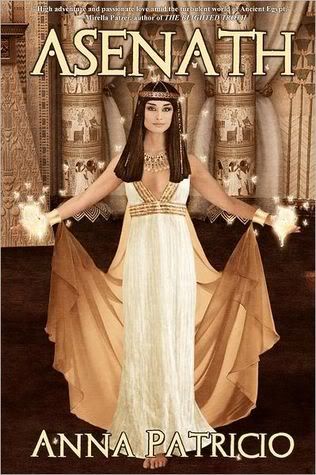
The cover is rather nice as well - I like the colours!

What I didn’t like:

As I said, the fact that it is clearly an YA position influenced the way it was told. In my humble opinion it was too sanitized. Asenath/Kiya’s slavery time is glossed over; the authoress also kind of forgot that the initial intention of Joseph’s brothers was to kill him; only after the intervention of the eldest one, Rueben, who seemed to be the most level-headed and responsible at that time, they agreed to spare him and sell into slavery (the Elohist version) . The rest of them were mad of jealousy and hated Joseph’s guts just because he dared to be the favourite of his dad.

I would also like to see more Egyptian court life and less teenage angst. I know the book was written from Asenath’s point of view but it would be more complex if another narrative voice was added and a new perspective with it.

Finally let me say that many details of everyday Egyptian life seemed surprisingly modern. Asenath’s childhood friend proposes during an official function, kneeling before her…I am not sure it was done that way in ancient times. Asenath gets married dressed in white with a veil…not sure about that either. The pharaoh appologising to his subject – no way, he was the living god! In other words – if you want to find out more about the culture of ancient Egypt, it is not the right book.

What I learned:

Joseph and Asenath (Mosaic in Basilica di San ...Joseph and Asenath, a mosaic in Basillica di San Marco  via Wikipedia
Let me also add that the story of Joseph's near seduction by his master's wife bears a marked similarity to the Egyptian story of the Tale of Two Brothers, which was popular at the time of Pharaoh Seti II (roughly 1200-1194 BCE). It has also been suggested that there are similarities between the rise to power of Joseph, and Manethos' tale of Osarseph, who was Syrian born, and rose to be Vizier of Egypt, beginning his career under Pharaoh Merenptah and his son Seti II. Indeed the name Potiphar (Joseph’s master) may even be a version of Merenptah's name (Poti = Ptah, Phar = Pharaoh). The "seven lean years" has been taken to refer to a Middle Eastern famine documented at that time.

Final verdict:

I liked the novel but only for its entertainment factor. The historical background was like that of any Disney movie (The Prince of Egypt anyone?) so not impressing at all. Still kudos for finding an interesting topic and an original heroine.