Showing posts with label dark fantasy. Show all posts

Monday, 3 June 2013

Review: Empress (Godspeaker trilogy 01) by Karen Miller

Book info:
Form: pdf format, e-book
Genre: dark fantasy
Target audience: adulst

Synopsis (from Goodreads):
Empress of Mijak
Empress of Mijak (Photo credit: Wikipedia)


Her name is Hekat--and she will be slave to no man.

In a family torn apart by poverty and violence, Hekat is no more than an unwanted mouth to feed, worth only a few coins from a passing slave trader.

But Hekat was not born to be a slave. For her, a different path has been chosen. It is a path that will take her from stinking back alleys to the house of her god, from blood-drenched battlefields to the glittering palaces of Mijak. For a cost, of course, because nothing comes for free.

What I liked: 

'Empress' is featuring a very original, recourceful and strong heroine although her character borders psychopatology in the first part, crossing that border frequently in the second. I admit it would be extremely difflicult to like her but, on the other hand, I fully appreciated the fact that Hekat was something fresh, not a clone of your common-and-garden fantasy good girl.

The story is very well-written, there is not one dull passage, the plot never diappoints you. The world building was presented in such a way that you feel fully immersed into the country of Mijak. The novel read like something ripped out of an ancient Sumerian myth of chariots and kings. Slavery! Blood and Entrails! Scorpions! Torture! Death! More scorpions! More death! You almost want to add 'Heavy Metal' to that bunch! The magic is there but it is subtle - reserved just for several scenes.

What I didn't like:

I admit the book would read far better if not for the dialect, which quickly grows tiresome. The religious system of Mijak, based on a primitive, blood-thirsty and rather shifty scorpion deity, could do with some variety. After a while I was rather tired with the whole number of things named after the god: godstone, godpost, godbraids, godpool, godbells, godsmite...godyawn?

And here it comes, my most serious complaint: the main character. Oh Hekat, you stupid fool.

Mount Everest (topgold)
Mount Everest (topgold) (Photo credit: Wikipedia)
I need something beautiful here.
I know Hekat had one hell of a childhood, being tortured, underfed, humiliated and hardly ever loved at all. Yes, she has grown up in a life of pain, blood, and the secret whispers of her god, a very primitive and very cruel demonic entity to begin with.The sympathy her childhood suffering had evoked in me was quickly burned away. In its place was left contempt, horror and distaste for her complete lack of altruism. I know she was supposed to be as though as a piece of concertina. Still I believe if it is 100% impossible for any person except for a hardened sociopath to relate to the main character, you end up disliking her story,  no matter how well it is told.

Believe me, I've read about and even liked many Dark Fantasy monsters but adult Hekat in my opinion is the most deeply crazy, primitive and disgustingly arrogant female ever written about. Her ambitions would fit Mount Everest and her ego is so inflated that you wonder how come she doesn't float while walking. Still you know what was the worst? No, not the killings and blood baths and the ruthless plotting against her own family. For me it was the fact that Hekat wasn't honest with herself. She simply lacked the necessary intelligence and lucidity to take a long, hard look at her inner soul and say it loud and clear: yes, I am a monster, THIS is what I've become.

What's worse, there is no counterpoint for her - no other character able to balance all these negative vibes. All Hekat's lovers (because she has no love interest) are definitely too weak to oppose her wickedness and correct her flaws, too primitive to even understand who and what they are dealing with. Neither sweet, naive Vortka nor Raklion the warlord bother to get to know the real Hekat. One of her enemies, Nagarak, comes the closest to the truth but then he dies (not telling you how, it would be a spoiler). It leaves a strange emotional void around Hekat the Monster so she has to stew in her own nauseatic juice. It is nothing pleasant to read - or to imagine.

Final verdict:

A strong beginning of a Dark Fantasy series; still it is not a book for everyone. You will deal here with a thoroughly unlikeable character, surrounded by a bland supporting cast, committing horrible deeds in the name of a sadistic god - consider yourself warned. Will I continue? Yes I will - but mainly because I've been told the rest of the series is different - it features less Hekat and more of her handsome and definitely less evil son Zandakar.

Enhanced by Zemanta

Thursday, 7 February 2013

Review: Twelve (The Danilov Quintet 01) by Jasper Kent

Book info:
Form: pdf
Genre: dark fantasy, historical fiction, Napoleonic wars,classic vampire story
Target audience: adults

Synopsis: 

On 12th June 1812, Napoleon's massive Grande Armee forded the River Niemen and by doing so crossed the proverbial Rubicon - the invasion of Russia had begun. In the face of superior numbers and tactics, the imperial Russian army began its fast retreat. But a handful of Russian officers - veterans of Borodino - are charged with trying to slow the enemy's inexorable march on Moscow. Indeed, one of their number has already set the wheels of resistance in motion, having summoned the help of a band of mercenaries from the outermost fringes of Christian Europe, Wallachia. They know everything about harrassing and defeating an enemy far more powerful than you and they are highly efficient.

The mercenaries are compared to the once-feared Russian secret police - the Oprichniki - and the name sticks. As rumours of plague travelling west from the Black Sea reach the Russians, the Oprichniki - but twelve in number - arrive. Preferring to work alone, and at night, the twelve prove brutally, shockingly effective against the French. But one amongst the Russians, Aleksei Ivanovich Danilov, is unnerved by the Oprichniki's ruthlessness. As he comes to understand the true, horrific nature of these strangers, he wonders at the nightmare they've unleashed in their midst...

What I liked:

Oprichniki, painting by Nikolai Nevrev.
Oprichniki, painting by Nikolai Nevrev. (Photo credit: Wikipedia)
The Napoleonic Wars, especially the disastroud and ill-guided invasion of Russia, are always a very colourful canvass for any novel; personally I like that period very much. This book didn't disappoint me either. Although I found some minor historical errors (like the narrator speaking of Poland which officially didn't exist at that time - just the ephemeral Grand Duchy of Warsaw, created by the Napoleon to appease the Poles and make them join his army). Ok, I know, it is not a historical novel and by the way who cares...just some weirdos like me.

The pace was fairly slow at the start, as the narrator focuses often on his private life and thoughts. At just over the midpoint, about 270 pages in, the book becomes faster and there was one twist at the very end which was a complete surprise to me.

Now about the voordalak (vampires). I am happy to say these are closer to the older image of a vamp so as far from your Twilight, sparkling, non-human-blood drinking, emotionally tortured vampires as a lap dog is from a wild wolf. The vampires in Twelve  are also not your average paranormal romance dudes, those exceptionally handsome and lustful, picking-up-the-best-babes-and-giving-them-the-best-sex-experience-ever-for-a-sip-or-two types . They are sadistic killers and parasites, having all the compassion and subtlety of a Jack the Ripper. They must drink blood to stay alive but they are not kind to their food sources. Getting the most satisfaction from the extreme emotional states of terror and despair in their victims (even other vampires) they will plan out their hunting and then they spend hours in performing the act to heighten their own enjoyment. In other words they were truly horrible monsters which fitted well the Russia and the ugly war around them. It was also nice that the author didn't hesitate to get back to the original themes of "Dracula", exploring such philosophical questions as what it means to be human, how you become a monster, what it means to be a loyal friend or a traitor etc.

Now a bit about the main character and the narrator, Aleksei Ivanovich Danilov. He is a complex hero, one of these flawed ones, not completely likeable to say the least of it but very real and completely honest which warmed me to him significantly. Although I admit that his moral compass was sometimes totally off he was an interesting man to follow around. Aleksei is a professional soldier and spy, thus not far away from mass murderers such as vampires. There's a huge war going on, and people are dying like flies anyway. The survivors commit horrible attrocities out of hunger and low morals, not to mention the harsh Russian winter. It is only too natural that, despite his initial hatred towards the Oprichniki, soon enough Aleksei starts asking himself whether these monsters are really worse than your average human being. 

Aleksei is married and has a young son; still, while lingering in Moskow, he enters an illicit relationship with a prostitute called Domnikiia or Dominique. Their relationship quickly exceeds the ordinary transaction turning into a proper affair or maybe even something more serious. It was funny that Dominique caught his eye because of her alleged likeness to the second wife of Napoleon, Marie Louise, the daughter of Francis I, emperor of Austria. Somehow Aleksey's  pangs of conscience, not very acute to begin with, were significantly diminishing with every death he witnessed and every enemy he killed. You might think that immoral or wrong but it was also very close to reality - especially during a war, when nobody was sure what the next day might bring. I have to admit I also appreciated the fact that Aleksei never turned into one of those annoyingly tortured heroes, being teared apart by his morality and urges. Once again, you might not like the fact that the hero had both a wife and a mistress and basically considered it ok but personally I found it in perfect accordance with that era and its often hypocritical mores.

Finally let me tell you that one of the vampires, Iuda, definitely deserved more attention that he got and I hope that he will be featured in the next installment. Why? Spoiler  highlight to read: Iuda is not a actually a vampire, just a very sick human sadist who pretends to be  one to indulge himself. I do wonder how he managed to dupe  his vampire companions, his boss and our brave Lyosha as well.

What I didn't like:

I grant it, the book was first published in January 2009. Still the fact that the main character for almost half of the novel tried to solve a big 'mystery' of Oprichniki  must seem a bit silly for any reader of fantasy. Even the fact that Aleksei emphasised every now and then that he was above folk fairy tales and other such absurdities didn't explain it well. All the clues were there from the very beginning - the novel starts with a Russian tale which immediately lets you know that there will be some paranormal elements involved. Then we are told that the creepy mercenaries came from Wallachia (Romania nowadays), leaving a trail of death in their wake, they operated only at night and slept during the day, they didn't want any money, always a surprising thing for a mercenary, their leader called himself 'Zmyeevich' so a son of a serpent, an adder or a dragon...honestly when I come to think about it there were actually too many clues around to make it half a decent secret.

Napoleons retreat from Moscow
Napoleons retreat from Moscow (Photo credit: Wikipedia)
Also I have to add that sometimes I was rather baffled by the powers of the Oprichniki. One moment they are pronounced to be worth more than ten ordinary soldiers - very stealthy, very deadly, freakishly strong and fast. The next moment Aleksei is able to finish off two of them at the same time and we are told that, in fact, it is easy to kill a vampire, providing you are prepared and you know what to do...hmmm. Still his other comrades were never as lucky or as skilled as him although they knew what they were dealing with...

The final showdown I found  a little too convenient for  Aleksei as well - it was one of these blatant cases of ‘being able to have your cake and eat it'. Still knowing that there are more installment coming I can forgive it.

Final verdict:

If you like historical fiction set in the 19th century, and  you have nothing against classic vampire mythology, this  romp where the odds are stacked against your hero at every turn might be up your valley.I will definitely give a try to the next book in the series despite the shortcomings of the first part.
Enhanced by Zemanta

Thursday, 25 October 2012

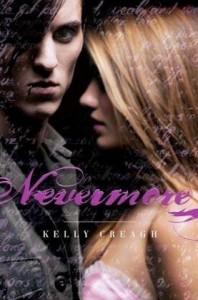
Review: Nevermore by Kelly Creagh


Book info:
Form: pdf file, e-book
Genre: Poe-inspired fantasy/romance
Target audience: YA

Synopsis: 


What can a blonde cheerleader extraordinaire and a Goth oddball wearing eyeliner have in common? They attend the same school and they’ve just paired for an English literature project by a mean professor. Neither Isobel Lanley nor Varen Nethers are exactly thrilled – he perceives her as a pink Barbie doll without brains, she thinks he drinks blood and sleeps in a coffin just to shock people and prove he can. Still both of them need a good grade and so they decide to work on that project and it starts their big adventure with Edgar Alan Poe and the world of dark fantasy resembling a bit the court of Unseelie, dark faeries from Irish mythology of the Daoine Sidhe.

Yes, they fall in love in-between – Isobel finds herself making excuses and lying just to be with Varen a little bit longer (unfortunately we don’t know what Varen thinks because the novel is narrated from Isobel’s POV). Steadily pulled away from her old circle of friends and a possessive football player of a boyfriend she ventures deeper and deeper into the dream world, seeing and talking to strange creature nobody can see or hear. She meets a man called Reynolds but is he real? Why does he look as if he jumped straight from another era? Will he help her to explore the mystery around Varen and his black notebook he carries whenever he goes?


What I liked:

Firstly let me say that the blurb didn’t make me warm up to this novel. Nevermore had the potential to be incredible, but also incredibly bad. First of all it is the first part of another YA series grrrr. Unfinished series to add (double grrrr but don’t let your dog hear you). Secondly a cheerleader girl is more often than not somebody I wouldn’t like to meet or read about – for plethora of reasons. Yes, plethora – one of these words your ordinary cheerleader from different YA stories would  confuse with a fancy, old musical instrument from France.  Still I, like most people in their right mind, love and appreciate poems and stories of Edgar Allan Poe and I have been informed that the male hero is a Goth kid who loves Poe to no end. What’s more I’ve been assured by my dear Heidenking in her great review that this book doesn’t feature any vampires, werewolves or angels, fallen or otherwise,  so I decided to give this one a chance.
Edgar Allan Poe
Cover of Edgar Allan Poe
yeah, chicks dig moustache

I have to admit I didn’t expect to be caught in the story as much as I did. I ended up reading the book in two sittings without noticing the passing hours. Why? Oh it is such a page-turner for YA and adult readers because the author cleverly and skillfully weaves many known facts about Poe’s life and mysterious death into the plot. She relates Poe’s works with the mysteries of a haunted ‘dreamland’ similar to the domain of elves from Jonathan Strange & Mr. Norrell by Suzanna Clarke (if you read and liked the magical aspect of that one you will enjoy Nevermore as well – different epoch, similar athmosphere) AND then she adds a well-know high school plot to it.

I’d also add the character setting to the number of advantages. Isobel is at first just your ordinary empty-headed cheerleader but then she shows her mettle confronting all the stereotypes and tropes – she starts reading Poe (ok, skimming more like, not being an avid reader and Poe not being a very easy author to read), she dares dump her boyfriend, she almost turns her entire life inside out just to find out more about Varen. 

I loved especially one short, funny scene when Isobel, visiting Varen’s house and looking at his childhood photo, discovers something truly shocking about him:

You're really a blond," she said, her tone just short of accusatory.

"And if you tell anyone, I will come to you in the night and smote your everlasting soul.” 

As her world begins to unravel around her, Isobel discovers that dreams, like words, hold more power than she ever imagined, and that the most frightening realities are those of the mind. Now she must find a way to reach Varen before he is consumed by the shadows of his own nightmares – a very ambitious task for a cheerleader or a teenage girl I suppose.

The best part is that neither Isobel nor Varen are perfect creatures, both are textured and layered. Ms. Creagh takes her time building these characters, starting with initial mutual dislike, and slowly peeling back the layers of their personalities. Varen is a classic young Severus Snape (a character from Harry Potter series) – a gifted boy, alienated at school and with an abusive parent to boot. He is also much more: he works in an ice-ream parlour, (yeah, actually selling ice-cream; can you imagine Snape doing that?) he dyes his hair and drives along in a vintage Jaguar (very cool!). Still, compared to intrepid Isobel, he seems too preoccupied with his reading, writing and Goth persona to be a truly active character; finally he falls into a not very manly category of damsel in distress (but I told you the author is playing with tropes and stereotypes, right?)

 What I didn’t like:

 Even though I'd looked forward to Isobel's exploration through the Poeland (I really couldn't restrain myself, 'Poeland' is so...right), but it turns out the progress of Isobel's learning more about Poe  is a rather rushy one, Isobel's own opinion on neither the author nor his works, is largely missing. We only got to see her read through The Masque of the Red Death then commented on it and there's no more mention of her opinion on Poe's works. I understand that she is not a reading type but I suppose if your fate and the fate of your beloved depends on information from books you should be far more committed to reading and finding stuff; still dear Isobel always acts as if she expected somebody to explain her everything (a fairy theory for dummies on Youtube,  not longer than 3 minutes, would definitely fit her better) and when nobody wants to do it she sulks. As a result she lands in that alternate reality, chased by ghouls and nocs (a kind of demons), completely unprepared and the fact that she actually manages to pull through comes as a major miracle.

Let me also carp about the role of adults. Unfortunately here the author decided to stick to the well-known patters. Although parents exist in this one, they are either too busy or completely out of touch with their kids and the reality for different reasons. As a result when the main lead has a problem she can talk to a friend or to her reflection in the mirror. I wish I read a book which author dared change that, showing a parent who not only cares but also knows how to show it and can actually impress their progeny with his/her knowledge.

My wishes for next parts.


I found Varen too vague a character to dominate the book (and I wish he DID dominate), there are so many things about him we don't know, e.g. his family's background, the reason why he had such a bad relationship with his dad, how he discovered Poe and became the way he was now, how he found a job in that bookstore and ice-cream parlour etc. After finishing Nevermore I'd very much love to learn more about him. Also some questions about Poeland simply beg for a creative answer – e.g why some people get trapped there and some can return to the land of living?

Final verdict:

Kelly Creagh's Nevermore is a very ambitious and interesting Young Adult novel which manages to bring  mystery and dark fantasy to life. Overall it is a worthy read not only for teen Poe's and/or Goth's fans. I'm looking forward to the sequel although, being spoiled and all, I know it is not as good as the first part. Maybe the third book will straighten things up nicely? I am definitely willing to give the author the benefit of the doubt.

A good idea for an alternative cover version

Enhanced by Zemanta

Wednesday, 14 March 2012

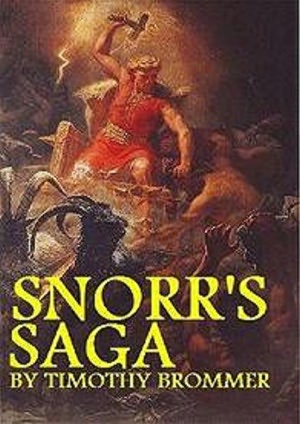
Review: Snorr’s Saga by Timothy Brommer


This book was provided by the author's publisher via my lady Blodeuedd's excellent blog in return for an honest review. I haven't been compensated for writing the said review in any way and the fact that the book came free of charge didn't influence me either.   

Book info:
Form: pdf format, e-book
Genre: dark fantasy based on Norse mythology
Target audience: adults

Synopsis:

Snorr Haemarsson, a skald, and Krym Freidleifsdottur, a spaekona (so a fortuneteller) has known and loved each other for ages. Unfortunately they are singled out to become pawns in the power play between Thor, Odin and Loki so their love is going to be severely tested.

Snorr kills Krym’s twin brother Hrut. Although Krym suspects Hrut, not the brightest or the nicest tool in the garden shed, should be blamed for the whole incident a family blood feud is started. For Krym it is a chance to prove her worth to her own clan - so far her father has been very disappointed with her meager abilities. He pronounced her good only for childbearing, a horrible insult for such an ambitious girl. She is gifted – she can channel frodleikur (a kind of magical superpower) but so far even her fortune telling was rather unimpressive. Now, with the help of Loki’s daughter, Hel, she becomes a volva (a far more potent sorceress) and creates a set of unique living runes.

Krym decides to avenge herself on her beloved and gain the recognition among her kinsfolk. She’s got the best chance after all – she can lure Snorr into a trap pretending she wants to date him. Snorr meets her in the forest and is sweet-talked into entering and robbing the fresh grave of Hrut, allegedly to retrieve her father’s belt with a golden buckle which would serve as Krym’s dowry. Unfortunately he doesn’t know that Krym has prepared her brother’s body beforehand, cutting the bonds on his feet and making Hrut ready to raise as a draugr – something between a vampire and a zombie. Snorr wakes the draugr stealing the belt and initiates a disastrous chain of events which will lead him and Krym to Asgard and Nilfheim – two of Nine Worlds inhabited by Norse gods and goddesses.

What I liked:

It was a fast-paced story with an intricate plot based on Norse religion, a bit long but very readable. It is obvious the author has made a lot of research because everything sounded plausible, especially the scenes in which he is recreating the habits, culture and ordinary life of the Vikings (at least in my humble opinion and I am hardly a scholar). The fantasy world building was fun to discover although I must warn you, the book is a bit bloody and violent. Well, those were rather ruthless times. As Snorr is hell-bent on becoming a hero, he must make some sacrifices even though Thor himself wants him to succeed. Also Krym has to pay for her gift, sometimes not even being aware of the price - when you deal with such tricky gods as Loki everything might happen.

What I didn’t like:

I admit it took me some time to understand all those Norse terms like ‘frodleikur’ or ‘spaekona’ but it didn’t prevent me from enjoying the narration. I also regretted the fact that there was so little action from Loki, my all-time favourite Norse deity and not many lighter, humorous scenes.

My only real complaint concerns the character of Krym. She is one mean, spiteful woman, especially after she became a volva. She is one of these women who crave power - I was really sick and tired with her endless plotting how to get Snorr and everybody else around her doing what she wanted them to do. I simply gagged when she told her future husband how she wanted to conceive a Valkyrie– it was as if she planned a highly effective in vitro pregnancy procedure, thinking just about material gains it might bring. He said ‘no’, finding it unmanly, but did it stop our lovely Krym? Absolutely not. She was still focused selfishly only on herself, her own glory, needs and plans. There is even a scene in which she rapes her betrothed to get pregnant on her own terms (I must grant the author – a very original premise but still revolting, a rape is a rape). True, Krym helps Snorr as they need each other badly to defeat that monster but let’s not forget the fact that she was more responsible for releasing that draugr than him – she led Snorr to his grave with premeditation. I felt hardly any chemistry between them and the ending left me wondering whether Snorr did the right thing, protecting and taking care of Krym during their ordeal. I would let her die – quite accidentally of course.

Finally the cover. I don't think it is in accordance with the character of this book. Not really.

Final verdict

If you enjoy darker fantasy and like Norse mythology this novel might be right up your street. I don’t regret reading it despite my reservations concerning the female lead because it is a very well-written and original book.

Wednesday, 23 November 2011

Review: Prince of Thorns (The Broken Empire 01) by Mark Lawrence

Book info:
Format: e-book, mobi
Genre: dark fantasy
Target audience: adults


Summary (mostly from Amazon.com):

A young prince like no other but hardly a Prince Charming. When he was nine, he watched his mother and brother brutally killed before him. One year later he ran off his father’s castle, freeing some men condemned to death and joining their band. By the time he was thirteen, he was the leader of that band, a group of bloodthirsty thugs calling each other “brother”. By fifteen, he intends to be king and by twenty – emperor...or better.

Before it happens, it's time for Prince Honorous Jorg Ancrath to return to the castle he turned his back on, to take what's rightfully his. Since the day he was hung on the thorns of a briar patch and forced to watch Count Renar's men rape his mother and slaughter his young brother, Jorg has been driven to vent his rage. Life and death are no more than a game to him- and it seems he has nothing left to lose.

But treachery awaits him in his father's castle. Treachery and dark magic. No matter how fierce, can the will of one young man conquer enemies with power beyond his imagining?

What I liked:

The book is told from Jorg’s point of view (the first person narration) and I consider it a huge asset, although normally I prefer the third person variety. We get to know this unusual prince’s inner turmoil and find out that many scars on his psyche seem to reflect only too well what he’s been through and what’s happening around him. He is simply haunted with darkness and speaks with the voice of a man twice his age, peppered with a wry sort of humour. Jorg might be one psychotic teenager but, as his story unravels, you understand why and you find the maniacal killer’s personality is just one of many masks he’s wearing. He doesn’t beat about the bush what sort of person he became since leaving his father’s castle and his honesty is sometimes chilling to the bone but we are shown glimpses of his softer side as well. He says:

"Before the thorns taught me their sharp lessons and bled weakness from me I had but one brother, and I loved him well. But those days are gone and what is left of them lies in my mother's tomb. Now I have many brothers, quick with knife and sword, and as evil as you please. We ride this broken empire and loot its corpse. They say these are violent times, the end of days when the dead roam and monsters haunt the night. All that's true enough, but there's something worse out there, in the dark. Much worse."

And one more, much darker quote:

“For the longest time I studied revenge to the exclusion of all else. I built my first torture chamber in the dark vaults of imagination. Lying on bloody sheets in the Healing Hall I discovered doors within my mind that I’d not found before, doors that even a child of nine knows should not be opened. Doors that never close again. I threw them wide.”

A sweetie, isn’t he? Warped but also relatable, taking everything into account.

The narration is solid, fast-flowing, logical and incredibly dynamic with some flashback chapters now and then. I usually don’t like flashbacks but, as the author kept them germane to the main narration and, as they are still told from Prince Jorg’s POV, they didn’t distract me too much, helping to understand the main storyline better.

It is definitely not one of those high fantasy novels where good characters are beautiful, chivalrous and noble (preferably with blond hair, many interesting trinkets and nice clothes on) and bad characters are mendacious, ugly, flesh-eating monsters. Don't expect much romance and love either - there is a hint or two, but no more. It is an advantage - romance doesn't fit this story at all. Overall the book is a gritty, momentarily very dark read. Small wonder – the author, not unlike George R.R. Martin (the author of ASOIAF series), clearly modelled some parts of it on the Hundred Years’ War – a series of battles waged from 1337 to 1453 by the House of Valois and the House of Plantagenet (also known as the House of Anjou) for the French throne, which had become vacant upon the extinction of the senior Capetian line of French kings. These were truly horrible times – only in France that conflict, along with deadly epidemics, famine and marauding mercenary armies, which often turned to banditry, reduced the population by about one-half.

Accordingly, something is rotten in the state of  Ancrath, a small kingdom surrounded by many other petty realms with their own petty rulers and tyrants. Without any real central government the land, apart from the main cities, is basically fair game for villains of different sorts. Small wonder our young hero is as cold as a steel dagger and he thinks nothing of plundering, burning, raping, beheading and torturing mostly innocent people as long as it furthers his aims. In fact he can be easily called an anti-hero – you might pity him but you can’t condone the bloodthirsty violence he decided to employ just to settle his score with Count Renar and the world at large. He craves vengeance not justice because he no longer believes in the latter.

The world building I found very original although a bit puzzling too. Magic is one part of it but not in usual way – don’t expect mighty wizards hurling balls of fire at each other. Also if you think that the book is set in a kind of Medieval Ages alternate reality, you will be forced to rethink that assumption from time to time. Prince Jorg tells us that he was taught Latin and Greek and has read Plato, Socrates and Euclid but he also quotes Shakespeare and Nietzsche... he fights with a sword and a crossbow but he has been taught Japanese martial arts as well. The world around him is supposed to reflect the material culture of the 14th century but at the Red Castle we are shown some surprisingly advanced AI technology along with a device which might be an equivalent of an atomic bomb...

What I didn’t like:

Almost no major issues but there was one thing which made me seriously wonder – how can a boy of just 12-13 lead a group of very adult and very nasty bandits? How can a sheltered child of ten, even after a very distressing and ground-shattering experience, turn into a cold-blooded psychopath and a charismatic leader during just a year or two? I would have less doubts if Prince Honorous Jorg Ancrath wasn’t castle-born and bred; it would also help if he was a tad older. I must admit the way it was presented, the whole premise sounded a bit preposterous. Seeing the raising wave of crime perpetrated by children I am perhaps wrong and/or overly optimistic, though.

Final verdict:

I recommend it to every dark fantasy fan. It was a truly spectacular book and I loved it very much but if you don’t feel comfortable with violence and killing in every chapter you might find it too gritty for your taste. Still it is definitely worth reading. I only hope the second installment will be as good as this one or even better – I am looking forward to the solutions of some mysteries left intact so far (Jorg's daddy is a shifty customer and those dream-witches!).