
Showing posts with label Blodeuedd. Show all posts

Friday, 19 July 2013

Movie review: The Host directed by Andrew Niccol and viewed by my fair lady Blodeuedd


Welcome Blodeuedd from Book Girl of Mur-y-Castell !!!

She agreed to review a movie for my blog and it is a movie I would never dare watch: The Host based on an infamous book of Stephenie Meyer, woo-hooo! She is a brave girl. What does she think of the movie? Was it better than the book? Let's check out!


Ana asked me to review The Host after I told her I watched this sorry excuse for a movie. And well if Ana asks you have to do what she wants.

It's not that the movie sucked, ok sure I sighed, rolled my eyes, laughed at it, but the scenery was nice and it had....sort of a good premise and potential. Oh and it was 100 million times better than the book. I tried to read the book but gave up at page 1 and tried to skim, but even skimming was boring. So the movie rocked the book.

Now what went wrong...everything! The story is about an alien and a human sharing a body and oh oh falling in love with different guys *head desk* Worst love triangle with 3 bodies and 4 minds ever. At one point the voice is all no no do not kiss him...eh, it's still your body stupid and you are still there, in a way you are kissing him. But yes I could go on and on, it was silly.

Right, so these are aliens who are so smart and have the best tech ever, but do they find the resistance? No. Instead they look for them. Oh god, let me laugh, looking with a flashlight. I would expect better technology searching for them. You are smart, figure it out.

Melanie Melanie, she is a special little snowflake. She has the strength to scream in Wanderer's head and even use the body. Isn't she the most special of them all. Then we have Wanderer, another little snowflake it seems. Sure we learn there is at least one other person but still. Special snowflakes lalala.

Melanie and Wanderer, 2 TSTL idiots. Wanda just blindly wanders off cos she is stupid. Yes let's go to the humans who want to kill you. And Melanie, does not want people to know she is inside Wanda..eh..excuse me? That makes no sense. The humans are stupid too, kill her at once! No, take her prisoner instead *head desk*. That they sure didn’t do with anyone else, but then Wanda is a special snowflake. She does not tell anyone that Mel is still inside her, instead a human falls in love with her. I still do not get it, I know it gives something to the sorry excuse of a plot to hide this fact but let's not forget that it makes no sense.

The world, le sigh. I had so many questions! More about the aliens, like who did they first take over? Sure they are logical but they take over and it means death. Are babies made? How will the world survive without babies? Are they like locust? They take over, eat everything and move on? But then I realized this was a Meyer book, so there is no world building.

The endings shows that yes maybe they humans will win. How the fuck they will manage that is another plot hole. They should not be able, but then the aliens are TSTL.

Wanda was also very forgiving. She had her lover boy so yes after being upset for a bit after the humans killed a bunch of aliens she moves on. The thing is I never saw the aliens as bad. They made perfect sense. This is a crap planet, we kill each other and destroy our world. The aliens made it better. The minute they are gone we would destroy each other again.


What to say then. If you liked twilight you will like this one. I would not recommend it though, it had too many roll your eyes moments and wtf? events. But I had to see it anyway, and I do not regret it, I always watch crap movies with this friend I have. It's our thing. So it won the bad awards. Congrats.

Wednesday, 30 May 2012

Review: Almodis the Peaceweaver by Tracey Warr


 This book was provided by the author's publisher via my lady Blodeuedd's excellent blog in return for an honest review. I haven't been compensated for writing the said review in any way and the fact that the book came free of charge didn't influence me either.    

Book info: 
Format: pdf file
Genre: historical fiction
Target audience: adults

A quote that stole my heart:

“I could work as a peasant in a field and live in a small hut built into the side of the mountain.
I could hunt my own food, write a book of my life, but I would never see my children or my sister again.

 I don’t care about clothes and jewels and castles but I would miss my books.”

Synopsis:

After generations of fighting amongst the ruling families of 11th century Occitania, the marriage of Almodis, daughter of the Count of La Marche, to Hugh of Lusignan is intended to bring peace and harmony to the region. Youg Almodis, raised by her grandfather among troubadours, trobairitz (female troubadours, imagine that) , books and poetry, of course expects much more, especially that her betrothed is handsome, young an amiable. Unfortunately he is also overly religious, almost to the point of complete zealotry. He would be a great monk. Instead, he has to produce heirs with his inexperienced but far more practical bride. As you can imagine the union does’t work; that’s why, after the birth of twin boys and a daughter (don’t even ask me how it was done or possible at all, you must find out on your own), their marriage is repudiated. Almodis is still resolved to create her own dynasty. She marries for the second time, choosing a far more important and more powerful man, Pons the Count of Toulouse.

Pons is old, ugly, stupid and lascivious. His young wife suffers greatly from his attentions but, as an ambitious princess, she gives him several children. When that grisly task is over she doesn’t want to even look at Pons any longer. It makes the Count very angry. He wants to imprison Almodis in a covent ( or rather literally brick her in an anchorite cell there so she knows who rules the roost). She barely escapes and marries for the third time. Her third husband, Ramon of Barcelona, seems to have it all (finally you might add): he is handsome, he’s been in love with Almodis for ages and he has political ambitions well-suited for such a lady. However, his grandmother Dowager Countess of Barcelona is against that marriage as, in her opinion, a marriage of inclination is strongly condemned in Catalonia. Will Almodis finally find her place and happiness she deserves?

What I liked:

The story of Almodis was written with a detailed care concerning history and our knowledge of that era. The main heroine, Almodis, was a woman who would deserve more than one novel. She was the ‘peaceweaver’ but also a passionate, intelligent woman who had to fight for her right to be happy, a living proof that life of a princess could be as difficult (if not much more difficult) than a life of a simple peasant woman. I really appreciated the fact that the author didn’t condone that simple truth, showing even in the very first scene how ugly things could turn out if a princess had forgotten herself.

After all her life was full of interesting ups and downs; what’s more, she was the mother of Raymond of Toulouse, a famous crusader and a great lord. The author informs us that both Martin Aurell (1995) and Jacques Le Goff (1980) have suggested that Almodis was the canvas for the Roman of Melusine, which was associated with the castle of Lusignan (check out that Melusine if you haven’t heard about her yet!) .

The cover is lovely!

What I didn’t like:
The narration is divided into several points of view and I found it a bit misleading, sometimes really awkward, especially that all the narrative voices of those different people seemed to be very similar to the voice of Almodis herself…they were simply not distinguishable enough to add to the story. I would rather the whole novel was written in the first person.

My other reservation concerns the plot. It isn’t one smooth continuum of a narration but simply seems to consist of episodes. Things tend to be told, not shown and overall the whole pacing is rather surprising, with events running too quickly (or at least such was my impression) - in one chapter Almodis is married, in the second she already has three children with Hugh, then they annul their marriage, she is married to Pons, bear him children…a real whirlwind! It is closer to a chronicle than a novel.

I know, basically she had five babies in three years, poor woman, with more to come, but it really sounded a bit like she just jumped from one marriage to the next, spouting children all along, without thinking or pondering over her situation much. She was a grand lady, by the way, not a peasant who would have to take care of all her progeny on her own.


Finally I found such an exchange in the text:

“‘We can’t push her to it, Dia, she’d only resist,’ I say, when she’s gone out
riding. ‘You can lead a horse to water but you can’t make it drink.”

When I read it I gasped. Oh really? So it is, according to the author, something which comes from the 11th century Occitania or France? Well, I found a different etymology of that one: according to this site

[This saying] was recorded as early as 1175 in Old English Homilies:

Hwa is thet mei thet hors wettrien the him self nule drinken
[who can give water to the horse that will not drink of its own accord?]
and is considered the oldest English proverb (emphasis mine). Hmmm...

Final verdict:

The narrative glitches spoiled this book for me a bit but if I find another novel about Almodis I will read it for sure!


Wednesday, 4 April 2012

Review: The Dragon’s Harp by Rachael Pruitt (Era of Dragon’s: The Lost Tales of Gwenhwyfar series #01)

This book was provided by the author's publisher via my lady Blodeuedd's excellent blog in return for an honest review. I haven't been compensated for writing the said review in any way and the fact that the book came free of charge didn't influence me either.   


Book info:


Format: e-book, Kindle
Genre: historical fantasy
Target audience: older YA and adults


Synopsis:

The novel is set in northern Wales during the 5th century CE and its narration follows the coming of age of a young Ordovici princess of Dinas Emrys, Gwenhwyfar. It is the first person narration – elderly Gwen tells the story of her life to a serving girl. Yes, she is the future wife of Arthur and Merlin/Emrys is actually her uncle but she is also a small, unruly, stubborn girl, much loved and surrounded by her family. She grows up in very uncertain times so soon enough must face harsh reality of war, plunder, murders, rape and betrayal. Will she find her inner strength to fight for her integrity and for those she loves? Will she dare to develop her unusual gifts to oppose dark, greedy druids and witches? Will Merlin, forever busy abroad, allegedly tutoring an important young princeling in the South, finally find time to help her?

 What I liked:

 Firstly and foremostly I loved the fact that the author really, truly did her homework concerning the period she wrote about. Mind you she did it with passion and it was felt. The narration rang true, the life of little Gwenhwyfar seemed as historically correct as it was only possible - I couldn’t help smiling e.g. when I stumbled on the Chi Ro symbol early Christians used most likely instead of a crucifix or a cross. 5th century Wales is presented as a real place, without idealizing the living conditions or problems its inhabitants faced. I am a sucker for good historical fiction, firmly based on the remnants and relicts from the appropriate era and here it was clear Ms Pruitt is a real history junkie who digs deep and is creative with her findings! It was a pleasure!

 I liked the red dragon, called Cymry (guess why such name was given to it ;p) which I suppose is a nice symbol of the magical aspect of the book. It wasn’t overdone but impressive enough, more like a natural magic than something flashy and loud. Bad druids and good druids seemed a very sensible idea –after all nobody said Julius Caesar, who gave them a very bad opinion in bulk writing his memoirs, was the most objective source of knowledge. They were his enemies and he was clearly afraid of them.

 I liked how Celtic women were made almost as powerful as their husbands if not actually more dangerous than any warrior. Gwen, just a child and then a teen, is presented as a kick-ass princess, not some whimpering bimbo or a shallow twit whose flirtatious was led to the destruction of Camelot.; her Grandma, Rhiannon, is actually even better! Also Sari, a slave girl from an Arabic country turned seer, and Hrwych, Gwen’s nurse and friend, were a very nice addition!

 Now something about the baddies: they were really good as well, both men and women who, in the end, happened to be one big ‘loving’ family! The main villain, Maelgwyn, Gwen’s other uncle, is handsome and rotten to the core – what a bliss!! – but his daughter is actually even better (or rather worse) a piece of art, nothing less, and of course as cute as a button! I am looking forward to meeting them again! Mind you it is a novel written clearly with a more mature audience in mind – not a fairy tale for children. There is one especially disturbing scene of an attempted rape (the victim being a minor) and then the would-be rapist is punished in a really ugly, brutal way – consider yourself warned.

 Finally the cover art is lovely! Those red curls and this dagger!

 What I didn’t like: 

 At first I couldn’t relate to Gwen. Not really. Only later, when she stopped behaving like a spoiled brat I warmed to her a bit. I think Lleu, her father’s ward and her main squeeze in this part, was a far more interesting, although secondary character. Well, it might change. I started reading this novel not being aware that it is a beginning of a series – there will be four more books or so I found out! Now I want more! Is there any justice? None!

 Final verdict: 

 A charming story, very unlike any novel based on Arthurian cycle I’ve read so far. I only hope the whole series will be as original and entertaining till the very end. Writing all five parts on the same high level – that’s a real challenge! I recommend it to readers who like Arthurian cycle stories but told in a more contemporary and historical way, without completely inadequate knights in shining armours and damsels in distress and a heavy dress (thus the distress I suppose).

Sunday, 1 April 2012

The Wonderful World of Happily Ever After


April Fool's Day deserves a special treat so here you go - I am pround and happy to host today Blodeuedd and present our discussion about HEA in literature and in real life. Enjoy!


Blodeuedd reviews books (everything from HR, PNR to fantasy and historical fiction) on Book Girl of Mur-y-Castell. She is a sucker for a happy ending and has a weak spot for Jane Austen variations. Even if fantasy is her one true love, and the one love where the happy ending can be thrown out of the window (but don’t tell anyone ;)


Anachronist (yes, that's me) is just helping Blodeuedd in a capacity of a poltergeist while she is not busy writing her own blog (Books As Portable Pieces of Thoughts,  I know, the name is far too long but somehow it seemed a good idea back then). She is a cynic when it comes to romantic endings but, after all,some balance must be kept or the Sun will fall from the sky ;)
Weclome to the Wonderful World of Happily Ever After 
by Blodeuedd and Anachronist


B: Now where to start? I love HEAs, how can you not love them. The prince gets the poor servant girl and the list continues …
A: Courtesan would be better than the servant girl you know...far more outlandish so to speak.
B: I actually took that away cos I fear my own ….
A: Prejudice?
B. Yeah, prejudice, came into play. Come on! A duke should never marry a courtesan! Oh I am a horrrible HEA lover.
A: HEA shouldn’t be limited, you know, and there are plenty of books about whores getting a nice HEA, male or female, no matter.

B. Now who is teaching who here? I knew that there is as big HEA lover inside you.
A: Not at all, just making a pertinent remark. You can edit that later ;) *snickering*
B. Edit, nah, this stays as it is, it’s perfect.
A: I hate HEAs all the same and nah, it is not perfect without at least two edits ;p

B: Back to the courtesan, I do love when the whore lives happily ever after, but that little voice inside of me tells that he can never take his whore to town cos the TON would laugh their asses off.
A: Ton or not people tend to be sensible - if you marry a whore you get no connections, usually no money and no political clout so why bother? You just keep paying her or him and get what you want anyway ;)

B. No, no! That is horrible. He should marry his whore, he should not care about what others thing if he truly is in love. He should live in a little cottage with her and cast his title aside
Edward VIII and Mrs. Simpson - yes, he abdicated and they married but do they look happy? Do they, really?
A: LOLOLOLOLOL dear me, you know there was just one king who actually more or less followed your instructions, my lady. He was called Edward, he married Mrs Simpson, an American divorcee, and the rest is the silence. Nobody else dared be as stupid as him. Still they didn’t live in a cottage.


B: Then I blame the Swedes, I learnt of the history of King Erik and Karin Månsdotter in school. The King married a soldier’s daughter...of course that ended badly too. They were put in prison by his brothers and then he was poisoned and she spent the rest of her life in Finland. Still he married for love *coughs lust  it was surely lust but who cares*


King Erik XIV and Karin Månsdotter (and someone who is not happy at all)
A: Stupid man...if it was lust then he shouldn’t have married her at all. And in real life, as you proved it yourself, there is no HEA. Not really.

B. True, it always ends badly. Now I am sad, where are the HEAs?!

B: Oh you are wicked ;) But bad books, oh no, you mean awesome books! A book should have a HEA. Everything should end with kisses and roses and no one should care about the ton or anything else. I love them, and I will always love them. But in real life, yeah, no HEAs, I did not go for the guy with the fancy car who would take me away. I went where my heart told me to go...still that is a HEA.

A: I think you hit the nail on its head. A good HEA - yes, such a thing exist - should be close to reality, so no princes, no roses but it doesn’t exclude happiness either. Just a different form of happiness I suppose.

B. But I love princes! Still you are right, I would love other sorts of romances, books where the Maid finds love with the valet and raises 6 kids in a cottage. It does not always have to be dukes and princes.


A: Ah, you love also these little cottages, don’t you? I suppose a big fat castle would be fine as well but...not for a maid. In other words, unless a maid transforms itself into a princess she is 100% better off with that valet in a simple hut. The transformation process - here lies the main difficulty. Some authors tend to forget that it takes a lot of pain and effort, it is a hell of give-and-take so you must lose something in order to gain something else and you are never sure if that ‘something else’ will be actually better.

B. *interrupts and forgets what that her point was*.

A: I just wanted to say that I am becoming a bit too verbose so back right to you :)

B: I think we have a lovely post right here. But I will say, we do love HEAs and no suffering and all that, because we want the fantasy. We do not want to know about the struggle cos we all struggle in real life. So for once it is nice to sink down and read a book where everything works out and no one is worried about money, or if they can take home their whore for dinner ;)

A: That’s rather an acute remark you know. We do want the impossible even if we are aware it is just a pie in the sky...


A: This guy is a bit overweight...I bet he doesn’t wash his teeth...and you know him how long exactly? You...don’t know him at all? Yeah...the best of luck, my princess! Mwuahahahahahaha!


Wednesday, 14 March 2012

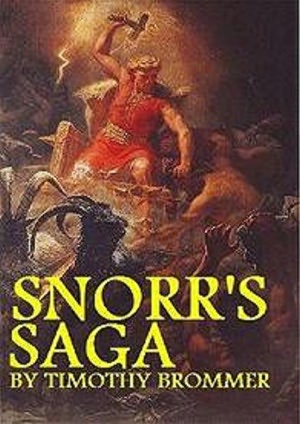
Review: Snorr’s Saga by Timothy Brommer


This book was provided by the author's publisher via my lady Blodeuedd's excellent blog in return for an honest review. I haven't been compensated for writing the said review in any way and the fact that the book came free of charge didn't influence me either.   

Book info:
Form: pdf format, e-book
Genre: dark fantasy based on Norse mythology
Target audience: adults

Synopsis:

Snorr Haemarsson, a skald, and Krym Freidleifsdottur, a spaekona (so a fortuneteller) has known and loved each other for ages. Unfortunately they are singled out to become pawns in the power play between Thor, Odin and Loki so their love is going to be severely tested.

Snorr kills Krym’s twin brother Hrut. Although Krym suspects Hrut, not the brightest or the nicest tool in the garden shed, should be blamed for the whole incident a family blood feud is started. For Krym it is a chance to prove her worth to her own clan - so far her father has been very disappointed with her meager abilities. He pronounced her good only for childbearing, a horrible insult for such an ambitious girl. She is gifted – she can channel frodleikur (a kind of magical superpower) but so far even her fortune telling was rather unimpressive. Now, with the help of Loki’s daughter, Hel, she becomes a volva (a far more potent sorceress) and creates a set of unique living runes.

Krym decides to avenge herself on her beloved and gain the recognition among her kinsfolk. She’s got the best chance after all – she can lure Snorr into a trap pretending she wants to date him. Snorr meets her in the forest and is sweet-talked into entering and robbing the fresh grave of Hrut, allegedly to retrieve her father’s belt with a golden buckle which would serve as Krym’s dowry. Unfortunately he doesn’t know that Krym has prepared her brother’s body beforehand, cutting the bonds on his feet and making Hrut ready to raise as a draugr – something between a vampire and a zombie. Snorr wakes the draugr stealing the belt and initiates a disastrous chain of events which will lead him and Krym to Asgard and Nilfheim – two of Nine Worlds inhabited by Norse gods and goddesses.

What I liked:

It was a fast-paced story with an intricate plot based on Norse religion, a bit long but very readable. It is obvious the author has made a lot of research because everything sounded plausible, especially the scenes in which he is recreating the habits, culture and ordinary life of the Vikings (at least in my humble opinion and I am hardly a scholar). The fantasy world building was fun to discover although I must warn you, the book is a bit bloody and violent. Well, those were rather ruthless times. As Snorr is hell-bent on becoming a hero, he must make some sacrifices even though Thor himself wants him to succeed. Also Krym has to pay for her gift, sometimes not even being aware of the price - when you deal with such tricky gods as Loki everything might happen.

What I didn’t like:

I admit it took me some time to understand all those Norse terms like ‘frodleikur’ or ‘spaekona’ but it didn’t prevent me from enjoying the narration. I also regretted the fact that there was so little action from Loki, my all-time favourite Norse deity and not many lighter, humorous scenes.

My only real complaint concerns the character of Krym. She is one mean, spiteful woman, especially after she became a volva. She is one of these women who crave power - I was really sick and tired with her endless plotting how to get Snorr and everybody else around her doing what she wanted them to do. I simply gagged when she told her future husband how she wanted to conceive a Valkyrie– it was as if she planned a highly effective in vitro pregnancy procedure, thinking just about material gains it might bring. He said ‘no’, finding it unmanly, but did it stop our lovely Krym? Absolutely not. She was still focused selfishly only on herself, her own glory, needs and plans. There is even a scene in which she rapes her betrothed to get pregnant on her own terms (I must grant the author – a very original premise but still revolting, a rape is a rape). True, Krym helps Snorr as they need each other badly to defeat that monster but let’s not forget the fact that she was more responsible for releasing that draugr than him – she led Snorr to his grave with premeditation. I felt hardly any chemistry between them and the ending left me wondering whether Snorr did the right thing, protecting and taking care of Krym during their ordeal. I would let her die – quite accidentally of course.

Finally the cover. I don't think it is in accordance with the character of this book. Not really.

Final verdict

If you enjoy darker fantasy and like Norse mythology this novel might be right up your street. I don’t regret reading it despite my reservations concerning the female lead because it is a very well-written and original book.

Tuesday, 28 February 2012

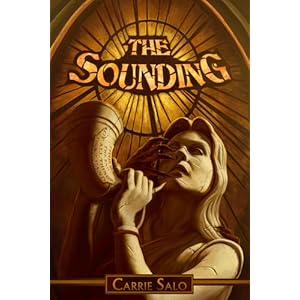
Review: The Sounding by Carrie Salo


This book was provided by the author's publisher via my lady Blodeuedd's excellent blog in return for an honest review. I haven't been compensated for writing the said review in any way and the fact that the book came free of charge didn't influence me either.   

Book info:
Form: paperback, 478 pages
Genre: supernatural thriller
Target audience: adults
Publisher: 23 House


Synopsis (from Amazon.com):

In the Book of Revelation, a man named John has a prophetic dream. He dreams of the final prophecies that will come to pass - and the seven archangels that guard them. Each angel waits to sound their trumpet at God's appointed time, preparing humanity to fight and win the final battle. 2,000 years later, Father Chris Mognahan is a member of the Hetairia Melchizedek, a secret society within the Catholic Church that studies Biblical omens. The society asks Chris to investigate an unusually grotesque crime - a murder on a college campus where the killer's hand literally burned off the victim's face. While the killing seems isolated at first, the society ties the murder to the final Biblical prophecy and a terrifying omen that the order of the prophecies is about to be disrupted. The final battle is coming too soon - long before humanity is prepared to win it. Suddenly, Chris finds himself fighting against time and hell to keep the prophecies in order and stop an early Armageddon. He is joined by a band of unlikely allies, and together they find themselves in Rome above the Vatican Necropolis - the city of the dead - where the future is revealed to them in ancient texts. They are not alone, however; an evil as old as time itself hunts them. As they travel across continents on their mission, the demonic force follows relentlessly, waiting in every shadowed corner, and every dark place. As Armageddon descends, Father Chris finds that his only hope lies in a young woman within the group who has a secret gift - and their belief that God Himself may have sent her to keep the final angelic trumpet from sounding out the early end of the Earth.

What I liked:

This novel surprised me nicely several times. I must admit it – I started to read it with a very negative feelings. First I thought it was something in the style of Dan Brown (insert an expletive of your choice here). The more I read the more I was delighted to be wrong. Then I thought it was veering too much toward paranormal romance and I was wrong again – there is some romance, it is rather paranormal but don’t expect testosterone-filled, heavily muscled, devastatingly handsome he-angels strutting around with their wings, making girls swoon (or, in a version for boys, angelic super-model girls with perfect proportion and fantastic hair dancing semi-nude in the moonlight. Or whatever such creatures usually do). A wrong book.

Its first huge asset was a number of very likeable, three-dimensional characters, some of them with a great sense of humour. First of all we have Elise Moore who is an angel, Remiel, but also a normal 19-year-old college student, working part time in a bar, fancying boys and men, swearing and having fun. She has some paranormal gifts but she must learn how to use them and it is not always easy. What’s more, when she is attacked she doesn’t wait for rescue, she doesn’t pray, she defends herself, hurting or even killing. That’s my angel - I have a soft spot for such heroines. Especially that she has pangs of conscience later.

Then there are several Catholic priests: Father Chris, Father Alan and a mute visionary monk called Francis. All of them are not exactly like your average image of a Catholic priest and take it from a girl born and bred in a Catholic country. They are more like normal people: they can fall in love (not spoiling, nuh-huh), they can sin, they are angry with the Vatican’s bureaucracy and red tape (from time to time, not overly so) even though they love their God and are good Christians (more or less). The main baddie (called the Other, a demonic entity of a kind) was simply delightful - so similar to our she-angel in some aspects that I gasped with joy more than one time. He also understood her the best (and my heart was dancing – that’s my demon!). In other words these characters made this book a very interesting read. Taking into account the fact that it is Ms. Salo’s debut novel – chapeau bas! This lady knows her craft when it comes to the characterization!

Then there is Vatican and its mysterious churches like palaces and palaces like labyrinths and labyrinths serving as catacombs. It could be really felt that the author was there, saw that all and most probably bought a t-shirt or two, maybe even one similar to a habit ;). It was very entertaining and well-written.

Finally the plot - it was good, original, full of suspense, even riveting from time to time, with the right emphasis in all proper places and a great final – no mean feat, many good novels have been ruined for me by a weak/improbable ending. Now a warning for those readers who must have their HEA no matter what. This book might make you cry. Seriously. I didn’t cry but if I weren’t one hard-as-nails daughter of a chienne (pardon my French) I would have cried for sure. There’s a HEA of a kind but not what you expect. It is a bit heart-wrenching.

My last remark: don’t worry if you don’t know the Bible or the Catholic church. Everything is explained nice and easy. Sometimes too easy – but it is a matter for my other section.

What I didn’t like:

Some minor info dumps appear in the text – not very bothersome and even partially understandable (try to explain the history of the mankind from the Bible to a lay man in five sentences, or the history of Vatican) but still noticeable. It was not my major problem, though.

My major problem was that sometimes, just sometimes, some blatant factual errors slipped in. Like, for example when one of the savant priests, Alan, says that Eve was the first Jewish woman (p.176). Hello? Jewish? How come? There was no such a thing as nationality at the beginning and even much later, right? Eve was just a woman as Adam was just a man or I am missing something?

Then our Bible scholar says that Bathsheba was the downfall of the Jewish king David and the death of their firstborn son interrupted the royal bloodline of kings. It made me truly mad – let me explain why. I promise it will be nerdy and longish but interesting :p

Bathsheba, the wife of Uriah the Hittite, was a very beautiful woman. King David saw her from his balcony while she was bathing in her private garden. I suppose he was at the peak of his male menopause – anyway he coveted her rather badly. Not that he was a sex-starved bachelor, mind you. A king is a king and has its rights – Bathsheba was brought to the royal palace asap and she was impregnated by her happy royal admirer while her hubby fought for David abroad. In an effort to conceal his sin, David summoned Uriah from the army, hoping that he would go to bed with Bathsheba to…er…cover things up nicely. Uriah, however, was unwilling to violate the ancient kingdom rule applying to warriors in active service which said that they had to refrain from carnal pleasures and sleeping under their own roof. Stupid, honorable, unimaginative knight. His nobleness cost him his life. The desperate king gave the order to his general, Joab, that Uriah should be placed in the front lines of the battle and then betrayed - left to the hands of the enemy. David had Uriah himself carry the message which was also his death warrant (the same trick was repeated by Shakespeare in Hamlet later). After Uriah’s murder, David made Bathsheba his wife.

David's action was displeasing to the Lord and, even though the king confessed his sin and expressed sincere repentance, Bathsheba's child by David was struck with a severe illness and died a few days after birth. The king accepted it as his punishment; mind you, according to the law he was supposed to die himself as he committed both adultery and murder. Kings have it easier, no matter what. Now tell me, was Bathsheba in your opinion really a downfall of David or was it rather his own lust?

When it comes to the infant, punished for the sin of his father – it was neither the first nor the only son of David at that time so his death, although sad, couldn’t interrupt the whole royal bloodline in any way. David, like many Eastern kings, had a lot of wives and concubines; some of them bore him sons years before he met Bathsheba (let me quote here the names of just two older princes alive: Absalom and Adonijah). Even a mediocre Bible scholar would know that much.

Final verdict:

A nice supernatural thriller with several great twists and turns and an original gallery of characters. It was really a pleasant surprise. For a debut novel – a great book, but I hope the author will try to omit factual errors in the future. Nevertheless I would like to read her other books (when she writes them of course) as well!

Thursday, 16 February 2012

Review: A Slot Machine Ate My Midlife Crisis by Irene Woodbury


This book was provided by the author's publisher via my lady Blodeuedd's excellent blog in return for an honest review. I haven't been compensated for writing the said review in any way and the fact that the book came free of charge didn't influence me either.   

Book info:
Genre: contemporary fiction
Target audience: adults
Form: e-book, pdf format
Page count: 222

Synopsis:

Wendy Cantrell, 45, has just married her steady boyfriend of seven years, Roger, and became Mrs. Sinclair - a respectable wife of a popular architect. They both moved to Houston where he started to work over a big new development, Magnolia Crescent, leaving his wife alone in a house full of chameleons and cockroaches - an isolated newlywed in a strange city, freshly unemployed and feeling more like fish out of water with every passing day.

When Wendy’s friend, Paula, phoned her and suggested a long weekend in Las Vegas, Wendy went over the moon. Finally a bit of fun and shopping far from Roger’s new conservative friends and their nosy, conceited, gossiping wives. She went to Las Vegas and never returned. For many reasons. Wendy found Vegas  more laid-back than L.A., quirkier than Denver, looser than Houston. In Vegas, irreverence and outrageousness were the order of the day. She loved the wackiness and impulsive energy of that place. Her husband didn’t understand at all.

Roger went ballistic but Wendy decided it was her turn to be busy, especially that she got a once-in-a-lifetime chance to work as a real clothing designer, not to mention her Ann-Margret act in the local casino. Was she just in the throes of some hideous midlife crisis, making a complete fool of herself because she‘d lost her job – and her identity – with it? What would become of her marriage and her career?

What I liked:

This novel was full of surprises. First of all its main heroine, Wendy, was far from a cliché I expected, judging this book from the cover. She was funny, she liked flirting, shopping and eating out but she tried to be faithful to her husband and she behaved in a far more dignified way than her younger friend, Paula.

It is a first-person narration so we get to know a lot about Wendy and her complicated marriage situation. Sometimes her reactions and musings are trite, sometimes poignant but always honest and believable. I do appreciate honesty a lot.

The way the plot was developed made the reading interesting as well. It wasn’t the ordinary “a married woman meets another guy and finds the love of her life but it’s already too late” kind. Practically till the very end we don’t know what Wendy’s decision will be. Such hesitancy about the future didn’t feel spurious although I did think once or twice how come a mature woman, knowing a man intimately for seven years, became so undecided all of a sudden. Well, the author tries to explain it in a logical way but you have to be patient.

Finally Las Vegas…well, here I share the feelings of Roger, who says:

“No other city in the world objectifies women as much and seems so proud of it. This whole town reeks of inauthenticity! Everything is fake. The buildings are façades or reproductions. Most of them are as disposable as movie sets in Hollywood. The breasts are silicone or saline. The entertainers are impersonators. Even the marriages are a sham. Vegas is an endless pit of illusions, cheap fakes, and trumped-up imitations, most of them stolen.”

In other words even if I were close to this city I wouldn’t feel like visiting it. However I did like the fact that the author presented both sides of it – the advantages and disadvantages. Let’s quote Wendy here:

On these raging binge-fests of consumerism, I never thought about tomorrow, I didn‘t look back on yesterday, and I couldn‘t have cared less about today. Screw all that perspective and moderation stuff. I was suspended in a never-never-land of No Limit Shopping – guaranteed to take away the pain, make you forget about everything, and then some.

 “At the end of these binge days in the Valley of the Malls, everything was hazy and blurred. I felt disconnected from reality, floating around in space at some cosmic super mall, where the only reality was shopping, shopping, shopping, eating, eating, eating. Nothing else mattered. Nothing else existed. It was a nirvana state, but agonizingly empty once the anesthesia wore off and I was back to square one the next day.”
  
What I didn’t like:

The title. I find it shallow and misleading. A slot machine eats just one kind of food – your money. Also the titles of particular chapters were a bit too long and silly. I would prefer there were no titles at all, just numbers, but it’s only me.

I  found some surprising mistakes inside. When a woman who, allegedly, worked a long time for an exclusive boutique chain speaks about Christian Laboutin instead of Louboutin, it makes my eyebrows arch. I am not a fashion fan but even I’ve heard of this designer brand name and its fabulously uncomfortable but beautiful and rather expensive shoes. Another example – fung shui instead of feng shui. Did the editor take a nap?

What’s more? Some expressions  like “lickety-split” were repeated a bit too often. After a while it started to annoy me. I am also not a big fan of the cover art. Once again - it is not a book about gamblers so what does that one-handed bandit do there?

Final verdict:

This book exceeded my expectations in a positive way. Despite some shallow parts and scenes straight from “Sex in the City” I enjoyed it. The ending...once again it took me by surprise. :)

One last quote, especially for my friend Tracy (she will know why):

But then they parted ways after she canceled a sold-out concert at Wembley Arena in London at the last minute because she wanted to party in the Cotswolds with Mick Jagger.” 


LOL!!!

Enhanced by Zemanta

Tuesday, 7 February 2012

Review: The Discovery of Jeanne Baret by Glynis Ridley


Genre: non-fiction, historical
Target audience: adults
Book form: paperback, 291 pages


 This book was provided by the author's publisher via my lady Blodeuedd's excellent blog in return for an honest review. I haven't been compensated for writing the said review in any way and the fact that the book came free of charge didn't influence me either.   

Synopsis (excerpts from Amazon.com):

The year was 1765. Eminent botanist Philibert Commerson had just been appointed to a grand new expedition: the first French circumnavigation of the world. As the ships’ official naturalist, Commerson would seek out resources—medicines, spices, timber, food—that could give the French an edge in the ever-accelerating race for empire.

Jeanne Baret, Commerson’s young mistress, housekeeper and collaborator, was desperate not to be left behind. She disguised herself as a teenage boy and signed on as his assistant. The journey made the twenty-six-year-old, known to her shipmates as “Jean” rather than “Jeanne,” the first woman to ever sail around the globe. Yet so little is known about this extraordinary woman, whose accomplishments were considered to be subversive, even impossible for someone of her sex and class.
            
When the ships made landfall and the secret lovers disembarked to explore, Baret carried heavy wooden field presses and bulky optical instruments over beaches and hills, impressing observers on the ships’ decks with her obvious strength and stamina. Less obvious were the strips of linen wound tight around her upper body and the months she had spent perfecting her masculine disguise in the streets and marketplaces of Paris.
            
In The Discovery of Jeanne Baret, Glynis Ridley unravels the conflicting accounts recorded by Baret’s crewmates to piece together the real story: how Baret’s identity was in fact widely suspected within just a couple of weeks of embarking, and the painful consequences of those suspicions; the newly discovered notebook, written in Baret’s own hand, that proves her scientific acumen; and the thousands of specimens she collected, most famously the showy vine bougainvillea.
 
What I liked:

This book is definitely a very well-researched position which presents plenty of interesting facts concerning life and habits of people living in the 18th century in France and abroad. Although the main emphasis is on the ethnobotanical tradition and, more generally, French scientists and thinkers such as Jean le Rond d’Alembert, Denis Diderot, Jean-Jacques Rousseau and Voltaire, the ordinary people and their fates are mentioned often as well, especially women.

The narrative voice of Ms Ridley is quiet and pleasant although you really must take your time to get into the book. When you finally find the right rhythm, though, you can find such interesting historical tidbits as a short history of the coffee trade, and a fresh look into the situation of women in France prior to the Great Revolution (I didn’t know that they were not allowed to rent a flat on their own or stay on a ship for longer than just a moment – it was the law mind you!)

Overall, if you are a girl/woman living in Europe or in the USA, after reading this book you might stop complaining about your life for a significant period of time. The fates of women used to be much, much worse, especially poor, uneducated women who, like Jeanne, gave birth to an illegitimate child.

What I didn’t like:

With a title like that, I expected the book would be more focused on the main heroine, Jeanne Baret, who was the first woman to make a tour around the world on a ship. In other words, I expected a portrait, perhaps with some other people close to her and  plants in the background. What I got was a full-scale landscape, teeming with different people, plants, breathtaking vistas, ships, cities, and even animals. The heroine was a bit lost in the middle of all these goodies and, in my opinion, the whole book suffered because of that.

Don’t get me wrong – we still get to know plenty about Jeanne, her family and her profession. However, it is a bit too diluted; as soon as you start getting interested in the story of this strong and undoubtedly very brave woman the author throws your way one digression after the other; even if these are interesting per se, they dwarf poor Jeanne and her ordeal, making the book bland as a result

Final verdict

I feel Jeanne Baret’s life deserves our full attention – I suppose she would be a great heroine of a truly gripping fictional story. Let me use this section to tell you why I think so.

This peasant female botanist was literate in times when 90% of women couldn’t read and write but still she couldn’t support herself without relying on Philibert Commerson. She became his mistress but also she helped him in his career, teaching him about plants and their properties. She had to give up their child to an orphanage most likely because the boy would be an obstacle to Commerson’s plans. Then she did what she could to be able to accompany him during a three-year long journey -  she took every risk possible.


She worked very hard during circumnavigating the globe – harder than plenty of men around her, definitely harder than her official employer and secret lover. She had to conceal her sex while living on a rather small ship full of men (the crew was over 100 people). She had to take care of Commerson’s ailing leg and the plants they gathered together. In return she was constantly watched, manhandled from time to time and finally gang-raped by the crew at least once during the journey. Her selfish employer failed to help or defend her. After Commerson’s death, she was left high and dry - far from home, with just clothes on her back, with no money or connections to ensure her a safe return. Commerson's house in Paris with everything inside, so also Jeanne's personal effects, has been impounded. And you know what? Miraculously, she still found her happily ever after – married a soldier, returned with him to France and made a life together.

Was her time with Commerson a complete waste and failure? No. He taught her independence and she used that knowledge – after returning to France she dared petition the appropriate ministry and she received her outstanding wages – a lump sum which made it possible to buy a house and some land. I love such endings!


Enhanced by Zemanta

Tuesday, 17 January 2012

Mini Review: Miss Bannerman and the Duke by Fenella J. Miller

This book was provided by the author's publisher via my lady Blodeuedd's excellent blog in return for an honest review. I haven't been compensated for writing the said review in any way and the fact that the book came free of charge didn't influence me either.  


Book form: e-book pdf format
Genre: historical romance (like 5% historical, 95% romance)
Target audience: women and girls who like pink dresses


Synopsis:

Two young sisters are climbing a tree when their older brother brings some male friends home. Each of those guests catches one girl helping them to descent. Later on they marry. Oh, and in-between there are some balls to be attended and different outfits to be described and ruined. And jewellery. You can dance a waltz only with your betrothed in order not to scandalize the ladies of the ton. Isn’t this rule rather silly?

Good girl review:

It was a sweet read, more a longer novella than a short novel, about twin girls who get exactly those husbands they dream of. Amelia is a golden-haired angel and she is paired with a more flashy but poorer guy; still she fancies him a lot. I think the buyer's regrets will come in time. ;p Rosamond is a bit of a tomboy and an original so she scores higher – the Duke of Essex, no less, a fine gent in his prime who understands her like no other and is filthy rich. Have I mentioned their mutual understanding yet? Awwww…and horses, do not let me forget their horses…you know it is a match made in heaven when your horse falls for the horse of your partner, right? Pour some pink champagne and say it with me in unison: awww…

Bad girl review:

Lady Gaga’s “Bad Romance” would be a perfect soundtrack here, perhaps with a dash of Behemoth. No story. There was simple no story - just balls and dresses and every Jill gets her Jack as soon as possible or even sooner without major complications or problems. Insta-love is rampant and I haven ‘t found any significant character development whatsoever. Apart from the horses, mentioned above, the book also features a homeless puppy found in the park – vermin- infested but what are those servants for, right? My inner Punk yawned and swore, my inner Goth went out looking for a vampire to share a pint of blood. Without the Magic Flute of Mr. Mozart (more precisely the Queen of Night aria “Der Hölle Rache”) I wouldn’t be able to finish it. Fortunately it was short. Just ten repetitions and I was almost at the end. Still…”Der Hölle Rache kocht in meinem Herzen; Tod und Verzweiflung flammet um mich her!...”

The quote that sums it all:

“The Duke of Essex was no longer proud and disdainful and Rose Bannerman was no longer prejudiced and wild. True love, as it always does, had changed them both.”


My foot! Even Miss Jane Austen would give a very polite snort.

Final verdict:

Bad girl wins - I didn’t enjoy this one but I love Mozart.

Thursday, 29 December 2011

Review: The Crown by Nancy Bilyeau

This book was provided by the author's publisher via my lady Blodeuedd's excellent blog in return for an honest review. I haven't been compensated for writing the said review in any way and the fact that the book came free of charge didn't influence me either. 


Book info:
Form: e-pub format
Genre: historical fiction, religious thriller
Target audience: every reader who is interested in the Tudor era and likes thrillers


Synopsis (from the site of the author):

"An aristocratic young nun must find a legendary crown in order to save her father—and preserve the Catholic faith from Cromwell’s ruthless terror. The year is 1537. . .

Joanna Stafford, a Dominican nun, learns that her favorite cousin has been condemned by Henry VIII to be burned at the stake. Defying the sacred rule of enclosure, Joanna leaves the priory to stand at her cousin’s side. Arrested for interfering with the king’s justice, Joanna, along with her father, is sent to the Tower of London.

The ruthless Stephen Gardiner, Bishop of Winchester, takes terrifying steps to force Joanna to agree to spy for him: to save her father’s life she must find an ancient relic—a crown so powerful, it may hold the ability to end the Reformation. Accompanied by two monks, Joanna returns home to Dartford Priory and searches in secret for this long-lost piece of history worn by the Saxon King Athelstan in 937 during the historic battle that first united Britain.

But Dartford Priory has become a dangerous place, and when more than one dead body is uncovered, Joanna departs with a sensitive young monk, Brother Edmund, to search elsewhere for the legendary crown. From royal castles with tapestry-filled rooms to Stonehenge to Malmesbury Abbey, the final resting place of King Athelstan, Joanna and Brother Edmund must hurry to find the crown if they want to keep Joanna’s father alive. At Malmesbury, secrets of the crown are revealed that bring to light the fates of the Black Prince, Richard the Lionhearted, and Katherine of Aragon’s first husband, Arthur. The crown’s intensity and strength are beyond the earthly realm and it must not fall into the wrong hands.

With Cromwell’s troops threatening to shutter her priory, bright and bold Joanna must now decide who she can trust with the secret of the crown so that she may save herself, her family, and her sacred way of life. This provocative story melds heart-stopping suspense with historical detail and brings to life the poignant dramas of women and men at a fascinating and critical moment in England’s past. "


What I liked:

First of all let me tell you that after finishing Wolf Hall by Hilary Mantel not so long ago I was really curious about this one as it concerned a similar period, only some years later – after the death of Jane Seymour, the queen number three. I wasn’t disappointed. My enjoyment was even enhanced by the fact that Ms Bilyeau presented the events as seen by the supporters of Catherine of Aragon and the Catholic Church, for whom Thomas Cromwell and his allies, closing the convents and confiscating their properties, were evil incarnated. It is always nice to hear the other side of the conflict.

Joanna Stafford was certainly a great heroine – loyal in her friendship, consistent, intelligent and curious enough to break and tweak the rules of her convent while searching for the truth. Her mother was a lady –in – waiting of Catherine but Joanna, after one horrible day at the court, preferred to enter the convent instead. At the end of the book it is explained how horrible her first experience really was. I found it a nice touch, showing that any royal court was a nest of vipers, a very demanding and dangerous place especially for a young girl. I would compare it to working for a big international concern – a lot of stress, plenty of traps, murky, merciless rivalry, no guidelines whatsoever.

Some secondary characters were a bit flat but I liked Edmund, the Dominican friar. His problems were interesting, I’m just sorry we weren’t shown more of him.

The plot was filled with excitement, intrigue and espionage; small wonder the book, although not exactly short, was a quick, entertaining read, especially telling a story of a rather unknown medieval king, Athelstan, and his precious regalia. I fully enjoyed the fact that the novel was very well-researched, at least for such an amateur historian like me. I especially liked the description of Stonehenge and a strange pilgrimage of monks to that place. I also liked the convent life and the theme of messages hidden in tapestries.

What I learned:

Athelstan or Æthelstan ( c. 893 or 894 – 27 October 939), called the Glorious, was the King of England from 924 or 925 to 939. He was the son of King Edward the Elder and the grandson of Alfred the Great . Æthelstan's success in securing the submission of Constantine II, King of Scots, at the Treaty of Eamont Bridge in 927 through to the Battle of Brunanburh in 937 led to his claiming the title "king of all Britain". According to William of Malmesbury, Athelstan had also the kings of the North British (meaning the Welsh) submit to him at Hereford, where he exacted a heavy tribute from them. His reign is frequently overlooked, with much focus going to Alfred the Great before him; however, it was of fundamental importance to political developments in the 10th century - Athelstan was the first King of a unified England from 927 A.D. Although he established many alliances through his family, he does not appear to have married or had children, although there is an uncorroborated allusion to an illegitimate daughter. (from Wikipedia)

What I didn’t like:

After finishing the reading I must say I felt a bit cheated. First of all, the tension started to ease too soon for me and at the end it kind of disappeared completely, even before I found the answer to all the mysteries. Mind you, the book is dubbed into a religious thriller. It was especially strange as it finishes with nothing less but a cliffhanger – we are not exactly sure what the future holds for Joanna and her fellow ex-nuns and ex- friars. Cliffhangers, contrary to the popular belief, don’t make me more curious; if anything, they make me twitchy and angry; in this case the ending was especially disappointing because I suspected something totally different, like a marriage of the main character with one of her suitors. Speaking about romance…I might be wrong but personally I didn’t feel the author handled it well. Let me explain.

First we get a very strong and a very promising beginning, then the whole thing, along with the guy in question, is forgotten for most of the book, then the author resurrects it all a bit superficially just to allow it to fizzle into nothingness. It was mean – if there are plans for a sequel (what author doesn’t plan a sequel nowadays) Ms Bilyeau could have at least hinted at it. In short I would prefer the novel ending in a more conclusive manner and its romantic thread executed in a different style (but you know me – I am rarely pleased when it comes to that).

Final verdict:

Despite my romance problem and a rather equivocal ending it was a nice book, especially if you like the Tudors and 16th century in England. I enjoyed reading it and I would recommend it to fans of historical thrillers.

The tomb of king Athelstan