
Saturday, 29 June 2013

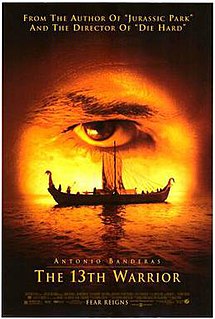
Movie review: The Thirteenth Warriror by John McTiernan


Directed by John McTiernan
Release date: 1999
based on the novel Eaters of the Dead
by Michael Crichton

Genre: historical (?) fiction action film
Cast:
Vladimir Kulich as Buliwyf
Antonio Banderas as Ahmad ibn Fadlan
Omar Sharif as Melchisidek
Diane Venora as Queen Weilew
Clive Russell as Helfdane

Synopsis:

AD 922. Ahmed ibn Fadlan is a court poet to the Caliph of Baghdad—until his amorous encounter with the wife of an influential noble gets him exiled as an "ambassador" to northern barbarians. Traveling with Melchisidek, his caravan is saved from Mongol-Tatar raiders by the appearance of Norsemen. Taking refuge at their settlement on the Volga river, communications are established through Melchisidek and Herger, a Norseman who speaks Vulgar Latin. Ahmed and Melchisidek are in time to witness the fight, which establishes Buliwyf as heir apparent, followed by the Viking funeral of their dead king.

A youth enters the camp requesting Buliwyf's aid: his father's kingdom in the far north is under attack from an ancient evil so frightening that even the bravest warriors dare not name it. The "angel of death," an oracle, determines the mission will be successful if thirteen warriors go to face this danger—but the thirteenth must not be a Norseman. That's how Ahmed is recruited against his will and goes to a completely barbaric land to fight an unknown evil.

Ahmed learns Norse during their journey by listening intently to their conversations. He is looked down upon by the huge Norsemen, who mock his physical weakness and his small Arabian horse, but he earns a measure of respect by his fast learning of their language, his horsemanship, ingenuity, and ability to write.

Reaching King Hrothgar's kingdom, they confirm that their foe is indeed the ancient 'Wendol' - fiends who come with the mist to kill and eat human flesh. In a string of clashes, Buliwyf's band establishes that the Wendol are humanoid cannibals who appear as, live like, and identify with bears. While the group searches through a raided cabin they find a small, headless sculpture of a naked woman's torso, similar to Upper Paleolithic 'venus' figurines. Their numbers dwindling and their position all but indefensible, an ancient wisewoman of the village tells them to track the Wendol to their lair and destroy their leaders, the "Mother of the Wendol" and the war leader who wears "the horns of power".Will they manage to defeat far stronger and completely ruthless opponents? What sacrifice will it take?

My impressions:

I didn't want to watch this movie for a long time. Firstly I read some bad reviews; secondly it featured Mr. Banderas who is not my favourite actor to put it mildly. After a bit of encouragement from The Red Witch, though, I decided to give it a chance. After all it was loosely based on the Anglo-Saxon epic poem, "Beowulf" even if it came via one of Crichton's books, right? "Beowulf" demands some respect and gives hope. Combine it with the fact that I really have a soft spot for epic fantasy movies and here you go - the decision wasn't that dififcult to make. Imagine me watching the movie one rainy May evening. Watching and wondering. 

At first glance the movie was really ok - the atmosphere, the blond, muscled Norsemen, their less-than-hygienic customs, their disregard for death and brutality, the 'oddball' swarthy Arab boy trying to fit in. Still, after watching it I couldn't get over some obvious mistakes which made me think that there were no historians or archeologists, helping the director as consultants. I would sum it up this way: too much Crichton, too little real history.

It is true: the Arabs and Norsemen traded with one another and the contrast must have been interesting. However any history nerd might find out that Hrothgar was a king of Denmark whose chronology was roughly after AD 500. Ahmed ibn Fadlan, a real Arab explorer, flourished circa AD 922. Over 400 years of difference means those two men couldn't possibly have met at all. What's more Ahmed's Islamic faith itself did not exist until after AD 622, so Hrothgar's court could't have encountered any Muslims to begin with. Do you want some more? Here it goes.

On the map at the start of the film Baghdad is in the Caucasus between the Black Sea and the Caspian Sea. In reality it is more to the south west of there, on the Tigris River. It is really one of the silliest mistakes I spotted because so easily avoidable - it's enough to check any map. How hard can it be?

 Then our handsome Ahmed encounters a beautiful woman in the street, who is wearing a strange headscarf over the low part of her face. Not only is this clothing not opaque, which is forbidden to Muslim women wearing headscarfs, but it is a Yashmak, worn first by Turkish women only around 1840. And it is brilliant red - a colour no decent Muslim woman would wear publicly. Of course it shows off the pretty, dark eyes of our enchantress so I guess the director didn't think twice about anything as stupid as historical plausibility...

Finally one more jewel in this short collection: before the last fight, Ahmed Ibn Fahdlan invokes God by calling Him 'Father'. Muslims don't address God like this, only Christians do. And do not let me start on the strange and quite stereotypical demonization of the mother goddess - I found it particularly ignorant and wrong. A Celtic tribe with their painted faces, worshipping a female deity, are once again at least a thousand years out of place.

The actors, however, kept the film from becoming too stupid. The acting was much better than average for this sort of film. Dennis Storhøi enthusiasticly portrayed Ahmed's closest friend among the Norsemen, and Vladimir Kulich gave a quiet dignity to his performance as Buliwyf, the leader of the Thirteen. 

Final verdict:

The atmosphere was right, some scenes I really appreciated and enjoyed but overall...At its best (the final battle) , this came close to the beauty and grandeur of a Kurosawa epic - at its worst, however, it felt like a Python remake of The Vikings. Do not expect anything deeper and do not treat the adjective 'historic' too literaly and you'll be fine. Well, as fine as it is possible.

Friday, 28 June 2013

Review: Glow (Sky Chasers #1) by Amy Kathleen Ryan

Synopsis:

What if you were bound for a new world, about to pledge your life to someone you'd been promised to since birth, and one unexpected violent attack made survival—not love—the issue?

Out in the murky nebula lurks an unseen enemy: the New Horizon. On its way to populate a distant planet in the wake of Earth's collapse, the ship's crew has been unable to conceive a generation to continue its mission. They need young girls desperately, or their zealous leader's efforts will fail. Onboard their sister ship, the Empyrean, the unsuspecting families don't know an attack is being mounted that could claim the most important among them...

Fifteen-year-old Waverly is part of the first generation to be successfully conceived in deep space; she was born on the Empyrean, and the large farming vessel is all she knows. Her concerns are those of any teenager—until Kieran Alden proposes to her. The handsome captain-to-be has everything Waverly could ever want in a husband, and with the pressure to start having children, everyone is sure he's the best choice. Except for Waverly, who wants more from life than marriage—and is secretly intrigued by the shy, darkly brilliant Seth.

But when the Empyrean faces sudden attack by their assumed allies, they quickly find out that the enemies aren't all from the outside.


This wasn’t an easy read for me. Not only did real life constraints make it difficult for me to find the time to read but the writing itself didn’t exactly suck me in. Ryan’s writing is efficient and it gets the point across but she isn’t a wordsmith like Laini Taylor is. She’s a plotter, and that’s a skill that means more to me than pretty words.

If you’ve read the blurb you know there are two space ships carrying the last vestiges of the human race to a faraway place and that there are two teenagers in the middle of it all. The blurb also promises a love story or a triangle, but it’s hardly mentioned after the set up. It’s the process of growing up in an unlikely situation and learning to take responsibility for one’s actions that dominates the story. That and survival.

I’m not going to talk about the science simply because I decided not to think about it too hard. I’d never been able to finish reading the book had tried. Not that there is much scientific detail to bog down the tragedy of humanity, but there was enough for me to consider it unlikely. That applies both to the space travel as well as to the fertility solution especially considering they were fleeing an environmental catastrophe… I said I wouldn’t talk about it and I won’t. Instead let me introduce you to the main characters.

On the plus column there’s Waverly, an anti-Mary Sue and a very regular sixteen year old girl at the cusp of adulthood. Because of the mission she’s expected to marry and procreate, but she has her doubts. In a way, what was done to her should’ve been a blessing for her and her desire to choose for herself had she actually been given the opportunity. Because she’s still a child she still needs her mother, but because she’s almost an adult she also learns to take care of herself and others, even if there are mistakes made along the way.

On the minus column there’s Kieran. He’s intolerable know-all who goes through a very difficult journey to realise that maybe he doesn’t know it all after all. He too learns from his mistakes even if he’s not ready to face the slippery slope he’s drifted on.

You can invert the columns if you like but you can’t change what dominates them both: Religion. Christianity. The folly of knowing God’s will and imposing it on others. Or simple ambition, thirst for power. And the rejection of it.

Glow reads like a carefully constructed adventure story with each point of view delivering only a sliver of the bigger picture. Both Waverly’s and Kieran’s chapters are subjective to their situation and viewpoint, but it’s the use of third limited that allows the reader enough distance to see through the (obvious) manipulation. Ryan doesn’t shy away from showing flaws and gaping holes in morality in absolutely everyone. Each character is only acting and reacting based on their own experiences. Except when they’re not.

Apart from Waverly, Kieran, and Anne Mather—and you can challenge me on Anne Mather—all other characters are accessories and subject to the whims of the plotter. For example, Ryan tries to justify Seth’s behaviour after the kidnapping in couple of different ways but I didn’t find those reasons completely believable. And unless he gets his own chapters in the following books, I fear he’s doomed to remain a pawn in Waberly and Kieran’s game and the object of their mutual desire.

Glow isn’t an easy read because of its subject matter and real moral dilemmas but it is a book that makes you think. I wasn’t completely sold on the delivery, but I applaud the message.

This recommendation comes with a warning: Glow is the first book of Sky Chasers series of which only first two have been published. The third is expected to be published in 2014.

Thursday, 27 June 2013

Rameau's Review Archive: Counterpunch (Belonging #2) by Aleksandr Voinov

Originally posted on Goodreads on Feburary 8th 2013.

Synopsis:
Fight like a man, or die like a slave.

Brooklyn Marshall used to be a policeman in London, with a wife and a promising future ahead of him. Then he accidentally killed a rioter whose father was a Member of Parliament and had him convicted of murder. To ease the burden on the overcrowded prison system, Brooklyn was sold into slavery rather than incarcerated. Now, he's the "Mean Machine", a boxer on the slave prizefighting circuit, pummelling other slaves for the entertainment of freemen and being rented out for the sexual service of his wealthier fans.

When Nathaniel Bishop purchases Brooklyn's services for a night, it seems like any other assignation. But the pair form an unexpected bond that grows into something more. Brooklyn hesitates to call it "love"—such things do not exist between freemen and slaves—but when Nathaniel reveals that he wants to help get Brooklyn's conviction overturned, he dares to hope. Then, an accident in the ring sends Brooklyn on the run, jeopardizing everything he has worked so hard to achieve and sending him into the most important fight of all—the fight for freedom.


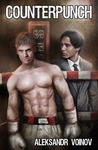
Counterpunch (Belonging, #2)Counterpunch by Aleksandr Voinov

This review can also be found on Book Girl of Mur-y-Castell-blog.

Imagine a modern Britain where at least two or three decades ago the politicians gave up on trying to keep up with the ever-growing prison population, chucked the fourth article of the Universal Declaration of Human rights, and started to commute life sentences into slavery. Now people are both born and condemned to it. And it’s not just in Britain, it’s all around the world.

Brooklyn Marshall was born free and worked hard to build a good life for himself. Then a simple mistake, an accident, at the job took all that away from him. He was made into an example and his life was no longer his own. Now he boxes because it’s better than getting shot at in a war zone, and he fucks and is fucked because he is told to. He is used. He’s chattel that can talk.

”You haven’t resigned yourself to slavery yet, have you?”
“No. And I never will.”


It’s cruel to give hope to a such man, but that’s exactly what Nathaniel Bishop does.

I’m not a fan of romanticising slavery, and I’m not a fan of any relationship that’s based on a severe imbalance of power, but I’m always curious to see if the author can make it work. If those obstacles of differing wealth, social status, and culture can be overcome believably. Realistically. Even in urban fantasy.

It works here because Brooklyn has never accepted his status as anything less than a human being. It works because both Brooklyn and Nathaniel recognise how wrong their situation is, and because both are fighters in their own way.

Much of the story focuses on the boxing—again, something I know nothing about—and how it reflects Brooklyn’s growth as a character. He’ll never see any of the winnings, but the fighting he does is for himself. He’s broken and beaten both in the ring and out, and he is affected by it, but he’s also a survivor. What doesn’t kill him makes him stronger, and the final fights show this vividly.

If I hadn’t struggled with the beginning of the story—it was good but not amazing—the ending would have earned Counterpunch its fifth star. Voinov opted out of the fanciful and kept it realistic.

P.S. The story includes triggers for <spoiler>    rape    </spoiler>.


Wednesday, 26 June 2013

Review: Blood of Victory by Alan Furst


Book info:

Form: e-book, pdf
Target audience: adults
Genre: historical spy thriller (WWII)

Synopsis:

Blood of Victory is a panoramic novel, moving between Istanbul, Bucharest, Paris, Sofia and the Black Sea coast, involving German Nazi officers,Turkish secret police, Russian chekhists, French aristocrats, Roumanian millionaires, Polish exiles and British spies.

The story begins on a Black Sea freighter in the winter of 1940. I.A. Serebin, half-Russian half-Jewish poet and journalist, is on his way to Istanbul to effect the release of a former lover. He is a member of the International Russian Union, an organization of Russians living abroad during the first part of World War II. The novel brings Serebin and his protector, police officer Ascher Levitch, into contact with a foreign espionage network centred in the Russian emigre communities of Paris, Berlin and Belgrade, as well as in Odessa itself. Serebin conspires and contrives to muck up Nazi access to the Romanian oil - a commodity they desperately need to win the war.The title refers to a statement at a 1918 oil conference: "Oil, the blood of the earth, in the time of war, has become the blood of victory." Very fitting. 

What I liked:

I jumped right in the middle of that series (and rather closer to the end than to the beginnnig as far as I know); still I had no problems whatsoever with the narration and the plot. In fact I found out the book belongs to a series only when I finished it! Though the outcome was generally predictable, the route to the final showdown was intriguing and told in a beautiful, engaging way.I truly admired Furst's ability to  portray so eloquently the atmosphere of insecurity and instability of the times, and to take the reader deeper into the shadows behind events than he or she may ever have been. There are scenes which make you want to slow down, pay attention and reread, time and again.

I have to admit the secondary characters stole the show a bit - especially the eastern Europeans in 'Blood' are marvelous characters, in particular two wild and wooly Serbian air force pilots and the Hungarian husband-and-wife team who run a tug up and down the Danube.

This main strength of Alan Furst's historical spy novels I suppose, is presenting real people, not imaginary master spies, the best, the fastest, the most efficient.  Instead  these are people with whom we can empathize, whose fears and wants sound like our own.

What I didn't like:

I admit that for most of the novel I wondered about the main protagonist - what made him tick, what were his goals and dreams, what motivated him to fight against the Germans and their powerful war machine to the point of endangering his life. I am sorry to say I didn't get the answer - not really. Seriebin seems to be partly frozen, wading through life as if in a coma; his emotions are stunted even if he goes to bed with beautiful Marie-Galante or he finds out that his former lover died of pneumonia.

I like books written in a "mysterious" and "dark" style but, in my humble opinion, it doesn't have to entail that most of the time the reader cannot figure out exactly what why the characters do what they do or even who they are. Complex and oblique? Not a problem.Just plain confusing? No, thanks.

Final verdict:

I think I am willing to give this series one more chance to charm me and get me addicted. Perhaps it was a mistake, starting in the middle? Anyway it's always a pleasure to read such a quality prose, even if the characters are a bit stolid and tepid.

Enhanced by Zemanta

Tuesday, 25 June 2013

Rameau's Review Archive: Skybound by Aleksandr Voinov

Originally posted on Goodreads January 13th 2013.

Synopsis:
Germany, 1945. The Third Reich is on its knees as Allied forces bomb Berlin to break the last resistance. Yet on an airfield near Berlin, the battle is far from over for a young mechanic, Felix, who’s attached to a squadron of fighter pilots. He’s especially attached to fighter ace Baldur Vogt, a man he admires and secretly loves. But there’s no room for love at the end of the world, never mind in Nazi Germany.

When Baldur narrowly cheats death, Felix pulls him from his plane, and the pilot makes his riskiest move yet. He takes a few days’ leave to recover, and he takes Felix with him. Away from the pressures of the airfield, their bond deepens, and Baldur shows Felix the kind of brotherhood he’d only ever dreamed of before.

But there’s no escaping the war, and when they return, Baldur joins the fray again in the skies over Berlin. As the Allies close in on the airfield where Felix waits for his lover, Baldur must face the truth that he is no longer the only one in mortal danger. 


SkyboundSkybound by Aleksandr Voinov

World War II fantasy love story between two men.

That’s the shortest summary I can think of for this lovely little novella. I don’t know enough about planes and I’ve mostly forgotten the details of war I learned on my history lessons to really gripe about the historical accuracy, but the weekend holiday, the family gamekeeper connections, and the ending did stretch my suspend disbelief abilities. That’s why there’s the word fantasy in my nine word summary.

And as the story didn’t wow me, three stars.


Monday, 24 June 2013

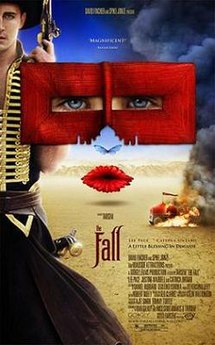
Movie review: The Fall by Tarsem Singh


Directed by Tarsem Singh
Release date: 2006

Cast:
 Roy Walker the stuntman - Lee Pace
Alexandria - Cantinca Untaru
Nurse Evelyn - Justine Waddell
Sinclair / Governor Odious -Daniel Caltagirone  

1915, the dawn of Hollywood. Roy, a movie stuntman, was gravely injured by an on-set mishap involving a horsebacked train-trestle tumble. Now he languishes in an LA hospital. He's become paraplegic, his beloved has broken his heart so he is deeply depressed and wants to commit a suicide. In order to get hold of a lethal dose of morphine he unspools tall tales to a five-year-old orphan girl called Alexandria from another ward. These two share with us the images they conjure up in their minds' eye – huge vistas, storybook heroism and colours so vivid they seem unreal. But of course every tale must reach its conclusion. Will it be Roy's untimely death? Will  Alexandria manage to save him from his demons, pulling him out of his slump ?

What I liked:

This movie is like candy to the eyes. Profiting from jaw-dropping Indian locations, the film dazzles like few others. Small wonder - it was shot in over 20 countries and its commitment to the wonders of the real world is refreshing.It can be actually called a 'two films in one' combo as the narration is divided into several threads. It is also very original, featuring animated sequences, waterborne pachyderms (but hey, the elephants really can swim!), and a drolly humorous imagining of a monkey-conversant Charles Darwin who is wearing a coat (?) worth an exotic parrot. And a bowler hat (see the pic on the left).
Crammed with vivid images of deserts, palaces, magical reefs,  historical figures (also Alexander the Great drops by) and famous landmarks (blink and you'll miss the Blue City in Rajastan or the Eiffel Tower or the Taj Mahal or the Statue of Liberty or the pyramids or the Great Wall), it comes down to earth long enough to establish a connection between two unlikely pals: a little unaffected but spunky girl and a young, disillusioned man, suffering from classic depression.

The power of imagination is the greatest asset of this movie. The year is 1915, but with Roy sharing stories as seductively as Scheherezade, the pair can be anywhere/anytime: jumping into the ring with Roman gladiators, matching wits with an ancient conqueror, battling the evil Governor Odious or transforming themselves into the Black Bandit and his tiny daughter in matching outfits of black and gold.Their story seems to include tall tales of Zorro, Ali Baba and Pecos Bill rolled into one. It was a fun ride - I appreciated evrey minute of it! 

What I didn't like:

Once you’ve been dazzled, that’s it. The pacing dragged after a while and the clichéd tussle between childhood innocence and adult disillusionment can only go one way. The story did lack some depths, being a bit too thin for adults and a bit too dark for kids.While every frame looked drop-dead gorgeous, Tarsem struggled to string them together in a logic way. The feature which disturbed me the most was the fact that there was no overriding tone to this film, which jumped from slapstick comedy to travelogue documentary to wrenching drama. It seems there was no real sense of suspense in the plot and the ending hardly provided any lasting conclusion because we weren't shown whether Alexandria's version of events was true or false.

Final verdict:

A treat in a static kind of way - visually superb but with a shallow story at its core. Still one of the most original movies I've seen this year.You might want to see it for no other reason than because it exists.

Enhanced by Zemanta

Saturday, 22 June 2013

Review: Among the Living (PsyCop 01) by Jordan Castillo Price


Book info:Form: pdf e-book
Genre: urban fantasy/paranormal m/m romance/crime story
Target audience: adults

Synopsis (from Goodreads):

Victor Bayne, the psychic half of a PsyCop team, is a gay medium who’s more concerned with flying under the radar than in making waves. He hooks up with handsome Jacob Marks, a non-psychic (or “Stiff”) from an adjacent precinct at his ex-partner’s retirement party and it seems like his dubious luck has taken a turn for the better. But then a serial killer surfaces who can change his appearance to match any witness’ idea of the world’s hottest guy.

Solving murders is a snap when you can ask the victims whodunit, but this killer’s not leaving any spirits behind. What's wrong?

What I liked:

I am not a fan of romance. I am definitely not a fan of m/m paranormal romance. My first impression was I wasn't going to like it. Vic hops on the first page higher than a kite and not ashamed or worried about it (as he is officially allowed to take drugs). Marks, Vic's crush, seems at first a bit too power-crazy and domineering for my taste, not to mention the fact that he is a gym rat through and through. I still ended up liking this novel quite a lot, all things considered. Why?

 Firstly it was an original idea, to present psychics not as shadowy charlatans they normally are (my skewed opinion of course) but as rare professionals whose talents are much sought-after by different government agencies, police and intelligence services among them. Accordingly Victor Bayne is a PsyCop, working with the local Chicago police force, with the ability to see and communicate with the dead. Imagine that: he arrives at a crime scene and he can actually see and sometimes even talk with the victim. He can't do anything else but his brains and intelligence make him more than just a level 5 medium. Detective Bayne also investigates and solves crimes - quite a nice surprise.

Apart from that Victor has one of the most fascinating narrative voices I've met recently.He's been through a lot, firstly diagnosed as schisophrenic and institutionalized, then closed in Camp Hell, where his unusual skills were supposed to be honed and developped and where he suffered mental and physical abuse. It left him scarred, perhaps for life. Now he is not bothered by his flaws and moderately interested in what happens around him if he's not involved. He keeps himself to himself. He is raw honest and not ashamed of practically anything = a flawed hero I like. And of course he has his secrets, not to be revealed to anyone, among them the true scope of his possibilities.

He is paired with Jacob Marks, "a big, strapping guy with a deep voice and a piercing gaze that could nail you to the wall." It is evident what those two see in each other: Vic, emotionally unstable and physically weaker, is looking for protection against the ugly world around him. Jacob admires Vic's skills when it comes to the souls of the departed, even though he is the elegant, smart and fitness-club-poster muscled one. Their love story started a bit too suddenly for me (but I suppose it will be explained in more detail later) but then it was surprisingly sweet and steamy for an m/m romance arc. Yes, the sex is rather prominent but the book actually has an interesting plot as well so I became a very tollerant and patient reader all of a sudden.

Finally let me say that I liked Lisa Guttierez - an  interesting albeit secondary character with an unusual gift. I do hope to meet her again.

What I didn't like:

My slight disappointment with this one was the showdown. Spoiler, highlight to read: so there is that shape-changing incubus which explodes, end of the story. That’s it? Really? That's all you've got? Oh, right…still a little anti-climactic. I wish there was a little more world building as well but I keep in mind the fact that it is just a beginning of a series so there is some hope. Let me also add that the sex scenes sometimes bordered on too descriptive, even gratuitous, but perhaps it's just me.

Final verdict:

There is so much scope for this author to build on.I have a feeling that if I continue with the series that Jacob and Vic will grow on me...considering that I really do like flawed characters and urban fantasy, even if it comes with m/m flavour.

Thursday, 20 June 2013

Rameau's Review Archive: Rakkautta rivien välissä (Past Secrets) by Cathy Kelly

Rameau's Ramblings: I read the Finnish translation of Past Secrets and reviewed it on July 6th 2011

Synopsis: 
They all hide secrets that won't go away....

From the outside, the welcoming, garden-adorned houses of Summer Street are the picture of Irish charm. But on the inside, unexpected and heartbreaking secrets swirl. At house number thirty-two, hardworking, single-mother Faye Reid conceals the truth about her marriage from her fiery daughter, Amber. But Amber, a budding artist, also hides something from her all-too-trusting mother: a relationship with a rock star hopeful for whom she plans to throw away her future. And at number forty-eight, Maggie Maguire arrives at her childhood home to help her sick mother, a welcome distraction from the life she left behind and the startling secret she's hiding -- from herself.

And only become harder to keep...

At thirty-four Summer Street, wise and kind Christie Devlin has the remarkable ability to see into the lives and hearts of others -- and may have the answers when her neighbors' carefully hidden secrets bubble to the surface. But when Christie's own past comes back to haunt her -- posing a threat to her picture-perfect marriage -- this time the answers aren't as clear.

Rakkautta rivien välissäRakkautta rivien välissä by Cathy Kelly


I honestly don't have a clue why I finished reading this one. Except that the paperback was lying on my desk for weeks and I needed something safe (as in I wasn't risking my Kindle) to read while travelling. I was expecting some kind of romance novel maybe with a bit more mature and realistic approach and that's about as much as I got.

What I didn't expect were three different novels in one about three different characters I never got the chance to like or care about. The only connecting thread was the name of the street and everything else promised in the first third of the book. The writing was perfunctory and so was the editing, apparently, because that's the only explanation I can think of for reading about someone picking up the phone and getting to the dialogue only a page later. Too often the author would go down these cul-de-sacs to explain something that had happened earlier instead of getting to the point.

The characters got their happy ending and while I can see the logic in the pats they took to get there, I never cared one bit.

Unless you're a devoted fan of the author, I'd give this one a miss.


Movie review: Compliance directed by Craig Zobel


Written and directed by Craig Zobel


Cast:
Sandra - Ann Dowd 

Becky - Dreama Walker

'Police Officer' Daniels - Pat Healy

Kevin- Phillip Ettinger


Synopsis:

A very busy fast food joint, somewhere in one of the unnamed towns of the USA. The manager, a middle-aged woman called Sandra, is having a really bad day: due to a screw-up by her underlings, almost $1,500 worth of bacon has been ruined, and she is now conscious of needing some extra effort to please her bosses. All of a sudden she gets a call from a cool, authoritative man who identifies himself as Officer Daniels; he claims one of her employees, a pretty twenty-something blonde called Becky working on the till, has stolen some money from a customer's bag.

Very distressed and very busy, Sandra more or less meekly complies with every request of that man, although they are just talking on the phone. Afer all he wants her to avoid the worst - an unnecessary delay and scandal, tarnishing the reputation of the whole joint and herself as an efficient manager. First she searches Becky's bag, then she strip-searches the girl and keeps her almost naked in the back office, under the 'surveillance' of several men. Becky is to be isolated, effectively imprisoned and helpless until the squad car arrives. The results of Sandra's decisions are disastrous. Soon most of the staff are involved in demeaning, humiliating and compromising activities. How will it end?

My impressions 

This chilling film, written and directed by Craig Zobel, is based closely on the true story of a serial phone-prankster sociopath in the US who, for a decade, got away with a bizarre repeated hoax. His daring escalated and in 2004 he brought off his masterstroke of insidious evil. The con trick was a very sadistic demonstration of the weakness and suggestibility of human nature, more devastating than anything in the well-known Stanford and Milgram experiments (testing individuals' response to authority in the 60s of 20th century) because real lives were wrecked.

From different optical illusions like Escher’s impossible labyrinths to unsolicited emails from rich and generous African officials who offer us a fortune for a very small favour, common sense has us hard-wired to reject the implausible. We should be able to do it in our best interest. Unfortunately sometimes we fail. Believe me, it is a movie which will drive a cruel punch to your gut far more effectively than any thriller or slasher because it will make you ask yourself: what would I do in such a situation? It is a cold, hard, shrewd film: satire with a drop of cyanide. The set and decorations match that : filth and grease set the scene for human sliminess.

What Compliance shows, however, is how very important it is that "Officer Daniels" targets a fast food chain. A fast food joint is a place to lower your guard as well as your standards. Here is where the real degradation can flourish because a chain is always conscious of a menacing corporate authority somewhere above them: branch managers, regional managers, people who might only reveal themselves as a voice on the phone. Obedience and badly suppressed fear are the order of the day, especially on the unthinkable subject of hurting your milking cow, a customer.  Relinquishing your free will and simply going with the flow is part of the process for all concerned.  So when some brazen authority figure on the phone knocks everyone with some new situation, submitting is the natural way to react. Your inner voice might nag you, suggesting that something is very wrong and yet at any time, in any period, when people supposedly in authority tell us what to do – more often than not we do it. Without thinking about the consequences. Without thinking at all.

One weakness of this low-budget film is that the characters — though realistically acted — are a bit too shallow and generic. It’s also a mistake, in my opinion, to keep cutting away to the prankster but without showing his inner self. I WANTED to know what made him tick and my questions weren't answered - not really. I also have to say  it seemed to me that Zobel didn’t sell the idea, just the outrage: The more indignities and violations Becky endured at the hands of people who were supposed to be her friends and co-workers, the more it felt like a hollow provocation. As things went from bad to horrible, I got the urge to walk into that back room where Becky was being interrogated and start yelling, “What’s wrong with you people? Are you a bunch of puppets? Switch on your brains! Take a moment and call somebody, like the actual freaking police!”

Final verdict:

A competently crafted film, telling a very chilly story - undoubtedly one of the toughest sits of the movie year 2012. Still sometimes it is good to be reminded how we are programmed to do things that go against our natural instincts as long as we believe we have the law on our side.


Tuesday, 18 June 2013

Rameau's Review Archive: Divergent by Veronica Roth

Rameau's Ramblings: Those were the days. Originally posted on Goodreads on October 24th 2011.

Synopsis:
In Beatrice Prior's dystopian Chicago, society is divided into five factions, each dedicated to the cultivation of a particular virtue--Candor (the honest), Abnegation (the selfless), Dauntless (the brave), Amity (the peaceful), and Erudite (the intelligent). On an appointed day of every year, all sixteen-year-olds must select the faction to which they will devote the rest of their lives. For Beatrice, the decision is between staying with her family and being who she really is--she can't have both. So she makes a choice that surprises everyone, including herself.

During the highly competitive initiation that follows, Beatrice renames herself Tris and struggles to determine who her friends really are--and where, exactly, a romance with a sometimes fascinating, sometimes infuriating boy fits into the life she's chosen. But Tris also has a secret, one she's kept hidden from everyone because she's been warned it can mean death. And as she discovers a growing conflict that threatens to unravel her seemingly perfect society, she also learns that her secret might help her save those she loves . . . or it might destroy her.

Debut author Veronica Roth bursts onto the literary scene with the first book in the Divergent series--dystopian thrillers filled with electrifying decisions, heartbreaking betrayals, stunning consequences, and unexpected romance.


Divergent (Divergent, #1)Divergent by Veronica Roth

This is one of those reviews that's going to earn me a bad name for going against every single review for this book on my timeline. I know I'm fixating on the smallest thing, but that's how my mind works. I simply can't help it. I have to be painfully honest about this.

It's bad when you can't get past the first page without serious prompting from friends and a fanfic high, isn't it? And it's not because Roth can't write, she absolutely can, beautifully and enticingly once you get going. It's because I made the fundamental mistake of looking for sense where there was none.

It was the hair.

I'm not spoiling anything because this all happens right at the beginning of chapter one.

I truly couldn't get past the hair. What's the point of cutting her hair every three months, four times a year, if it's still long enough to be tied on a knot? It doesn't matter how long the hair is on the knot as long as it's long enough to make one. Split ends? They're Abnegations, supposed to veer towards selflessness, they're not supposed to notice or care. Appearances aren't supposed to matter to Abnegations. Even their food is plain.

The scene was about the mother taking care of her daughter, you tell me. It's still vanity and an indication of the lives modern city women lead, if this is what they consider normal.

I have long hair which is often tied on a knot. I get it cut or trimmed twice a year, at most. More often, if I want to keep my chemically induced curls, but that would be considered flaunting and I wouldn't fit in Abnegation then.

Speaking of which, I wouldn't fit in any of the factions this society is divided in. Not even the rogue Divergent faction. That's how artificial the setting is and that is how unbelievable it is to me.

There's no way this kind of society could spring from the ashes of war ravaged earth. I don't buy it for a second. And with that crumbles everything beautiful and true the author tried to convey. The love and loyalty? I simply didn't care.

But if you do, if you find yourself swept away by the futile and the pretty, it is an entertaining novel on a certain superficial level. I'm just sad I couldn't find that level when I started reading this book.

No, wait. I'm not sorry. I'm more complicated a person than that and that's the way I like it.

Factionless, out.


Monday, 17 June 2013

Review: A Short Story of Nuclear Folly by Rudolf Herzog


Book info:
Form: pdf e-book
Genre: non-fiction
Target audience: everybody interested in the history of nuclear materials and their usage
Translated by Jefferson Chase.


It's a second opinion; the first review, written by my fair Rameau who also lent me a copy of that book (mwah! thanks!), can be read here.

Synopsis:

When the physicist discovered the way how to use the process of fission in practice the humankind entered a truly Faustian bargain. On the one hand we were promised an unending source of energy and also some quite ingenious nuclear-powered machines. On the other hand we were given a constant threat that the world as we know it might cease to exist in a blink of the eye.

It didn't exactly help that the researchg was conducted with the WWII in the background. No matter whether the nuclear military tests have been performed in the East or in the West, by ruthless Stalin generals or the American ones, one thing repeats itself with a nauseated frequency: an utter disregard for the protection of the environment and, linked to that, the life and well-being of ordinary people, be them soldiers or civilians or both. Corners have been cut in safety because it was less expensive than…what exactly? Human life? Wildlife? The future of next generations? In fact this book can also be called “A Short Story of A Surprising Lack of Imagination”.
An induced nuclear fission event involving ura...
An induced nuclear fission event involving uranium-235 (Photo credit: Wikipedia)

What I liked:

If you think the topic is a bit heavy and this book should interest only nuclear scientists, historians and students, think again. Mr. Herzog did what he could to make his narration factual, colourful and dynamic at the same time. In my opinion he succeeded, presenting even those strictly technical issues in such a way that they can be understood – and enjoyed- by an ordinary reader. Personally I was able to read the book during three evenings (during a rather busy period of time, mind you) and it kept me interested most of the time. It also features great photographs, which can help you visualizing those exotic Kazakhstan steppes or Utah deserts. A preachy bit of edutainment? Perhaps yes, but of the highest quality – definitely the author not only knows what he is talking about but also he can make his narration compelling.

An example and a direct quote describing the situation after one of American nuclear explosions:

“A radioactive cloud drifted off toward St. George, 270 kilometers away from Ground Zero. For several hours, unsuspecting residents were showered with radiation. Many of the 5,000 “downwinders” who populated the town would later develop cancer—a late result of Harry’s fallout. Yet the authorities rejected the idea that the high levels of radioactivity in Utah could have anything to do with atomic tests in Nevada. (…) 
There is absolutely no doubt that Hughes knew about the potentially lethal effects of radiation exposure. He had co-financed a 1953 film, Split Second, that had been set in a nuclear testing range. The director of that film was none other than Dick Powell. Nonetheless, the two men sent their team out into the gleaming sands of the valley. Five thousand Indian extras were brought in for the monumental battle scenes, 1,000 horses galloped across the 120-degree heat of the landscape, and dozens of aspiring starlets hired to play concubines strolled around half-naked, fulfilling male fantasies.” 


In times when some irresponsible scientists have taken nuclear reactors and batteries with them wherever they went, be it to the bottom of the sea or to the peaks of the highest mountains you can never be overly concerned of what is happening in your backyard or closest neighbourhood. There is complacency and irresponsibility everywhere, including Europe, Japan and the United States and not mentioning the Middle East and Africa, creating a host of ethical problems.

No matter whether you like it or not, there is no escape from nuclear power. We will need it to appease our increasing appetites for energy the dwindling coal-seams or crude oil reserves cannot satisfy. That’s why such books are needed and should be read because they prove another obvious truth: you can’t trust people who are involved with the nuclear fission. Don’t delude yourself – they won’t take care of you and the environment, no matter who they are and what government or/and organization they represent. Yes, nuclear chain reactions release extremely radioactive fission by-products but I admit after reading this book I consider that issue to be actually a lesser challenge than the responsibility of people, using the nuclear power. So far we have been moderately lucky but how to create a workable long-term solution? You will be left with this question and more and no, it won’t make the outlook less black. Still it will make it real – and it is just a tip of the iceberg.

What I didn’t like:

I found some annoying typos in the text, numerous enough to be noticed even by a casual reader. While I don’t blame the author for them (I read the translated English version, not the German original) the editor and proof-reader should have been more thorough.

I also have to admit the last chapter was a bit less interesting and somewhat worse when it comes to the style than the rest of the book.

Final verdict:

A very good non-fiction position which actually taught me a lot. Highly recommendable – it will broaden your horizons while keeping you entertained. Still I warn you – after the lecture you might be a bit depressed.
Enhanced by Zemanta

Saturday, 15 June 2013

Review: After Math (Off the Subject 01) by Denise Grover Swank

Synopsis (from Goodreads):

Scarlett Goodwin’s world is divided into Before and After.

Before she agreed to tutor Tucker Price, college junior Scarlett was introvert, struggling with her social anxiety and determined to not end up living in a trailer park like her mother and her younger sister. A mathematics major, she goes to her classes, to her job in the tutoring lab, and then hides in the apartment she shares with her friend, Caroline.

After junior Tucker Price, Southern University’s star soccer player enters the equation, her carefully plotted life is thrown off its axis. Tucker’s failing his required College Algebra class. With his eligibility is at risk, the university chancellor dangles an expensive piece of computer software for the math department if Scarlett agrees to privately tutor him.Tucker’s bad boy, womanizer reputation makes Scarlett wary of any contact, let alone spending several hours a week in close proximity.

But from her first encounter, she realizes Tucker isn’t the person everyone else sees. He carries a mountain of secrets which she suspects hold the reason to his self-destructive behavior. But the deeper she delves into the cause of his pain, the deeper she gets sucked into his chaos. Will Scarlett find the happiness she’s looking for, or will she be caught in Tucker’s aftermath?


My impressions:

I honestly swear I am up to no good. Yes, my friends, I've sinned again - one moment of weakness and here you are: I went to Lucimazon (anathema sit!) and bought a New Adult novel just because I was curious and it cost me merely one US dollar. Then, as if I had no better positions on my TBR list, I started to read it. You can guess the outcome - the book was not entirely a hit, featuring some of less pleasant NA characteristic traits. Oh well. As a form of atonement I decided to write a review.

First of all let me tell you that I found the blurb interesting enough and the book started out with a bit of potential, I liked meeting a character which suffered from social anxiety, I appreciated the fact that she liked math and using it she was able to build protective boundaries around herself.

 Still it was surprising that, for an advanced math college student, Scarlett knew pretty little. I got a distinct impression that the author didn't feel completely comfortable around that topic - we were never told what branch of maths was the closest to Scarlett's heart, what kind of math problems she liked solving the most, who was her favourite mathematician and/or theory and why. Even while we saw her tutoring Tucker, we never heard her explaining things to him, reasoning or elaborating on this or that problem - not really. It sounded especially spurious if you compare those scenes to the ones with Tucker teaching Scarlett the basics of running - those lessons I found far more believable and concrete. After a while it started to bother me that Scarlett never thought and spoke like avid mathematicians do.

Then there was that strange 'second boyfriend' of Scarlett, Daniel and her 'bff" Caroline. I really didn't understand why such  characters were featured at all - they didn't contribute anything to the story. Daniel's only function consisted of making Tucker jealous from time to time and Scarlett - embarassed. Caroline was there to make Scarlett go out, attend some parties and then shake her head and comment on her love life. They were like two cardboard props, nothing else, soon discarded and forgotten. Oh wait, they may be used in other parts of the series...if you actually care about them. I admit I don't.

The pace of the narration was nice but a bit predictable, so typical for all NA books I've read so far. The constant roundabout of: "they meet because they are forced to do so, they speak a bit, they fall in love, they speak more, they go to bed, they quarrel, they go to bed, they quarrel and make up and go to bed" is really anything but original. Funny thing, the narrative voice of Tucker, a badass football rising star, sounded sometimes so very close to a narrative voice of a girl; mind you the book is told in 1st limited person, from Scarlett's POV - weird indeed. A positive remark - Tucker was not a controlling, overbearing jerk. He was just a jerk. Still, with NA books, you should be thankful for small graces.

Finally let me add something about that little note from the author you might find at the end of this and many other books as well. Here is the direct quote:

"If you enjoyed AFTER MATH please consider leaving a review and recommending it to your friends."

Such a short, innocent sentence and somehow it can always make me more or less annoyed, pressing the wrong set of buttons. In my view Ms. Grover Swank (or any other author who includes it) hereby informs her customers and readers that she enjoys hearing only good opinion about the novel in question and if somebody has any negative feedback, no matter whether the critique is deserved or not, they should shut up and disappear from the universe...Excuse me? Are you really an adult writer?

Correct me if I am mistaken but it seems that such authors want to create a protective circle of mutual appreciation, full of starry-eyed fans, around their less-than-averagely-good work (my skewed opinion only of course but a good novel would defend itself, right?) so no unpleasantness can permeate inside and reach their sensitive ears. How very Young Adult of you. With the emphasis on 'Young'.

No final verdict this time - I don't feel it is necessary.
Enhanced by Zemanta

Thursday, 13 June 2013

Rameau's Review Archive: Never Let Me Go by Kazuo Ishiguro

Rameau's Ramblings: This is from when I'd just started reviewing books properly and putting some thought into it. If you can call it that. Originally posted on Goodreads on April 26th 2011. 
Oh, and look at that. This is a


Synopsis: 
From the acclaimed author of The Remains of the Day and When We Were Orphans, a moving new novel that subtly reimagines our world and time in a haunting story of friendship and love.

As a child, Kathy – now thirty-one years old – lived at Hailsham, a private school in the scenic English countryside where the children were sheltered from the outside world, brought up to believe that they were special and that their well-being was crucial not only for themselves but for the society they would eventually enter. Kathy had long ago put this idyllic past behind her, but when two of her Hailsham friends come back into her life, she stops resisting the pull of memory.

And so, as her friendship with Ruth is rekindled, and as the feelings that long ago fueled her adolescent crush on Tommy begin to deepen into love, Kathy recalls their years at Hailsham. She describes happy scenes of boys and girls growing up together, unperturbed – even comforted – by their isolation. But she describes other scenes as well: of discord and misunderstanding that hint at a dark secret behind Hailsham’s nurturing facade. With the dawning clarity of hindsight, the three friends are compelled to face the truth about their childhood–and about their lives now.

A tale of deceptive simplicity, Never Let Me Go slowly reveals an extraordinary emotional depth and resonance – and takes its place among Kazuo Ishiguro’s finest work.


Never Let Me GoNever Let Me Go by Kazuo Ishiguro


There's this thing I like to call the Eternal Sunshine of the Spotless Mind-effect. Some tie it to Inception instead, but for me that would oversimplifying things. Regardless what you call it, the basic idea is, you either get it or you don't.

However, in this case, it's difficult to get anything in the absence of substance.

The average rating of this book makes me think people are afraid to admit that even a revered author can sometimes write a book worth less than the paper it's printed on. And with the current electricity prices, the kindle edition is plain old robbery.

The writing is apathetic and detached making connecting with the characters impossible, which is very bad for a novel that's supposed to be character driven. It certainly isn't a good sign when the most unlikeable of the main three is the most relatable of the characters.

Kathy, the narrator, is insipid, back boneless shell of a human being who constantly bad mouths the supposed love of her life. The name calling, however, wasn't the only reason why the token romance of this book turned out be unconvincing and dubious at best.

In the end, it was the utter lack of emotion - and plot - that killed the story. I refuse to believe that anyone could be so dispassionate about sex with someone they claim to love, especially when the written description of their first sexual act nears rape - no consent was given or asked. That along with the decimation of the last plot strings downgraded this book from it's possible three star maximum to one.


Tuesday, 11 June 2013

Rameau's Review Archive: The Hunger Games trilogy by Suzanne Collins — 3 in 1

Originally posted on my long forgotten personal blog and imported to Goodreads in January 2011. Spoilers ahead.

Synopsis (for the first book):
Could you survive on your own, in the wild, with everyone out to make sure you don't live to see the morning? 

In the ruins of a place once known as North America lies the nation of Panem, a shining Capitol surrounded by twelve outlying districts. The Capitol is harsh and cruel and keeps the districts in line by forcing them all to send one boy and one girl between the ages of twelve and eighteen to participate in the annual Hunger Games, a fight to the death on live TV. 

Sixteen-year-old Katniss Everdeen, who lives alone with her mother and younger sister, regards it as a death sentence when she steps forward to take her sister’s place in the Games. But Katniss has been close to dead before—and survival, for her, is second nature. Without really meaning to, she becomes a contender. 

If she is to win, she will have to start making choices that will weigh survival against humanity and life against love.

The Hunger Games (The Hunger Games #1)The Hunger Games by Suzanne Collins


(My rating: 4 of 5 stars)

I liked it. I didn't hate Katniss which is always a big plus for me and I enjoyed the story as well.

I just wish this is where the story had ended.


Catching Fire (The Hunger Games, #2)Catching Fire by Suzanne Collins (My rating: 2 of 5 stars)
No character growth for Katniss what so ever. Okay, she was scarred by the events at the arena and yadda yadda yadda, but this was one of the times I was actually waiting for the triangle to kick off. I've heard people say that they couldn't wait to read the third book after finishing this one, but I was not one of those people. I just wanted to forget I'd ever read it. I should have done just that.


Mockingjay (The Hunger Games, #3)Mockingjay by Suzanne Collins

My rating: 1 of 5 stars

The book that ended the trilogy and could have saved the story ended up destroying everything I liked about the first book. The preachy tone couldn't be ignored any longer neither could the destruction of my favourite character, Gale. He should not have been equated with War and Peeta with Love. Katniss was a bitch that deserved to die a miserable death alone. That is if I could be bothered to care enough.

The worst, though, was that I could see it all coming and still I finished reading the book. Masochist that I am.

It's pretty safe to say that I won't be reading Suzanne Collins' work any more.