Showing posts with label steampunk. Show all posts

Friday, 5 July 2013

The Kingmakers (Vampire Empire #3) by Clay Griffith, Susan Griffith

Book info:
Form: pdf format, e-book
Genre: steampunk with vampires
Target audience: YA

Synopsis (from Goodreads):
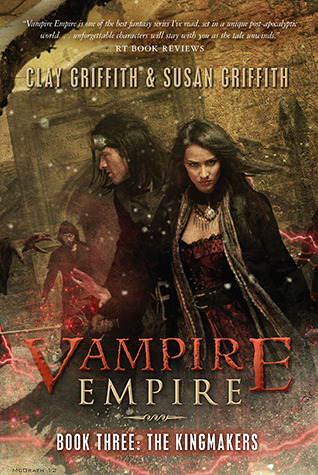
The epic Vampire Empire trilogy rushes to a conclusion of honor and love, hatred and vengeance, sacrifice and loss. A war to the death. Empress Adele has launched a grand crusade against the vampire clans of the north. Prince Gareth, the vampire lord of Scotland, serves the Equatorian cause, fighting in the bloody trenches of France in his guise as the dashing Greyfriar. But the human armies are pinned down, battered by harsh weather and merciless attacks from vampire packs. To even the odds, Adele unleashes the power of her geomancy, a fearsome weapon capable of slaughtering vampires in vast numbers. However, the power she expends threatens her own life even as she questions the morality of such a weapon. As the war turns ever bloodier and Adele is threatened by betrayal, Gareth faces a terrible choice. Their only hope is a desperate strike against the lord of the vampire clans-Gareth's brother, Cesare. It is a gamble that could win the war or signal the final days of the Greyfriar.

My impressions:

It wasn't a bad ending of a series but also one which left me a bit disappointed and strangely detached. I would call it an ending of lost potential. Perhaps it's been too long between this one and part 2. Who knows.

My first carping: a big epic showdown should be anything but slow. This one was slow. I expected battles, strategy and wartime mayhem, a whirlwind of activity I got pages and pages devoted to single battles, Adele’s angst over the Greyfriar and the difficulties in their relationship. Pages and pages of the Greyfriar’s own angst – about everything not exactly connected to the ongoing war. I think everything that happened and everything anyone felt in this book had to be accompanied by a rather long winded internal monologue, sometimes but not always switching to a dialogue.

Many of these scenes weren’t bad – like Gareth visiting the King of Paris (a nice scene but also one that ended up pretty irrelevant so hardly mattered in the end), or Gareth cooking for Adele. Adele re-uniting with Morgana. Adele talking with Sanah. Anhalt sparring with Senator Clark. Senator Clark’s war in the US. They were all good scenes, albeit overly written with too much monologue, but they were great in their own right for character development and exploration and just plain fun with this world and these people who I enjoy. But they weren’t relevant to the plot – if they were removed the ending would be exactly the same as it was with them. It did seem as if glue, holding the whole novel together, was too weak or simply forgotten.

Gareth was just a bore, there was nothing to him except for his love for Adele. Adele was supposed to mature and become a kick-ass empress which she did to some extend but also she could be surprisingly annoying. I didn't understand why she kept questioning whether she should use her powers to kill the vampires despite the fact that 1) they were evil, most of them 2) they were responsible for millions of deaths and planned even more slaughter 3) they wanted to enslave humanity 4) they did nothing, literally nothing to persuade her and other humans otherwise. I suppose her defense of the vampires was meant to make her seem forgiving and compassionate but it just made her look like a dumb empress who wore her heart on her sleeve permanently, being the one and only person with super powers around enamoured with a real VAMPIRE who happened to be a decent guy and love her back.

Never mind that the future of humanity was in her hands, never mind that humans were dropping dead. None of that mattered if it hurt her centuries old lover (?). Everything seemed to fall into place too easily. Adele reads some doodles and realizes she's the most powerful geomancer in the world at a time when all seems lost. A little too deus ex machina for my taste. All of the planning went nowhere, Adele saves the day and Gareth is immune to her geomancy now and they will be together and all ugly baddies who count are just killed, killed, killed. It served them right perhaps but it was also boring. No subtlety, no wits and no scheming. No compromises either.

Final verdict:

I expected this series to be better. I wanted this series to be better. Unfortunately I was a bit delusional about my expectations. I liked the first book the best, the second was weak and the last one was just so-so.

Monday, 22 October 2012

Review: The Girl in the Steel Corset by Kady Cross (Steampunk Chronicles #01)

Book info:
Form: pdf file
Genre: steampunk-flavoured romance/adventure
Target audience: YA

Synopsis:

1897, Victorian England.16-year-old Finley Jayne is convinced she’s a freak. No normal girl has a darker side that makes her capable of knocking out a full-grown man or throwing him across the room. Is that monster inside her an ally or her biggest enemy? How has she ended up like that?  Who knows. One thing is true – it is the only option left to Finley. Only Griffin King, a young peer of the realm, sees the magical darkness inside her as something good, something that means she’s special . . . that she’s one of “them”, a gang of freaks of nature or maybe people who’s just got to another evolution stage. Still difference is not always a good, acceptable thing especially when somebody equally gifted tries to use it to take over the whole country and maybe even the whole world.

What I liked:

It started like a YA novel full of great ideas, taken from different books. As Journey to the Centre of the Earth by Jules Verne and The Strange Case of Dr Jekyll and Mr Hyde by R.L. Stevenson are two of them (I read and liked them both) I decided to give it a try. Finley also seemed like a heroine with some spine – unfortunately she had to crash into Griffin King too soon and then her potential was somehow diminishing with every page. I was on board with the whole Jekyll/Hyde dichotomy and the battle for good and evil going on inside of her but it ended in no time.

Also the cover is very nice.

What I didn’t like:

My first carping is that, in my humble opinion, the author couldn’t decide how steampunky this novel should be. Ok, there are automatons, bionic people and other fantastic aether devices but they never get into the spotlight, not truly – that’s why I wouldn’t call this book ‘steampunk’, it just comes with a steampunk flavour. In real steampunk novels the love is always in the details– it’s not just about shoving in some wheels, engines and corsets, you have to create the entire world in all its depth and intricacies. Here random devices make appearances for no apparent reason as if the author was afraid she can bore her female readers with too many technical elements. Well, if you write about  kick-ass heroines and their female side-kicks who are also technical whizzes you surely must be aware such types exist in real life as well. So who is your real audience?

What’s more the scientific aspect hasn’t been researched well or rather it was mixed with the ordinary religious beliefs: correct me if I am mistaken but either there is a ‘spirit world’ with the souls of the departed (so human beings have a soul and there is God, Heaven, Hell etc) or there are just those particles of life, the Organites, found in the core of the Earth by Griffin’s father, which make it possible to cure all illnesses, enhance your natural talents and even resurrect freshly deceased if only applied in copious amounts by somebody skilled (so no soul is needed, right? No soul = no creator, just evolution). Either or. Meanwhile Ms Cross tries to sell us on both. Which is not exactly the best idea from my point of view.

My second remark: the plot and the narration style. The book was very predicable and a bit boring. The first crime the author committed is too much telling instead of showing. The next - a bland bunch of characters. A baddie starts as a big, strong, bogeyman and ends up a broken creature, almost hopelessly weak without any mechanical help. Finley’s little problem also is resolved with childish ease (I did expect it go far worse and somehow it didn’t); her dual nature seemed nothing else but a device which had to justify the fact she had two boyfriends. By the way if you have to have a duke in the book please, do your research, and call him something nice and probable, not Griffin King. ‘King’ sounds spurious even to teenage American readers and believe it or not, some of them know European history and peerage pretty well. I know, it might come as a surprise but still…

And here we hit my third major complaint: two love triangles would be bad enough in any YA book but here, additionally one element of the main triangle (Griffin-Finley-Jack), Jack Dandy was simply misconstrued. He was supposed to be that epitome of bad boy: dark, lean, handsome, ruthless, criminally-inclined, street-wise, mysterious, irresistible. Instead he was a sissy who danced around Finley like a well-trained circus poodle and never even dared to kiss her. We also weren’t told anything about his nefarious exploits which seemed a bit strange to me as well – such a big criminal mastermind and not even one juicy burglary? No fisticuffs? He seemed to exist just to mangle Queen’s English, buy Finley that gorgeous fancy dress and provide useful info to Griffin. Booooring.

Finally, imagine it or not, one of the major criminal mysteries (the identity of the killer of Felix, the rakish son of the employer of Finley, beaten to a pulp by her at the beginning because of a rape attempt) is left unresolved and even forgotten. No character mentions it, nobody wonders what happened to that obnoxious type and it seemed so important to all of them at first...

Final verdict:

I know it’s the first in a planned trilogy but on its own, “The Girl in the Steel Corset” felt like a novel half-done. I admit the ideas were great but it is also another example of a book which significant potential was sadly squandered. It was not the YA Steampunk entertainment I was hoping for and it made me definitely unwilling to continue the series.

Tuesday, 6 March 2012

Review: Timeless by Gail Carriger (Parasol Protectorate #05)


Form: e-book, Kindle edition
Genre: fantasy steampunk
Target audience: YA and adults who like such novels (like me)

Synopsis:

Lord Conall Maccon, the Alfa of London werewolf pack and his lovely perternatural wife, Alexia nee Tarabotti, are planning a visit to Egypt. They have to – a very old vampire queen from Alexandria, called Matakara, invited them along. If somebody like her bothers to send an invitation you simply can’t say ‘no’ – the consequences might be…well, bloody.

Matakara is especially interested in little Prudence, Alexia’s daughter and not without a good reason – the little girl can do more than she can say, especially using full sentences. In order to keep the real reason of their journey hidden, Alexia takes with herself her old friend Ivy Hisselpenny Tunstell with her lovely hubby, her twins and a part of their theatrical troupe. Ivy and Tunstell have a new play in their repertoire – a spectacular love story between a werewolf and a vampire queen. It fits only too well what will happen to them in Egypt…

What I liked:

Little Prudence and Biffy stole the show – they were two major highlights of this book. Prudence is not only a toddler who can change into a vampire and/or a werewolf, wreaking havoc and having a great time, she also hates baths and for a very good reason (I can’t tell, it’s a spoiler). Her parents and her foster parent, Lord Akeldama, are hardly a match for her - their hands are always full of this girl. A scary thought – Prudence will be a teenager soon. Speak about an ultimate parental challenge.

Biffy exceeded my wildest expectations – not only he managed to find his place in the pack (previously being rather more fond of vampires, I can’t tell more because it would be a spoiler) but also he found a new love interest and one of his abilities proved you shouldn’t judge a man by his cravat or by his waistcoat. I really appreciate such twists in fiction, especially when they are not entirely serious.

What’s more, I liked the setting of this one (Egypt) although I grieve to say it wasn’t explored to the full. More in the next section.

What I didn’t like:

It pains me to admit it but in my humble opinion the last installment of this series is also the weakest. It seems the author, who previously kept rather high writing standards, spoiling her readers mercilessly,  ran out of steam. On the one hand I do understand – it is the fifth Alexia novel after all, how many new things you can think of... On the other hand it is a pity – perhaps it would be better if the whole series was one-two books shorter.

First of all the steampunk factor, so deliciously explored in previous books, here is almost non-existent. An example: in the first part Alexia was attacked by deadly mechanical ladybugs and barely escaped. The whole scene was a hoot. Here the same ladybugs are nothing more than a toy for her two-year-old daughter (and some other equally childish adults as well). See the difference? Another example: in the first novel Alexia became a happy owner of a not very beautiful or stylish but otherwise extremely useful parasol. A very important accessory as it saved her life many times. In the last book her husband orders a substitute (as the first was destroyed) and Alexia uses it…once or twice – so barely at all, as if she didn’t need it anymore. Sad but true, substitutes never work.

Then Egypt. It is a perfect setting for such a fantasy steampunk novel: full of old ruins, mysterious monuments and intriguing secrets from the past. Our Alexia should have had plenty of fun there, right? Wrong. She gets dusty, goes up in a balloon and…she is thrown into the Nile. She sees the temple of Hatshepsut, half buried in the sand ( and very rightly so, it was excavated and restored only in the 20th century but still such a pity) and is promptly chased away. No pyramids, no sphinxes, just one old vampire queen and even she, the famous, horribly old, horribly scary Matakara, barely speaks or moves or kills. She dies. Kind of anticlimactic, you must admit.

Overall reading this one I felt a bit sad – it was supposed to be a glass of fine wine; unfortunately it tasted as if that wine was heavily diluted and then doctored a bit, sweetened and scented. Oh well, I’ve always knew ending a series is definitely more tricky than starting it.

I am also not a very big fan of the cover art. Why feature a sphinx or the pyramids if Alexia never gets close to them?

Final verdict:

If you liked the series like yours truly you will read the last installment anyway. Timeless wasn't very bad, especially compared to other books of this genre, but, compared to other Parasol Protectorate books I found it a bit wishy-washy.

Thursday, 22 September 2011

Mini review: Vampire Empire Book Two: The Rift Walker by Clay Griffith and Susan Griffith

Book info:

  • Paperback: 300 pages
  • Publisher: Pyr (September 6, 2011)
  • Language: English
  • ISBN-10: 1616145234
  • ISBN-13: 978-1616145231
  • Genre: steampunk, pulp action
  • Target audience: YA


Synopsis (from Goodreads):

Princess Adele struggles with a life of marriage and obligation as her Equatorian Empire and their American Republic allies stand on the brink of war against the vampire clans of the north. However, the alliance's horrific strategy for total victory drives Adele to abandon her duty and embark on a desperate quest to keep her nation from staining its hands with genocide. Reunited with her great love, the mysterious adventurer known to the world as the Greyfriar, Adele is pursued by her own people as well as her vengeful almost-husband, senator Clark who wants to be emperor at all costs. With the human alliance in disarrray, Prince Cesare, lord of the British vampire clan, seizes the initiative and strikes at the very heart of Equatoria.

As Adele labors to bring order to her world, she learns more about the strange powers she exhibited in the north. Her teacher, Mamoru, leads a secret cabal of geomancers who believe Adele is the one who can touch the vast power of the Earth that surges through ley lines and wells up at the rifts where the lines meet. These energies are the key to defeating the enemy of mankind, and if Princess Adele could ever bring this power under her command, she could be death to vampires. But such a victory will also cost the life of Adele's beloved Greyfriar.

The Rift Walker is the second book in a trilogy of high adventure and alternative history. Combining rousing pulp action with steampunk style, the Vampire Empire series brings epic politcal themes to life within a story of heartbreaking romance, sacrifice, and heroism.


What I liked:

Adele is getting more mature and she learns to make her own choices – always a good thing in any novel. Vampires change their tactics (ok, prince Cesare changes them to tell you the truth and he has some brilliant ideas despite being a monster so overall I warmed up to him despite his murder at the end) and make alliances previously unheard-of. Characters who were supposed to be white hats in the first part got gray hats or even black hats this time – I liked that very much, especially as it concerned some of court politicians. Good moves.

The world building was exquisite although this time we see more of Africa and less of Scotland or London. Still it was a nice trip, especially as it featured the Abu-Simbel temple of Ramsesses and Amun – I would love to visit that site myself. The steampunk factor was not as pronounced as in the first part but it was felt there nevertheless. Farenheit blades are great. ;D I would fancy one.

The plot was fast-paced with some really nice scenes (the meetings between Adele and senator Clark were actually my favourites), the narration smooth and interesting although not to the very end. Why not ? Read the next section to find out.

What I didn’t like:

The closer the plot drifted to those cheesy Zorro movies and indeed, pulp fiction, the less enjoyable it became to me. Rescuing Adele right from the altar at the last possible moment, right after vows? Oh dear, please, it was done to death; it’s enough to remind that fabulous scene from Shrek 01 where the Donkey flies through a big glass window (exactly like our Greyfriar) on a she-dragon (not exactly like Greyfriar who is a vampire and can fly on his own) and shouts: “I have a dragon and I won’t hesitate to use it!” As an ironic, tongue-in-cheek pastiche it worked perfectly well for me; as a serious, big, fat and romantic plot device – not at all. In fact, in my very humble opinion, it was an insult to Adele’s and Gareth’s intelligence and their ability of strategic planning – they could have orchestrated the whole kindnapping a lot better. 


Unfortunately after that scene everything went pretty much downhill. Greyfriar proves time and again that the South is not for vampires and the second part of this book is not for more demanding audience. It is heartbreaking to write it  but so I felt. Not even Flay who, next to Cesare, is indeed my favourite black character of this series (if you haven't read the first part - she is a powerful vampiress in love with Gareth and also a woman spurned by him), could rescue it. Not really. I also hated the fact that Gareth was so weak while travelling in the South. I liked him better while in Scotland.

What I found downright funny (beware: spoilers and some nasty PG remarks ahead – highlight and read at your own risk!):

Ok, so we have this big, teary romance between the princess and her vampiric beloved. They  missed each other terribly and they finally meet after a long time in extremely romantic circumstances – he saves her from being married to an American brute she doesn’t love, right? After that they run away together and spend a lot of time alone. Aaaaaaaaaaaaand...he kisses her. Only. Oh, wait, they also cuddle a bit on the same bed and yes, he treats her as his private emergency food storage so he drinks her blood. Still, nothing untoward passes between them because…well, the authors seem very inclined to tiptoeing around that issue as if it was one big hot piece of coal, to be treated with utmost care, preferably to be avoided completely. Honestly... I know it is an YA book but even in such novels these things are at least mentioned, if not vaguely described. At the very end Gareth is princess Adele’s official consort and still they only cuddle…and kiss…and cuddle some more... and drink deeply.
My conclusions? Gareth must be homosexual or a saint or he simply cannot perform. Maybe all these three are true who knowns...anyway I found it silly and spurious.Poor Adele. Poor series. Poor eunuch vampires. Sigh. Strangely enough this books are  written by a husband-and-wife team...
Final verdict:


A good YA novel but also, in my opinion, one definitely worse than the first part which I truly enjoyed.  I am still willing to read the third and the final one but I must admit I am a bit wary now. The Rift Walker fell a bit short of my expectations so I wonder what solutions the authors will chose to finish the series.


Abu Simbel Temple of Ramesses II. Taken by mys...Image via Wikipedia

Enhanced by Zemanta

Sunday, 10 July 2011

Summer mini review: Heartless by Gail Carriger (The Parasol Protectorate series 04)


Book info:

  • Mass Market Paperback: 400 pages
  • Publisher: Orbit; Original edition (June 28, 2011)
  • Language: English
  • ISBN-10: 0316127191
  • ISBN-13: 978-0316127196
  • Genre: paranormal fiction, romance, steampunk, 
  • Target audience: adults and not only...


Synopsis:

Alexia lady Maccon, nee Tarabotti, might be in her last months of  pregnancy but never indolent, inactive or bored. With a werewolf Alfa male for a husband and a single vampire extraordinaire for a best friend you can practically never have one  minute of peace. As if anybody would want one. 

An unknown ghost with short concentration span has just informed Alexia that somebody is plotting a regicide and certain vampires are still hell-bent on killing her unborn infant-inconvenience. To protect her unborn child she is going to do something unthinkable - let it be adopted even before it is born. And the happy foster parent will be... well, guess. :-)

One problem solved; now Alexia, still employed by Queen Victoria as a mujah, must do her utmost to prevent any regicide, especially that most likely a supernatural being is involved - more precisely a werewolf. The uncomfortable investigation will make her discover a lot about her husband's and her late father's past, always a dangerous thing when there are so many secrets to unveil...and so many sensitive toes to tread on. Prepare yourself for plenty of tea, treacle tart and some murderous teapots as well.

What I liked:

I don't try to conceal the fact that I am Gail Carriger's fan. Why I like her novels so much? Of course I might tell you that this book, like the previous ones, had very good plot with interesting twists and turns, a well-paced  narration which flows nicely, a strong, likeable heroine, a bevy of great secondary characters and so on. It would be all true but it wouldn’t make the whole series unique. So, what makes The Parasol Protectorate books really great and distinctly different from many other paranormal series? I tried to pinpoint some of the features in the list below:


  • The heroine is married and pregnant for the second book and still there is some well-balanced romance between her and her werewolf husband - go figure ;). No love triangle, no teenage angst, no third party involved.
  • The series is undoubtedly steampunk but without getting very violent or bloody or deadly serious. I would call it steampunk entertainment because it does entertain.
  • As I've already mentioned entertainment...the paranormal aspect is seasoned with a healthy dose of humour, that's why even vampires, ghosts and werewolves are palatable.
  • Generally Ms. Carriger's sense of humour appeals to me (which means I grin or even laugh like mad while reading her books)...forgive me if I repeat myself.
  • Comestibles like tea, treacle tart, sponge cakes and finger sandwiches make the book so incredibly appetizing to read that I get instantly hungry. Normally I am a poor eater so it is an advantage, no?
  • Secondary characters from previous parts are never forgotten; what’s more, they are also  given a chance to develop and become more and more three-dimensional with every part (I think here mainly but not only about Lord Akeldama, Madame Lefoux, Professor Lyall, Floote  and of course Alessandro Tarabotti, the long-deceased father of our dear Alexia; I can never get enough of him).
  • Finally Victorian London and its society is really nicely rendered here.
Quite a list, isn't it? Would you wish for anything more? Well, perhaps you would but it would be also rather foolish...;)

What I didn’t like:

I do admit that Madame Lefoux disappointed me a bit in this part with her mad scheme (a sensible woman and a scientist should have known better than resort to brute force even in very dramatic circumstances) and zombie porcupines never seemed half as funny as mechanical ladybirds, presented in part three but perhaps it’s only the old grumpy me.

Final verdict:

A lovely series with great steampunk accents which gets better and better. Definitely worth discovering and reading. What else could I say...I am looking forward to the next part – I’ve already pre-ordered it!


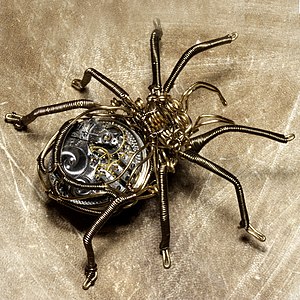
Steampunk Clockwork Spider Brass and Copper Wi...A mechanical spider via Wikipedia - I want one!


Enhanced by Zemanta

Wednesday, 6 July 2011

Mini summer review: The Strange Case of Finley Jayne (The Steampunk Chronicles) by Kady Cross

Book info:


Form: e-book, pdf
Genre: steampunk, adventure novella
Target audience: YA


Synopsis:

This novella is set in alternate-world London, late April 1897 and it features Finley Jayne, the heroine of other Kady Cross's book, The Girl in the Steel Corset. I suppose it is a prequel. I might be wrong.

Finley, a young maid, has just lost her job again – this time she dared to punch a governess who had mistreated a child in her presence. The punch was powerful enough to knock out some of  the governess's teeth. Being from a rather poor, working-class family Finley needs a new job badly. Surprisingly, right the very next day an offer presents itself in the person of a fashionable Lady Morton who seeks a lady companion for her youngest daughter, Phoebe. Lady Morton is aware of Finley’s problems and that fact doesn’t discourage her. Quite the opposite.

Phoebe Morton is betrothed to rich and much older Lord Vincent so why would she need a companion at all? Especially a companion who is not only known to defend children in the most unladylike manner but also doesn’t come from a good family? Of course Finley doesn’t refuse such an advantageous, well-paid offer. Soon enough her situation at the Mortons becomes even stranger. She is treated by both Lady Morton and Phoebe practically like a member of their family, not a servant - she is given her own, spacious room, they buy her some fashionable clothes. She goes with them to cafes and parties. Then she is asked to tell all and sundry that her name is Finley Bennet and she is Phoebe’s distant cousin from the country. What's really going on?

What I liked:

· Finley was a likeable character indeed – a girl you would like to befriend, honest, honourable and intelligent. Freakishly strong but still...rather nice.

· The narration flowed smoothly and was well-paced – in short it was an entertaining and short read, perfect for a summer afternoon.

· Chocolate features a lot in here and, as I adore eating it, reading about it and smelling it (preferably all these combined. ;-)) I was fully satisfied.


What I didn’t like:

· The author didn’t manage to persuade me that she really likes and knows steampunk. Mentioning automatons, mechanical horses, mad inventors and brains in viscous liquid is not enough to make your novel/novella steampunk. Not really.

· To tell you the truth the plot was predictable and not very original. From the very beginning we know Lord Vincent is up to no good (we are right) and poor Phoebe needs help (we are right again). We also get too many clues about the possible nature of the danger – the mystery was really too easy to solve.

· The world building I found a bit lacking (and nineteenth century London is such a nice place to write about!) but, after all, it was just a short novella.

Final verdict:

I enjoyed this one well enough to wish for The Girl in the Steel Corset, featuring the same heroine. Finley’s all secrets weren’t revealed here and she has just found another job - sounds interesting. I only hope a fully-fledged novel will be better when it comes to world-building.

Tuesday, 28 June 2011

Mini review: Whitechapel Gods by S.M. Peters

Book info:


Form: e-book, pdf format
Genre: Steampunk, horror, sci-fi
Target audience: adults (too much gore to qualify it as YA)


Synopsis:

Victorian London. The Whitechapel section has been turned into a mechanized, steam-driven horrific hell, cut off and ruled by two mysterious, mechanical god-like entities- Mama Engine and Grandfather Clock. They have a virtually undestructible army of minions at their disposal, composed of people whose hearts have been replaced with coal furnaces and nerves and veins - with copper wiring. In short people turned into machines.

The rest of populace had had enough but the first time they were too weak to prevail - some years have passed since the Great Uprising and everything seemingly returned to the old order. However a few brave veterans of the Uprising have formed their own new Resistance-and are gathering for another attack. John Scared schemes to usurp Grandfather Clock's power while Oliver Sumner and other revolutionaries look to overthrow both gods for the benefit of humanity. Both sides have discovered a secret weapon that may finally free them-or kill them all...who will prevail this time?

What I liked:

· Steampunk at its best – reeking of metal, soot, oil and coal, almost tangible in its mechanical passion and glory. Sometimes the creatures like clickrats sent shivers down my spine.

· Some compelling questions are asked about humanity and technology. Very well.

· The main characters, Olivier and Missy, I found rather likeable (but I am not sure whether it was more pity than anything else...)

· The cover I find intriguing and fitting.

What I didn’t like:

· I found the book a bit too grim to be read in the summer, too neurotic and unnerving. Sometimes I didn’t feel like continuing reading. I do think this is the most gore I've ever seen in any Steampunk novel; it got downright bloody at times. There was also too little sense of humour to make up for it.

· The prose, especially at the beginning, wasn’t flowing smoothly enough to draw you into the narration and keep you interested.

· Mr. S.M. Peters has a lot to say on religion, philosophy and the horrors of the mind but sometimes those fragments overshadow the main action and heroes. It took me forever to figure out that Oliver was indeed the central character in the story. Why? Whitechapel Gods for an action-packed book about an uprising tends to get a little too abstract, especially towards the end (after all drug-induced dreams and hallucinations are not something you expect in a steampunk book).

· Some heroes and villains were a bit too generic.


Final verdict:

 I like steampunk so this one I found still interesting - I must admit the world that S.M. Peters created here was original and a very well developed… I just wish it was a bit more cheerful. Definitely not a relaxing summer read.

Better luck next time I suppose - I am willing to try another book of this author but mainly because of his...

Enhanced by Zemanta

Monday, 27 December 2010

Review: Leviathan by Scott Westerfeld

Reading level: Young Adult
Hardcover: 448 pages
Publisher: Simon Pulse; First Edition edition (October 6, 2009)
Language: English
ISBN-10: 1416971734
Cover of Cover of Leviathan

ISBN-13: 978-1416971733
Genre: steampunk, adventure

I got a copy of this book courtesy of one of my friends (thanks Kasiul!) in a form of an e-book.

Synopsis:


The first novel of this series presents World War I as never seen before. The story begins in accordance with the historical facts: on June 28, 1914, Archduke Franz Ferdinand and his wife Sophie are assassinated, triggering a sequence of alliances that plunges the world into war. But that is where the similarity with history ends. After the assassination of his parents, Prince Aleksandar, their only child, must run for his life or he will be assassinated as well. The worst thing is that he is not aware of the danger. He is smuggled out of his palace by a small group of loyal servants – apparently his father has organized everything beforehand just in case. The five of them flee Austria at night in a Cyklop Stormwalker, a war machine powered by Diesel engines that walks on two legs. Not everything goes smoothly, though. How do you get a 15-year old boy to do exactly what you want him to do? Ask him if he's too scared to do it and he will be eager to prove you can’t be more wrong. The technique works with princes too - at first Aleksandar is defiant and almost openly hostile but soon enough, thanks to the cleverness of one of his tutors, Wildcount Volger, he provides full support to his people. They will need every help they can get.

The war, however, won't be about mustard gas and months spent by tired soldiers in muddy trenches; Aleksandar's Great War is going to be a showdown between two factions: the Clankers and the Darwinists. The Clankers (Austrians and Germans) depend on mechanics and steam power, man-made machines with a various number of legs and firepower that rivals the creative weaponry and biotechnology of their opponents. The Darwinists are inspired by Charles Darwin and his Theory of Evolution, creating crossbreeds of animals and also airships out of living organisms with changed DNA. On one such an airship, called Leviathan, serves an unusual girl called Deryn (or Dylan) Sharp. She prays that no one will discover that she is a girl or her career as an airman, the most exciting thing she’s ever done in her young life, might end rather abruptly. Girls can't be soldiers. When her airship crashes in Switzerland, Alek and Deryn’s paths cross, and suddenly the line between enemy and ally is no longer clearly defined. The damaged ship needs plenty of food and new engines – two of many things hard to get on a glacier unless you can get help from the Clankers; Aleksandar, contrary to his servants, thinks it would be a good idea to help with the repairing of the ship and move outside Switzerland… As it happens Leviathan heads south, to the Ottoman Empire, and its mission is highly secretive, involving a lady-scientist, a thylacine, some talking lizards, talking parrots, and a batch of temperature-sensitive eggs. Will the representatives of two so different nations cooperate peacefully to save their skins?

What I liked:

This is a novel which seems to return to the wonderland of Jules Verne but with 20th century history instead of the fin de siecle world of Verne's 1900 France. In a digitalized reality of 21 century, where most children, let alone adults, have long lost the sense of wonder, it is a pleasure to read about awe-inspiring science without computers, light sabers, holodecks, spacecraft or green aliens.

The plot is full of action - you will be glued to the book till the very end. It presents a very interesting historical twist and mentions some complex problems as well: for example in Leviathan the mystery of DNA has been manipulated to create a huge, living dirigible or airship. However there are some countries and even a lot of people in the Great Britain itself (called Monkey Luddites) , who oppose the very idea of artificial life creation. It promises a lot of conflict and I hope it will be explored further in the next books of the series.

Last but not least: Wildcount Volger is a really great fictional character (although secondary) and I am looking forward to reading more about him!

What I didn’t like:

While I don't deny that I was completely fascinated with the fast-paced plot and the whole world-building, I found the characterization of main teenage characters a little flat. It is just the first part so I expect more character development and emotional depth in next books – there’s certainly a lot of potential for it. I fully know, however, that it is a YA book and the author's intended target audience may disagree with that criticism.

The final verdict:

It's a fun, fresh and decidedly unique tale. If you like steampunk and adventure don't miss this one. Buy the second book and even pre-order the third. I certainly will.
Enhanced by Zemanta

Tuesday, 21 December 2010

Wishful Wednesday, 22 December


The meme is hosted by Brooke Bluestocking Guide.


 Welcome to Wishful Wednesday!


I love steampunk. Having said so, this week I wish I could grab the Leviathan series of Scott Westerfield. Not so long ago Brooke Bluestocking reviewed the second book "Behemot" but I would like to start from the first one, "Lewiathan". This is a short summary from the page of the author himself:

"Prince Aleksander, would-be heir to the Austro-Hungarian throne, is on the run. His own people have turned on him. His title is worthless. All he has is a battletorn war machine and a loyal crew of men.Deryn Sharp is a commoner, disguised as a boy in the British Air Service. She’s a brilliant airman. But her secret is in constant danger of being discovered.
With World War I brewing, Alek and Deryn’s paths cross in the most unexpected way…taking them on a fantastical, around-the-world adventure that will change both their lives forever."
Cover of Cover of Leviathan

Enhanced by Zemanta

Thursday, 9 December 2010

Review: Vampire Empire Book 1: The Greyfriar by Clay & Susan Griffith

Paperback: 320 pages
Publisher: Pyr (November 18, 2010)
Language: English
ISBN-10: 1616142472
Genre: steampunk, fantasy

Synopsis:

1870 seemed to be the beginning of the end of the human race - vampires, half mythical creatures lurking in the shadows since time immemorial - finally came out of their graveyards and tombs. They decided to attack western civilizations in the northern zone, climatically the best suited for them, and by doing so to gain access to unlimited free food supplies. The civilized world of humans, totally unprepared for such an enemy, collapsed under the attack in a matter of five years. Human leaders fled south, creating new countries in Africa, South America and Asia while those of their former subjects who were left behind became blood slaves of the conquerors.

A century and a half later, the world remains divided between the vampire and human zones which might be called the North (vampires) and the South (people). Every side prepares to war as nobody is satisfied with their current status quo. Humans rely on the advance of their technology – steel, chemical weapons, quick-firing arms and airships- ignoring the spiritual field and religions of any denomination. Vampires rely on their superior senses and ruthlessness. It seems all sides are in for a surprise.

The Equatorian heiress to the throne, Princess Adele, with her younger brother, Simon, is on a state tour of the northern border free city-states (like Marseilles) when British vampire-in-chief Prince Cesare organizes a successful kidnapping action. The stranded princess meets a mysterious half-legendary (and obviously very lonely) freedom fighter, known as the Greyfriar, but even his amazing skills are not able to save her – she is taken to London and held as a hostage. This event, though, seals a treaty between the two human superpowers, Equatoria and America, and a plan to attack jointly the vampire empires in Europe. After all Princess Adele has recently got engaged to a powerful American senator Clark, a renowned vampire killer, to make such an attack not only possible but also successful. Now she is missing in action - will her fiance be able to save her from the clutches of one of the most cruel vampire warlords? Will this experience change Adele’s outlook on life? Are all vampires as bad as they seem to be?

 
Vampire lore:

The authors decided to present vampires in a different way for what I am truly grateful. Firstly vampires are born not made; they constitute simply a different species apart from the Homo Sapiens; they also age and some of them don't age well. While vampires need humans to survive, humans would be better off without such deadly parasites.

Secondly vampires come with flaws – apart from the fact that not all of them are beautiful their sense of touch is very limited (so they don’t feel pain when injured, even very seriously, but they are also a tad clumsy) and their creativeness is pretty much non-existent. Most of them can’t read or write (well, what’s the point, after all, when you live over 800 years and have seen all these historical events?). High temperatures make them sluggish and drowsy – apparently they can’t survive in tropical climate for long. Vampires’ main defense mechanisms are their sight, smell and hearing, superior even to the senses of dogs and cats, their fastness and the fact that they can regenerate very quickly. They can also fly (or maybe rather float changing their density at will) and they speak their own language (but if they want to they can learn human languages as well.)


What I liked:

When I first heard and read about this book I immediately assumed it was intended to appeal to young adult female readers and, as such, ride the well-worn coattails of Twilight - a romantic trio etc etc. The word “steampunk” and some reviews, posted before the release, caught my attention, though. Well, it is an example that you really shouldn’t judge a book by the cover (and the cover of this book is quite nice btw).

The Griffith's have created a very interesting world and their take on the vampires is unique. The book might be also perceived as a paranormal futuristic spin to the Cold War. The story line is fast-paced (but if you are a more demanding reader you should ignore the plausibility factor from time to time) and the characters – well-rounded. I also loved the mixture of different themes, scattered around the plot: I found some borrowings from “Romeo and Juliet”, “Zorro”, “Beauty and the Beast”, “V for Vendetta”, “The North and the South” – the list might be continued! I am also curious about the future clash of spirituality and technology in Equatoria – it really sounds good!

Last but not the least: both male and female main leads are very likeable. There is no romantic triangle in view (well done!). I found Princess Adele to be a compassionate, resourceful, and truly kick-ass heroine despite her high position. The Greyfriar turns out to be far more complex than an ordinary “Zorro-type” hero who saves damsels in distress (and I really can’t write anything more because it would be a huge spoiler).

What I didn’t like:

I must admit it - some of the scenes were a bit cheesy,  kind of taken straight from a B class adventure movie (or a graphic novel). I also hope there will be more politics and less slaughter in the next parts– I do understand some fighting scenes are necessary in such a book but honestly, after a while you might feel a bit tired by the cadavers and the carnage. It is good when the characters can plan and think, not only wield a sabre.

The final verdict:

So far so good but let’s wait for other installments – it is supposed to be a trilogy, after all!

Friday, 15 October 2010

Review: The Parasol Protectorate series by Gail Carriger (Souless, Changeless, Blameless)

Review: The Parasol Protectorate series by Gail Carriger (Souless, Changeless, Blameless)

Content note: This review includes some mild spoilers for all of books of The Parasol Protectorate series, published so far (Souless, Changeless, Blameless), more or less along the lines of what you would find in the jacket blurbs. If you are highly spoiler-averse, you might want to skip the synopsis section.


Synopsis


The main heroine, Miss Alexia Tarabotti, is a well-bred and surprisingly well-educated spinster with highly independent personality – she is even-minded and calm but she knows perfectly well what she wants and she acts accordingly. Her family, consisting of a step-father, a silly mother and two even sillier half-sisters, doesn’t appreciate Alexia and openly frowns upon her bluestocking interests. After all her opinion hardly matter as she has no marriage prospects and more importantly, no soul – a trait inherited from her biological Italian father, the late Alessandro Tarabotti. So far you can call the story a supernatural Cinderella. Being soulless, referred to politely as preternatural, or impolitely as soul-sucker, her touch cancels out all of the supernatural attributes of vampires, werewolves, and ghosts. Preternaturals, especially female preternaturals, are extremely rare and so Miss Tarabotti’s nature is unknown to everyone outside of herself, the English supernatural community, and the relevant parts of Her Majesty’s Government, Queen Victoria including.

Alexia’s life takes an unexpected turn when a poorly dressed, uncouth vampire attacks her in a library and she kills him using her famous parasol. The Bureau of Unnatural Registry (BUR) is called in to investigate the incident, forcing Miss Tarabotti to renew her acquaintance with Lord Maccon, Earl of Woolsey, and Alpha of the London werewolves. As romance as much as mystery is at the heart of the series, Alexia and Lord Maccon fall in love with each other and get married at the end of the first part. 
In the second installment, Changeless, we see them already living together (a rare thing, the author didn’t shrink from describing a married couple!) and trying hard to adjust to their new situation and duties. Not that their life is peaceful and easy. Somebody tries, unsuccessfully, to kill Alexia as she follows Lord Maccon to his native Scotland, where he had departed rather suddenly one day after talking to a ghost. Alexia travels in a dirigible with one of her sisters, two friends and her faithful secretary, Floote. I must say the dirigibles (a.k.a. Zeppelins) were greater fun than the planes although they were also slower and the food was still awful.

Without giving off too much I must mention that at the end of the second part ludicrous allegations are made against our heroine, but nobody, let alone her husband, listens to her explanations. The worst thing is that she doesn't have a clue how to proceed either. Rational thinking seemed to have flown out the windows of that damp, mouldy Scottish castle, and the third part, Blameless, is about Alexia clearing her unjustly besmirched reputation and making her stubborn husband understand the depth of her attachment. Doing so, she is forced to travel to the native country of her father despite her delicate condition and the fact that all the vampires seem to be hell-bent on finishing her off. In Italy she partially uncovers some mysteries of her dad's childhood (he died in Alexia's infancy so she didn't know anything about him), his ties to Knights Templars and many other things, pleasant or unpleasant but always fascinating, not to mention pesto, the famous Italian delicacy.


What I liked:

All three books entertain through sharp wit, dry commentary, and an unusual array of paranormals but their biggest asset, in my opinion, lies elsewhere. This fantasy series is based on the premise that the separation of the Church of England from the Roman Catholic Church came about not because King Henry VIII wanted to have a fresher wife by his ample side but because he decided to integrate the supernaturals – namely vampires, werewolves, and ghosts – into English society. The supernaturals stopped being treated as natural enemies of the humankind and their skills were put to good uses with incredible success, creating thus the British Empire. Personally I found such a theory very original if not well-founded.

The romantic thread was presented equally well - the relationship between Alexia and Conall Maccon is so authentically awkward that it becomes nostalgically charming instead of boring. It was so nice to sit back and read about two people whose biggest obstacles were themselves.
I was also fascinated by the secondary characters – the development of Floote, Alexia’s butler/her father’s former valet, who has had much more history with the supernaturals/Templars than we’d known was riveting and the character Madame LeFoux as a liberated French woman in Victorian England was presented perfectly well. Not to mention the long-suffering Beta of the Woolsey pack, professor Lyall, a specialist in sheep.


What I didn’t like:

My only complaint is that we kept getting explanations about the alternative London world that Alexia exists in over and over again. It was slightly boring I must say. Several times, someone mentions Alexia’s odd state, and the effects thereof, and about how greatly disappointed her family was with her. All of this was given ample time and consideration in the first book, there was no need to repeat it in the sequels too.


The final verdict:

I think anyone not fundamentally opposed to the paranormal romance genre will find something, if not everything, to enjoy in Carriger’s series. Personally I am looking forward to reading the next installments (“Heartless” and "Timeless").