Showing posts with label murder mystery. Show all posts

Tuesday, 27 August 2013

Somebody Killed His Editor by Josh Lanyon (Holmes & Moriarity #1)

Synopsis:
Thanks to an elderly spinster sleuth and her ingenious cat, Christopher Holmes has enjoyed a celebrated career as a bestselling mystery writer. Until now. Sales are down and his new editor is allergic to geriatric gumshoes.

On the advice of his agent, he reinvents his fortyish, frumpy, recently dumped self into the sleek, sexy image of a literary lion, and heads for a Northern California writers conference to try and resurrect his career. A career nearly as dead as the body he stumbles over in the woods.

In a weirdly déjà vu replay of one of his own novels, he finds himself stranded in an isolated lodge full of frightened women—and not a lawman in sight. Except for J.X. Moriarity, former cop and bestselling novelist. The man with whom he shared a one-night stand—okay, maybe three—long ago. The man who wants to arrest him for murder.

A ruthless, stalking killer, or a hot, handsome ex-lover. Which poses the greater danger? It’s elementary, my dear Holmes! 


Christopher Holmes is a writer who writes mysteries a la Agatha Christie’s Ms Marple. Or he used to, apparently they’re not selling anymore. This is why he’s taking a break from his reclusion and going on a trip to a writers’ conference hoping to reinvent himself just enough to sell another book. Well, no. The reinvention is his editor’s idea, who along with everyone else in the hotel becomes a suspect the moment Christopher stumbles on a dead body. Also, there’s a storm.

It isn’t much of a mystery but Lanyon successfully kept me distracted with gossip and Christopher’s reheated love affair with another mystery writer J.X. Moriarity. Yes, you read that right and no, that’s not a typo. Lanyon isn’t paying homage just to Christie but to Conan Doyle as well.

Somebody Killed His Editor is written in Lanyon’s usual style, in first person voice, and is full of witty remarks and the kind of gaslighting an unreliable narrator causes. There is an attempt to sketch a few of the secondary characters in more detail but not quite enough for proper characterisation. The object of Christopher’s desires is left aloof and only mirrored in his reactions to J.X. I’m guessing the rest of the specifics are delivered in the sequel.

Other than that, there’s very little to say about the book. I enjoyed reading it but it wasn’t anything special. Still, I wouldn’t call it a meh-book either.

Sunday, 17 February 2013

Review: In the Frame by Dick Francis

Book info:
Form: pdf e-book
Genre: crime mystery, thriller
Target audience: adults

I was encouraged to read this one by an excellent review of Heidenkind - thank you very much for the inspiration!
Synopsis

When Charles Todd visits his cousin, Donald, he lands unexpectedly right in the middle of a major crisis: a burgled house, Donald's young wife, Regina, brutally murdered, Donald himself prostrated by grief, almost at his wit's end. What's even worse the police inspector instead of looking for a murderer starts accusing Donald of orchestrating the whole burglary to profit financially from it and help his ailing firm. Charles is outraged by their approach but what can be done? Especially that shocked Donald doesn't even think of defending himself efficiently.

Returning to London Todd, who earns his living as a painter specialising in horses, is hired by Maisie to immortalize her burned house on canvass (not a horse, I know, but still an income). Chatting with that lady he almost has a sense of déjà vu: Maisie, like his cousin, has visited Australia recently, she, like his cousin, brought back a Munnings painting bought for a very reasonable price in an obscure, little art gallery and now she lost her house and almost all her belongings. Just a coincidence? Or maybe those two tragedies are somehow connected? Also in the case of Maisie the insurers are giving the victim a lot of grief, suspecting foul play.  When Todd decides to investigate, Maisie is only too willing to assist him financially.

With her money, Charles is able to go to Australia and start sniffing around. He is helped by Jik, his old university friend, also a painter, and his wife, Sarah who live in Melbourne. Soon enough they trail a set of clues only to realize that someone is trailing them. What will they discover?

What I liked

I liked the characterization in this novel, I really liked it a lot. It was done in really great way (and yes, I felt like repeating myself). Charles (or rather Todd, he hated being called Charles in fact)  is a painter and he talks, thinks and breathes his passion. If he watches somebody he can describe them very accurately afterwards, he can tell you what ingredients are in particular paint colours, he can distinguish between a fake and an original just looking at the paint brushes; you don't doubt for one second that he is the real thing. The same can be said about his friend Jik - although he is a man of a completely different temperament and style, he and Todd understand each other perfectly well mainly because they share the same way of thinking.

It was a nice change that Todd wasn't made to fall in love during his investigation. Well, he kind of fell for Sarah but he controlled his feelings like an adult, responsible person. No insta-love or insta-lust - it made the novel even better. At least I got the feeling that the relationships between Jik, Sarah and Charles were natural and real.

What's more, I loved the narration style - smooth, elegant, unaffected, peppered with funny dialogues and situations in the right moments, teaching you a thing or two about art as well. In fact I was surprised when I found out that Francis was not a painter but a retired jockey; the man definitely knew a lot about painting and must have had an artisitc soul.

It is a crime story and I am glad to say that the whole mystery was nicely done, not very difficult but also not so easy to solve. Sometimes Todd reminded me of Sweeney Todd the Demon Barber of Fleet Street - they shared the same passion in pursuing the justice. It is a compliment of a kind I suppose ;).

What I didn't like

I admit that Charles Todd was a bit too lucky from time to time, especially for a total rookie of a private investigator who encoutered very ruthless and agressive criminals on his path. It was his first case, after all! I was also surprised a bit that such a big, efficient criminal organization like the one he discovered didn't have a plant inside the police forces. However, those are minor quibbles.

Final verdict

One of better murder mysteries I've read for a long time even if it felt a bit dated. I will gladly take another Francis book.


Sunday, 19 February 2012

Review: Captives of the Night (Berkeley Sensation/ Scoundrels #2) by Loretta Chase

Genre: Historical Romance (1820s England), murder mystery
Form: e-book, pdf format
Target audience: adults


Why I read this?

Why I have to explain myself? Well, ok, I just feel like explaining… Every time I read a romance book I think I need to explain…oh well…maybe because a romance, historical, paranormal or contemporary, is not exactly my favourite genre. I read this novel only because it was recommended to me - otherwise I wouldn't touch it for sure . Apparently this is part 2 in the 4 book series. Here are the titles of other parts:  The Lion's Daughter (01, out of print), Lord of Scoundrels (03), The Last Hellion (04). Here you go. Let's get back to the review.

Synopsis:

After a visit of three strangers in their nice Venice apartment 17-year old Leila Bridgeburton finds herself all of a sudden a penniless orphan as the body of her dear papa is floating in one of the canals. She is just one step away from being thrown out on the streets and facing a very bleak future. Fortunately a prince charming in the person of a young, handsome Francis Beaumont rescues her. Instantly smitten with his young charge, he seduces Leila first and then, very chivalrously, marries her (my hero!). They move to Paris where Leila studies painting and leads a relatively comfortable life. End of the story? Nah. Just a beginning.

About six years later Francis's hedonistic lifestyle and complete lack of common sense have aged him significantly, weakening his body and garnering him legions of enemies, his wife among them. Leila, now a talented portrait painter, finds herself utterly disgusted with her savior. Francis’s primary function is to act as a buffer against the many men interested in pursuing her but Leila becomes more and more outraged when her husband openly entertains whores in their house and takes drugs. They quarrel a lot. Of course he claims that, somehow, it is still her fault. However, when he turns up so conveniently dead in their London house, it's Leila who has to face murder charges. The investigation is led by Comte d'Esmond, a man of many talents who not only moves easily within the highest levels of society but has also spent the past ten years as one of the government's most trusted and discreet covert operatives. Because of his skillful maneuvering  she is acquitted but she must help a quiet investigation, initiated by government officials. They fear the fallout from Francis's numerous blackmail and extortion schemes which were financing his bad habits - they could do irreversible damage to the ranks of careless statesmen and aristocrats alike.

The investigation promises to be lengthy and tedious. Neither Leila nor Esmond are particularly happy about his involvement in the case, as their relationship, since he orchestrated a meeting in Paris the year before, has been a tug-of-war between attraction and resistance. Esmond is a man with a dark and treacherous past, Leila has been gravely disappointed by her late husband. However, she knows she must find the culprit and clear her name if she wants to pursue her artistic career. Not to mention the fact that the murderer might be after her as well. Will they find who murdered Francis and for what reasons? What else will they discover during that process?
  
What  I liked:

This book was 70% mystery and 30% romance – that’s why I think I appreciated it more than an average romantic novel. We get here a mysterious death puzzle with plenty of viable and interesting suspects and secondary characters, two fascinating protagonists, a complex interrelationship and an escalating emotional and sexual tension (yes, in this exact order, not the other way round). I found it very well executed, not unlike plots in books of my favourite romance writer, Courtney Milan.

When it comes to the seduction – it was realistic. The whole situation could be described shortly this way: "the husband lusts after d'Esmond, who's after the wife, who only wants to be left alone to paint but somehow couldn’t get d’Esmond out of her head for a reason or two". A romantic triangle? Hardly. Most of  it takes part after the demise of dear Francis and very rightly so, that man was up to  no good.

Now some more about the mystery, revolving around Francis’ killer, and the main characters, trying to solve the said mystery.

The criminal puzzle, which takes up much more space than the romantic thread, is clever. Francis, a great baddie, was a real deviant who loved blackmailing people and made them dance to his own tune. He had so many enemies you are rather spoiled for choice. Reading about his exploits and strategies you start to admire his wife. You see, Leila is one of these heroines who develop before the eyes of the reader. Soon she becomes so much stronger and savvy that the frightened, drugged young girl, introduced at the very beginning. She is nicely rounded, has a depth and passion. She did love her husband at first but she couldn’t save him from his own demons. What’s more, she is so clearly Esmond's match, both of body and mind, that their inevitability as a couple with a satisfying HEA stretching out before them, became a given for me from almost the start. Both of them have scars and wounds to heal. Neither character wallows in their misfortune. The Comte is decidedly not as serene as he appears on the surface. Leila Beaumont has been emotionally damaged by her husband and can't trust men at all – as soon as she realizes how many secrets the Comte is keeping she knows she can't trust him either. And yet they have to work together and she slowly begins to unpick his story and find out more about him, much against his will. 

I was rather afraid, reading about the Big Misunderstanding that was trailed from about a third of the book, a bit silly plot device which is very often used and abused in such novels. Fortunately the author did something rather better with this than you would usually expect in this kind of fictional narration. 

What I didn’t like:

First let me tell you that I am simply puzzled by the cover art, presented above. We see a man with a very modern haircut peeping through some bed hangings or curtains; he's got a definite five o'clock shadow and completely hairless arms (waxed? shaved? both?). He certainly doesn't look like an Albanian masquerading as a French Count in 1829, who is described as having slightly overlong blonde hair  and amazingly sapphire blue eyes. He also doesn’t look like Francis Beaumont – his face is far too young and too fresh, without any those tell-tale symptoms of drug abuse. I really don’t understand who he is and what he is doing here - it seems as if the book got a cover from another story. 

Speaking about Albanians - I didn’t read the first part of this series so I might not know all the facts but it simply galled me that the omniscient narrator several times referred to Count d’Esmond  as a ‘barbarian’ or  wrote about his 'barbarian half'. It seems she did so to emphasize the fact that the man came from a very wild and exotic country, apparently full of man-eaters, dragons, vampires and such. I found it rather unjust. If it was said by other characters I would understand - at that time British people treated everything non-British as simply 'barbarian'. However, it was stated by that wretched omniscient narrator...and she should have known better. For example Francis was never called a barbarian because he was a British citizen who lived many years in Paris. It didn’t matter that he was clearly a sadist and a drug fiend, it didn’t matter that he loved to blackmail his victims and was not above exploiting them psychologically and sexually…but he was not a barbarian, he was British…hmmm…

Final verdict:

This one really exceeded my expectations in a very positive way. I caught myself several times thinking 'it is really good! how come it is so good?'  If you feel like reading a romance novel I highly recommend this one. You can always make a nice dust jacket out of a newspaper sheet and hide that stupid man on the cover.

Tuesday, 30 August 2011

Mini review: The Summoner (Dominic Gray 01) by Layton Green


Book form: e-book, Kindle edition
Published December 8th 2010 (first published December 6th 2010)
Genre: thriller, adventure, mystery novel


Synopsis:

Harare, Zimbabwe. William Addison, an American embassy employee, is missing – allegedly he and his local girlfriend attended a religious ceremony after which he simply disappeared in front of hundreds of onlookers in a whiff of smoke.  As he was a close friend and a golf buddy of the ambassador himself and the local police, understaffed and underpaid, can’t and/or don’t want to cope with such a mysterious case, Dominic Grey, a Diplomatic Security special agent, is ordered to investigate. Adding the investigation is a Czech religious phenomenology professor, Viktor Radek, and the local government liaison, Nya Mashumba.

Soon enough Grey uncovers crimes which can be traced back to a terrifying ancient cult and quite contemporary local mobsters, both of them ruthless, deadly and hell-bent to achieve their goals and kill him in the process. Will his violent, abusive childhood, martial art training and diplomatic connections allow him to get to the truth in time? Will he be able to protect the others?

What I liked:

One of the huge assets of this book was the fact that Zimbabwe felt very real, with its problems, poverty, crime, inflation, fauna and flora, culture etc. Somehow you can always tell whether or not the author has personally visited and explored the country he/she is writing about, even if you haven’t been to the country in question yourself. Here the answer to that question was definitely a yes. I might not have a chance to visit Zimbabwe so I was even more eager to dwell on every tidbit about the local culture and atmosphere. It was an interesting journey and it made this book more original than the usual fare.

The premise was interesting as well – few authors bother with religion-based crime and cults because, let’s face it, religion is a sensitive topic. Even if you don’t mean any harm some people will be outraged/offended anyway. Mr. Green put an appropriate disclaimer at the end of the story just in case – a proof that he knows how delicate a topic can it be. Still he managed to balance things nicely, at least in my very humble opinion, bringing up interesting issues of the power of faith and boundaries of our mind. Well done!

The research on Yoruba religions and Juju was impressive, detail-rich and absolutely persuading, exceeding the usual standards of such novels. I enjoyed it as African folklore is not exactly a well-known topic, definitely not as popular as European mythologies.

The pace of the narration was as fast as I like, with several twists and turns; the mystery – not so easy to solve. I swallowed this one in two evenings and I liked the way it was written.

What I didn’t like:

If only the psychological portraits of main characters were more profound I would be very pleased indeed. Unfortunately they weren’t, despite the offered background. The book is clearly plot-driven, not character-driven and it’s a pity. Let’s say just this: most of the characters had potential which was left unexplored.

Dominic was a bit too stiff to be totally likeable, not to mention his paramour, Miss Mashumba, who seemed to be a classic case of an introverted little clam. I know, I know, she has been mourning her late father; still her pain was not so terribly acute to prevent a little romance…and do not let me start on baddies who remained cardboard-flat and ugly, every single one of them…on the other hand I do hope not all is lost yet, there is at least one more book available; perhaps I will be able to warm to Dominic Gray, his beautiful Nya and even the mysterious, and a bit stodgy Victor.

Final verdict with a warning:

For the second time I was surprised that such a good book didn’t find a publisher – the Summoner is certainly better and more original than the average fare I have had the opportunity to get acquainted with. I will gladly continue reading this series. If you’re in the mood for an intriguing thriller, give it a try!

For those who are squeamish about torture scenes: there are some parts of this book that might make you uncomfortable to say the least of it. They are not very bad, not nearly the worst I’ve read, but bad enough. Here, you have been forewarned.

Sunday, 12 June 2011

Review: A Conspiracy of Paper by David Liss

Book info:
Form: e-book, mobi format
Genre: historical fiction/murder mystery
Target audience: adults


Synopsis:

The book, a first-person narration, is set in 1719 in London, one year before the famous stock-market crash known in the English-speaking world as the South Sea Bubble. 


What happens when a big, bad corporation finds out that you know its dirty secrets and you intend to expose them? Well, it depends. You might be ‘accidentally’ run down by a hackney cab at night or you might all of a sudden display some suicidal tendencies and hang yourself in your own house. The choice is rather not entirely yours.

The main lead of this book is called Benjamin Weaver but his real surname used to be Lienzi; he comes from a family of Portuguese Jews who fled the Inquisiton. One day he is informed that the recent death of his father, who had been run down by a hackney, was most probably arranged. A William Balfour, the son of another victim (self-murder), who had been Benjamin's father’s close associate, asked him to investigate both cases. The problem is that Benjamin had been estranged from his family since he turned fourteen and now he knows very little about stock-jobbing, finances, and banking. He had never finished any school – he is an ex-pugilist and now he earns his living as a kind of private investigator, specializing in rather straightforward activity of retrieving stolen goods. Why such a person could find employment in those times? The answer is simple.

William Hogarth - The PitImage via Wikipedia
In the early 18th century there were no British police as such, only the so-called thief-takers. The London underworld was ruled by one of them, Jonathan Wild – a real person and the first real crime lord ever officially recorded. He used to profit from selling thieves he allegedly “caught” to the justice – the price for one such individual was 40 pounds – and of course he caught only those who crossed him or dared to defy his power (for comparison – a poor laborer in London could earn only 20 pounds a year and still was able to feed his family - I am quoting the author's explanations). It was not Wild's only source of profit of course. His people stole different things and then used to resell them to their legal proprietors, pretending that they “retrieved” them. Wild  also controlled most of prostitution and prohibited traffic in the city. If somebody was intelligent enough to see through his  practices, he would be a potential customer of such people as Benjamin Weaver (a fictional character) but usually people considered Wild a hero who fought crime day and night. Until he was hanged that is. Ok, let's return to the summary itself.

Although the conspiracy of the title seems to go way over Benjamin’s head or experience he decides he owes that much to his late father and starts the investigation. He will need all the luck and help he can get, though, as it is clear from the very beginning that he got involved in something far bigger than an occasional thievery or murder. He will have to cross his path with Wild and his henchmen more than once, he will also have to reconcile with his uncle, meeting in the process Miriam, an intelligent, beautiful woman he will fall in love with.

What I liked:

Plenty. Let me state it loud and clear – it was a delicious book and I simply devoured it. It kept me up far later than I should have been several nights in a row and for a good reason - although the book was rather long it was unputdownable.

A Conspiracy Of Paper has it all. It presents very well developed and interesting characters (particularly Benjamin Weaver - let's face it, you have to adore a man who, living in that strange, unhygienic era, washes his head thrice a month to avoid lice and uses condoms made of sheep intestines), an exciting and mysterious plot, an ability to make early 18th century London come alive for the reader and a compelling historical perspective of the London’s stock market in its infancy, the criminal underworld, the powerful business elite which doesn't hide its anti-Semitic sentiments.


If you are not interested in the world of finances, don’t worry – our main character knows precious little about it either so there is ample (but never overly so) explanation provided. If, however, you have studied the history of economics or particularly the trade disasters of modern day stock exchanges  you will be able to identify with the excitement and confusion of the 1719 trade market even better. Believe me, the South Sea Company and dark machinations to protect their public image while earning as much as they can are a surprisingly contemporary topic. A fool and his money are soon parted after all- and nowhere so quickly as in the stock market, it would seem.

The author employs high action plot in a very good way, seducing the reader to enter the financial trading scene. I was happy to find all the accumulated implausibilities and unlikelihoods neatly wrapped up at the end – no mean task for such a long book. Additionally, Mr. Liss writes with confidence and humour. Is there anything more you can wish for?

What I didn’t like:

One really minor quibble from me (and now my romance-loving friends will gasp with surprise and clap with delight): I wanted so much a good solid HEA for Benjamin that my hands itched to slap that rebellious, stupid, overly ambitious Miriam over her lovely but stubborn head. Of course the way the author tied up the romantic plot line was very realistic and logical but still it made me sad. Well, real life is mostly sad, isn't it? Dear me, I suppose I complain because I keep bad company. ;p Or maybe because it's summer and I've been spoiled by too much chicklit?


Final verdict:

If you  like detective as well as historical novels, you will be delighted with this book. I found it completely absorbing and entertaining – a very strong contestant to the title of the best book I’ve read this year. Historical fiction at its finest - I can hardly wait for the sequel!


William Hogarth's Gin Lane - I had it on my mind all the time.


Enhanced by Zemanta

Thursday, 12 August 2010

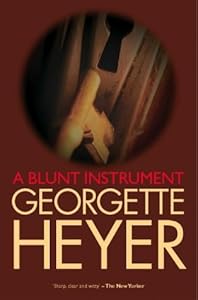
Review: Georgette Heyer, „A Blunt Instrument”


Cover of
Cover of A Blunt Instrument


Synopsis:

As I deal with a whodunnit here, I will keep the synopsis short and sweet. The plot of the book presents an old-fashioned murder mystery set in the days when life was simpler and gentlemen wore hats at any time of the night or day. Dame Agatha Christie would definitely feel at home and aprove.

A very religious, Bible-quoting policeman, called Malachi Glass, while patrolling his beat finds out that Ernest Fletcher was bludgeoned to death in his study. Everyone seems to be shocked and mystified about possible reasons of such a horrid murder - Ernest was old, rich, single, well liked and respected, although he also enjoyed an opinion of a ladies man. As usual, Ernest’s life, and his family's too, come under close scrutiny; the police is especially interested in his nephew, Neville Fletcher, who, as a main beneficiary, inherited a vast fortune. Neville doesn’t make the police work any easier, though, teasing mercilessly Superintendent Hannasyde; even the morose PC Glass is unpleasantly surprised as Neville quotes back some Bible at him. Is it just an innocent play of a young, bored prankster or maybe a cunning trick of an intelligent murderer? Why did Ernest Fletcher keep the IOUs of his beautiful gambling neighbour in the safe? Why did she pay him a clandestine visit shortly before the murder? Will her sister, a monocle-wearing mystery writer, guess the identity of the culprit and help the police with the investigation? Any help will come in useful as soon enough a second murder is discovered, right under the nose of the furious Superintendent. Will there be a third one?

What I liked:

The sense of humour and witty dialogues are evidently the highlights of this whodunnit: best lines are passed among Superintendent Hannasyde and Sergeant Hemmingway but some of PC Glass’s quotes, although rather grim, have had their merit too. The mystery itself, although relatively trite at first glance, proved to be more twisted than I expected – I haven’t guessed the identity of the real murderer till the very end (mind you I am not good at it).I also appreciated the fact that the policemen, presented in the novel, were close to real people, with all these foibles, quirks and flaws; I must admit that aspect of the police force I missed in Agatha Christie’s books the most.


What I didn’t like:

The story would have been more captivating, in my humble opinion, if only the late Ernest Fletcher had been presented as a younger and nicer man – a modern reader must wonder why any woman would get within ten meters of him. I was also surprised the character of his sister wasn’t explored more by the author who also happened to be a woman. The romantic thread seemed to me a bit of a stretch; it looked as if Ms Heyer were absolutely determined to feature a proposal in every single one of her books no matter whether it was probable or not. It was supposed to be a whodunnit, not a romance!

The final verdict:

A light reading stuff for the summer without nasty surprises inside- it wasn't bad but I wasn’t enchanted by it. It’s my first Heyer’s whodunnit, though, so I can’t say right now how it compares with the rest. However, I am likely to find out very soon – the second Heyer’s mystery is waiting on my shelves.

Enhanced by Zemanta