Sunday, 30 September 2012

Review: The Casual Vacancy by J.K. Rowling


Book info:
Kindle format
Genre: Contemporary fiction
Target audience: adults only 

Synopsis:

When Barry Fairbrother dies suddenly of aneurism in his early forties, leaving his family and a lot of unfinished issues behind, the town of Pagford is  in shock. He was a well-known  councilor and a coach of the local female rowing team. He was also a man with a mission. Who will fill his shoes? Will his death benefit his allies or his enemies?
Surprisingly there are more than one or two token candidates. Pagford, seemingly an English sleepy town like many others, with a cobbled market square and an ancient abbey, becomes a war zone and, like in every war, there will be casualties. Who will prevail? Is it important at all?

My impressions:

First of all let me state the obvious: hearing the name of J.K. Rowling you will immediately think ‘Harry Potter’ even if you haven’t read any of the books or haven’t seen the movies.  But HP series was finished some time ago and now Ms Rowling decided to branch out. I am far from criticizing her for that, let me just say it was a very bold move, rejecting a genre which made you famous, renowned and super-rich, trying something entirely new and different.  I grant it, she could afford that little experiment without breaking out into a financial sweat, a rare luxury among authors. My question is rather why it was done the way it was done when it could have been done almost any other way ?

My first surprise: the new book was still published under the name of J.K. Rowling. Let’s face it – whether the author likes it or not that name belongs firmly to Harry Potter. Using it to market a contemporary fiction novel for adults is like trying to sell e.g. BMW shoes or Manolo Blahnik computers.  Of course it has its short-term advantages:  plenty of people have bought the book out of sheer curiosity  (like me) or  loyalty so I suppose the publisher and the author will make nice, fat profit, no problem.  Still most of those casual readers will be confused and disenchanted at best,  getting not exactly what they have expected or used to expect. I suppose next time they won’t fall for the magic name alone.

The novel itself is a solid piece of writing, planned and executed decently well, but the topic isn’t either  fresh or  original, let alone ground-breaking.  I am not an especially well-read person in English literature and even I have read many similar position by Kate Atkinson or Sue Townsend; I can even add Agatha Christie to the bunch here, and  I must say their books were actually better – funnier, more edgy.  Do not expect in The Casual Vacancy  any magic, even of the metaphorical kind, or fireworks of humour and wisdom.  While reading it I didn’t feel that intense urge to find out what happened next, or to devour the book as soon as possible. It was a tepid story set in a banal, industrial-grey world;  after reading it I could shrug my shoulders and move on.  I related to  none of the characters, I didn’t hate anybody in particular, I am not curious what will happen to them in the near future. If I have to be honest I could live without meeting them at all.

I suppose I would be far more comfortable if the book was published under an alias.  Now it seems to me that Ms Rowling decided to minimize any risk and to capitalize shamelessly on her previous success, selling readers something which is supposedly connected to the HP series but in reality as far away from those books as it can only be. Only after the lecture of reviews or the book itself you see you have been conned.   Had this one been penned by a debut author, without all that glamour of a world-famous name,  it would have still been published but I am sure it would have also passed unnoticed and would have been forgotten soon.

By the way would it be such a bad idea to write something new (heck, even starting a new series) for adults but with fantasy elements included? Do only kids deserve a bit of fun? Taking into account how many mature readers have enjoyed the adventures of Harry and his friends, not to mention his enemies (yours truly among them) it seems like a completely rhetorical question, right?

Final verdict:

A decent novel about contemporary  Britain but nothing outstanding you must or should read or you miss out on an important book. Rowling has said pre-emptively: ‘ I'm a writer and I will write what I want to write.'  Ok, fine. I am a reader and I will read what I want to read. Not something like this one, though.


Silent Sunday


Friday, 28 September 2012

Mini Review: Mean by Renata F. Barcelos

Book info:
Form: pdf 
Length: 60 pages
Genre: psychological thriller
Target audience: adult

A copy of this novelette for reviewing purposes was sent to me free of charge by the author - thank you very much Renata!  That fact, of course,  didn't influence my review in any way.

Synopsis:

Because I am really feeling mean after the lecture let me start the synopsis like one of these jokes.

A nice girl with green eyes comes to a shrink. She knocks, enters and says: “Good evening. I want to kill somebody really worth killing but I’m still undecided. Would you mind my talking to you for a moment or two?”

Of course the shrink doesn’t mind it at all - it’s her job, after all, and she is paid handsomely for listening to different nutcases and wacky people. Is it really as safe as it seems to be, is she just a therapist? Is it possible such a nice girl really has a serious reason to kill anybody? Is she really so mean or is it just her sick imagination?

What I liked:

The idea behind this novelette was a very nice one - simple yet captivating. I truly enjoyed getting to know Cassandra and her horrible family. I was also immediately interested in the identity of her potential victim. I didn’t mind the first person narration much because  it helped creating an illusion the reader is actually a shrink. Some things Cassandra had been through sent a thrill down my spine and the more she told the more I wanted to know.

The best feature of this one was actually Cassandra herself – such a nice, intelligent girl with such a dark, twisted, narcissistic mind. She kept me wondering: was it because of her horrible childhood or was it because of her gene pool or maybe both ? Nurture or nature?  I  loved the ambiguity of her situation: she was not only a potential killer but also a victim; she was so self-centered and narcissistic she hardly noticed how much harm she was doing to herself. Still she remained perceptive enough to pursue a successful career and to plan a murder in a really clever way.

What I didn’t like:

Perhaps I have a dangerous mind but I guessed pretty quickly who Cassandra wanted to kill. Still I  didn’t know why till the very end so it didn't spoil my pleasure. An my main carping: this novelette would be far nicer if it was turned into a novel, with a richer characterization of the main lead and some other characters added in the background.

Final verdict:

A nice, short, intelligent read. Next time I  want a fully-fledged novel, though! Preferably with Cassie as a main character as well because her story is not over, is it? 

Wednesday, 26 September 2012

The Most Fascinating Libraries in the World 06 - The New Library of Alexandria

I visited a friend's blog one day and I was literary blown over by a picture of one of the most fascinating libraries around - Trinity College Library in Dublin, Ireland. It also gave me an idea of a series of posts about the best, the most beautiful, the strangest and the biggest libraries there are. The libraries that can make you drool, where you would be able to spend an indefinite period of time without noticing, where you would like to live and die till the end of the world (if they only served coffee and cake that is). Perhaps you can't visit them all but what is the Internet for? I'll try to illustrate my posts as well as it is only possible, providing, I hope, a nice tour for every visitor around. Enjoy!
English: The Bibliotheca Alexandrina as seen f...
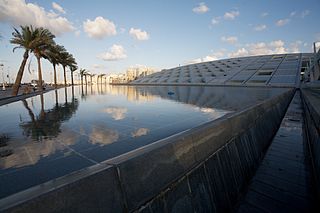
English: The Bibliotheca Alexandrina as seen from behind a Statue of Poseidon mating with Athena. Alexandria, Egypt. (Photo credit: Wikipedia)


The Bibliotheca Alexandrina (English: Library of Alexandria; Arabic: مكتبة الإسكندرية‎ Maktabat al-Iskandarīyah)

The idea of reviving the old library, so famously destructed by fire in antiquity, dates back to 1974, when a committee set up by Alexandria University selected a plot of land for its new equivalent, between the campus and the seafront, close to where the ancient library once stood. The notion of recreating the ancient library was soon enthusiastically adopted by other individuals and agencies. One leading supporter of the project was former Egyptian President Hosni Mubarak; UNESCO was also quick to embrace the concept of endowing the Mediterranean region with a center of cultural and scientific excellence. A very generous check from Saddam Hussein (seven digits, no less) was allegedly cashed in just before the War in the Gulf.


An architectural design competition, organized by UNESCO in 1988 to choose a design worthy of the site and its heritage, was won by Snøhetta, a Norwegian architectural office, from among more than 1,400 entries.

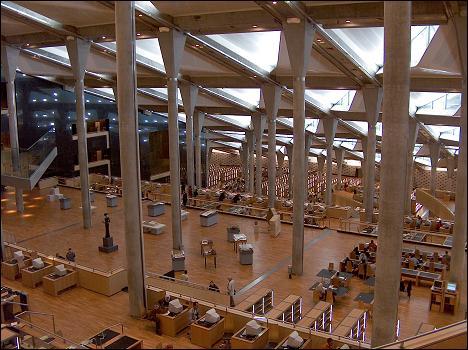
The library has shelf space for eight million books, with the main reading room covering 70,000 m² on eleven cascading levels. The complex also houses a conference center; specialized libraries for maps, multimedia, the blind and visually impaired, young people, and for children; four museums; four art galleries for temporary exhibitions; 15 permanent exhibitions; a planetarium; and a manuscript restoration laboratory. The library's architecture is equally striking. The main reading room stands beneath a 32-meter-high glass-panelled roof, tilted out toward the sea like a sundial, and measuring some 160 m in diameter. The walls are of gray Aswan granite, carved with characters from 120 different human scripts.


The collections at the Bibliotheca Alexandrina were donated from all over the world. The Spanish donated documents that detailed their period of Moorish rule. The French also donated, giving the library documents dealing with the building of the Suez Canal.


The Bibliotheca Alexandrina is trilingual, containing books in Arabic, English and French. In 2010, the library received a generous donation of 500,000 books from the National Library of France, Bibliothèque nationale de France (BnF). The gift makes the Bibliotheca Alexandrina the sixth-largest 
Francophone library in the world.


What do you think? Do you think the modern interior suits here? By the way if you want to know who burnt the old Library of Alexandria I found a very nice article about it here.


Enhanced by Zemanta

Monday, 24 September 2012

A More Diverse Universe review - Fledgling by Octavia E. Butler


I'm participating in an event called A More Diverse Universe, hosted by Aarti at BookLust. I found out about it because of Heidenkind and her excellent blog called Truth Beauty Freedom and Books The event is meant to help promote people of color in speculative fiction, and will run for one week, from September 23rd to September 29. That's why  this intro is written in different colours as well. ;p

Because  we live in a world full of stupid idiosyncrasies somehow a person of color writing sci-fi or fantasy is less likely to be published than a white person writing about ethnic minorities. That's why A More Diverse Universe is an event focusing on books written by people of colour ONLY. In order to participade you had to choose such a book and review it.

I chose Fledgling by Octavia E. Butler - I was fortunate enough to find that novel somehow and here is my review.
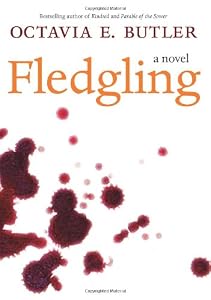
Cover of "Fledgling: A Novel"
Cover of Fledgling: A Novel

Synopsis:


A girl wakes up in the middle of nowhere. She’s suffered a major trauma – her body is badly burnt and her cranium has been broken in at least two places.  She doesn’t remember anything, not even her name,  she is blind and very hungry. The story is told in the first limited person so  you don’t know more than the  girl herself – a confused, mauled victim of something which looks like a fire or an arson and a grievous assault.

After some days the girl grows stronger and regains her sense of sight as she hunts and eats raw meat. The fact that she is recovering surprisingly fast, being able to catch and kill deer with her bare hands despite her injuries, is a very good hint she might be something more than a human child. Then she finds burned ruins of a settlement. She dresses in badly-fitting clothes left scattered around and she  goes out of the woods to look for help and company.

A car stops for her – it is driven by Wright Hamlin, a young construction worker who, seeing a lonely child on a road in mismatched clothes, decides to be a good Samaritan. The girl gets into his car but firmly refuses to be taken to a hospital or a police station. As Wright wants to take her there against her will anyway, the girl tries to get out of the running car and when she fails she bites his hand.  After the bite the girl takes control over her rescuer – he agrees not to drive to a hospital, he gives her more blood and a shelter even though he clearly has second thoughts whether it is rational or safe.  Now you are pretty sure you are dealing with a vampire child who will stop at nothing to find out who she is, who has attacked her and for what reasons.

What I liked:

The  world building. I’ve read plenty of vampire books – romances, thrillers, urban fantasy, crime stories, steampunk,  you name it –  this one was really, truly different than the rest and I mean it in a positive way. It was so original and imaginative that I would compare it to the books of Scott Orson Card. Vampires, called here Ina, are presented as a sentient race; they take human blood and have to have human symbionts to survive but they are hardly like humans and shouldn’t be judged by normal standards. The more you find out about them the more you can tollerate and understand  their customs and absorbe some disturbing scenes (see the next section below). It is definitely a novel with a science-fiction context.

The pace of narration was very quick and dynamic, maybe apart from the trial, described at the very end; anyway I’ve swallowed this book in two evenings and its plot kept me enthralled -  I stayed much longer than I wanted to and I  literally had to force myself to stop reading and drag myself to bed. It was addictive.

The main heroine, first named Renee by her rescuer and later called Shori, was as unique as the story itself – a dark-skinned vampire ( mind you the colour of her skin was actually an important advantage)  with a very strong character. She was very intelligent, brave, loyal and quick-witted despite the horrible circumstances which broke her childhood. Overall I liked her very much and I liked the fact that Ina females wielded so much power and were so important (I can't say more, it would be a spoiler).

What made me almost dump this one:

I admit I gagged when Wright and Shori went to bed and had sex for the first time. It was in the third or fourth chapter, right at the beginning.  Let me explain: she looked like a  small twelve-year-old, he was an adult guy, much bigger and allegedly physically stronger than her. Even if it seemed to be completely consensual  it stank to heaven of child abuse.  I had to stop, rewind a bit and think it over. Here is what allowed me to read on.

 Shori belonged evidently to a different species; nobody knew her real age (only later in the book an attentive reader can find out that this ‘child’ is over fifty and it wasn’t the first time she had sex) and she was clearly in control of the situation. A  girl who was able to catch and kill a deer with her bare hands and then eat the meat of her prey without using even the simplest tool had to be much stronger than any adult human so if she wanted to defend herself she would do it no problem. Still the thing that persuaded me the most and allowed me to continue reading at all  were her mind control skills.

Wright seemed to be completely smitten by Shori from the very beginning and remained right under her small, dark thumb all the time- although he kept calling her a jailbait (so he knew the danger of child molesting) he never refused her anything. If she told him to go outside and sleep in the open air he would do it without one ‘but’. If she told him to sleep with her fully clothed and never touch her, he would obey.  Shori dominated him from the very start; the fact that she was small and looked like a human child didn’t change it. It was disturbing and I felt I had to mention it in my review but the further I read the more understandable it became. 

What I didn't like:

I admit the book, although very intense, was also a bit too short - it didn't explain all the questions about the Ina I had in my head. Butler herself passed Fledgling off as a lark (I bet plenty of authors would give anything for such a lark) but I heard the novel is connected to her other works, continuing the theme raised explicitly in Parable of the Sower, that diversity is a biological imperative. Still I regret the author didn't continue this topic. I would love to see how Shori grew up. 

Final verdict:

It is the first but certainly not the last book by Octavia Butler I am going to read and, hopefully, review here. I truly enjoyed reading this story and getting to know its heroine.
Enhanced by Zemanta
Octavia Estelle Butler signing a copy of Fledg...
Octavia Estelle Butler signing a copy of Fledgling. (Photo credit: Wikipedia)

Check out the other stops on the A More Diverse Universe Blog Tour and celebrate POC authors in science fiction and fantasy!

Friday, 21 September 2012

Movie review: Bel Ami by Declan Donnellan and Nick Ormerod


Directed by Declan Donnellan and Nick Ormerod;
written by Rachel Bennette,
based on a novel by Guy de Maupassant under the same title 

Cast:
Robert Pattinson (Georges Duroy),
Uma Thurman (Madeleine Forestier),
Kristin Scott Thomas (Virginie Rousset),
Christina Ricci (Clotilde de Marelle),
Colm Meaney (Monsieur Rousset),
Philip Glenister (Charles Forestier),


Synopsis:

1890, the capital of France. Georges Duroy is a very handsome young man who, after serving a spell as a cavalry officer in Algeria, tries to make his fortune in Paris. As he is neither very bright nor educated, coming from an impoverished Normandy farming family, and he hardly knows anybody, he is living in abject poverty. One night, though, at a raucous can-can joint he meets Charles Forestier, an old army buddy who is an editor at La Vie Française, a powerful Parisian newspaper. Forestier out of pity gives him some money to buy a new set of clothes so he can come for dinner. After that dinner Charles’s beautiful wife, Madeleine, helps Georges get a job at the paper by writing his first article for him. She also gives him a very useful tip: “The most important people in Paris aren’t the men but their wives.” When she refuses to sleep with him, George seduces her married and more ethusiastic friend, Clotilde de Marelle, who purchases a “love nest” for them, freeing George from his roach-infested garret he’d hated so much. It’s Clotilde’s little daughter who nicknames George “Bel Ami,” loosely translated in this case to, ‘That Hot Wuss’ (officially ‘beautiful friend’in French).

When Charles Forestier dies from tuberculosis Georges instantly pounces on Madeleine and marries her. Madeleine doesn't love him but she appreciates his looks and bedroom skills. She uses him also to indulge her literary gifts that she, as a respectable woman, cannot openly showcase. Georges can't write one decent sentence, but he becomes the pliable instrument of his wife's ambitions. However it doesn’t mean he is completely idle – soon afterwards he zeros in on Virginie Rousset, the virtuous wife of the newspaper’s top editor, and seduces her in a church. After a single night with him, Virginie becomes a complete doormat, cooing instantly “my beautiful boy” to her transparently disgusted lover. Still it is not enough for more and more greedy Georges.

Ultimately he discovers that he's not respected and has been manipulated by his more intelligent wife. He arranges a divorce, catching her in flagranti with a politician, and then he devises a 'coolly efficient' revenge, which just happens to involve, surprise, surprise, seducing a fourth woman, the young daughter of Virginie with a dowry fit for a princess. She's young and fresh, if otherwise not very interesting, sort of like Georges himself, and she agrees to elope with him just because she knows her parents would oppose their match the most. That’s how Duroy ends up filthy rich, married to the most desirable heiress in Paris. A complete success, right? 

My impressions:

I admit I couldn’t decide whether I wanted to watch this movie at all. On the one hand there was Kristin Scott Thomas which I like and appreciate as an actress. On the other hand there was Robert Pattinson aka Edward Cullen, the sparkling wampire which I would love to forget, preferably for my lifetime. Finally I was tempted to borrow and see it, mainly because I have a thing or two for the 19th century, Guy de Maupassant novels and French literature in general. Sadly it proved to be a mistake. 

This movie is another proof that Robert Pattinson is a big black hole of talent. In his hands George is a naive and petulant opportunist, simultaneously devious and dumb. He is neither a fun villain nor a secret good guy, just an ornament- that’s why this movie, focusing entirely on the character of Bel Ami who should be portrayed as a direct descendant of the Vicomte de Valmont in “Les Liaisons Dangereuses,” but with an added layer of cruelty, felt senseless to me. Even with his pants down on top of Clotilde or coldly manhandling poor besotted Virginie George played by Pattinson was the dullest scoundrel imaginable. The effect was as if you were shown a stupid Hamlet or a wooden King Lear. In the scenes set in the beautiful villa he comes to share with Madeleine, I found myself focusing on the wallpaper, delicious bookcases and different knick-knacks behind him, which were equally beautiful, but far more interesting. Lowering your gaze and flashing a vampirish glare is not acting, it’s making faces. Stupid faces.

The movie also gives short shrift to the interesting collusion between the newspaper and the government in setting the stage for a secret North African invasion that will enrich them all. Although this is potentially juicy stuff, presented from Georges/Robert point of view it is as dry and tasteless as a shrunken piece of lemon left forgotten in the refrigerator. The script seems to be too sketchy and Pattinson simply lacks the recources to show any inner life of his character. As a result the movie is less a tale of intricate scheming and more one about a lucky airhead who fails upward just because he is so insanely good-looking. Well, actually watching Robert Pattinson I really wondered what all these women saw in his character. Bushy, dark eyebrows perchance?

Final verdict: 


"Bel Ami" is hardly the first screen adaptation of the Guy de Maupassant novel (there was also a 1947 version starring George Sanders) and certainly not one to be remembered as something special. In fact, the casting of an inexpressive pinup boy in the lead role is the most up-to-date thing about Bel Ami. Everything else is painfully conventional if not downright dull - definitely not enough to make this a contemporary rethink of a classic tale about a career of a male whore or even an entertaining movie. Pity.


Enhanced by Zemanta

Wednesday, 19 September 2012

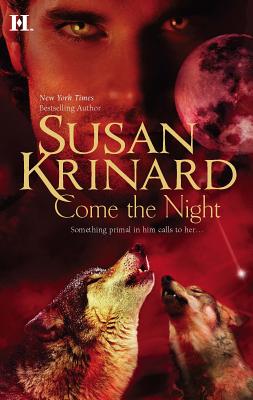
Review: Come The Night (Vampire/Werewolf Trilogy #3) by Susan Krinard

Book info:
Form: paperback from my local library
Genre: paranormal romance, werewolves
Target audience: adults


Synopsis:


Gillian Delvaux, nee Maitland, a young widow with a 12-year-old son, belongs to a very exclusive pure blood British werewolf family. Noblesse oblige – she must marry an appropriate candidate even if it is the 20th century and normal people have something to say about it. She doesn’t. The problem is her father, sir Averil Maitland, still treats his children and household as if he was a medieval prince and them – his chattels. It concerns mainly Gillian but also to some extend her younger brother, Hugh. Marrying or in fact doing anything without their father’s consent is out of question. Sir Averil plans to organize a Convocation of all pure blood werewolves from Britain and abroad and he wants to choose Gillian a new husband (of course without consulting anybody, let alone his own daughter).

Still there was that Great War not so long ago (the novel is set in the Roaring Twenties) during which Gillian worked as a nurse in London and met a very nice young American soldier, Ross Kavanaugh. Ross was only ¼ of a werewolf but somehow it didn’t bother her. In spite of the fact her dad would disapprove (to put it mildly) she decided to have a child with him (and didn’t inform him about it – are you seeing a pattern?). Then she married promptly a Belgian werewolf who, very conveniently, went to war one week after his marriage and died. The boy, named Toby, has been raised at Snowfell, the manor his grandfather, and, being a bright boy, found out about his real father and decided to visit America and meet with Ross. All alone and without as much as by your leave of course. Like mother like son…

Meantime Ross Kavanaugh, a disgraced ex-police officer, is having a lot of free time as a down-at-heel unemployed without any hopes for a new career and hardly any money. What’s more the New York police force, his former buddies, are almost sure he has been corrupted by a mafia and has killed a woman. When young Toby shows up as a stow-away and declares he is his son it seems that it is just another stroke of bad luck, especially that his mother and uncle are close behind. Who needs a son when he hardly has two dollars to rub together? Who needs a former aristocratic lover who abandoned you once for no reason at all and haven’t contacted you ever since? Who needs more problems? Or maybe it is actually a chance to start anew?


What I liked:


First of all the plot is interesting and rather original as it tells not the ordinary a-boy-meets-a-girl-and-they-fall-in-love-but- there-is-complication story but something a bit more real and twisted. Both main characters are mature with their issues and responsibilities. Additionally Gillian must fight her father’s prejudice against ‘mongrels’ (so mixed blood werewolves) and humans – secretly she doesn’t share his rabid opinions but, being dependent on him and completely dominated, she hides it most of the time. I must admit I had hard time getting to like our Gillian – her love for Toby seemed to be her one single redeeming quality. True, she treated the servants well and, while on her own, she behaved like a normal sensible and almost human being but in the presence of her father she became a puppet repeating stupid things and hoping that this time she wouldn’t be punished that badly. Or if she did, nobody would find out.

When it comes to the relationship between Gillian and Ross it was indeed all barbs and thorns, almost no roses– but I wouldn’t expect less. Krinard explores the relationship between two people from two different worlds that fit the "opposites attract" adage. In fact till the very end you are not sure whether they will reunite at all, even for their son’s sake.

The main baddie, Ethan Warbrick was nicely constructed – I mean here the psychological basis of his undeniable insanity. It is always a pleasure to encounter a complicated baddie. I also liked the mentioning of Hitler and the fact that pure blood, snobby German werewolves wanted to support a human only because he shared their stupid ideas – the hypocrisy pure and simple!


What I didn’t like:


Reading this one I asked myself more than once: where are the Roaring Twenties? They even disappeared from the official title of this series (according to Goodreads; my library copy still features them). Maybe it was the right move because you get here just a description of an amusement park in Coney Island. I mean, there is no indication whatsoever what colourful era we are dealing with – no balls, no clubs, no jazz, nothing. It seems as if the author got bored of the original idea and decided to get rid of it. The characters are staying at Snowfell for most of the novel and Snowfell is like a medieval stronghold – completely isolated – but even when Gillian was with her son in New York she hardly ever went out. Pity.

Apart from that I must tell you that in my humble opinion Ross and Gillian didn't work well as a couple, even a quarreling one. Gillian was too rigid and cold and also maybe a tad too selfish. I found her a female character difficult to like or relate. I could understand her but, after the umpteen argument about past and a lot of icy stares and upturned noses, it made me wonder what the appeal was for Ross. She got her HEA in the end but it was almost a kind of surprise. She deserved to stay alone and think her priorities over.

Finally the fact that Ross, a complete underdog, penniless, hunted by the police, werewolves and lovely Ethan, managed to solve ALL mysteries and ALL his and his friends’ problems seemed a bit over the top. It reminded me of these silly Hollywood movies in which the protagonist saves single-handedly his girlfriend, his country and the whole planet. And then he has a beer and a burger with his best buddies.


Final verdict:


This novel was neither outstanding nor exceptionally bad – better than your average werewolf tale, I grant you, mainly because a dash of interesting psychology, but featuring several flaws which spoiled my reading a bit. Still I don’t regret borrowing it from the library.

BTW I also discussed this book with Tasha/Heidenkind - the result can be found here. Drop by and say hello! 

Enhanced by Zemanta

Sunday, 16 September 2012

Reviewing a classic: Mansfield Park by Jane Austen

Book info:
Form: paperback
Genre: Jane Austen novel ;p
Target audience: anybody
Synopsis:

Brace yourself, it will be a long, detailed synopsis with spoilers but hey, the book is a classic, right? Let me indulge myself a bit ;)

Once upon a time there were three sisters. One of them, being the prettiest, married very well, the second one, a bit wild, married very badly but for love and the third one married just because it was the right thing to do. The first sister, Lady Bertram, a rich wife of a baronet, was spending her days idly by the side of her husband, Sir Thomas, enjoying luxuries of Mansfield Park, their country estate. She had four children: two sons, Tom and Edmund, and two daughters, Maria and Julia. She also decided to help her other two sisters, less fortunate when it came to the choice of husbands.

That’s how Fanny Price, our heroine, aged just 10, arrived to Mansfield Park - she was  Aunt Bertram’s charity case. As one of many children of the second sister, Frances, and Lieut. Price, a retired naval officer, Fanny was sent away to live with her fine relatives. Her mother was very grateful as it was considered a great opportunity and social advancement. Of course nobody asked the opinion of the shy, awkward child. Fanny was never exactly mistreated by the Bertrams but she never felt at home with them either. Still Edmund, the younger son, being the most good-natured of all, managed to show his young cousin real kindness from time to time. Fanny’s other maternal aunt, Mrs. Norris, the local parson's wife, showered attention and affection on her Bertram nieces, particularly Maria, but was frequently unpleasant and mean-spirited toward Fanny, making the girl feeing inadequate.

The narration starts when Fanny is 16. Sir Thomas must leave for a year to deal with problems on his plantation in Antiqua. He takes his eldest son, Tom, along in hopes to isolate him from bad company he had been keeping. Meanwhile Mrs. Norris finds a husband for Maria Bertram – a completely stupid but very rich Mr. Rushworth. Maria accepts his proposal subject to Sir Thomas’s approval on his return.

About this time, the fashionable, wealthy, and worldly Henry Crawford and his sister, Mary , arrive at the parsonage to stay with Mrs. Grant, their half-sister. The arrival of the lively, attractive Crawford siblings disrupts the staid world of Mansfield and sparks a series of romantic entanglements. Mary and Edmund begin to form an attachment, despite her original interest in Tom as the eldest son and the heir of Mansfield Park. Although Edmund worries that Mary’s cynical remarks may mask a lack of firm principle and Mary is unhappy that Edmund wants to become just a simple country clergyman, their mutual attraction grows. Fanny fears that Mary has enchanted Edmund, and that love has blinded him to her flaws - of course, she is in love with him herself but her judgment is definitely better than the judgment of any of interesting parties.  Meanwhile, during a visit to Mr. Rushworth's ancestral estate in Sotherton, Henry deliberately plays with the affections of both Maria and Julia, driving them apart. Maria believes that Henry is falling in love with her and treats Mr. Rushworth dismissively, provoking his jealousy. Fanny witnesses Maria and Henry in compromising situation and is appalled by their lack of decency. Encouraged by Tom and his friend Mr. Yates, the young people decide to put on Elizabeth Inchbald's play Lovers' Vows, a rather frivolous farce which allows Henry, Maria, Julia, Mary and, to some extend, Edmund continue their public flirt.

When Sir Thomas unexpectedly arrives home in the middle of a rehearsal, the theatricals are abruptly terminated. Henry, whom Maria had expected to propose, leaves, and she feels crushed, realizing that he didn’t love her. Although she neither likes nor respects Mr. Rushworth, she goes ahead and marries him out of spite. They leave for Brighton, taking Julia with them. With Maria and Julia gone, Fanny and Mary Crawford are naturally thrown into each other's company. In fact Mary goes out of her way to befriend Fanny. Henry returns to Mansfield Park and, lacking other distractions, decides to amuse himself by making love to the shy new best friend of his sister. However, Fanny is steadfastly if secretly in love with Edmund, and the tables are turned - Henry actually falls in love with her. To further his suit, he uses his family connections to raise Fanny's brother William to the rank of naval lieutenant. However, when he proposes marriage, Fanny rejects him out of hand, partially because she disapproves of his moral character, and also because she still hopes Edmund might love her back one day. Sir Thomas is dismayed and startled by her refusal, since it is an extremely advantageous match for a girl without any dowry or useful connections.

To bring Fanny to her senses, Sir Thomas sends her home to Portsmouth, hoping that the lack of comforts will help her appreciate Henry's offer more. At Portsmouth, she develops a firm bond with her younger sister Susan, but is taken aback by the contrast between the dissolute surroundings of her mother’s house and the environment at Mansfield. Henry visits and tries to convince her that he has changed for good and is worthy of her affection. Although Fanny still maintains that she cannot marry him, her attitude begins to soften, particularly as Edmund and Mary seem to be moving steadily toward an engagement.Henry leaves for London, and shortly afterwards, Fanny learns that scandal has enveloped him and Maria. The two had met at a party and rekindled their flirtation; as a result Maria has left her husband for him. A national scandal sheet gets wind of the affair, Maria is exposed as an adulterous wife, Mr. Rushworth sues for divorce, and the proud Bertram family is devastated. To make matters worse, Tom has taken ill, and Julia, fearing that her father will  lock her up, punishing for the sins of the older sister, has eloped with Tom's flighty friend Mr. Yates.

In the midst of this crisis, Fanny returns to Mansfield Park with her sister, Susan. Sir Thomas realizes that Fanny was right to reject Henry's proposal and now regards her as his daughter. During an emotional meeting with Mary Crawford, Edmund discovers that Mary does not condemn Henry and Maria's adultery, only the fact  it was discovered. She implies that if Fanny had only accepted Henry, there would have been no affair. She also speaks very callously about the possible death of Tom and the perspectives it would create for the younger son. Edmund, who had idolized Mary, feels that her true, rather ugly nature, has been finally revealed to him. He returns to Mansfield Park and goes ahead with plans to be ordained a minister, abandoning any engagement plans.While he is despairing of ever getting over Mary, Edmund comes to realize how important Fanny became to him. After a while he declares his love for her, they are married, and eventually they move to the Mansfield Park parsonage, where they live close to those they love best. Henry Crawford refuses to marry Maria, who is banished by her family to live, secluded, "in another country," (France) where she is joined by her aunt Mrs. Norris, the initial creator of her misery.

 What I liked:

If you wonder why my synopsis is so long and detailed here are two main reasons. First – I admit that Mansfield Park is my favourite Jane Austen book and I can talk about it forever. Second – I wanted to show how dissimilar that novel is when compared to those awful movie adaptations. Really, truly, completely different.

First of all the main heroine, Fanny, is perhaps the most complex female character created by Austen, maybe because she is portrayed not as a young adult but we can follow most of her childhood as well. Plenty of readers don’t like Fanny for being a bit priggish. Jane Austen's own mother thought Fanny "insipid". I don’t agree with such an assessment. Although, as any young girl, she is sometimes given to wishful thinking and she is often too timid to speak up her mind, Fanny can be surprisingly perceptive and intelligent; it is quite stunning as she lacked any moral guidance or support among her real or adoptive family. Still she is the only one who can assess the Crawfords in the right way, she notices how badly Maria treats her fiancé before almost anybody else and she can criticize the household of her own mother in a very clear-headed way. By rejecting Henry she shows a lot of courage; she also grows in self-esteem during the latter part of the story, weathering a major crisis caused by Maria’s divorce and Tom’s illness.

Many modern readers find Fanny's timidity and disapproval of the theatricals difficult to sympathize with but I found it in perfect accordance with her introvert character – she did enjoy listening to Henry Crawford’s skillful reading, she just didn’t want to offend her absent uncle doing something overly frivolous; I suppose she also didn’t want to mix with a crowd who treated her indifferently at best and disapproved of her at worst. Their attitude might be well summed up by this quote:

“My dear Miss Price,” said Miss Crawford, as soon as she was at all within hearing, “I am come to make my own apologies for keeping you waiting; but I have nothing in the world to say for myself-I knew it was very late, and that I was behaving extremely ill; and therefore, if you please, you must forgive me. Selfishness must always be forgiven, you know, because there is no hope of a cure.” Mary Crawford, Mansfield Park, Chapter 7


Apart from Fanny there are plenty of other great characters, presented here, but two of them, namely Henry and Mary Crawford deserve a paragraph or two of their own.

 They are a pair of antagonists, predators, but they are presented as quite likeable creatures, so nice to be with and so interesting nobody notices their wickedness. Let’s start with the lady.  I would describe Mary Crawford as Elizabeth Bennett without moral principles – she is clever, she has a great sense of humour, she is additionally rich (twenty thousand pounds of dowry, no small matter) and pretty spoiled. You might argue that her faults stem from the fact that she wasn’t given  proper education and example in her childhood but so wasn’t Fanny and there is vast difference between the way of thinking of these two young women. Mary is so dazzled by the glitter of the beau monde that she rarely notices any real values in people. She likes luxury, she appreciates theatre and fun, she thinks she is entitled to everything the best, including men. Although from time to time she can be also understanding, generous and kind, she thinks mostly about her own convenience and social status. She tolerates Fanny to please Edmund and Sir Thomas but, given a choice, she remorselessly forgets her timid friend to enjoy a more interesting company. 

Her brother is even worse – it is a predator similar to Monsieur Vicomte de Valmont from Les Liaisons Dangereuses, another classic reviewed by me here. As he has definitely too much money for his own good and is too lazy and lax to find himself a proper occupation he preys on women for fun (mind you we speak about the Napoleonic Wars period, such easy time to find an occupation for an aggressive, clever man of means!). The way he plays both sisters Bertram is really callous and ruthless; after the marriage of Maria he doesn’t hesitate to contact her in public and when she pretends reserve he decides to conquer her again – not because he loves her but because he must prove his seductive skills before himself and all the world around. Of course the fact that he might be ruining more than one life and a reputation of the whole family in the process never even crosses his mind. He would do anything and everything for a moment of thrill.

What I didn’t like:

One small carping: I really hated the fact that Jane Austen didn’t punish Henry Crawford for his villainy. While Maria Bertram was sent into exile in the really acidic company of her aunt Norris he was left with all the privileges of a rich squire and his reputation didn’t suffer either. NOT FAIR. His only punishment? He didn’t get Fanny and he knew what he lost. I wish Austen at least made him poor (gambling?) and then forced him to marry for money some horrible harpy, twice his age.

Final verdict

I may risk a statement that  Mansfield Park is not an easy novel to understand. It enjoys that dubious distinction of being disliked by more of Jane Austen's fans than any of her other novels. Perhaps it is because its themes are very different from those of her other books, which can generally be summed up by one sentence or, indeed a phrase: Sense and Sensibility is about balancing emotions and reason, Pride and Prejudice is about consequences of judging others too quickly, Emma is about growing into adulthood while being terribly nosy, and Persuasion is about giving others and yourself second chances. The theme of Mansfield Park, on the other hand, defies such a simple description. Is it an allegory of Regency England? Is it about the negative impact of slavery? Is it about the right and wrong education of children? Is it about the difference between appearances and reality? Is it about the consequences of breaking with society's rigid rules? In my opinion any, or all of those themes can, and have been applied to Mansfield Park – let it be the proof that this novel is something truly exceptional and worth reading.

Friday, 14 September 2012

Movie review: The Ides of March directed by George Clooney

Written By: George Clooney, Grant Heslov, Beau Willimon

Cast:
Governor Mike Morris: George Clooney
Stephen Meyers: Ryan Gosling
Ida Horowich: Marisa Tomei
Molly Stearn: Evan Rachel Wood
Paul Zara : Philip Seymour Hoffman

Synopsis:

A Democratic Party primary campaign is unfolding in the key state of Ohio - Governor Mike Morris is running against Republican Senator Pullman and his people will do everything possible to make him win. In that process they also want to secure the best vantage point for themselves - small wonder the atmosphere is heavy with fratricidal betrayal and vicious back-stabbing behind the scenes.

Stephen Meyers, although just 30, is Mike’s PR guru; surprisingly he truly seems to believe in the ideas preached by his candidate, mistaking the charm-boy blunt talk for idealism. Soon enough he will get a crash course in dirty politics, finding out that there are no friends, just co-workers, and your conscience is the first thing to compromise if you want to go places fast.

 One clandestine meeting is enough to put Stephen in conflict with Paul Zara, Mike’s campaign manager, and Tom Duffy, the chief Republican strategist. Duffy arranged that meeting, pretending he was keen on luring the brilliant communication guy from the other team over to Pullman’s side. Although Stephen said ‘no’ the mere fact that he talked to Duffy could be taken against him. His position became even more complex when he found out that Molly, the sexy young intern he picked up (not without her playing an active part in the process) and was sleeping with, was not exactly as guileless and faithful as you would expect from a 20-year-old girl. Finally Stephen is fired unceremoniously by Zara, the very man he trusted so much, and it seems nobody cares that his career in politics is over. What will he have to sacrifice in order to return to the game he loves? Will it be the same game?

My impressions:

First a bit about the historical reference of the title itself.

“The Ides of March” was a festive day dedicated to the god Mars in ancient Rome; it is also the date on which Julius Caesar was assassinated in 44 B.C. by his fellow senators, led by Marcus Junius Brutus, his close friend, and Gaius Cassius Longinus. At that time Caesar was the dictator of the Roman Republic, having recently been declared dictator perpetuo (so for the infinite period of time) by the Senate. This declaration made several senators fear that Caesar wanted to overthrow the Senate in favor of tyranny. The result, unforeseen by the assassins, was that Caesar's death precipitated the end of the Roman Republic. Since then “the Ides of March” mean a fateful day during which something unpredictable and evil can happen, often as a result of a secret plotting or clandestine activity.

Well, the soothsayer who warned Julius Caesar to “beware the ides of March” didn’t know anything – since then politics has only got dirtier and more dangerous. You might wonder how anybody similar to wide-eyed, idealistic Stephen could actually go so far without becoming seriously disillusioned at some point. Yet Stephen's is the sort of idealism that turns out to be thin-skinned and highly strung very quickly, in spite of the apparent unflappable competence, so impressive in the eyes of his own boss and his adversaries.

The premise of this movie is to show a young idealist at the point of turning sour (meaning here turning fully professional). There is a kind of assassination (but not of a major political figure), a funeral oration and someone with blood on his hands who wants to and manages to get away with it but only by compromising his own ideals. Still, in my opinion Clooney is hunting an even bigger game. He scratches the surface of each of his flawed characters to find out when they first put their souls on the market and for what reason. Because everybody can be bought and broken, it’s only a matter of the currency and the price. Even a very young trainee who just brings coffee and hangs around to make some telemarketing calls might be used and abused in the process. Still the price she has to pay will be significantly higher.

I found this movie a bit repetitive, copying the ideas from previous productions like Primary Colors, Bob Roberts or Wag the Dog. The key revelation, concerning Molly the intern and her shadowy dealing with the Governor, lacked 'wow' factor so, I suppose, wasn’t sufficiently worked out in dramatic terms. Still there were scenes in which this film felt very real, definitely closer to the atmosphere that make up most political campaigning. The performance of both Mr. Clooney and Gosling was really good, making the whole story definitely more believable and chilly.

One more thing: I loved the fact that some of Governor Morris’s campaign posters were clearly inspired by Shepard Fairey’s iconic “Hope” poster, used during Barack Obama’s campaign in 2008.

Final verdict:

A high-IQ film, with a really good lead performance and some great if not a bit bleak commentary on contemporary politics. Still, nothing revolutionary or fresh and certainly nothing to make you want to vote.


Wednesday, 12 September 2012

Review: King of Thorns (The Broken Empire #02) by Mark Lawrence

Book info:
Form: e-book, Kindle format
Genre: very dark fantasy
Target audience: adults

Synopsis:

Honorous Jorg Ancrath has never exactly wanted to be a mere king but, as a mountainous strip of land falls into his hands he takes the crown and never looks back. A future emperor has to know his priorities, right? One step at a time...

Currently, in order to clear the path to his empire, he must defeat two Princes of Arrow, brothers Orrin and Egan. Many prophecies declare that a Prince of Arrow will be the next Emperor, able to unify the kingdoms and bring much-needed peace; the fact that one of the brothers marry Katherine of Scorron, Jorg's beloved, only adds to his determination.

Meanwhile Jorg himself has to marry for political reasons - without allies even he can't dream of keeping his modest crown for long. He is surrounded by enemies, visible and invisible ones; one of them, Sageous, can even invade his dreams. Finally faced by an enemy many times his strength Jorg knows that he cannot win a fair fight. Fortunately playing fair was never part of Jorg’s game plan.

What will happen during King Jorg's wedding day battle? Something spectacular, you might be sure of it.

What I liked:

I am glad to say young Jorg has matured a lot in the second installment. Compared to the previous part he became positively mellow. Not that he's become a nice, flawless hero of course, but, compared to his previous self,  that of a deranged, murderous child full of angst and something even darker, there was noticeable improvement.

There were several clever scenes in this book, most of them involving the clash of the "new-old" technology (like a nice Colt gun or a watch) with medieval artefacts. One of them reminded me strongly of Indiana Jones movies and therefore made me smile.

After reading this one I admit I am even more curious what happened to the Builders and why the humankind had to return to the level straight from the Middle Ages when it comes to material culture. Oh and little Miana, Jorg's betrothed, is an interesting creature, definitely worth more place in the next book.

What I didn't like:

I admit the whole story lost a bit of momentum. Constant jumps forward and backward in the plot line were a bit bothersome, especially at the beginning, before you get into the rythm of the narration.
Also the POV of Katherine was, in my humble opinion, not such a great idea; in most of her diary entries the girl simply didn't have anything important to say and when she finally did, she disappeared (a spoiler, highlight to read or skip) most probably killed during the big blaze which consumed the Prince of Arrow's army. I hope she will stay absent - she was getting annoying with her "I-hate-Jorg-I-love-hating-Jorg-so-much-that-I-almost-love-him" soliloquy.

Final verdict:

Not bad continuation of an interesting series but I found it weaker than the first part. Well, the ending will be decisive. By the way my review of the first part, Prince of Thorns, you can find here.

Monday, 10 September 2012

The Most Fascinating Libraries of the World 05 - the Austrian National Library in Vienna

English: Austrian National Library pano França...
Austrian National Library pano :  Wikipedia)
Kaiserlichen Court Library (Hofbibliothek) in ...
Kaiserlichen Court Library (Hofbibliothek) in Vienna (Photo credit: Wikipedia)
I visited a friend's blog one day and I was literary blown over by a picture of one of the most fascinating libraries around - Trinity College Library in Dublin, Ireland. It also gave me an idea of a series of posts about the best, the most beautiful, the strangest and the biggest libraries there are. The libraries that can make you drool, where you would be able to spend an indefinite period of time without noticing, where you would like to live and die till the end of the world (if they only served coffee and cake that is). Perhaps you can't visit them all but what is the Internet for? I'll try to illustrate my posts as well as it is only possible, providing, I hope, a nice tour for every visitor around. Enjoy!


 The Austrian National Library (German: Österreichische Nationalbibliothek, abbreviated "ÖNB" and formerly Hof-Bibliothek)


It is the largest library in Austria with 7.4 million items in its various collections. The library is located in the Hofburg Palace in Vienna. Since 2005, some of the collections have been relocated within the baroque structure of the Palais Mollard-Clary. Founded by the Habsburgs, the library was originally called the 'Hof-Bibliothek' ("Imperial Library"); the change to the current name occurred in 1920. The library complex includes four museums, as well as multiple special collections and archives. I really truly wanted to visit it but it was closed due to renovation. Oh well. I can always do a virtual tour and invite you along.


The part especially worth visiting is the Baroque State Hall, which prides itself as being one of the world’s most beautiful historic libraries. It was Emperor Charles VI who ordered it to be constructed as his Court Library. Architect Johann Bernard Fischer von Erlach planned its construction, and it was built from 1723 to 1726 by his son Joseph Emanuel. Court painter Daniel Gran, in turn, can be thanked for the beautiful ceiling frescoes.


Enhanced by Zemanta

Thursday, 6 September 2012

Review: Purge by Sofi Oksanen

Book info:
Form: e-book, pdf format
Genre: contemporary fiction
Target audience: adults


Synopsis:

You can call this book a tale of two sisters and indeed, it reminded me of all these folk songs about sibling rivalry. Ingel and Aliide, two Estonian peasant girls, had a very bad luck of falling for the same German boy. Ingel was very pretty, even beautiful, and whatever she did, she did it always better than other girls. Aliide was less pretty and less gifted, completely overshadowed by her perfect sister. The boy in question, Hans Pekk, chose Ingel. They married, were very happy and soon they had a little baby girl, Linda. Despite that fact Aliide never stopped loving Hans; her torment made her slowly ruin her own life and the life of her closest relatives, with a little help from the Russian communists who were simply great at wreaking havoc and ruining people’s lives whenever they went.

The novel starts when elderly and widowed Aliide, living alone in a half-deserted Estonian village, finds a strange girl near her house. The girl needs help very badly – she is hungry, filthy and it is obvious she’s been beaten regularly. In spite of her initial fear Aliide empathizes with the girl  too much to ignore her; she invites her inside, gives her a bath, some fresh clothes and food. The girl is called Zara and it seems she is running from the cruel Russian Mafia men. Gradually, as the story unfurls, you find out it was hardly by accident that Zara wandered to Aliide’s house; she sought out that woman because they are actually related. Still at first Zara tells a lot of lies, only later revealing a very disturbing and sad truth about herself and her situation. It makes Aliide reminisce about the difficult times under the Soviet rule – ironically nothing changed. Her own youth was full of horrible experiences as well, similar to those of young Zara,. Will these two women help each other? Will they understand each other’s decisions? Will they become family again?

My impressions:

I was very deeply moved by this book; as a result my review is much more personal and a bit different than usual. I felt connected to it on more than one level. 

Believe me or not but it was a book which kept me awake at night and gave me nightmares (a very rare occurrence). It was a book that reminded me of some simple truths, namely that life is a bitch and sometimes you simply cannot do anything about it. One stupid decision might ruin your future and sometimes no decision is needed at all because, no matter what you do, your life will be ruined anyway – it’s your fate, karma, politics, war, or other stupid circumstances completely beyond your control. It was a book that made me want to howl with rage and cry.

It was a book that portrayed love at its cruelest and most beautiful. It made me pet my dog for hours because animals, seen from some aspects, are far better than humans – they never judge you by appearances and, as long as you treat them well, they will pay you back with love and lasting attachment. It was a book which, like ancient tragedies, was able to trigger a haunting catharsis, a purge promised in the title. Have you read or seen “Atonement”? Compared to this one, “Atonement” seemed to me just like a child’s prattle, nothing more. Because sometimes you can’t atone for your sins, no matter what you do.

It was a book I couldn’t stop reading even though I had more pressing tasks at hand. I got sucked into it and, although I was very uncomfortable from time to time, I didn’t want to leave till the last word. 

Final verdict:

Heartrending. Incredibly sad and wise. Hauntingly beautiful. The plot and the characters are like an accident waiting to happen – you can’t divert your eyes even though nobody forces you to watch. Highly recommendable but not a comfortable read. Still easily the best book I’ve read this year. I don't know when I will be able to read another book.