Thursday, 29 November 2012

NaNoWriMo 2012 - my impressions

Yes, I did it! I managed to write 50,000 words in roughly 30 days! I am so happy!!!

It wasn't easy. It wasn't problem-free but it was and is doable!

What did I produce?
A 50k+ story. With a proper beginning and a proper ending and plenty of typos. It is about a young magician called Vakr who gets involved in an affair that exceeds his expecations but makes him stronger. 1st person limited narration.

Is it readable/publishable?
No. I weren't able to edit much. I am pretty sure it is a horrible story but I did try to eliminate any inconsistencies.

What did I learn?
How to plan your writing in order to be effective. How to be disciplined about the amount of words you have to write a given day. How to sketch some scenes beforehand and fill them in later. How to go with the flow of the story, let your characters decide from time to time although you had planned it differently.

Will I be willing to repeat that experience?
YES. It was fun and it was worth my effort. Still I am happy I finished it. Demanding like hell.

If you have participated this year (it is not over yet) or previous years let me know about your experiences.

Tuesday, 27 November 2012

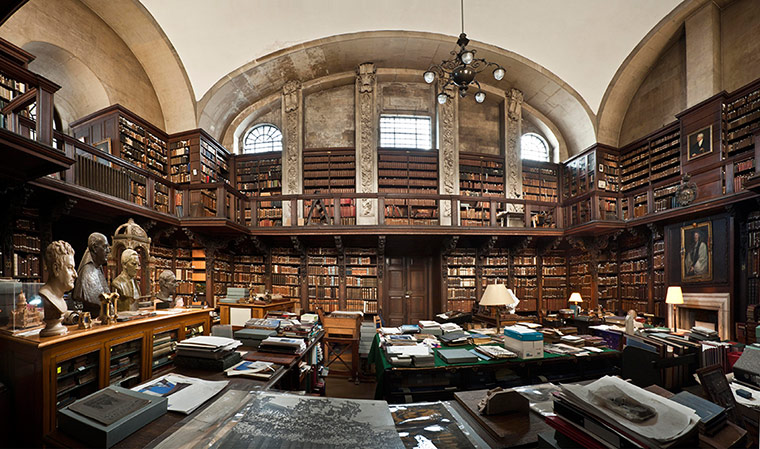
The Most Fascinating Libraries of the World 09 - St. Paul's Cathedral Library, London

I visited a friend's blog one day and I was literary blown over by a picture of one of the most fascinating libraries around - Trinity College Library in Dublin, Ireland. It also gave me an idea of a series of posts about the best, the most beautiful, the strangest and the biggest libraries there are. The libraries that can make you drool, where you would be able to spend an indefinite period of time without noticing, where you would like to live and die till the end of the world (if they only served coffee and cake that is). Perhaps you can't visit them all but what is the Internet for? I'll try to illustrate my posts as well as it is only possible, providing, I hope, a nice tour for every visitor around. Enjoy!


By the way, if you want to admire other great libraries, presented by me in this series, search this blog using 'libraries of the world' tag and you'll find them all.

St.Paul's Cathedral Library, London
(thanks, Tasha/Heidenkind from Truth Beauty, Freedom and Books blog, for the tip!)


History (from the official website)

The library's collection was almost completely destroyed in the Great Fire of London. Lists surviving from 1313 onwards give a picture of the pre-fire library. Wren's library chamber was restocked by the Commissioners for rebuilding St Paul's: they bought collections, including valuable Bibles and liturgical texts, and were fortunate to receive a generous bequest in 1712 of nearly two thousand volumes from the library of Henry Compton, late Bishop of London. In 1783 the library of John Mangey, Vicar of Dunmow and Prebendary of St Paul's, was added. In the nineteenth century large collections of ecclesiastical tracts and pamphlets were brought in and improvements made to the library's holdings of sermons preached in the Cathedral and at Paul's Cross.


The subject strength of the historical collections lies in theology, church history and patristics. Current acquisitions are restricted to major works on the history of the Church in England, on Wren and the building of the Cathedral, the Church in the City, and 'alumni' material.

Access to the cathedral Library

The library of Dean and Chapter is normally open to researchers by prior appointment on Mondays and Tuesdays, and on Fridays in the afternoons only. It is sometimes possible to arrange for library material to be made available at other times.

For enquiries relating to the library please contact the Librarian Joseph Wisdom .


Cathedral archives

The Cathedral library retains little archival material. The archive of Dean and Chapter, and the smaller archives of the College of Minor Canons, and of the Cathedral (Choir) School are deposited at Guildhall Library.


Saturday, 24 November 2012

La Voisin or a 17th century self-made woman à la française


As the title suggests it will be a story of one intrepid woman who lived in the 17th century France. She didn’t have any wealth or titles to her name. Despite that fact she managed to educate herself and find a good, high-profile job or rather create one. In fact she was far more successful than her husband and she was able to cater for the needs of all her household. She became a very prominent figure in Paris, feared and visited
Catherine Deshayes, "La Voisin", 17th-century print of her portrait held by a winged devil (so you know at once she is bad). (Photo credit: Wikipedia)
even by those rich and mighty. Still her job wasn’t exactly respectful – I would call it demanding and dangerous. No, she wasn’t a prostitute. She was a fortuneteller and a poisoner. Her name is Catherine Monvoisin, née Deshayes, but she was better known as "La Voisin".


Nobody knows when Catherine was born. At that times children from lower classes weren’t registered at all, especially girls. It was most probably around 1640. You also won’t be able to find anything about her childhood or youth. Her public life started with a marriage to one Antoine Monvoisin, a jeweler with a shop at Pont-Marie in Paris. Antoine wasn’t a great businessman – soon enough he was ruined. Catherine decided to take things into her own hands – she started practicing chiromancy, face-reading and midwifery to support her family. Some say she specialized mainly in performing abortions.

There are several conclusions to be drawn from that facts. First is that Catherine must have had a real gift of reading people’s characters. She said that she developed the talent God had given her and, allegedly, she had been taught the art of fortune telling from the age of nine. It is known that she actively studied methods of physiology but without being a natural psychologist she would have never achieved so much. She was clever enough to spend a lot of money to provide the right atmosphere which would make her clients more inclined to believe in her authority and the prophecies provided. For example she acquired a special robe of crimson red velvet embroidered with eagles in gold for an exorbitant price of 1500 livres to perform in because her sessions were a kind of performance, no doubt of it.

In order to give you some notion how exorbitant a price it really was compare it to the expenses of one Aubert de la Chesnaye a merchant, fur-trader, seigneur, financier, member of the Conseil Souverain of New France who lived in the same period. Soon after his arrival in the colony La Chesnaye began to acquire land. In 1659 he purchased for 1,000 livres 70 acres on Coteau Sainte-Geneviève, one of the colony’s most favoured sites for agriculture by virtue of its proximity to Quebec, and a lot on Rue du Sault-au-Matelot in Lower Town where he built a spacious home in the 1660s. La Voisin seemed to aim really high, feeling the need to spend more on a robe.

During her work as a fortune teller, she noticed the similarities between her customers wishes about their future: almost all wanted to have someone fall in love with them, that someone would die so that they might inherit, or that their spouses would die, so that they might marry someone else. Her clients were her masters and she knew how to be flexible and meet their expectations. Initially, she told her clients that their will would be true if it was also the will of God. Then, she started to recommend to her clients some actions: to visit the church of some particular saint; eventually, she was selling them amulets and recommend magical practices of various kinds. She started to sell aphrodisiacs to those who wished for people to fall in love with them, and poison to those who wished for someone to die. The bones of toads, teeth of moles, Spanish flies, iron filings, human blood and mummy, or the dust of human remains, were among the alleged ingredients of the love powders concocted by La Voisin. Apparently not all her clients wanted to visit a church or believed in divine interventions so she was arranging black masses where they could pray to the Devil. It was only a matter of money.

Of course La Voisin hardly worked alone although her unlucky husband seemed to be content to keep to the background. Catherine found other, more skilled professionals, to cooperate with and soon enough she had a large network of colleagues and assistants, among them Adam Lesage, who was one of her lovers and performed allegedly magical tasks; the reneged priests Étienne Guibourg and abbé Mariotte, who officiated at the black masses; and poisoners like Catherine Trianon as La Voisin was not particularly skilled in that area and her clients, recruiting from those privileged, influential and rich, were more and more demanding. She had also an extensive network of associates and had been able to place young girls among the ladies-in-waiting at the royal court to spy for her.

That way Catherine had made a real fortune from her business. Among her noted clients were countess de Soissons, duchess de Bouillon; Comtesse de Gramont ("la belle Hamilton"), François-Henri de Montmorency, duc de Luxembourg, princesse Marie Louise Charlotte de Tingry, marchioness Benigne d'Alluye, countess Claude Marie du Roure, count de Clermont-Lodéve, countess Jacqueline de Polignac, duchess Antoinette de Vivonne, Marquis Louis de Cessac, Marquis Antoine de Feuquieres and Marechal de la Ferthe. La Voisin resided at Villeneuve-sur-Gravois, where she received her clients. Like a good businesswoman she tended to them all day and them she entertained them at parties with violin music in her gardens at night. The house also included a furnace, allegedly for the bodies of dead babies, who were then buried in the garden.

Officially La Voisin was a religious woman although it’s hard to say whether she truly believed in God or just pretended to do so in order to deflect any accusations and make a part of her clientele more comfortable with her services. Anyway she regularly attended the church of the Jansenist abbé de Sant-Amour, principal at the Paris University. On the other hand she was also interested in science and alchemy and financed several private projects and enterprises, some of them made by con artists who tried to fool money out of her. Privately it is said her glamorous life was also a stressful one - she suffered from alcoholism. It must have been a high-stress and high-risk career, full of unexpected pitfalls. For example in 1665/66, her fortune telling was questioned by the priests of Saint Vincent de Paul's order, the Congregation of the Mission, but La Voisin defended herself successfully before the professors at the Sorbonne. She proved to be one intelligent lady but it was hardly the end of her problems.

The death of the king's sister-in-law, the Duchesse d'Orléans, had been falsely attributed to poison, and the crimes of Madame de Brinvilliers (executed in 1676) and her accomplices were still fresh in the public mind. In parallel, a riot took place where people accused witches of abducting children for the black masses, and priests reported that a growing number of people were confessing to poisoning in their confessions. In 1677, the fortune teller Magdelaine de La Grange was arrested for poisoning, and claimed that she had information about crimes of high importance. It led to the arrest of the successful fortune teller and poisoner Marie Bosse and Marie Vigoreux in January 1679. All these events made the police aware that there existed a network of fortune tellers in Paris who dealt with the distribution of poison. They started to look for other members of that network but I suppose nobody could predict that they would be dealing with an attempted regicide soon.

Madame de Montespan
The most important client of La Voisin was Madame de Montespan, the official royal mistress to King Louis XIV of France. She was also her downfall. In 1667, Montespan hired La Voisin to arrange a black mass, allegedly celebrated in a house in Rue de la Tannerie. Adam Lesage and abbé Mariotte officiated, while Montespan prayed to win the love of the king. The same year, Montespan became the official mistress of the king, and after this, she employed La Voisin whenever a problem occurred in her relationship with Louis. As you can guess, she could practically take it for granted that sooner or later there would be problems.

In 1673, when the king's interest in Montespan seemed to deteriorate, she again turned to La Voisin, who provided a series of black masses officiated by Etienne Guibourg. Allegedly on a least one occasion, Montespan herself acted as the human altar during the mass. I don’t doubt the royal mistress was a great client but she was also too ambitious for her own sake. In 1677 she made clear that if the king should abandon her, she would have him killed. When the King entered in to a relationship with Angélique de Fontanges in 1679, Montespan called for La Voisin and asked her to have both the king and Fontages poisoned. La Voisin hesitated, but was eventually convinced or blackmailed to agree. At the house of her colleague, Catherine Trianon, La Voisin came with a plan to kill the king together with other fellow poisoners, Bertrand and Romani, the last being also the fiancé of her daughter. Trianon was unwilling to participate and tried to make her change her mind by constructing an ill-fated fortune for her, but Voisin refused to listen to her. Perhaps she was in a very tight corner and I suppose she knew the best how worthless these fortunes were. The group decided to murder the king by poisoning a petition which was to be delivered to his own hands.

The 5 March 1679, La Voisin visited the royal court in Saint-Germain to deliver the petition. At that day, however, there were too many petitioners and the king did not take them in his hands, which made her return without having delivered it. Upon her return to her home in Paris, she handed the petition to her daughter and asked her to burn it, which she also did. The next day, she made plans to visit Catherine Trianon after mass, allegedly to plan the next murder attempt upon Louis XIV.

The 12 March 1679, La Voisin was arrested outside Notre-Dame de Bonne-Nouvelle after having heard mass, just before her appointed meeting at Catherine Trianon. In April 1679, a commission appointed to inquire into the subject and to prosecute the offenders met for the first time. Its proceedings, including some suppressed in the official records, are preserved in the notes of one of the official court reporters, Gabriel Nicolas de la Reynie.
Louis XIV

At the arrest of La Voisin, her maid Margot stated that the persecution would mean the end of a number of people of all positions of society. Still the commission didn’t hesitate to arrest Marguerite Monvoisin, the only daughter of La Voisin, Guibourg, Lesage, Bertrand, Romain and the rest of her network of her associates. La Voisin was kept at Vincennes, were she was subjected to questioning. On 27 December 1679, Louis XIV issued an order that the whole network should be exterminated by all methods regardless of the rank, gender or age of those involved.

La Voisin confessed to the crimes she was accused of and described the development of her career. She was never subjected to torture: a formal order was issued giving permission to the use of torture, but it was made clear that the order was not to be put in effect, and consequently it was never made use of. The reason it suggested to be the fear that she might give away the names of influential people if she was questioned under torture. La Voisin never mentioned the names of any of her clients during the interviews. She once mentioned to the guards, that the question she feared most was that they should ask her about her visits at the royal court. It is likely that she was referring to Montespan as her client and her attempt of murdering the king, and that she feared that such a confession should result in her execution for regicide. Other sources state that, after being held a year, she was subjected to three days of intense torture during which her legs were systematically crushed. Still she did not confess.

Her list of clients, the arranging of the black masses, her connection to Montespan and the murder attempt on the king was not to be revealed until after her death, when it was stated by her daughter and confirmed by the uncontaminated testimonies of the other accused.

La Voisin was convicted of witchcraft and was burned in public on the Place de Grève in Paris the 22 February 1680. In July, her daughter Marguerite Monvoisin revealed her connection to Montespan, which was confirmed by the statements of the other accused. This caused the monarch to eventually close the investigation, despite his earlier threats, seal the testimonies and place the remaining accused outside of the public justice system by imprisoning them under a lettre de cachet (a letter under the sovereign's seal, often authorizing imprisonment without trial; literally: letter with a seal)

After many years of stories circulating throughout Europe of witches, Satanists, and black masses, largely believed to have been created by the imaginations of Inquisitors, the case of La Voisin appears to have been the first real registering of events that began to conform to the rumors. It would, of course, not be the last. Still La Voisin seems to me firstly and foremostly a successful businesswoman and a clever psychologist who was destroyed by her own ambition, not an evil witch.


 
La Voisin and her organisation is portrayed in a novel by Judith Merkle Riley: The Oracle Glass (1994), which was reviewed by Blodeuedd not so long ago.


Enhanced by Zemanta

Tuesday, 20 November 2012

Movie review: Lost in Translation by Sofia Coppola

Directed by: Sofia Coppola

Cast:
 Bill Murray as Bob Harris
Scarlett Johansson as Charlotte
Giovanni Ribisi as John, Charlotte’s husband
Anna Faris as Kelly
Fumihiro Hayashi as Charlie Brown
Akiko Takeshita as Ms. Kawasaki


Synopsis:

If you are an European or an American and you wanted to visit a very exotic country with a great culture but as different as possible from your own, where would you go? A small hint – you should try Japan. You won’t be able to read the simplest newspaper headline or signboard (just read, I don’t speak about understanding it) and even all those old good Arabic numerals will be mostly non-existent. What cheer, isn’t it? Small wonder such an extreme environment can force two foreigners, even as they differ from each other in practically every way, to spend their free time together and befriend each other.

Bob Harris, an aging American movie star, arrives in Tokyo to film an advertisement for Suntory whisky, for which he will receive $2 million. Charlotte, a young college graduate (she studied philosophy, imagine that!) freshly married to a celebrity photographer, John, is left behind in her hotel room as her husband has to work long hours on an assignment in Tokyo. Charlotte is unsure of her future with him, as she believes he takes more interest in his celebrity models, most notably a young and popular American actress named Kelly, than he does in her. At the same time, Bob's own 25-year marriage is lacking in romance as he goes through a midlife crisis and a career crisis at the same time. After a chance meeting in a lift these two develop a rapport and then a friendship while experiencing the differences between Japanese and American culture, and between their own generations.

Charlotte invites Bob to meet up with some local friends of hers. Bob accepts and arrives later at her hotel room dressed in clothes that appear to be designed for somebody at least 20 years younger. They go out and have fun in a karaoke bar with a couple of friendly Japanese (some of them even speak English). On the penultimate night of his stay, Bob attracts the attention of the resident vocalist. The next morning, Bob awakens to find the woman in his room, having apparently slept with her. Charlotte arrives at his room to go out for breakfast only to find that woman singing peacefully in the background. It creates a conflict and tension over a subsequent lunch. Later that night, during a fire alarm at the hotel, Bob and Charlotte reconcile and express how they will miss each other as they make one more trip back to the hotel bar. Still will their bond, created almost by accident in a foreign country, last longer than their Japanese adventure? What have they learned, spending so much time together in different circumstances?

What I liked:

I expected a lot from that movie and it gave me even more. There's not a word or a wistful glance out of place in Sofia Coppola's offbeat comedy drama. The tale of two Americans in Tokyo who come together in culture shock is all at once laugh-out-loud funny and lovingly tender. Not only fans of Bill Murray will relish, in my humble opinion, the most subtle performance of his career.
His hangdog charisma serves him to perfection as jaded movie actor Bob Harris, alone in Tokyo to shoot a tacky whiskey commercial, thoroughly bewildered by the in-your-face enthusiasm and politeness of the Japanese. Bob faces a midlife crisis, he is shocked by a completely alien culture and he feels his career goes downwards even if he still earns a lot. A whimsical twentysomething, Charlotte is struggling to find her place in the world, wondering whether she took the right decision and married the right man. Like two negatives these two ‘lost souls’ are magnetically drawn to one another and inevitably wind up making beautiful music - in a karaoke booth, where else? I must admit it is easy to imagine why somebody like Charlotte fell for somebody like Bob. He might be much older, balding and not exactly handsome but he cares and he pays attention to her. Overall Coppola gives her primary characters a Gothic twist replacing the older, brooding, tired masculine figure and the young, naive heroine with a feminine adventurer who provides the masculine figure with the motivation and opportunity to journey into the unfamiliar landscape.
Totally zoned out but at least they are together...
I liked an ethereal, dreamlike quality of this movie, something only distantly connected to soft-focus close-ups and an atmospheric score. The twinkling neon lights of Tokyo become the fairytale setting, its peculiarities giving rise to brilliantly surreal comic twists. Marvel at Japanese television's answer to Graham Norton, or the overzealous hooker who tackles Bob in what looks like an ungodly game of Twister.

It’s true that the laughs sometimes come in broad strokes (‘lip my tights!’), but more often Coppola demonstrates a delicate touch, never losing sight of the heartbreak that looms over her characters from day one. Like all the most memorable love stories, the tale is bittersweet, beautiful, and immaculate. And it is far more than that. In my opinion Lost in Translation offers a new spin on the romantic comedy – its narrative is rather minimalistic, it focuses on the Gothic’s “negative register” plenty of secrets, unfamiliar spaces, estrangement and dislocation in every plane. It explores cultural dislocation, loneliness and emotional estrangement by highlighting the gap between seeing, hearing and understanding. Not that the characters don’t try to fit in, they do: Charlotte visits a Shinto shrine, Bob asks his interpreter to be more precise while rendering the words of the director, shooting the commercial. Still they don’t succeed and the presence of the Gothic casts a shadow over the promise of romance between them although they need it both.

I’ve read reviews in which people complained that this movie was actually boring. You know, I can see their point. In superficial terms, Lost in Translation seems to be indeed a film in which nothing much happens. Its plot is fluid and subordinated to the more ephemeral story elements. Silence is more expressive than dialogue and poetic lyricism dominates spectacle. I found it very sublime but I think it is not everybody’s piece of cake.


Lost in Translation begins explicitly and ends implicitly. The opening title credits are pasted over a close up of Scarlett Johannson’s bottom covered in pink lacy underpants – a very controversial opening shot but also one which belongs to a classic repertoire of the cinema. In 1963 Godard produced a prologue for Contempt (Le Mépris) which comprised an extended single shot of Brigitte Bardot’s naked body, focusing particularly on her bottom. Coppola’s intention with this opening shot appears to be to defy taboos and to undermine expectations surrounding what might be considered the “money shot” in more traditionally exploitative cinema – just another way to emphasize the fact that more often than not things are more complicated than they appear at first glance and yes, it also concerns lacy underwear.The movie ends with a beautiful scene (spoiler, highlight to read) Bob's final words to Charlotte are audible only to her, and her reaction is really fantastic, creating a devastatingly beautiful moment of realizaition that while her future is uncertain, she will always have Tokyo.

What I didn’t like:

One minor carping. The fact that Tokyo is never much more than a metaphor there I find to be a downside of this movie. It felt as if great foreign cities exist only so that  Americans like Bob the fading megastar and Charlotte, a bit less privileged Yale grad can have a special environment for their struggles and epiphanies. While Bob and Charlotte worry that they will never carve fully-fledged identities for themselves, away from the demands of other people that is, the movie is making Tokyo, a vibrant, interesting city per se, fully dependent on them, miniaturizing it into just a pocket mirror of their souls. Also the Japanese supporting cast seemed just slapsticky, without a voice of their own.

Final verdict:

Definitely one of the best movies I have ever seen – a love letter to the totally unique and haphazard connections that human beings make with each other when they feel disconnected from the things that normally frame their lives. It was made with great technical prowess, it sparkles with a great sense of humour and asks you difficult questions without providing any easy solutions. Just like real life.

Saturday, 17 November 2012

Review: The Daughter of Time (Inspector Alan Grant 05) by Josephine Tey

Book info:
Genre: historical crime story
Target audience: pretty much everybody interested in history
Form: paperback, 220 pages


Synopsis (from Goodreads): 

 In one of Tey's bestselling mystery novels ever, Scotland Yard Inspector Alan Grant, immobile in his hospital bed, is intrigued by a portrait of Richard III. Could such a sensitive face actually belong to one of history's most heinous villains—a king who killed his brother's children to secure his crown? Grant determines to find out once and for all what kind of man Richard was and who in fact killed the princes in the tower.

 What I liked: 

Yorkist king Richard III grew up at Middleham....
Yorkist king Richard III grew up at Middleham. "Middleham Castle". RichardIII.com . . Retrieved 2007-10-24 . (Photo credit: Wikipedia)
 This novel deals with Richard III and all the various permutations of the Yorkist, Lancastrian and Tudor factions in late medieval England. I wanted to read it for a really long time but I couldn’t find a decent copy. What can be said… this book could have been as boring as your average history lesson but it isn’t, mainly because it is written in a very compelling way. Ms Tey (a pseudonym of Elizabeth Mackintosh) certainly knew how to keep the attention of her readers while presenting convoluted schemes of the royal palace and a police inspector trying to kill the time while recovering in hospital because of a leg injury.

 While dying of boredom Alan Grant is presented with a portrait of England's King Richard III (reigned 1483-1485) and comes to the conclusion that a man so genteel-looking couldn't possibly be the ruthless murderer Shakespeare made him out to be because 'villains don't suffer, and that face is full of the most dreadful pain' (judge for yourself here). Certainly Shakespeare made Richard III into a character who we love to loathe. An ugly hunchback, sneaky, rotten to the core, Shakespeare's Richard is the seducer of widows, the betrayer of loyal friends and the killer of the young princes in the Tower of London. Was the bard right or maybe it was just convenient for him to paint Richard the blackest of black?

 Intrigued, Grant starts reading books concerning the appropriate period – from middle grade textbooks, full of pictures, simplifications and doodles drawn by bored pupils, to serious positions appropriate for university scholars. He is also helped by a young, rich history enthusiast from America, Brent Carradine, on a scholarship to study at the British Museum, who does more complicated source research. They findings are impressive and inspiring – I admit that after finishing The Daughter of Time, I spent several hours on line googling the authors and historians Tey mentions in her book, looking at different portraits of Richard III and his family. I gather it was the best thing about the book itself: it made me curious and inspired, it taught me a lot while entertaining. I love such books to no end.

 What I didn’t like: 

 It was a lovely book but hardly flawless. Though there are arguments, with which I agree wholeheartedly (and no, never believe a word of a historian, Ms Tey is here absolutely right), the main hook of her novel--that the most famous surviving portrait of Richard III shows the face of a man who could not possibly kill defenceless children of his brother--is flawed to say the least of it. Every portrait ever made has been the portrait of not one person, but at least two--of the sitter and of the artist--and the practice of reading a person's character through their portrait is an interesting one, though it must always be seen as very dubious if not completely futile from the psychological point of view.

There have been mass murderers whose faces were kind, innocent and fresh. There have been (and will always be) innocent people, such types who wouldn’t hurt a fly, who look as if they were born in a prison and released only because the guards were afraid for their lives. No serious policeman can trust their own judgment when it comes to assessing faces. I presented one such example in my essay Beautiful Beast.

 Apart from that I think the book could have done with slightly more individualized and characteristic dialogue, but really, that's a minor complaint.

 Final verdict:

 Despite its shortcomings it is a story I would recommend to every history nerd, especially if you like the War of Roses period and criminal riddles solved with great sense of humour. I am not surprised this book was voted number 4 out of 100 best mysteries of all time by Mystery Writers of America (www.mysterywriters.org) . If you want to read the history of Richard III presented from a less fictional perspective I recommend “Historic Doubts on the Life and Reign of King Richard the Third by Horace Walpole.

ETA: The latest news on Richard III: http://www.telegraph.co.uk/history/9681019/Scientists-to-reconstruct-Richard-IIIs-face.html
Enhanced by Zemanta

Thursday, 15 November 2012

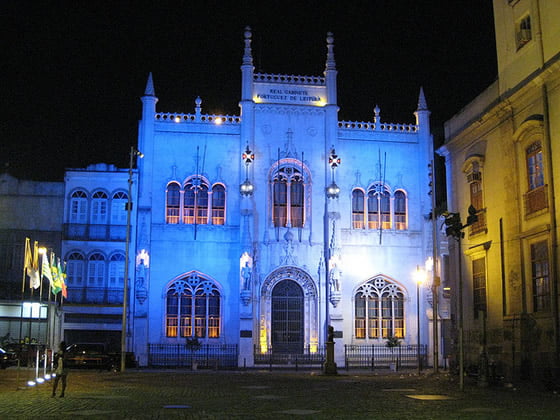
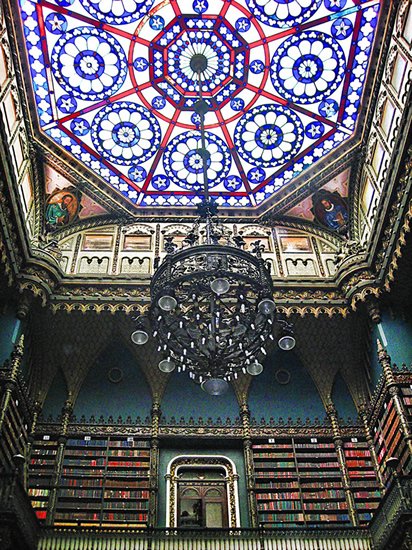
The Most Fascinating Libraries of the World 08 - The Royal Portugese Reading Room in Brazil

I visited a friend's blog one day and I was literary blown over by a picture of one of the most fascinating libraries around - Trinity College Library in Dublin, Ireland. It also gave me an idea of a series of posts about the best, the most beautiful, the strangest and the biggest libraries there are. The libraries that can make you drool, where you would be able to spend an indefinite period of time without noticing, where you would like to live and die till the end of the world (if they only served coffee and cake that is). Perhaps you can't visit them all but what is the Internet for? I'll try to illustrate my posts as well as it is only possible, providing, I hope, a nice tour for every visitor around. Enjoy!


The Royal Portuguese Reading Room, Rio de Janeiro, Brazil


The Real Gabinete Português de Leitura in Rio de Janeiro holds more Portuguese works than anywhere outside of Portugal, including a number of rare titles. The building is adorned in the neomanuelino style based on the Gothic-renaissance style that was popular at the time of the Portuguese discovery of Brazil. Inside the library there is both a stunning chandelier and a gorgeous iron skylight that was the first of its kind in the country.
Images courtesy of Luciano Joaquim’sSebastian R.’s and Mathieu Struck’s Flickr streams.


Read the full text here: http://www.mentalfloss.com/blogs/archives/125697#ixzz2CHkYJdNC
--brought to you by mental_floss! 


Constructed between 1880 and 1887, it has more than 350,000 volumes in a library, fully computerized, which brings together rare books from the XVI, XVII and XVIII. The library receives a copy of Portugal for each of the works published in the country according to its status of “legal deposit”.

The facade, inspired by the Jeronimos Monastery in Lisbon, was carved in limestone in Lisbon and brought by ship to Rio. The statues and medallions sculptured in the entrance portray distinguished Portuguese, including Pedro Álvares Cabral, Luís de Camões and Vasco da Gama, as the eternal guardians of the human knowledge.


Gorgeous, isn't it?
By the way, if you want to admire other great libraries, presented by me in this series, search this blog using 'libraries of the world' tag and you'll find them all.

Tuesday, 13 November 2012

Review: A Night Like This by Julia Quinn

Book info:Form: e-book, pdf format
Genre: bad romance
Target audience: fans of bad romance
My impressions:

Once upon a time an English aristocrat called Daniel returned home from three years of wandering abroad. You see, he was hiding from another aristocrat who wanted to kill him because Daniel wounded his son during a duel. Ok, never mind.  As soon as our hero returned he saw a beautiful girl.

 "She was petite, small in that way that made a man want to slay dragons". 
Hmmm...I don't doubt she looked like this:


Oh no, sorry, wrong picture. She was of course looking like this:


Nononono, wrong picture again. Ok, I am pretty sure she looked more like this:


Here you go. She was playing the piano during a concert and, as soon as he saw her and she saw him they fell in complete insta-lust. It was as if his inner self kept whispering into his ear:


WRhawwwrrrr....Of course, being a young man and an English aristocrat to boot he had to check whether that claim was more or less true. His beloved was called Anne Wynter and she was employed as a governess in the house of his female cousins who, being unbearably shallow and sweet, all looked the same :


They tittered and quarrelled and giggled...Well, they had every right to be similar and stupid, it's not their story, right? Anyway Daniel started to visit them very often just to be in the blissful presence of their governess and...er...touch her hand from time to time.


Still the governess had her own secrets and, being very sadly experienced when it comes to the close contacts with the so-called gentlemen she wasn't that willing to let him touch her...er... anything. Daniel also had a bunch of problems on his own. 


No, dear ladies, there is nothing to laugh about. English aristocrats do have serious problems and English governesses always have a secret or two hidden in a drawer right next to their underwear. Do you want proof? Here you go, a direct quote:

"He wanted her. He wanted her completely.
But his family was waiting for him at supper, and his ancestors were staring down at him from their portrait frames, and she—the woman in question—was watching him with a wariness that broke his heart.."

You see? A real problem. 


Then they go to the country together and our sweet Anne found herself falling deeper and deeper in lust because Daniel was so sweet and so pretty and SO incredibly rich...and here the problems of our governess started to emerge from her overflowing drawer:

But really, it didn’t matter who she was. Anne Wynter . . . Annelise Shawcross . . . Neither one of them was a suitable match for Daniel Smythe-Smith, Earl of Winstead, Viscount Streathermore, and Baron Touchton of Stoke. He had more names than she did. It was almost funny.


Yes, dear sir, you heard it right. The word was 'funny'.

Then there is a lot of talk about food and food preferences, kissing or not kissing, strolling or not strolling and different trivial hobbies of young brainless ladies. You see, Daniel wanted to know his beloved better, to see her soul and her heart, not only her luscious body. Do guys necessarily need a woman's background history to spontaneously want to bang her or play epic-kiss-face? Yes they do. But only just a little bit. A real masterpiece of romance literature, with great, well-rounded, interesting characters don't you think, dear reader? 

After a while my eyebrows get stuck up high and I couldn't believe I was reading such a depressingly shallow book. Still a challege is a challege, right? After page number 65 I started SKIMMING very seriously. Otherwise it would be...


It didn't help much. You see I kept encountering such fragments:

"Could you imagine? Telling Lady Pleinsworth the truth about her background?
Well, the thing is, I’m not a virgin.
And my name is not really Anne Wynter.
Oh, and I stabbed a man and now he’s madly hunting me until I’m dead.
A desperate, horrified giggle popped out of Anne’s throat. What a resumé that was."


I was just waiting for the main villain to appear and save the day. Silly, silly me. Instead of a villain I got a papercut bloke.

"George just shrugged, and in that moment he confirmed all of Anne’s darkest suspicions. He was mad. He was utterly, completely, loonlike mad. There could be no other explanation. No sane individual would risk killing a peer of the realm in order to get to her."

Irrefutable logic, my lady.


The endig was in perfect accordance with the rest of the book: senseless, stupid, shallow, not really resolving anything so completely redundant. But it was the end of my suffering. 


Final verdict:

After reading such a book I feel like this:


I do not recommend it to anybody. Unless you are a masochist. Even then try a therapy first.

Sunday, 11 November 2012

Review: The Raven Prince (Princes Trilogy 01) by Elizabeth Hoyt

Book info:

Genre: historical romance but I would drop the historical part
Target audience: adults
Form: e-book, pdf format

Synopsis:

The Raven Prince takes place in eighteenth century England.

Edward de Raaf, the temperamental Earl of Swartingham, nearly runs over Anna Wren, a relatively young widow returning from the market. Shortly after that, Edward finds himself in need of a new secretary. The last few secretaries have all fled the earl’s employ in the face of his appalling temper and since he doesn’t give his steward, Mr. Hopple, much time to come up with one, Hopple hires Anna. It is unconventional, to say the least, to have a female secretary but Anna has a fair hand and is not intimidated by Edward, so the job is hers. By the way she is desperate to keep her position - the investments that the late Peter Wren left to his wife and by extension, his mother, are not doing very well.

It doesn’t take long for a sexual attraction to emerge between Edward and Anna as they spend time together. All of Edward’s family died of smallpox when he was a child, and he lost his first wife in childbirth, so starting a new family is important to him. Still Anna is infertile and she belongs to lower class, so he feels he can’t marry her, and he goes to London to propose marriage to a more appropriate young lady with a significant dowry. While in London, he also plans to visit Aphrodite’s Grotto, a luxury house of ill repute.

A bit earlier Anna discovers a bill from Aphrodite’s Grotto, and she realizes Edward is a customer there. Soon afterwards she finds a sick prostitute lying in a ditch and takes her home to nurse. The girl, called Pearl, asks Anna to contact her demimondaine sister, Coral, who is living and working in London. Pearl and Coral help Anna to gain access to the said whorehouse wearing a mask and become secretly the lover of Edward. Still will it help solving other problems of Anna or will it make her situation even more complicated?


What I liked:

Never judge a book by what is written on the insert or at the back of the cover. Frankly the blurb of this one reads like some idiotic erotic romance book that publishers seem to think are so popular and profitable nowadays – a virginal heroine turns all of a sudden a skanky ass prostitute in order to sate her newly discovered passions and get her man.

It is a romance book with an actual plot and its characters are interested in something more than just going to bed together. Both Anna and Edward seem real and are grounded in the reality, as constructed by the author. What’s more their physical appearances are relatively ordinary – Anna’s only good feature is her luscious mouth and Edward is a blunt, unpretentious farmer, not afraid to get dirty, with pox scars all over his face and body – his appearance is actually closer to ugliness and he is pretty much aware of it. It was a nice surprise after reading about all these beauties who charm everybody around them and have just one big problem: what colour emphasizes their beauty the best.

The fairy tale of the raven prince, intertwined with the story, was lovely, and I enjoyed the way the bird theme was woven throughout the book, with Anna’s last name, the comparisons of Edward to a raven and the fact that the prostitutes were sometimes (but not in this book, pity) called ‘birds of paradise’ or ‘soiled doves’. Oh, and the sex scenes were hot – one of the best I’ve read so far. Indeed, I have no gripes at all with Anna and Edward’s erotic encounters, which were sensual and rich with sensory descriptions.

I also liked the character of Coral, the successful demimondaine, and I regretted she didn’t play a more important role in the novel. Her cynicism really appealed to me and I hope that she makes further appearances in future books of this series – she clearly deserves that.

What I didn’t like:

The biggest issue for me was probably how wrong and anachronistic the book felt to me. It was supposed to be a historical romance but it is as far from any historical reality as it can only be. In fact it would be better if you forgot about the ‘historical’ adjective altogether, treating all these stays, tricorn hats, bustiers and wigs as merely theatrical props. First of all let me tell you that the characters, ALL the characters, speak and think using more or less modern language and 21st century way of thinking. When Anna finds out that Edward patronizes a brothel in London she is incensed by his hypocrisy – why should whores be anathema when the men who use them remain perfectly respectable? Very well, my lady, I agree with you on principle but it is definitely not a way of thinking for a respectable, church-attending 18th century female.

Then, Hopple and Edward hired Anna as a secretary, at a time when only men were secretaries and woman’s place was only in the kitchen and in the nursery or cleaning rooms. I am pretty sure a lady in the 1760’s wouldn’t be able to take up such a post to a peer without causing huge ructions and a lot of condemning - I found this really difficult to swallow.

I’m not saying that these words themselves are actually anachronistic. They may in fact have been in use in 1760. But the expressions comprised of those words sound contemporary to me, and that was enough to pull me out of the story. For example, Anna goes on about Edward’s attractiveness to her mother-in-law and I just couldn’t suspend disbelief that this conversation was taking place in 1760. There were other examples of speech that seemed contemporary to me. Edward says “Shit" in Anna’s presence. He also refers to another character as “that baboon”. There’s mention of a “crackpot theory”. Edward’s valet says to Anna, “Don’t have to be snotty”. I really wish the author did some in-depth research or change the settings of the novel.

Finally the little London adventure of Anna…well, it was something few modern women would be brave enough to do; I really couldn’t believe she, a respectable widow, decided to play a prostitute just to get the attention of Edward. When he found out her ruse he was surprised but not outraged. Are we really talking about times when a single woman, widow or otherwise, couldn’t talk to a gentleman face to face without a companion because she risked tarnishing her reputation? In my opinion Edward was strangely unconcerned by the resourcefulness of his beloved although before he had expressed his worry that she took a sick whore to her house.

Now the ending…it was as if a nasty witch sneaked inside the novel and changed it from a reasonably good story into something unbearably naïve and inane because otherwise it wouldn’t be a romance. Spoiler - highlight to read or skip: although Anna was pretty much sure she was barren, all of a sudden we find her with a son and pregnant again, her husband on cloud nine. It seems the moment you find the right man you get cured from whatever have ailed you before and you can have children if you wish so, right? WRONG.

Let me also say that the cover isn't reflecting either the story or the period - a major meh.

Final verdict:

As far as romance books go this one wasn’t bad – I really appreciated some fresh ideas and the fact that its characters were closer to real people. You can enjoy it providing you treat the whole historical set in a very liberal way and you don’t mind those cloying HEA endings.

Tuesday, 6 November 2012

The Ffifth of November

English: Fireworks display, Aykley Heads, Durham
English: Fireworks display, Aykley Heads, Durham (Photo credit: Wikipedia)
English: Sparkler, violent reaction (guy fawke...
English: Sparkler, violent reaction (guy fawkes) Français : Cierge magique pendant la nuit de Guy Fawkes, en Angleterre. (Photo credit: Wikipedia)

English Folk Verse (c.1870)

The Fifth of November


Remember, remember!
The fifth of November,
The Gunpowder treason and plot;
I know of no reason
Why the Gunpowder treason
Should ever be forgot!
Guy Fawkes and his companions
Did the scheme contrive,
To blow the King and Parliament
All up alive.
Threescore barrels, laid below,
To prove old England's overthrow.
But, by God's providence, him they catch,
With a dark lantern, lighting a match!
A stick and a stake
For King James's sake!
If you won't give me one,
I'll take two,
The better for me,
And the worse for you.
A rope, a rope, to hang the Pope,
A penn'orth of cheese to choke him,
A pint of beer to wash it down,
And a jolly good fire to burn him.
Holloa, boys! holloa, boys! make the bells ring!
Holloa, boys! holloa boys! God save the King!
Hip, hip, hooor-r-r-ray!


I know, today is the 6th of November but still better late than never.

On the 5th November 1605 Guy Fawkes was caught in the cellars of the Houses of Parliament with several dozen barrels of gunpowder. Guy Fawkes was subsequently tried as a traitor with his co-conspirators for plotting against the government. He was tried by Judge Popham who came to Londonspecifically for the trial from his country manor Littlecote House in Hungerford, Gloucestershire. Fawkes was sentenced to death and the form of the execution was one of the most horrendous ever practised (hung ,drawn and quartered) which reflected the serious nature of the crime of treason.

A contemporary engraving of eight of the thirteen conspirators, by Crispijn van de Passe.
 Fawkes is third from the right.


Within a few decades Gunpowder Treason Day, as it was known, became the predominant English state commemoration, but as it carried strong religious overtones it also became a focus for anti-Catholic sentiment.Puritans delivered sermons regarding the perceived dangers of popery, while during increasingly raucous celebrations common folk burnt effigies of popular hate-figures, such as the pope.

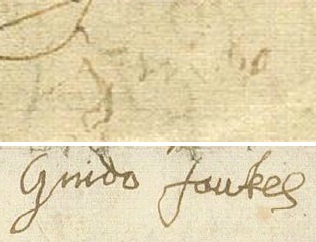
Top: Signature of
Top: Signature of "Guido" on his confession under torture, very faint and shaky. Bottom: Signature of "Guido Fawkes" on a further confession 8 days after being tortured. (Photo credit: Wikipedia)

Towards the end of the 18th century reports appear of children begging for money with effigies of Guy Fawkes and 5 November gradually became known as Guy Fawkes Day. Towns such as Lewes and Guildford were in the 19th century scenes of increasingly violent class-based confrontations, fostering traditions those towns celebrate still, albeit peaceably. In the 1850s changing attitudes eventually resulted in the toning down of much of the day's anti-Catholic rhetoric, and in 1859 the original 1606 legislation was repealed. Eventually, the violence was dealt with, and by the 20th century Guy Fawkes Day had become an enjoyable social commemoration, although lacking much of its original focus. The present-day Guy Fawkes Night is usually celebrated at large organised events, centred around a bonfire and extravagant firework displays.
Enhanced by Zemanta

Monday, 5 November 2012

Review: The Prince (Original Sinners 03) by Tiffany Reisz

Synopsis (from Goodreads):

Keep your friends close and your enemies closer...preferably in bed. That's always been Kingsley Edge's strategy with his associate, the notorious New York dominatrix Nora Sutherlin. But with Nora away in Kentucky, now it's Kingsley's chance to take her place at the feet of the only man he's ever wanted -- Søren, Nora's on-again, off-again lover -- until a new threat from an old enemy forces him to confront his past.

Wes Railey is still the object of Nora's tamest yet most maddening fantasies, and the one man she can't forget. He's young. He's wonderful. He's also thoroughbred royalty and she's in "his" world now. But Nora is no simpering Southern belle, and her dream of fitting into Wesley's world is perpetually at odds with her dear Søren's relentlessly seductive pull.

Two worlds of wealth and passion call to her and whichever one Nora chooses, it will be the hardest decision she will ever have to make... unless someone makes it for her...

My impressions:

It will be an unusual review. If you want to read a real, serious, adult, more or less intelligent critique and know what I roughly think about The Original Sinners books penned by Ms. Reisz, please go to my review of the Angel or The Siren. I feel I told everything I had to tell while writing those two. Now time for some reviewer's fun. I started the book in the appropriate mood, knowing already what I was going to find. Still, as I got it from NetGalley free of charge I felt obliged to read it despite my lack of enthusiasm:
Ok, we get some flashbacks in which the author tells us about Soren and Kingsley's mutual infatuation at that very Catholic school of theirs. It still was the best thread of this story, honestly. But as soon as we returned to "the present" my mood changed dramatically:


When Nora went to Kentucky with Wes, who happened to be a rich, handsome, sweet Prince, no longer just a poor college student with type 1 diabetes my disgust increased :


Couldn't at least one character in this series be actually less than pretty and rather poor? Then there was the whole process of Wesley losing his virginity - yes, he forgot about his faith and moral principles because clearly they never concerned the divine Nora Sutherlin. Acting out of character and going with her to er...more or less bed was roughly as sexy as this beauty:
Then we got that mystery thread (who wants to attack Soren, Nora, Kingsley and destroy their little BDSM kingdom? Who DARES?) which was TRANSPARENT from the very beginning to anybody with 1 brain cell in working order.


Really, that obvious. 

 And finaly the big love between Nora and Wes despite their huge differences in practically anything and the big fat love between Soren and Kingsley despite the fact that Soren is a sadist and Kingsley is...well...French *groan* How come nobody saw anything coming their way?  I would comment it shortly:

The writing style? It made me as nice and cozy as looking at this guy:


The book ends with a big fat cliffhanger. There will be the fourth part coming. Will I continue reading the series? NO.


Final verdict:

Thank you very much for your kind attention. Have a nice day.
Enhanced by Zemanta