Showing posts with label movie review. Show all posts

Friday, 16 August 2013

Movie Review: The Invisible War by Kirby Dick

The Invisible War is a 2012 documentary film written and directed by Kirby Dick and produced by Amy Ziering and Tanner King Barklow about sexual assault in the United States military. It premiered at the 2012 Sundance Film Festival, where it received the U.S. Documentary Audience Award. The film was nominated for Best Documentary Feature at the 85th Academy Awards. I am not surprised - it fully deserves far more than just that.

My impressions

The movie features interviews with veterans (mainly female but also male) from multiple branches of the United States Armed Forces who recount the events surrounding their assaults. Their stories show many common, depressingly recurring themes:  the lack of recourse to an impartial justice system, reprisals against the victims instead of against perpetrators, the absence of adequate emotional and physical care for survivors, and something which I found perhaps the most sickening of all,  the unhindered advancement of perpetrators' careers, and the forced expulsion of survivors from service. In short they show how low the US Army really values their best and brightest soldiers.

In the film's most prominent narrative, Coast Guard veteran Seaman Kori Cioca struggles to earn benefits from the Department of Veterans Affairs to pay for the many medical difficulties that have resulted from her very brutal rape perpetrated by one of her colleagues. Although she has a husband and a little daughter, Kori cannot function normally and she needs urgently several costly operations but nobody wants to hear about her problems, let alone finance the treatment. She shows that the doctors keep prescribing her the same set of pills which, combined, might have led to her premature death - fortunately she's learned not to take them together. With the help of attorney Susan L. Burke, Cioca, along with other survivors featured in the film, brings a civil suit against the Department of Defense alleging a failure to adequately address sexual assault within the military. Their suit is, surprise, surprise, unsuccessful. They don't give up but you can say it is going to be one long struggle, lined with barbed wire and concertina of neglect, lies, procrastination and humiliations.

If you're a young person thinking of enlisting in the U.S. military, you might want to give this some thought: a recent court decision held that rape was actualy among "occupational hazards" of the job. I bet they haven't included that one in any recruitment materials, have they? Department of Defense official figures indicate 22,800 rapes occurred last year in the Armed Services. Most of the victims were women, but perhaps 10 percent were men. Everybody agrees it is just a tip of the iceberg because most of assaults, like 80%, aren't reported - for obvious reasons. If victims are told that they might be accused of adultery, public intoxication and slander in turn, then publicly punished shamed and demoted, you should be hardly surprised they do think twice before filing a complaint.

Why rape is so disgustingly popular among military? Why is it so difficult to get any amount of justice? The military is a macho, adrenaline-fueled culture which in turn draws attention of power-crazy, abusive sociopaths. It doesn't mean every single one of military men and/or women is a rapist; it rather means that a violent rapist might be particularly inclined to join the ranks of military because he/she might perceive it as an opportunity for having mostly nonpunishable 'fun' and a fresh batch of victims in a form of recruits.

The Army lay great emphasis on authority and teamwork. You follow the leader - no questions asked. You go along with the program - no matter at what cost. You never mention anything negative or criminal because it might lower the morale and cast a shadow on your own career prospects. What's more, your complaint not only puts your commanding officer in a bad light, but also may involve him; the film says "25 percent of women didn't report an incident — because their commander was their rapist." Quis custodiet ipsos custodes?

Until a few months ago, there was no way to go above your commander to report a rape. Defense Dept. Secretary Leon Panetta saw this film, and two days later, issued an order changing that practice. But the over-all problem remains. Rape is twice as common in the military as in civilian life, and "an estimated 15 percent of recruits attempted or committed rape before entering service." In other words if you need a rapist in your life, join the Army - any branch will do - and sooner or later you're bound to meet one.

If I had to choose the most disturbing moment I would be really spoilt for choices; still I guess my award would go to that silly military sex abuse prevention campaign which was supposed to make all the difference. One of its slogans reads: 'ask her when she is sober'. I found it highly offensive, especially after getting to know all those sad, horrible stories of rape. So, accroding to the military PR specialists, basically only women soldiers get drunk, right? And, after all, it IS a bit of their fault because they tend to overuse alcohol and then some men, poor things, simply cannot restrain themselves...but still, mind you, they will always ask you first, like fine gentlemen they are...what a pile of stinking, macho bullshit.

Finally the most moving and absolutely heartrending parts were about the aftermath of rape. Every victim, and we speak here about incredibly strong women and men, both physically and mentally, cried when talking about their experience. Some said it was actually more humiliating than the rape itself. Their tears were more telling than any statistics or facts provided.

Final verdict:

An absolute must-see for any young woman who dreams about a military career in the US or anywhere else - watch it before it is too late, do your research and ask the right questions during the recruitment process. Also a strong documentary which tries to explain why  rape culture is alive and kicking and why, even if you are a high-profile professional, male or female, you cannot demand any respect or decency from your military superiors and coworkers. The film's implication, quite starkly, is that a strong military doesn't favor crybabies, that a certain degree of rape is simply unavoidable — and inevitably, that some women may have been asking for it. Begging for it in fact. One hearing noted that the victim was dressed provocatively in a short skirt- the said skirt being the part of her official uniform. How very indecent of her. Catch 22 anyone? The US Army is waiting.


Monday, 12 August 2013

Movie review: Red by Robert Schwentke

Release date: 2010


Starring: Bruce Willis, Mary-Louise Parker, Morgan Freeman, John Malkovich, Helen Mirren

Synopsis:

Frank Moses is a retired CIA agent. He lives alone in a comfortable, pristine house, takes his pills every morning, exercises in the basement and waits for the pension check to arrive. As soon as he gets it, he tears it down in order to have a pretext to phone and talk with his social security phone crush, a woman called Sara. It is his only pastime and he has never seen Sara in real life. Yes, he is so romantically awkward, lonely and bored. Fortunately lovely Sara, although much younger than Frank, seems almost as bored with her life as him – she reads Harlequins (“Love’s Wild Secret” is her latest choice - horrible but so enticing), she goes on dates, one more botched than the other, she dreams of travelling and exotic countries.

One night, though, Frank’s boredom is over. A special forces squad is sent to murder him. Who and why – you can only guess and our hero is hardly surprised. After so many years in CIA you are bound to know some dangerous secrets, right? In fact it seems he has been preparing himself for such a possibility all that time; mind you he knows every trick in the special operations books and then some. Not only he neutralizes his opponents very efficiently but also he manages to escape more or less unscathed, grabbing a bag full of documents, cash and everything a man on the run might need in order to survive for several weeks. Still Frank will be anything but alone. He goes to Sara in Kansas City and takes her away for their first date – literally kidnapping her. Then he pays visits to all his old pals who might be also targeted. They form a nice little squad on their own. Who will prevail, young CIA agents or their retired counterparts?

My impressions:

It's a comic book adaptation starring actors who are mostly over the age of 50 or 60. And it's paced like a movie for older audiences, too. Technically I shouldn’t have liked it but I did. This film might be not a killer thrill ride but I admit I haven’t seen a better spy comedy for a long time. It tells you that you are never too old for a mayhem (read: fun and fireworks) in your life and the allure of firing an honest-to-god RPG outweighs the prospects of peaceful retirement and tending to your garden – a refreshingly original premise.

Bruce Willis did surprise me – I hardly remember his other roles but this one was fun! A retired agent role suited him perfectly and there was one simply precious scene when he and his beloved Sara were reading the same romance novel (but, of course, for different reasons!).

Overall all the actors seemed to have a lot of fun while shooting this one and it translated into a piece of effortless entertainment even though, from time to time, you must put your brain on hold, preferably with some relaxing music in the background. Not every plot twist makes sense, not everything is easily believable but who cares when Helen Mirren is killing a bunch of baddies with a big machine gun positioned on a tripod, wearing a scrumptious evening dress with make-up and an impeccable hairdo to match? Or John Malkovitch, in full obsessed-weirdo-camouflage outfit, helps her swapping glossy stilettos for sturdy outdoor boots? You would have to be dead in order not to smile!

Final verdict:

A perfect light comedy for an easy evening – good humour afterwards guaranteed. You can even watch it with the whole family, most probably nobody will get bored
Enhanced by Zemanta

Wednesday, 31 July 2013

Movie review: The Life of David Gale by Alan Parker

Directed by Alan Parker
Release date: 2003
Screenplay: Charles Randolph
Cast: Kevin Spacey, Kate Winslet, Laura Linney, Gabriel Mann, Matt Craven, Rhona Mitra
The Life of David Gale
The Life of David Gale (Photo credit: Wikipedia)

Summary:

"The Life of David Gale" tells the story of a professor of philosophy and a famous opponent of capital punishment who, in what he must find an absurdly ironic development, finds himself on death row in Texas, charged with the rape and murder of Constance Harraway (Laura Linney), a woman who was not only his fellow activist but also one of his few real friends. The whole plot revolves about David’s brilliant academic career and his swift, steep fall, right into the arms of degrading unemployment, alcoholism and despair, with a divorce and even more painful estrangement from his little son as seasoning.

While in prison, David Gale, understandably a very bitter man who's lost literally everything, decides to tell his version of events and to protest his innocence to a reporter named Bitsey Bloom (Kate Winslet), summoned especially to Texas. They are given a limited amount of time, two hours every day in a short, 72-hour period right before the impending execution. Very soon – apparently during the first session- Bitsey becomes more or less convinced of David's innocence. She is joined in her investigation by her eager intern Zack (Gabriel Mann), and they become aware that: a) Gale’s attorney is a shifty fellow who won’t lift his little finger if he doesn’t have to and, it seems, he doesn’t care b) they are being followed everywhere in a pickup truck by a gaunt-faced man in a cowboy hat, who is either a right-wing death-penalty supporter who really killed the victim and framed David or somebody sinister else. Will they manage to prevent the worst – a judicial murder of an innocent – against all odds?

My impressions:

This movie was recommended to me by Rameau (thank you!) and its online blurbs read really well: an interesting plot about a complex man with a cause, an important cause to boot, a film starring plenty of great actors and actresses and set in Texas (yeeehaaaw!). What could go wrong? Unfortunately quite a lot but let’s start with the positives.

I really liked David Gale as portrayed by Kevin Spacey. He was a truly three-dimensional character, a man with many vices and demons, a brilliant scholar, very human and never ashamed to admit it, cruelly punished for his own cleverness. Spacey has exactly the right amount of understated earnestness to make such a character work effectively; actually it seemed that the role was too easy for him, especially if you remember his other creations. I believe this kind of role he could play in his sleep. Spacey's finely honed performance was coupled with those of Kate Winslet and Gabriel Mann who did their bits well – no fireworks but good, believable performances nevertheless.

The movie is set in Texas, a delightful location as it is the very US state which, in a good year, all by itself, carries out almost half of the executions in America. Death Row in Texas is like a machine. It’s no longer about human life and sanctity thereof, it’s about efficiency of getting rid of those pesky criminals. Faced with such a soulless, bureaucratic machine , Gale knows very well he has just a few days to prove his innocence before he's sent for some short, sharp, shock treatment in the big, uncomfortable chair. And here all my problems began. Told in flashback, "The Life of David Gale" started piling up more and more clicheed red herrings than a fishmonger. As the plot twists are ironed out for the revelatory finale, it's clear that there's actually a lot less to this than meets the eye. The man in the cowboy hat – why did they need him to behave in such an outrageous way? It was beyond silly as it screamed 'guilty' from a great distance. And that lawyer? He screamed “guilty” in every frame as well and guess what? He was! (not a big spoiler, really). Where is the subtlety and subterfuge? As though Parker felt the film's point was in danger of being missed, he spelled it out for us at critical moments with the use of text. Words such as 'Guilty', 'Innocent', 'Lust' 'Power' and 'Desire' flash up on screen, serving little purpose other than take you out of the drama and remind you that you're in the hands of a calculating director.

Finally my biggest complaint. I am sure the filmmakers believe their film is against the death penalty but, contrary to them, I believe it supports it. In my eyes the ending discredited the opponents of that penalty as unprincipled fraudsters, shifty and ruthless like (or even more than) your average politician or lawyer. In other words (spoiler, highlight to read) the final revelation on the videotape registered during the so-called murder, when we see it was in fact a suicide, was to me like a punch in the gut. Surely David Gale knew that Bitsey Bloom couldn't keep it private without violating the ethics of journalism and sacrificing probably the biggest scoop of her career so it served no functional purpose except to give a cheap thrill to the audience and make you doubt everything, the noble 'no-death-penalty' cause included. If you are against the killing you are not supposed to kill yourself or force anybody else to kill - it sounds like a logical premise, right? I was left stupefied that somebody as intelligent as David and his fellow activists had ever agreed with such a plan. Congratulations on shooting your cause movie in the leg, Mr. Parker because no, with such an ending I don't think it was deliberate.

Final verdict:

I would call this movie an excellent example of lost opportunities - an unconvincing, dishonest and leaden political message drama that takes a stand against capital punishishment, but does its cause more harm than good . It could have been something epic and it is merely average. What a pity. Still I do not regret having watched it.
Enhanced by Zemanta

Friday, 26 July 2013

Movie Review: Hollywoodland by Allen Coulter

Directed by Allen Coulter
Written by Paul Bernbaum
 Cast:
Adrien Brody as Louis Simo
Diane Lane as Toni Mannix
Ben Affleck as George Reeves

Bob Hoskins as Eddie Mannix
Robin Tunney as Leonore Lemmon


Synopsis:

The story presents a fictionalized account of the shadowy circumstances surrounding the death of a real actor, George Reeves (played by Ben Affleck), the star of the 1950s television series Adventures of Superman.

Adrien Brody co-stars as a fictional character, Louis Simo, a private detective investigating the death of Reeves at a request of his mother who doesn't believe in the official version of events. Soon Simo learns from a former police colleague that the Reeves suicide has aspects that the cops don't want to touch. Sensing the potential for making a name for himself and earn some money as well, Simo begins investigating and notes several apparent conflicts with the official version of Reeves's death. Soon enough he feels sympathy for the victim and wants to solve the mystery of his death despite many obstacles, thrown his way and knowing fully well that it might be detrimental to his professional plans.

In a flashback to 1951, Reeves, a charming young journeyman actor whose career has stalled since appearing in Gone With the Wind, catches the eye of a beautiful but definitely older woman in a restaurant. They end the night in bed. In the morning, a newspaper photo reveals to Reeves that his lover is nobody else but Toni Mannix (Diane Lane), the wife of MGM studio executive Eddie Mannix (Bob Hoskins). Frightened that an affair with a studio boss's wife will destroy his every chance for a decent role, Reeves wants to make it just a one-night stand. Toni, however, claims to have an open relationship with her husband, who, with her knowledge and consent, has a Japanese mistress of his own. Toni and George continue to see each other and everything seems to be rosy.

 Being much wealthier and apparently completely infatuated with her younger lover, Toni behaves like your average sugar mommy. She buys Reeves expensive gifts such as a house and a car. She also arranges a meeting with her husband, helping him to get the starring role in the television series Adventures of Superman, based on the comic-book hero. The role makes Reeves famous and gives him a steady income, but he longs for more ambitious work. He becomes rather uncomfortable with the public's stereotype of him as Superman, resulting in snickers when he is seen on screen in other productions like the war film From Here to Eternity.

Right before his death Reeves ends the affair with Toni and becomes engaged to a younger woman, an aspiring actress Leonore Lemmon (Robin Tunney). He wants to direct his own movies, move forward so people finally stop connecting him with the Superman. Unfortunately one night, right in the middle of a modest house party, he goes to his bedroom and shots himself, or is shot, apparently without any reason at all. Who did it and why?

My impressions:

It was one great movie. Actually I was surprised by the fact how much I liked it. Everything worked fine: Ben Aflleck as Reeves, Adrien Brody as Simo, the atmosphere of the 50s in Hollywood, the difficulties and woes of pursuing an acting career, everything. I never thought I would praise Ben Affleck as an actor and here he acted splendidly! What's more I learned why Superman series is cursed (yes, it is! that's official!) and some actors actually fear to be cast as that super hero in blue and red body stocking. The premise that the mysterious and unexpected death of an iconic Hollywood star may be just the tip of an iceberg of scandal in this showbiz drama rang so true.
Reeves’ death is still shrouded in mystery and Hollywoodland does its best to shed light on the decades old case which remains officially classified as a suicide.

This is a rare film that can be both intelligent and entertaining. It has comedy (not a lot but nevertheless), powerful scenes, great acting and a compelling story. Its biggest advantage? The director doesn't offer a ready-to-adopt solution, Olivier Stone - style, doesn't pretend to know more than the public, doesn’t yield any answers to the lingering question of did he or didn’t he. He only presents a couple of the more widely believed theories as to what happened that tragic night and plops them front and center to be examined and talked about by contemporary audiences. He treats the viewers as his peers, not a class of stupid pupils to be patronized and educated. 

The actors were splendid. I know I've already mentioned it but let me also add that Diane Lane’s sexy and vulnerable performance as Toni Mannix I consider one of her best. Lane never takes it over the top, even keeping the more emotionally charged scenes under control. The choice of Lane and Affleck as lovers isn't obvious but it works thanks to solid performances from both actors. Yes, Mr Affleck, this time you won me over, what a very pleasant surprise! Finally Adrien Brody delivers another riveting performance as the intelligent private eye with his own set of issues who tenaciously fights for the truth. Brody's responsible for making the story accessible, and in his hands the tale fully springs to life.

Final verdict:

A movie I recomment and one I'll watch again with real pleasure. It is an example of a well-written adult drama, that teases answers and sparks conversations. Although it could have been a bit shorter, Hollywoodland’s definitely a must-see for mature audiences who love a good mystery.
Enhanced by Zemanta

Friday, 19 July 2013

Movie review: The Host directed by Andrew Niccol and viewed by my fair lady Blodeuedd


Welcome Blodeuedd from Book Girl of Mur-y-Castell !!!

She agreed to review a movie for my blog and it is a movie I would never dare watch: The Host based on an infamous book of Stephenie Meyer, woo-hooo! She is a brave girl. What does she think of the movie? Was it better than the book? Let's check out!


Ana asked me to review The Host after I told her I watched this sorry excuse for a movie. And well if Ana asks you have to do what she wants.

It's not that the movie sucked, ok sure I sighed, rolled my eyes, laughed at it, but the scenery was nice and it had....sort of a good premise and potential. Oh and it was 100 million times better than the book. I tried to read the book but gave up at page 1 and tried to skim, but even skimming was boring. So the movie rocked the book.

Now what went wrong...everything! The story is about an alien and a human sharing a body and oh oh falling in love with different guys *head desk* Worst love triangle with 3 bodies and 4 minds ever. At one point the voice is all no no do not kiss him...eh, it's still your body stupid and you are still there, in a way you are kissing him. But yes I could go on and on, it was silly.

Right, so these are aliens who are so smart and have the best tech ever, but do they find the resistance? No. Instead they look for them. Oh god, let me laugh, looking with a flashlight. I would expect better technology searching for them. You are smart, figure it out.

Melanie Melanie, she is a special little snowflake. She has the strength to scream in Wanderer's head and even use the body. Isn't she the most special of them all. Then we have Wanderer, another little snowflake it seems. Sure we learn there is at least one other person but still. Special snowflakes lalala.

Melanie and Wanderer, 2 TSTL idiots. Wanda just blindly wanders off cos she is stupid. Yes let's go to the humans who want to kill you. And Melanie, does not want people to know she is inside Wanda..eh..excuse me? That makes no sense. The humans are stupid too, kill her at once! No, take her prisoner instead *head desk*. That they sure didn’t do with anyone else, but then Wanda is a special snowflake. She does not tell anyone that Mel is still inside her, instead a human falls in love with her. I still do not get it, I know it gives something to the sorry excuse of a plot to hide this fact but let's not forget that it makes no sense.

The world, le sigh. I had so many questions! More about the aliens, like who did they first take over? Sure they are logical but they take over and it means death. Are babies made? How will the world survive without babies? Are they like locust? They take over, eat everything and move on? But then I realized this was a Meyer book, so there is no world building.

The endings shows that yes maybe they humans will win. How the fuck they will manage that is another plot hole. They should not be able, but then the aliens are TSTL.

Wanda was also very forgiving. She had her lover boy so yes after being upset for a bit after the humans killed a bunch of aliens she moves on. The thing is I never saw the aliens as bad. They made perfect sense. This is a crap planet, we kill each other and destroy our world. The aliens made it better. The minute they are gone we would destroy each other again.


What to say then. If you liked twilight you will like this one. I would not recommend it though, it had too many roll your eyes moments and wtf? events. But I had to see it anyway, and I do not regret it, I always watch crap movies with this friend I have. It's our thing. So it won the bad awards. Congrats.

Saturday, 29 June 2013

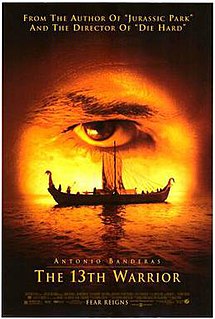
Movie review: The Thirteenth Warriror by John McTiernan


Directed by John McTiernan
Release date: 1999
based on the novel Eaters of the Dead
by Michael Crichton

Genre: historical (?) fiction action film
Cast:
Vladimir Kulich as Buliwyf
Antonio Banderas as Ahmad ibn Fadlan
Omar Sharif as Melchisidek
Diane Venora as Queen Weilew
Clive Russell as Helfdane

Synopsis:

AD 922. Ahmed ibn Fadlan is a court poet to the Caliph of Baghdad—until his amorous encounter with the wife of an influential noble gets him exiled as an "ambassador" to northern barbarians. Traveling with Melchisidek, his caravan is saved from Mongol-Tatar raiders by the appearance of Norsemen. Taking refuge at their settlement on the Volga river, communications are established through Melchisidek and Herger, a Norseman who speaks Vulgar Latin. Ahmed and Melchisidek are in time to witness the fight, which establishes Buliwyf as heir apparent, followed by the Viking funeral of their dead king.

A youth enters the camp requesting Buliwyf's aid: his father's kingdom in the far north is under attack from an ancient evil so frightening that even the bravest warriors dare not name it. The "angel of death," an oracle, determines the mission will be successful if thirteen warriors go to face this danger—but the thirteenth must not be a Norseman. That's how Ahmed is recruited against his will and goes to a completely barbaric land to fight an unknown evil.

Ahmed learns Norse during their journey by listening intently to their conversations. He is looked down upon by the huge Norsemen, who mock his physical weakness and his small Arabian horse, but he earns a measure of respect by his fast learning of their language, his horsemanship, ingenuity, and ability to write.

Reaching King Hrothgar's kingdom, they confirm that their foe is indeed the ancient 'Wendol' - fiends who come with the mist to kill and eat human flesh. In a string of clashes, Buliwyf's band establishes that the Wendol are humanoid cannibals who appear as, live like, and identify with bears. While the group searches through a raided cabin they find a small, headless sculpture of a naked woman's torso, similar to Upper Paleolithic 'venus' figurines. Their numbers dwindling and their position all but indefensible, an ancient wisewoman of the village tells them to track the Wendol to their lair and destroy their leaders, the "Mother of the Wendol" and the war leader who wears "the horns of power".Will they manage to defeat far stronger and completely ruthless opponents? What sacrifice will it take?

My impressions:

I didn't want to watch this movie for a long time. Firstly I read some bad reviews; secondly it featured Mr. Banderas who is not my favourite actor to put it mildly. After a bit of encouragement from The Red Witch, though, I decided to give it a chance. After all it was loosely based on the Anglo-Saxon epic poem, "Beowulf" even if it came via one of Crichton's books, right? "Beowulf" demands some respect and gives hope. Combine it with the fact that I really have a soft spot for epic fantasy movies and here you go - the decision wasn't that dififcult to make. Imagine me watching the movie one rainy May evening. Watching and wondering. 

At first glance the movie was really ok - the atmosphere, the blond, muscled Norsemen, their less-than-hygienic customs, their disregard for death and brutality, the 'oddball' swarthy Arab boy trying to fit in. Still, after watching it I couldn't get over some obvious mistakes which made me think that there were no historians or archeologists, helping the director as consultants. I would sum it up this way: too much Crichton, too little real history.

It is true: the Arabs and Norsemen traded with one another and the contrast must have been interesting. However any history nerd might find out that Hrothgar was a king of Denmark whose chronology was roughly after AD 500. Ahmed ibn Fadlan, a real Arab explorer, flourished circa AD 922. Over 400 years of difference means those two men couldn't possibly have met at all. What's more Ahmed's Islamic faith itself did not exist until after AD 622, so Hrothgar's court could't have encountered any Muslims to begin with. Do you want some more? Here it goes.

On the map at the start of the film Baghdad is in the Caucasus between the Black Sea and the Caspian Sea. In reality it is more to the south west of there, on the Tigris River. It is really one of the silliest mistakes I spotted because so easily avoidable - it's enough to check any map. How hard can it be?

 Then our handsome Ahmed encounters a beautiful woman in the street, who is wearing a strange headscarf over the low part of her face. Not only is this clothing not opaque, which is forbidden to Muslim women wearing headscarfs, but it is a Yashmak, worn first by Turkish women only around 1840. And it is brilliant red - a colour no decent Muslim woman would wear publicly. Of course it shows off the pretty, dark eyes of our enchantress so I guess the director didn't think twice about anything as stupid as historical plausibility...

Finally one more jewel in this short collection: before the last fight, Ahmed Ibn Fahdlan invokes God by calling Him 'Father'. Muslims don't address God like this, only Christians do. And do not let me start on the strange and quite stereotypical demonization of the mother goddess - I found it particularly ignorant and wrong. A Celtic tribe with their painted faces, worshipping a female deity, are once again at least a thousand years out of place.

The actors, however, kept the film from becoming too stupid. The acting was much better than average for this sort of film. Dennis Storhøi enthusiasticly portrayed Ahmed's closest friend among the Norsemen, and Vladimir Kulich gave a quiet dignity to his performance as Buliwyf, the leader of the Thirteen. 

Final verdict:

The atmosphere was right, some scenes I really appreciated and enjoyed but overall...At its best (the final battle) , this came close to the beauty and grandeur of a Kurosawa epic - at its worst, however, it felt like a Python remake of The Vikings. Do not expect anything deeper and do not treat the adjective 'historic' too literaly and you'll be fine. Well, as fine as it is possible.

Monday, 24 June 2013

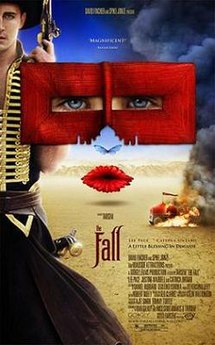
Movie review: The Fall by Tarsem Singh


Directed by Tarsem Singh
Release date: 2006

Cast:
 Roy Walker the stuntman - Lee Pace
Alexandria - Cantinca Untaru
Nurse Evelyn - Justine Waddell
Sinclair / Governor Odious -Daniel Caltagirone  

1915, the dawn of Hollywood. Roy, a movie stuntman, was gravely injured by an on-set mishap involving a horsebacked train-trestle tumble. Now he languishes in an LA hospital. He's become paraplegic, his beloved has broken his heart so he is deeply depressed and wants to commit a suicide. In order to get hold of a lethal dose of morphine he unspools tall tales to a five-year-old orphan girl called Alexandria from another ward. These two share with us the images they conjure up in their minds' eye – huge vistas, storybook heroism and colours so vivid they seem unreal. But of course every tale must reach its conclusion. Will it be Roy's untimely death? Will  Alexandria manage to save him from his demons, pulling him out of his slump ?

What I liked:

This movie is like candy to the eyes. Profiting from jaw-dropping Indian locations, the film dazzles like few others. Small wonder - it was shot in over 20 countries and its commitment to the wonders of the real world is refreshing.It can be actually called a 'two films in one' combo as the narration is divided into several threads. It is also very original, featuring animated sequences, waterborne pachyderms (but hey, the elephants really can swim!), and a drolly humorous imagining of a monkey-conversant Charles Darwin who is wearing a coat (?) worth an exotic parrot. And a bowler hat (see the pic on the left).
Crammed with vivid images of deserts, palaces, magical reefs,  historical figures (also Alexander the Great drops by) and famous landmarks (blink and you'll miss the Blue City in Rajastan or the Eiffel Tower or the Taj Mahal or the Statue of Liberty or the pyramids or the Great Wall), it comes down to earth long enough to establish a connection between two unlikely pals: a little unaffected but spunky girl and a young, disillusioned man, suffering from classic depression.

The power of imagination is the greatest asset of this movie. The year is 1915, but with Roy sharing stories as seductively as Scheherezade, the pair can be anywhere/anytime: jumping into the ring with Roman gladiators, matching wits with an ancient conqueror, battling the evil Governor Odious or transforming themselves into the Black Bandit and his tiny daughter in matching outfits of black and gold.Their story seems to include tall tales of Zorro, Ali Baba and Pecos Bill rolled into one. It was a fun ride - I appreciated evrey minute of it! 

What I didn't like:

Once you’ve been dazzled, that’s it. The pacing dragged after a while and the clichéd tussle between childhood innocence and adult disillusionment can only go one way. The story did lack some depths, being a bit too thin for adults and a bit too dark for kids.While every frame looked drop-dead gorgeous, Tarsem struggled to string them together in a logic way. The feature which disturbed me the most was the fact that there was no overriding tone to this film, which jumped from slapstick comedy to travelogue documentary to wrenching drama. It seems there was no real sense of suspense in the plot and the ending hardly provided any lasting conclusion because we weren't shown whether Alexandria's version of events was true or false.

Final verdict:

A treat in a static kind of way - visually superb but with a shallow story at its core. Still one of the most original movies I've seen this year.You might want to see it for no other reason than because it exists.

Enhanced by Zemanta

Thursday, 20 June 2013

Movie review: Compliance directed by Craig Zobel


Written and directed by Craig Zobel


Cast:
Sandra - Ann Dowd 

Becky - Dreama Walker

'Police Officer' Daniels - Pat Healy

Kevin- Phillip Ettinger


Synopsis:

A very busy fast food joint, somewhere in one of the unnamed towns of the USA. The manager, a middle-aged woman called Sandra, is having a really bad day: due to a screw-up by her underlings, almost $1,500 worth of bacon has been ruined, and she is now conscious of needing some extra effort to please her bosses. All of a sudden she gets a call from a cool, authoritative man who identifies himself as Officer Daniels; he claims one of her employees, a pretty twenty-something blonde called Becky working on the till, has stolen some money from a customer's bag.

Very distressed and very busy, Sandra more or less meekly complies with every request of that man, although they are just talking on the phone. Afer all he wants her to avoid the worst - an unnecessary delay and scandal, tarnishing the reputation of the whole joint and herself as an efficient manager. First she searches Becky's bag, then she strip-searches the girl and keeps her almost naked in the back office, under the 'surveillance' of several men. Becky is to be isolated, effectively imprisoned and helpless until the squad car arrives. The results of Sandra's decisions are disastrous. Soon most of the staff are involved in demeaning, humiliating and compromising activities. How will it end?

My impressions 

This chilling film, written and directed by Craig Zobel, is based closely on the true story of a serial phone-prankster sociopath in the US who, for a decade, got away with a bizarre repeated hoax. His daring escalated and in 2004 he brought off his masterstroke of insidious evil. The con trick was a very sadistic demonstration of the weakness and suggestibility of human nature, more devastating than anything in the well-known Stanford and Milgram experiments (testing individuals' response to authority in the 60s of 20th century) because real lives were wrecked.

From different optical illusions like Escher’s impossible labyrinths to unsolicited emails from rich and generous African officials who offer us a fortune for a very small favour, common sense has us hard-wired to reject the implausible. We should be able to do it in our best interest. Unfortunately sometimes we fail. Believe me, it is a movie which will drive a cruel punch to your gut far more effectively than any thriller or slasher because it will make you ask yourself: what would I do in such a situation? It is a cold, hard, shrewd film: satire with a drop of cyanide. The set and decorations match that : filth and grease set the scene for human sliminess.

What Compliance shows, however, is how very important it is that "Officer Daniels" targets a fast food chain. A fast food joint is a place to lower your guard as well as your standards. Here is where the real degradation can flourish because a chain is always conscious of a menacing corporate authority somewhere above them: branch managers, regional managers, people who might only reveal themselves as a voice on the phone. Obedience and badly suppressed fear are the order of the day, especially on the unthinkable subject of hurting your milking cow, a customer.  Relinquishing your free will and simply going with the flow is part of the process for all concerned.  So when some brazen authority figure on the phone knocks everyone with some new situation, submitting is the natural way to react. Your inner voice might nag you, suggesting that something is very wrong and yet at any time, in any period, when people supposedly in authority tell us what to do – more often than not we do it. Without thinking about the consequences. Without thinking at all.

One weakness of this low-budget film is that the characters — though realistically acted — are a bit too shallow and generic. It’s also a mistake, in my opinion, to keep cutting away to the prankster but without showing his inner self. I WANTED to know what made him tick and my questions weren't answered - not really. I also have to say  it seemed to me that Zobel didn’t sell the idea, just the outrage: The more indignities and violations Becky endured at the hands of people who were supposed to be her friends and co-workers, the more it felt like a hollow provocation. As things went from bad to horrible, I got the urge to walk into that back room where Becky was being interrogated and start yelling, “What’s wrong with you people? Are you a bunch of puppets? Switch on your brains! Take a moment and call somebody, like the actual freaking police!”

Final verdict:

A competently crafted film, telling a very chilly story - undoubtedly one of the toughest sits of the movie year 2012. Still sometimes it is good to be reminded how we are programmed to do things that go against our natural instincts as long as we believe we have the law on our side.


Thursday, 18 April 2013

Review: Nothing Lasts Forever (Die Hard #1) by Roderick Throp

Synopsis:
This bestseller was the basis for the blockbuster film "Die Hard" starring Bruce Willis. 

High atop a Los Angeles skyscraper, an office Christmas party turns into a deadly cage-match between a lone New York City cop and a gang of international terrorists. Every action fan knows it could only be the explosive big-screen blockbuster Die Hard. But before Bruce Willis blew away audiences as unstoppable hero John McClane, author Roderick Thorp knocked out thriller readers with the bestseller that started it all.

A dozen heavily armed terrorists have taken hostages, issued demands, and promised bloodshed all according to plan. But they haven't counted on a death-defying, one-man cavalry with no shoes, no backup, and no intention of going down easily. As hot-headed cops swarm outside, and cold-blooded killers wield machine guns and rocket launchers inside, the stage is set for the ultimate showdown between anti-hero and uber-villains. Merry Christmas to all, and to all a good fight to the death. Ho ho ho! 


I grew up watching action films with my Dad just as I grew up reading Harlequin novels with my Mum. Until I got older and broke out of the predetermined genre preferences, Bruce Willis, Arnold Schwarzenegger, Sylvester Stallone and Mel Gibson—before his descend to cray cray—were my childhood. Die Hard is one of those films I knew by heart and that has stood the test of time better than most. So, when I saw that the book that had inspired Die Hard was available on NetGalley I had to jump on it.

Nothing Lasts Forever was first published in 1979. Die Hard came out in 1988. The book focuses on Joseph Leland, a World War II veteran, retired cop, private detective, terrorism expert, and a security consultant, who just gave up flying his own place seven years earlier. Leland is divorced, widowed, and a grandfather of two. He never liked his son-in-law but has patched up his relationship with his daughter after he stopped drinking and is on his way to see her now. John McClane is a youngish married cop from New York on his way to see his estranged wife and two children for the Christmas. And he just happens to be afraid of flying. Both land in L.A., get a limo drive to a high rise and are in the middle of a phonecall when the shooting starts.

As I said, I knew the story going in. There wasn’t a slightest chance that Thorp might surprise me with a plot twist, brutality, or gore. What surprised me was how Thorp filled the pages between the action scenes. Where Bruce Willis fills the solitary scenes with muttering and talking to himself, Leland in the book recounts his personal history. He reminiscences the war as he maps out the empty floors between 32nd and 40th. He laments over his failed marriage, his slightly skewed priorities in life, and friends he’s lost in the war and since the war. And there’s no question of which war he’s talking about. These passages could have easily been mind-numbingly boring but they’re not. They give Leland the room to think and the reader the feeling of time passing. And unlike John McClane, Leland is markedly in pain. He’s weary, tired and struggling each step of the way.

For all the details that the filmmakers changed—characters, relationships, making the company a Japanese conglomerate instead of an American oil company called Klaxxon (I’ll give you a minute to let that sink in)—I was more surprised to see the things that they didn’t change. From bare feet to the safe full of money, from the people thrown out the building to the explosions aside from snapped necks and led poisonings, it’s all there.

This book really is the bare bones of the film.

The film improved on the pacing and mixed some things up, like the bazooka attack happening much earlier in the film than in the book, but it also took a few steps in the wrong direction. Die Hard is a sexist creation and I’m not just talking about the unnecessary scene with a bare-chested woman or the titty pictures plastered on a service tunnel wall. I’m talking about female terrorists. The book has several, the film has none.

The motives and over all causality in the book is much more complex than it is in the film. Aside from the brothers, what motivates the terrorists and Hans Gruber especially is pure greed where as in the book Little Tony the Red has ideological objections to Klaxxon’s dealings in Chile. As the book focuses on Leland alone, it’s natural that the film adds to the character gallery—all additions men—and deepens a characterisation or two, but I would argue that what Al Powell does in the end of the book is far more complicated than any sob story told over the radio could ever be—and possibly worth an essay of its own.

For all their similarities Die Hard and Nothing Lasts Forever are two different creations that work well in their own mediums despite their flaws.


I received a copy of this book from the publisher through NetGalley.

Saturday, 13 April 2013

Total Total Recall

I might have mentioned earlier—in my Nothing Lasts Forever review—that I grew up watching action films with my Dad. Skip ahead twenty years and I’m sitting in a dark movie theatre, baffled by the previews.

They’re remaking Total Recall.

They’re actually remaking Total Recall?

And with Colin Farrell?

What the actual fuck?

I was miffed. Utterly irked and exasperated. But I was also curious.

I didn’t go to see the remake in the theatre, but did eventually get the dvd. And if I’m going to suspend disbelief for two hours I might as well refresh my memory on the original film too.

Total Recall 1990

Arnold Schwarzenegger wakes up in bed with Sharon Stone, they fight and they make up. After there’s some bad news on their wall panel tv. Rebels are causing trouble on the Mars colony and Schwarzenegger wants to move there. Sharon Stone isn’t enthusiastic. Instead of going there for real, Schwarzenegger decides to take a memory implant trip at Rekall. Something goes wrong and the bloody trip to actual Mars—or to sandpit with a red lens—starts.

The original film is a wonderful mindfuck. It really is. It makes you question what makes a person and just how important those memories are to you, what’s the real you, and can science ever override what you know to be true to make you into something more convenient.

Of the two films, the 1990 version has the stronger script. Douglas Quaid’s—Schwarzenegger’s implanted personality—marriage to Lori is stronger and more real. I’m not just saying that because we get to see Sharon Stone in a nightie, but because whenever Lori speaks to Doug, he doubts himself and what he thinks is real.

Or he would if Schwarzenegger could act. Trying to be two different characters in one film is obviously too much to ask from him, although in the short recordings of Houser Schwarzenegger comes across quite convincing. Think of what the world would have been like had Schwarzenegger played the devilish villains instead of the wooden heroes.

Naturally, this being a Paul Verhoeven film, there’s gore too. The director of Robocop and Starship Troopers seems to relish in overabundant gunfights and blood spray covering pretty much everyone.

Total Recall 2012

The film starts with an explanation. I’m guessing the passing twenty years have lowered the audience’s average intelligence enough that the filmmakers need to provide written introduction for the film. Here’s a clue: It’s set in the dark, dystopic future on Earth.

Watching this overcrowded The Colony and the exploitative United Federation of Britain all I can think is: What happened to reaching for the stars? And that thought, that humans have given up on space travel, makes this vision of future all the more bleaker.

One of the reasons I was miffed about how the promotion for this film was handled, was that they didn’t even try to keep Lori’s motivations secret. Of course as I watched the film, I understood why—Beckinsale is playing an amalgam of Stone’s and Ironside’s roles—but I can’t help but feel some sort of affection for Stone’s duplicitous portrayal. Beckinsale’s part is simple in comparison despite the expanded role.

The same can be said about Biel. Her role is bigger in comparison to Rachel Ticotin’s Melina, but also superficial. Again, I’m blaming the script, because Biel is brilliant in the short <spoiler>identity swap</spoiler> scene at the very end.

As good an actor as Colin Farrell can be, he’s no match to the women. Neither is he good enough to create a distinction between Hauser and Quaid. He basically plays one character occasionally plagued with amnesiac identity crisis rather than a man who has changed and wants to stay as he is. You could say that he loses even to Schwarzenegger in this, even if his version of Quaid isn’t as panful to watch as the Terminator’s.

The 2012 version improves on the special effects and gadgets, and I’m guessing that’s the only reason for updating the film, because the script certainly isn’t it. Alien species have been replaced with robots—which also makes this film conveniently less bloody—but they’ve kept the three breasted woman. Australia has become Asian and has been relegated back to its historical colony status.

And worst of all are the stolen and defaced scenes. For example when Cohaagen’s troops try to convince Quaid that he’s still in the chair in Rekall and hallucinating, the dialogue sounds like it was cut from the original script, put through a shredder, and pasted on the the new script. The acting’s not much better either.


If you want to watch a film called Total Recall I recommend you watch the original 1990’s version with bad acting and all. You can imagine societal criticism in the comments about the price of air, and you can revel in the childlike imagination humanity used to have. You can still dream of reaching the stars.

Friday, 5 April 2013

Two Movies Duel Review: Skyfall vs. Argo

Two Movies Duel Review

Skyfall vs. Argo

1. Presentation of the opponents (a.k.a synopsis):

Skyfall: Although his name is Bond, James Bond, and he still drinks his martini stirred not shaken, it doesn't mean he is in top form and infallible all the time. Yes, in this continuation of adventures of the most famous secret agent of Her Majesty the Queen, 007 is left in the serious lurch, mainly because his colleagues are less efficient than him and his boss is an insensitive, stubborn old lady.The movie kickstarts with an uproarious chase scene in Istambul during which James is wounded  by his glamorous partner, Eve, who was ordered by M to shoot their opponent, no matter what. As it wasn't a clear shot, she hurt Bond instead. Presumed dead, James hides in an exotic country and enjoys a well-earned respite in the arms of an anonymous exotic beauty and in a river of alcohol. Not for long, though. When he finds out that the MI6 headquarters in London have been attacked and nearly blown sky-high by a terrorizing computer hack of incredible reach he knows it's time to move. The upshot of this disaster is a request for M's  resignation from a higher-up bureaucrat played by Ralph Fiennes. "Like hell," is the short version of steely M's answer and it will be hell, no problem. At which point the presumed-dead Bond returns, a little worse for the wear after his partying sabbatical. M sets him loose despite his shakiness, shamelessly doctoring the results of his physical and psychological tests; the quest for a villain who knows too much begins. What secrets will be revealed this time?

Argo: 1979. Antonio J. Mendez, a Central Intelligence Agency officer, is tapped to help free six State Department employees stranded in Tehran. While revolutionary forces (or rather an angry mob) were overrunning the embassy and taking hostages, including the 52 men and women who were held for 444 days, five Americans fled undetected, joined later by the sixth one. Eventually, they made their way to safety, hiding at the Canadian ambassador’s house while the C.I.A., the State Department and the president struggled to find a way to ferry them home. Mr. Mendez, an unorthodox wizard of disguise, came up with the cover story for the six escapees that improbably stuck: they would pose as a Canadian movie crew, shooting one of these cheesy space operas. Set in, surprise, surprise, Iran, because there is no safer and better place on Earth, especially during a revolution, right? To make the movie idea work, Mendez flies to Los Angeles, where he brings in an old colleague, John Chambers a real makeup artist who received an honorary Oscar for “Planet of the Apes.” Next on board is a  producer, Lester Siegel who helps make the fake  science-fiction flick called “Argo,” look legit. Still it is Tony who has to actually travel to the very mouth of the lion and snatch the victims away, outwitting the enemy. Will he manage to do it on time?

2. Round one: reality check

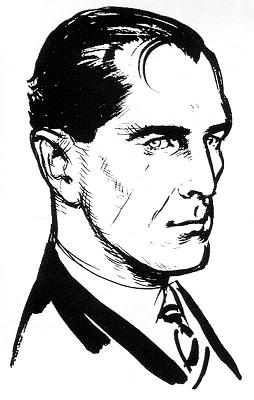
Skyfall: James Bond, a creation of Ian Fleming, has never been real, not to me anyway. How could he? The guy changes faces like girlfriends and girlfriends like tuxedos and other spying gadgets. At first he looked like this:

Ian Fleming's image of James Bond; commissione...
Ian Fleming's image of James Bond; commissioned to aid the Daily Express comic strip artists. (Photo credit: Wikipedia)
...and the rest is the silence. Can you really trust such a character? Nuh-huh. Can it be considered real? No way.

Argo: Antonio J. Mendez, on the other hand, was based on a real CIA officer so here he wins, hands down.

James: 0 points
Tony: 2 points

3. Round two - likeability factor

Skyfall features a Bond who has something to prove, and who could be damaged goods, physically and mentally, like any other mortal. He also is not exactly handsome - jug-eared and bandy-legged, definitely older and weary. Did it work? Yes, it did - I was impressed, James! What a change compared to the previous Bond movies full of agressive males in their primes! You are no longer fit but even at your lowest you were still capable of pulling off a very scary drinking trick involving a scorpion. Overall you become attractively human (though never humane) which really suited me fine.

Argo's character is based on a real hero so it should have been even better but somehow he wasn't. I admit Ben Afleck tried and tried to make his Tony three-dimensional and likeable. A bit of personal drama? Here you go, he and his wife are in separation and it is obvious he misses her rather badly. Not even a whiff of an office romance, no clubbing, just pure depression. A cute kid to make the soft-hearted ladies swoon? Not a problem, Tony has a little son and he loves him dearly, trying to relate to him even if they live apart (aww...a family guy!). Did it work? No. It sounded spurious and somehow, looking at the smooth, thoughtless face of Mr. Afleck, covered so becomingly with facial hair, I didn't care or liked his character.

James: 2 points
Tony: 1 point

4. Round three - visuals

Skyfal is hands down the most visually beautiful Bond movie I have ever seen. Usually such flicks are watched  just for action and fighting scenes, guns and babes. This one is different. From the opening in Istanbul to the final siege shootout in the Scottish Highlands, this film is a supremely enjoyable when it comes to the landscapes, presented. My favourites? Shanghai at night and the deep Scottish countryside in the mist. Incredible!

Argo's crew evidently had a lot of fun with the Chia Pet facial hair, oversize glasses, wide collars, fat ties and earth-toned threads - so did I while watching it! The movie takes us to Hollywood and to Iran. Hollywood is more or less well-known but Teheran shots were really interesting. Still nothing can match Scotland!

James: 2 points
Tony: 1 point

5. Round four: secondary characters

Skyfall: Say what you might but Dame Judi Dench stole the show, at least for me. Playing M, Bond's boss, she dominates every frame with her character, being 100% better and more interesting than any Bond girl and/or associate, featured so far. She is so irritating at the opening, so poignant and admirable at its end that she turns into a kind of fulcrum of the whole movie. A great performance!

Argo: There are plenty of secondary characters which were better/more likeable than the main hero. Which was kind of weird because well, aren't you supposed to support the lead the most? Instead you laugh and cheer John Chambers (played by John Goodman, breezy and reined in), a real makeup artist and a curmudgeonly Jewish producer, Lester Siegel (a wonderful Alan Arkin) - two Hollywood beasts who help make the fake project sound real and legit.

James: 2 points
Tony: 1.5 points

6. Roud five: the ending

Skyfall shows once again the wisdom of Godard's dictum that all you need to make a movie is a girl and a gun and once the girl is dead or married and the gun - shot the movie ends. Still I liked the ending far better than the antics connected to your common and garden James Bond movie.

Argo is a very optimistic thriller - in the end, this is a story about outwitting rather than killing the enemy, making it a homage to actual intelligence and an example of the same. Very uplifiting! Still the director didn't manage to avoid some cheesiness so my rating is lower a bit.

James: 2 points
Tony: 1.5 points

7. Duel results

James: 8 points
Tony: 7 points

James Bond prevailed but it was a close-run contest - in my opinion Skyfall was only marginally better and, mind you, it was pitted against a rather weak movie too. In fact both filcks can be described as  examples of decent cinematic workmanship but nothing special. In the case of an Oscar-winning movie it's criticizm, in the case of another James Bond installment it is a compliment - here I see the main difference.

What do you think? Have you seen any of these?  If yes, did you enjoy them?
Enhanced by Zemanta

Wednesday, 27 March 2013

Movie review: Stranger Than Fiction by Marc Forster

Directed by: Marc Forster
Written by: Zach Helm
Genre: literary drama, romantic comedy
Release date: 2006
Cast: 

Harold Crick: Will Ferrell
Ana Pascal: Maggie Gyllenhaal
Professor Jules Hilbert: Dustin Hoffman
Kay Eiffel: Emma Thompson


Synopsis
Harold Crick leads a completely predictable, boring, lonely life. He works as an IRS agent and his only entertainment is counting: he counts the steps to a bus stop, the minutes of his coffee break, the brushes of his toothbrush, the random sums thrown at him by his colleagues.

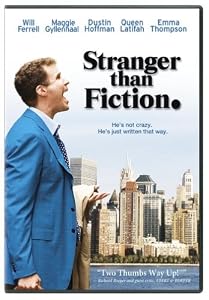
Cover of "Stranger Than Fiction"
Cover of Stranger Than Fiction
One day, however, he discovers that his life is the subject of a book currently being written by a best-selling author, Kay Eiffel, whose creative block has temporarily stunted her repeated efforts to kill him off. How lovely. Now either he finds that author and persuades her to change the dramatic ending (Kay is known for killing off her characters in a spectacular manner) or he dies. Rather sooner than later.

The truth is Harold, fictional or not, doesn't want to die. He's just met a beautiful baker, Ana Pascal, bought himself a fender stratocaster and discovered a real passion for home-made cookies. Life is beautiful, damn it! Why does he need to die? In order to find professional help he visits a literature professor Jules Hilbert, a fan of Eiffel's books. Will they be able to find a good solution? What is more important: a longer life of Harold, his happiness or just a brilliant novel?

My impressions:

Let me deal with the good points first.

I admit when I read a blurb on the dvd cover of that movie I salivated. A comedy about metatextualism? Finally something original, intelligent and fun! Bring it on!!!
It started so nicely too.

 "Death and Taxes" is the title of Kay's newest novel, a book about IRS agent Harold Crick who is so preoccupied with the mundane minutia of his life that he's lost sight of the bigger things –like love, happiness, etc. It is indeed unfortunate since a very big and heavy thing is about to squash him dead. Kay loves doing her characters in. The problem is Harold has become somehow real (it is never explained how and why, my first carping here). His creator is simply left in the dark; so is Harold but for a short period of time only. After he hears a female voice in his head, narrating his everyday living routine, he must find an explanation ASAP and persuade Kay to let him live a bit longer. Theory: brilliant. The execution seemed nice at first too.

The film's minimalist design, with unbreakingly gray, impersonal IRS offices and near-empty rooms, keep the focus where it belongs: on the words and the action. "Stranger Than Fiction" is both about a novel and like a novel; you eagerly await the turning of the pages. For roughly the first half of the movie the narration  made me both interested and involved which was good. Mind you it's important to remember that it is not a film about the nature of reality and the non-separation of fictional people and their creators so much as it is about what makes up reality and what in reality is really important; what constitutes living a life and what needs to be thrown by the wayside, including art, if it's getting in the way of living a life. Such a premise sounded fantastic, with so many great slapstick possibilites, but unfortunately was dumbed down very soon.

Of course no movie can be very bad if it features Emma Thompson who here played the refreshingly   sardonic chain-smoking novelist stalking death for her long-lost inspiration. Some scenes, like the one in the guitar shop where Harold was choosing the instrument of his dreams, or the one with Kay visiting a hospital ward and searching for viable death causes, were indeed great - intelligent and very funny. And here my praise must end.

The dialogue fell too often flat, being  neither witty nor off-kilter enough and I do wonder why. There were so many potenital moments of high comedy and the director simply seemed completely lost how to birng them out properly and make the most of them. Imagine you unexpectedly find out that you are a sentient fictional character whose life is being written by a contemporary author. You have a unique opportunity to meet her in person. What's more as soon as you meet it becomes obvious that the book featuring you is not finished so a lot can be edited/added/ improved. What would you do? Wouldn't it be normal and completely understandable to ask for some changes concerning your skills or physical appearance or occupation? Unfortunately our poor Harold doesn't even dream of doing so. Instead (spoiler, highlight to read) he meekly agrees with everything, even with his premature death.

 Still the worst was the ending - full of lousy feelgood scenes that carried all the depth of a phone company TV ad and left me really underwhelmed. It seemed to convey the same old message: sure, you might be able to control your destiny in a Hollywood movie as long as the outcome is a saccharine one. Plus you must save one of the following: a) our lovely western civilization b) your great country (i.e. the US of A) c) a kid or kids d) a puppy (if the movie has a limited budget, or the hero is a philosophically inclined misanthrope).

Final verdict:

I don't regret watching this one but I admit I expected a far better movie. "Stranger Than Fiction" merely poses big questions; what a pity it doesn't do much to answer them. The movie also tends towards triteness as it goes along, particularly in its conclusion. They wanted to have their cake and eat it too, and it just doesn't work - it's not a big surprise. Still kudos for trying and some scenes were worth the effort of suffering the bland ending.


Enhanced by Zemanta

Wednesday, 20 March 2013

Movie review: Searching for Sugar Man directed by Malik Bendjelloul


Release date: 2012
Directed by : Malik Bendjelloul
Genre: documentary

Synopsis:

What do you need to become a world-wide famous musician? A good voice? A talent? A great personality? Agents who believe in you ? A guitar?  Sixto Rodriguez had it all. Even now his songs really resonate with inner beauty – their lyrics are deep and sad, their music makes you want to sing along and rock. Back in the seventies they must have been like a lightning and thunder. Only they weren’t.

 His first longplay record was released in 1970. It should have launched Rodriguez on a brilliant career, allowing him to go to the very top, among  Jimi Hendrix, Simon and Garfunkel, Bob Dylan, Janis Joplin, The Beatles. Somehow it didn’t.  Maybe because of his Latino name. Maybe because he lived in Detroit. Maybe because he was not a showman. Overall he released two albums: Cold Fact and Coming From Reality; then his company, Sussex Recordings, dropped him off the label and he disappeared from the scene.  Some people claimed he committed a suicide during a flop concert. Some people said he overdosed drugs in a prison. Nobody really knew anything.

 However one of his vinyl records somehow found its way to the Republic of South Africa and it became a big hit there. People simply adored Rodriguez – his albums were sold in millions of copies and his songs were being listened to everywhere. However his South African fans knew nothing, literally nothing, about the singer they loved so much, not even the most basic facts. Small wonder some of them decided to look for him and solve the mystery surrounding his persona. Who was he? What was his real name? Did he have a family, a wife, children? What really happened to him? This documentary is about their incredible search for the truth about Rodriguez and a career which never was.

My impressions:

I completely agree – this documentary deserves and Oscar. It is an incredible story, told in an engaging way, illustrated with great music, sad and uplifting at the same time. What’s more, it is not fiction. 

Still the best thing about this movie is a message it conveys: no matter what your job is if you do it the right way you are not wasting your time - you are creating something special and worthwhile.  You’re an artist. Perhaps you won’t be able to reap the rewards of your efforts immediately, maybe not even during your lifetime, which is of course very sad, but still you’ve done something good which might have a positive influence over people living in a country you’ve never visited in a way nobody can predict. There is never enough positive influence around, right?

I really don’t have much more to say  apart from this: go (or order) and see this movie. You won’t regret it.

Final verdict:

An incredible documentary; a must for all 70’s music fans but I recommend it to everybody.