
Showing posts with label reviewing a classic. Show all posts

Sunday, 7 July 2013

Reviewing a Classic, Quotes and Notes: The Sheik by E.M. Hull


Form: e-book
Genre: misogynist romantic drama from the previous century ;p
Target audience: women masochists

Introduction: 

Lady Diana Mayo and her older brother, Sir Aubrey Mayo are two perfect examples of British upper class - people with too much money, too much time and too little brains between them. I would call them a Mayo salad gone wrong: completely green (her), rather heavy to digest (him), very pleased with themselves, all form no substance (both of them).

You see, everything is nicely explained in big, stinky infodumps at the beginning: Diana was brought up by Aubrey after the death of their mother during the birth followed by the suicide of her father. Poor Aubrey had no idea how to raise a girl, being a 19-year-old boy at that time and apparently not very bright, so he brought her up as if she was his younger brother. Surprise surprise, the result was such that the girl became spoiled rotten – she smoked, she wore men’s clothes, she did only what she wanted and when she wanted, she was arrogant and she knew everything best. A marriage proposal from a young, kind, conventional gentleman, deeply in love and full of best intentions? Preposterous! Silly! Why would she want to get married at all? Such an attitude, according to Ms. Hull, begs for punishment and punished it will be.


Quotes and Notes:


Let me start with a scene when the siblings are quarreling about Diana’s latest plans how to spend a month without being bored to death by the polite society and its restrictions – she intends to travel alone across the desert with a caravan of Arabs for the whole company. A very foolish idea which doesn't prove Diane's independence but her complete lack of brain and imagination. Still it is her idea so it must be good. She announces:

“I will do what I choose when and how I choose, and I will never obey any will but my own."
Sir Aubrey's eyes narrowed suddenly.
"Then I hope to Heaven that one day you will fall into the hands of a man who will make you obey," he cried wrathfully. Her scornful mouth curled still more scornfully. "Then Heaven help him!" she retorted scathingly, and turned away to her tent.„


As you see Diana is a spoiled, stupid girl – very strong-minded, completely persuaded about her own worth, almost foolishly green. It seems she is emulating her namesake goddess, Diana or Artemis, and here comes her Orion. However, as Diana is no real deity, just a spoiled brat, she has no chance against him.

"She writhed in his arms as he crushed her to him in a sudden access of possessive passion. His head bent slowly down to her, his eyes burned deeper, and, held immovable, she endured the first kiss she had ever received.”

Yes, the time of comeuppance has come: according to Aubrey's brotherly wishes a brutally handsome sheik kidnapped our intrepid heroine as soon as she was left alone in the desert and decided to help her understand what women are really created for. Welcome to Middle Ages, ladies and gentlemen, prepare your whips, chastity belts and proceed. Things will turn ugly very soon.

“Her body was aching with the grip of his powerful arms, her mouth was bruised with his savage kisses. She clenched her hands in anguish. "Oh, God!" she sobbed, with scalding tears that scorched her cheeks. "Curse him! Curse him!"”


Indeed. As you can guess Diana had no other option than to endure the rape and feel bad afterwards but at least she was also offered a bath, a friendly Arab servant girl and a meal. Which made it almost ok, right? Ahmed ben Hassan was not a total beast or a caveman after all. You see, he could read and write and had an artistic soul - go figure...

“She was utterly in his power and at his mercy—the mercy of an Arab who was merciless.”

Ha! That’s the fate which, according to our authoress, befalls arrogant little fools who, being born just lowly girls, want to pretend they can be like boys or even like men who are, of course, the peak of creation, the epitome of all perfection and finesse! Read and learn, foolish creatures!

“She had paid heavily for the determination to ignore the restrictions of her sex laid upon her and the payment was not yet over.“

Here was Diane's problem - it was all her fault to begin with, for being too avant-garde. Of course her punishment wasn’t over. She sinned too much, cutting her hair short and going around in breeches, on her own day and night, smoking those cigarettes, bad, bad girl. Our authoress, showing a really cruel streak, decided to torment her victim further.


“And, according to his mood, he noticed or ignored her. He demanded implicit obedience to his lightest whim with the unconscious tyranny of one who had always been accustomed to command. (…)She was physically afraid of him, and she hated him and loathed herself for the fear he inspired. And her fear was legitimate. His strength was abnormal, and behind it was the lawlessness and absolutism that allowed free rein to his savage impulses. He held life and death in his hand.”

If you are bigger and stronger you can do everything and anything! Hell yeah, male dominance forever and sieg heil! Err… I mean, of course, how horrible! But it was her fault, she had it coming, right? All her fault! She provoked him!

“ With a start of recollection she realized fully whose arm was round her, and whose breast her head was resting on. Her heart beat with sudden violence. What was the matter with her? Why did she not shrink from the pressure of his arm and the contact of his warm, strong body? What had happened to her? Quite suddenly she knew—knew that she loved him, that she had loved him for a long time, even when she thought she hated him and when she had fled from him. She knew now why his face had haunted her in the little oasis at midday —that it was love calling to her subconsciously.”

Sigh and groan…why I am not surprised? Of course she had to fall in love with him – who wouldn’t? After the ruthless kidnapping, humiliations, imprisonment and a series of rapes she was being dragged endlessly through a desert; she had to love her torturer, right? He shot her horse before her own eyes and was flogging different men to show that when it came to punishment, girls and boys, Ahmed always meant business. Who wouldn’t fall in love with such a man?

“ He was a brute, but she loved him, loved him for his very brutality and superb animal strength. And he was an Arab! A man of different race and colour, a native; Aubrey would indiscriminately class him as a "damned nigger." She did not care. It made no difference.”

Moral elevation of a female mind through complete submission and a series of rapes. Please let me puke for a moment or two.
" He was an Arab, and to him a woman was a slave, and as a slave she must give everything and ask for nothing.”


Honestly, who needs emetics or purgatives with quotes like that?

And here comes the educated second opinion from a completely civilized French gentleman, a close friend of our Arab, who came for a visit and shared with Diane such a pearl of wisdom:

"Beautiful women, Madame," he said slowly, "unfortunately provoke in some men all that is basest and vilest in their natures. No man knows to what depths of infamy he may stoop under the stress of a sudden temptation."

It might be a favourite quote of, I believe, every heterosexual rapist on Earth. It conveys more or less their favourite message: women, the victims, are the real source of the evil. Without women men would be like a bunch of angels. Banish all women, especially those beautiful and young - no temptation, no crime, the world is a paradise.

“Sex had supervened to overthrow all her preconceived notions. The womanly instincts that under Aubrey's training had been suppressed and undeveloped had, in contact with the Sheik's vivid masculinity and compelling personality, risen to the surface with startling completeness.”

I beg your pardon? Since when a rapist and an aggressive control freak has a compelling personality? Since when forced sex can make you understand anything better? Now let me mourn Diana and this novel in silence. Such a big pile of stinking rubbish should rest in peace.

“Diane, Diane, my sunshine. The tent is cold and dark without you….Ibraheim Omair! That devil and Diane! Oh, Allah! Grant me time to get to her….How the jackals are howling….”

Typical. Only when she is abducted by another skeik and no longer available, her beloved Ahmed finally finds something nice to say to her and shows that he cares at all. Yawn. And of course since Lawrence of Arabia no sheik is a real sheik if he doesn’t have some British aristocratic blood in his veins hahaha. Nice touch about the jackals btw. Let them howl some more. I might join them out of sheer frustration.

Final verdict:

Heavens help me it is a 1919 book. It depicts an immature, bratty heroine being 'tamed' by a man who rapes her repeatedly and generally treats her like an object. This is exacerbated by the fact that she falls in love with her rapist, head over heels, and never wants to leave him – the fully fledged Stockholm syndrome with a dash of good old masochism. I would call this novel an ugly mother of the worst Harlequin romances. I don’t know much about psychology but it seems to me Ms. Hull really hated strong, independent women, I wonder why. Still she got her revenge no problem.

Was it worth reading? Hell, yes. It made me understand so many things. But look, madam, what you have done to the literature at large. Only look at this mess. You should be so ashamed of yourself.


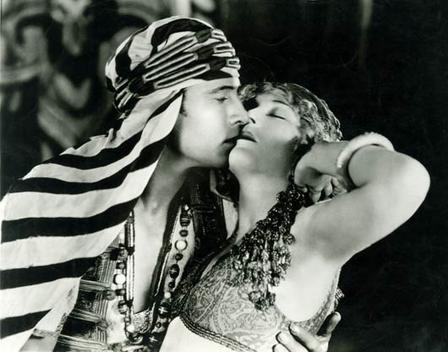
All stills are taken from The Sheik, a 1921 American silent romantic drama film directed by George Melford and starring Rudolph Valentino, Agnes Ayres, and Adolphe Menjou.

ETA: check also the awesome discussion Heidenkind and I had some time ago

Tuesday, 9 April 2013

Rameau's Review Archive: Maurice by E. M. Forster

Rameau's ramblings: I mentioned in the introduction post that I would be bringing over my old reviews one or two a week. Today, I'm going to start with a brilliant book I read fell in love with last month. A five star review is always a good example on how to render me speechless. 

Originally published on Goodreads March 17th 2013.


Synopsis:
Set in the elegant Edwardian world of Cambridge undergraduate life, this story by a master novelist introduces us to Maurice Hall when he is fourteen. We follow him through public school and Cambridge, and on into his father's firm, Hill and Hall, Stock Brokers. In a highly structured society, Maurice is a conventional young man in almost every way, "stepping into the niche that England had prepared for him": except that he is homosexual.


Maurice Maurice by E.M. Forster

You know that moment you and start a book you’ve been wanting to read but haven’t. Maybe you’ve had trouble finding a copy of it or maybe all the hype around it has turned you off or maybe you’re not quite sure you’ll like the book simply because of who wrote it and when and why. And then you fall head over heels in love.

Yeah. That.

Whenever I read a classic, I prepare myself for the inevitable disappointment. In my experience, too many of the great works of literature only represent some form of change in the history of written words and the society that influenced them rather than being good books. If there is any true deeper meaning on the pages of a classic, it’s usually buried under too many decades or centuries of years passed for me to understand.

That wasn’t the case here. For every layer I discovered there were at least two I missed and there’s nothing I love better than subtle complexity, obvious to see for those who’d only look.

It wasn’t just the story describing and showing what life was like a hundred years ago for a young man, what it was like to fall in love and know it could cost him everything, it was the writing I fell in love with. The way Forster uses words to say exactly what he means to and more. How elegant it is.

Maurice was written on the cusp of The Great War and it tells a story of a world long since lost. It shows a young man growing up to take his place in society as he’s expected, and finding himself fundamentally queer in a time when homosexuality was still a crime in Britain. That law is the reason the manuscript remained unpublished for 57 years until after Forster’s death.

I wasn’t even recommended the book; it was the film I saw raved about. When I have the option, I usually prefer to read the book first and see the film second. Having now both read the book and seen the film, I have to say I prefer Forster’s words over the acting of James Wilby, Hugh Grant, and Rupert Graves. And I liked the casting despite Wilby being nothing like the Maurice I imagined until that last scene with Grant.

You’ll notice that I haven’t actually said anything about the story or the characters and that’s because it’s better if you go in blind without expectations. Skip the introductions, acknowledgements, notes on further reading, skip everything and read E. M. Forster’s own words. Read Maurice.


ETA: This blog is being featured at Book Bloggers International today - feel free to visit, say 'hi' and you'll make our day!

Tuesday, 12 February 2013

Reviewing a Classic St. Valentine's Day Special Edition: Romeo and Juliet by Will Shakespeare

 St Valentine's Day is approaching fast- it is such a unique occassion for a sworn anti-romantic reviewer! Let me indulge myself and present a rant about my least favourite Shakespeare play, 'Romeo and Juliet'.

A bit of backstory first (and if you don't like backstories a.k.a. nerdspeak please, have a coffee ans skip the next section).

Romeo and Juliet belongs to a tradition of tragic romances stretching back to antiquity. Yes, even back then some people were just stupid and accordingly they wrote stupid books which were devoured by...you know who. The stupid, the curious, the idle.  Anyway its plot is based on an Italian tale, translated into verse as The Tragical History of Romeus and Juliet by Arthur Brooke in 1562 and retold in prose in Palace of Pleasure by William Painter in 1567. Romeus LOL! 

Allegedly Shakespeare borrowed heavily from both but he wasn't a total copycat. He added and/or developed plot along with supporting characters, particularly Mercutio and Paris. Believed to have been written between 1591 and 1595, the play was first published in a quarto version in 1597. This text was of poor quality, and later editions corrected it, bringing it more in line with Shakespeare's original. Shakespeare's use of dramatic structure, especially effects such as switching between comedy and tragedy to heighten tension, his expansion of minor characters, and his use of sub-plots to embellish the story, has been praised as an early sign of his dramatic skill. The play ascribes different poetic forms to different characters, sometimes changing the form as the character develops. Romeo, for example, grows more adept at the sonnet over the course of the play. In my humble opinion he should have grown more adept at reasoning but it's just me. 

Ok...ready for a blow-by-blow analysis of this hot-air kitsch production?
Good.

Charlotte and Susan Cushman (the Cushman siste...
Charlotte and Susan Cushman (the Cushman sisters) in Shakespeare's Romeo and Juliet in 1846 (Photo credit: Wikipedia)
Let's start easy, with the simplest question possible.
Is Romeo and Juliet really a romantic love story?


IS IT ?

NO.
It is a story of two insipid children who have too much free time and too much money but no sensible hobby or interest to occupy their brains with. So they decide to fall in love with the first passable person they see. Romantic? Hardly.


Have you heard this saying: an idle mind is the devil's playground or workshop? Romeo and Juliet are two perfect showcases.They married young without their parent’s consent and without properly knowing each other and died because they were too stupid to step back and think for half a second.
Two "star-cross'd lovers" indeed.
Well, perhaps back then the lack of brains qualified as "star-cross'd", who knows...

Let's face it: they were worth each other, at least that much is true.

Romeo was a young, easily impressionable fool. He began the play lovesick over Rosaline and within an act he was mooning over younger Juliet as if you suddenly pushed a button. His beloved girl wasn’t much better. She glanced at a handsome boy at a party, found out that he is one of her family's enemies and was suddenly head over heels for him and vowing her love on a balcony at night. Risking a serious pulmonary inflammation (yes, I am sure you remember the balcony scene . Ridiculous.). No sense of responsibility whatsoever, no critical thinking, no ordinary decency, just insta-love. 

So, a fickle, immature 15-year-old boy and a startlingly childish 13 year old girl agree to get married in secret, having known each other all of six hours. SIX HOURS people! They’re young, I know, but still plenty of young people prove time and again that they can take reasonable, surprisingly mature decisions so no excuses. Neither Romeo nor Juliet had any sense to talk to anybody older and wiser than themselves because, obviously, they knew everything better and yes, they were in love and the secrecy surrounding their feelings seemed to be the whole point. Teens love secrets, right?


Then you have a suddden case of a bum rash, tight britches and hot tempers with the whole duel and killing. Outraged Tybalt challenges Romeo, Romeo refuses, Mercutio fights instead and is mortally wounded so Romeo slays Tybalt out of grief, guilt and revenge… Bob’s your uncle, Amanda’s your aunt Sally's your sister and EVERYONE JUST DEFIED THE PRINCE!!!A very stupid thing to do if you plan a secret marriage AND you want to defy your entire family as well!

Romeo is exiled, but of course first he has to spend the night and consummate his marriage with Juliet…does it really need commenting (of course it does) ? It is not romance, it is rutting of a pair of short-sighted teenagers on bubbling hormones! No adult supervision! No responsibility! Where are the chastity belts when you really need them? Will Shakespeare you should be ashamed of yourself!

Then Capulet goes off the deep end, telling Juliet she WILL marry Paris or else be drowned. Come on… the dude started the play saying she was too young to marry and then, when she seems grief stricken, he forces her to get married as a kind of remedy? Perhaps he had actually glimpsed Romeo leaving her room in the morning... Her mom was no wiser, rejecting her just because Juliet wanted to postpone the date. Small wonder poor girl had no brains - it seems she was doomed from the very inception...Still drowning is NOT NICE even if your victim is your own stupid daughter.

So Juliet goes to the Friar for help and like any good man of the faith, he comes up with some inefficiently grandiose plan that at no step involves being honest and talking with those who care the most. Instead he gives her a “drug” that puts her in a deep coma for 42 hours. I recognize the fact that daddy Capulet probably would have drown her for sure had she come out and told him – “hey daddy, I love you to death but I really can’t marry Paris because... well, you remember that dude, Romeo? The one who got exiled because he'd killed my cousin Tyb? Good riddance by the way, Tybald was never exactly an asset if you ask me so Romeo did us practically a favour...actually you know, I and Romeo kind of...yea…sort of...ummm...anyhoo here's my wedding ring. Pretty, isn't it?”


But at least she went to an adult this time – this is what children are supposed to do when they are faced with a problem they cannot handle themselves – and somehow the friar manages to be just as childish in his handling of the situation as the kids are. Or maybe even more childish, all things considered. Since when you can solve a problem, any problem, with drugs ? Whenever I think of it the depression makes me melt...


And of course we all know what happened then…a string of bad luck which Shakespeare loved so much. Romeo doesn’t get the message in time (how could he even dream of getting it in time is beyond me), he goes to the crypt with his draught of poison, kills Paris, poisons himself, only to have Juliet wake seconds later to find him dead and kill herself… and THEN the families reconcile. I don’t know about you, but having the secondary characters learn something from the deaths of two completely naïve children is not what I call a satisfying ending. I see no real love in this story nor much sense or any other value apart from sheer shock value. Let's face it, it's obvious Will loved making people shout and cry in shock. Then he counted the proceeds and smiled. Probably like that:
Yes, I DID it again!
Whan can be said? The Prince’s ending words are the only part of this that rings true: For never was a story of more woe than this of Juliet and her Romeo. Hear, hear my Prince. Even a good editor wouldn't be able to improve much; mind you this horrible, senseless play is read by innocent children and teenagers at school with the full approval of the adults.

Now I ask you, dear Readers: is it ok?

Sherlock, what would you say?


Is it ok, dr. Watson?


Gentlemen, I completely agree.

ETA: if you want to know what I really think of St. Valentine's Day please follow this link to one of my older essays. ;)
Enhanced by Zemanta

Wednesday, 10 October 2012

Reviewing a classic: The Picture of Dorian Gray by Oscar Wilde


Oscar Wilde's only novel The Picture of Dorian Gray(1891) is a classic instance of the aestheticism of the late 19th century's English literature. The maxim of aestheticism "art for art's sake" is reflected in the opening of the novel, which specifies art's aim to "reveal the art and conceal the artist."For greater emphasis, Wilde defines the artist as free of ethical sympathies and morbidity. Even books are seen as only "well written" or "badly written" and not as moral or amoral. Following this prelude on art and beauty, Wilde weaves a plot that explores the issue to its core.

Synopsis:

Three main characters, Dorian Gray, Sir Henry Wotton and Basil Hallward are being introduced while lingering in the studio of Hallward, a painter. The painter has developed a sort of infatuation with the striking beauty of young Dorian and is completing a portrait that he feels is his best work to date. Amidst the final stages of the painting, Lord Wotton engages in conversation with the two, and imparts as much of his cynicism and seemingly shallow values as he can on the impressionable Gray. Being somewhat indoctrinated with Wotton’s idea of “beauty before all else”, Gray wishes that the painting of his likeness would age in his place, so he might retain the looks that have won him so much admiration and favor. This wish somehow comes true and it would become a great regret for Mr. Gray.

Over the coming chapters, Gray meets Sibyl Vane, a very young, beautiful and very poor Shakespearean actress. Though Sibyl only knows him as ”Prince Charming” the two of them seem to be madly in love and plan to run off together. The sweet, wholesome Sibyl discusses her engagement with her family. Because her mother is indebted to the theatre manager, Mr. Isaacs, for fifty pounds, she is against the marriage unless Dorian is wealthy; they do not know that he is. Sibyl's angry brother, James, is leaving for Australia, but he vows to kill Dorian if he wrongs his sister in any way. James also confronts his mother about gossip he has heard — that his mother and deceased father never married, which Mrs. Vane admits is true.
Oscar Wilde in New York
Oscar Wilde in New York (Photo credit: Wikipedia)

Unfortunately, Dorian invites his friends along to what will be Sibyl’s last performance before leaving to be with him and her focus on her own love produces a dismal portrayal of her role as Juliet. With his love of beauty, Dorian suddenly becomes disgusted with the girl and her poor performance and breaks her heart backstage that very night. Tragically, the loss is too much for Sibyl to bear and we find out very shortly after she was found dead later that night, presumably she committed suicide. Dorian awakes the next morning regretting his actions against Sibyl but is informed of her recent end by Lord Wotton. His despair is quickly averted by Wotton’s assurances that this was just a passing love and that beauty and pleasure should be his only pursuits. This would be Dorian’s last love and over the next 18 years he leads a hedonistic life guided by an unnamed novel (a yellow book) given to him by Wotton.

Later, though still not showing his age thanks to his wish for his portrait to bear the years and consequences of his actions, Dorian begins to realize that his life somehow has not been of the quality it should have been. Brought to a head by a visit from Basil, the painter, Dorian is shocked by the effects his lifestyle has had on the once beautiful portrait of his. In the process of unveiling it to Basil, Dorian comes to blame this on him, the originator of the work, and murders Basil in secret. Using blackmail against a former friend, he is able to cover up his act, and visits an opium den for relief from his guilt. While there, by chance a whore refers to him as “Prince Charming” which is overheard by James Vane (Sibyl’s brother). In a moment of irony, James is convinced not to kill Dorian by being asked to look at him in the light and assess whether the man who broke his sister’s heart 18 years ago could possibly appear so youngful and fresh. Effectively saved by the very curse that lead him down this path, Dorian lives on.

After returning to London, Dorian becomes paranoid that James is stalking him. He believes he saw him outside his window and later, while out in the country, discovers it was James who was accidentally shot by hunters. Believing he is safe now, Dorian sets out to turn over a new leaf and live a better life, his first act being to spare a local girl the heartbreak of being in love with him. Dorian hopes this new act of “mercy” will show in the portrait, a lessening of the horrible image it now bears. Much to his dismay, the image is even worse, causing to doubt his own motives in the act. Believing his only absolution would be public confession to his acts, including Basil’s murder, which he cannot bring himself to do, Dorian tries to destroy the reflection of his life, the painting. In an rage, he stabs a knife into the painting, but is discovered in the locked room with the knife in his heart and the painting returned to it’s original form. Dorian’s body is now withered and aged, and is only identified after careful examination.

My impressions:

Oscar Wilde’s The Picture of Dorian Gray is a thought-provoking novel that vacillates between ambling, seemingly directionless conversation and a riveting narrative thread. Oscar Wilde has created an amusing tale that does not end very happily but ends beautifully. Still the plot of The Picture of Dorian Gray, if seen apart from the wit and epigrams of Lord Henry is serious and, at times, even somber.

The Picture of Dorian Gray addresses more than one theme. The primary appeal of the subject of beauty, as it appears to eyes, is the main focus of the novel. Wilde reveals the tenderness of self-love, or narcissism, which sometimes fails to find an object outside itself. Dorian's beauty, unlike Basil's art and Lord Henry's social status, is more vulnerable to decay with time.

But it is not this weakness of beauty to age that brings the disaster upon our protagonist. It is the consciousness of the owner of beauty to his own wealth that triggers the boundless fear of perishing--fear that causes his doom. Unlike Lord Henry's ease about his rank, Dorian's angst about the ephemeral nature of his looks is shown as the true enemy of a person's self.

The philosophical boundaries of Oscar Wilde's The Picture of Dorian Gray are too deep to track to their ends. The novel addresses the issue of self-concept as portrayed in art. Further, it connects a person's emotional response to his/her own image. While Dorian remains young and beautiful, the mere sight of an aging picture of him is unbearably painful because it reminds him of his own weaknesses and fate. The portrait begins to transform itself into the image of his soul. Dorian Gray turns himself into a work of art by making a Faustian pact that ensures that he is endlessly desirable and always youthful. It is his heart that withers so no, it doesn’t bring him happiness.

Let me also state the obvious: Wilde’s command of the English language is almost unparalleled in recent literature. His prose is almost visibly sparkling with gems and gilded bric-a-brac; reading Dorian Gray is like watching an all-out, massively expensive period film. Just take a look at this, the second sentence:

From the corner of the divan of Persian saddle-bags on which he was lying, smoking, as was his custom, innumerable cigarettes, Lord Henry Wotton could just catch the gleam of the honey-sweet and honey-coloured blossoms of a laburnum, whose tremulous branches seemed hardly able to bear the burden of a beauty so flamelike as theirs; and now and then the fantastic shadows of birds in flight flitted across the long tussore-silk curtains that were stretched in front of the huge window, producing a kind of momentary Japanese effect, and making him think of those pallid, jade-faced painters of Tokyo who, through the medium of an art that is necessarily immobile, seek to convey the sense of swiftness and motion. (1.2)”

You might wonder whether it is still readable. Well, I was able to read my copy of the novel, about 260 pages long, in two evenings. Even though the story was written and set in a time when people drove around in horse-drawn carriages and used candles more often than light bulbs I didn’t find it dated. It is about sin and vanity, about friendship that fall by the wayside, about life choices and their consequences. These things never go out of fashion but plenty of contemporary artists and writers have problems with presenting them in an interesting way. In my humble opinion they should read Dorian Gray and take a leaf out of Mr. Wilde’s book.

Dorian destroys a lot of lives and one of the saddest parts of the book is when he murders his close friend, Basil Hallward, the only man Dorrian let see the grotesque portrait that once was a masterpiece – the picture of his true self. It proves how corrupt and how lonely Dorian has become. When, overcome with a sudden loathing for Basil and perhaps also for his own weaknesses and faults, Dorian sticks a knife in his friend’s neck he kind of sacrifices him in front of that painting, a monument to his own evilness. It was as breathtaking as if you witnessed somebody sacrificing their own humanity.

Final verdict:

A book definitely worth reading and rereading. Intelligent, funny, sparkling prose dealing with serious topics. Now pray, tell me, do you know of any good movie adaptations? 


Quotes: 

“The ugly and the stupid have the best of it in this world. They can sit at their ease and gape at the play.”

“An artist should create beautiful things, but should put nothing of his own life into them.”

The only way to get rid of a temptation is to yield to it. Resist it, and your soul grows sick with longing for the things it has forbidden to itself, with desire for what its monstrous laws have made monstrous (…)”


“You are a wonderful creation. You know more than you think you know, just as you know less than you want to know.”

“I hope that Dorian Gray will make this woman his wife, passionately adore her for six months, and then suddenly become fascinated by someone else. He would be a wonderful study.”

“My dear boy, no woman is a genius. Women are a decorative sex. They never have anything to say, but they say it charmingly. Women represent the triumph of matter over mind, just as men represent the triumph of mind over morals.” (haha!)
Enhanced by Zemanta

Sunday, 16 September 2012

Reviewing a classic: Mansfield Park by Jane Austen

Book info:
Form: paperback
Genre: Jane Austen novel ;p
Target audience: anybody
Synopsis:

Brace yourself, it will be a long, detailed synopsis with spoilers but hey, the book is a classic, right? Let me indulge myself a bit ;)

Once upon a time there were three sisters. One of them, being the prettiest, married very well, the second one, a bit wild, married very badly but for love and the third one married just because it was the right thing to do. The first sister, Lady Bertram, a rich wife of a baronet, was spending her days idly by the side of her husband, Sir Thomas, enjoying luxuries of Mansfield Park, their country estate. She had four children: two sons, Tom and Edmund, and two daughters, Maria and Julia. She also decided to help her other two sisters, less fortunate when it came to the choice of husbands.

That’s how Fanny Price, our heroine, aged just 10, arrived to Mansfield Park - she was  Aunt Bertram’s charity case. As one of many children of the second sister, Frances, and Lieut. Price, a retired naval officer, Fanny was sent away to live with her fine relatives. Her mother was very grateful as it was considered a great opportunity and social advancement. Of course nobody asked the opinion of the shy, awkward child. Fanny was never exactly mistreated by the Bertrams but she never felt at home with them either. Still Edmund, the younger son, being the most good-natured of all, managed to show his young cousin real kindness from time to time. Fanny’s other maternal aunt, Mrs. Norris, the local parson's wife, showered attention and affection on her Bertram nieces, particularly Maria, but was frequently unpleasant and mean-spirited toward Fanny, making the girl feeing inadequate.

The narration starts when Fanny is 16. Sir Thomas must leave for a year to deal with problems on his plantation in Antiqua. He takes his eldest son, Tom, along in hopes to isolate him from bad company he had been keeping. Meanwhile Mrs. Norris finds a husband for Maria Bertram – a completely stupid but very rich Mr. Rushworth. Maria accepts his proposal subject to Sir Thomas’s approval on his return.

About this time, the fashionable, wealthy, and worldly Henry Crawford and his sister, Mary , arrive at the parsonage to stay with Mrs. Grant, their half-sister. The arrival of the lively, attractive Crawford siblings disrupts the staid world of Mansfield and sparks a series of romantic entanglements. Mary and Edmund begin to form an attachment, despite her original interest in Tom as the eldest son and the heir of Mansfield Park. Although Edmund worries that Mary’s cynical remarks may mask a lack of firm principle and Mary is unhappy that Edmund wants to become just a simple country clergyman, their mutual attraction grows. Fanny fears that Mary has enchanted Edmund, and that love has blinded him to her flaws - of course, she is in love with him herself but her judgment is definitely better than the judgment of any of interesting parties.  Meanwhile, during a visit to Mr. Rushworth's ancestral estate in Sotherton, Henry deliberately plays with the affections of both Maria and Julia, driving them apart. Maria believes that Henry is falling in love with her and treats Mr. Rushworth dismissively, provoking his jealousy. Fanny witnesses Maria and Henry in compromising situation and is appalled by their lack of decency. Encouraged by Tom and his friend Mr. Yates, the young people decide to put on Elizabeth Inchbald's play Lovers' Vows, a rather frivolous farce which allows Henry, Maria, Julia, Mary and, to some extend, Edmund continue their public flirt.

When Sir Thomas unexpectedly arrives home in the middle of a rehearsal, the theatricals are abruptly terminated. Henry, whom Maria had expected to propose, leaves, and she feels crushed, realizing that he didn’t love her. Although she neither likes nor respects Mr. Rushworth, she goes ahead and marries him out of spite. They leave for Brighton, taking Julia with them. With Maria and Julia gone, Fanny and Mary Crawford are naturally thrown into each other's company. In fact Mary goes out of her way to befriend Fanny. Henry returns to Mansfield Park and, lacking other distractions, decides to amuse himself by making love to the shy new best friend of his sister. However, Fanny is steadfastly if secretly in love with Edmund, and the tables are turned - Henry actually falls in love with her. To further his suit, he uses his family connections to raise Fanny's brother William to the rank of naval lieutenant. However, when he proposes marriage, Fanny rejects him out of hand, partially because she disapproves of his moral character, and also because she still hopes Edmund might love her back one day. Sir Thomas is dismayed and startled by her refusal, since it is an extremely advantageous match for a girl without any dowry or useful connections.

To bring Fanny to her senses, Sir Thomas sends her home to Portsmouth, hoping that the lack of comforts will help her appreciate Henry's offer more. At Portsmouth, she develops a firm bond with her younger sister Susan, but is taken aback by the contrast between the dissolute surroundings of her mother’s house and the environment at Mansfield. Henry visits and tries to convince her that he has changed for good and is worthy of her affection. Although Fanny still maintains that she cannot marry him, her attitude begins to soften, particularly as Edmund and Mary seem to be moving steadily toward an engagement.Henry leaves for London, and shortly afterwards, Fanny learns that scandal has enveloped him and Maria. The two had met at a party and rekindled their flirtation; as a result Maria has left her husband for him. A national scandal sheet gets wind of the affair, Maria is exposed as an adulterous wife, Mr. Rushworth sues for divorce, and the proud Bertram family is devastated. To make matters worse, Tom has taken ill, and Julia, fearing that her father will  lock her up, punishing for the sins of the older sister, has eloped with Tom's flighty friend Mr. Yates.

In the midst of this crisis, Fanny returns to Mansfield Park with her sister, Susan. Sir Thomas realizes that Fanny was right to reject Henry's proposal and now regards her as his daughter. During an emotional meeting with Mary Crawford, Edmund discovers that Mary does not condemn Henry and Maria's adultery, only the fact  it was discovered. She implies that if Fanny had only accepted Henry, there would have been no affair. She also speaks very callously about the possible death of Tom and the perspectives it would create for the younger son. Edmund, who had idolized Mary, feels that her true, rather ugly nature, has been finally revealed to him. He returns to Mansfield Park and goes ahead with plans to be ordained a minister, abandoning any engagement plans.While he is despairing of ever getting over Mary, Edmund comes to realize how important Fanny became to him. After a while he declares his love for her, they are married, and eventually they move to the Mansfield Park parsonage, where they live close to those they love best. Henry Crawford refuses to marry Maria, who is banished by her family to live, secluded, "in another country," (France) where she is joined by her aunt Mrs. Norris, the initial creator of her misery.

 What I liked:

If you wonder why my synopsis is so long and detailed here are two main reasons. First – I admit that Mansfield Park is my favourite Jane Austen book and I can talk about it forever. Second – I wanted to show how dissimilar that novel is when compared to those awful movie adaptations. Really, truly, completely different.

First of all the main heroine, Fanny, is perhaps the most complex female character created by Austen, maybe because she is portrayed not as a young adult but we can follow most of her childhood as well. Plenty of readers don’t like Fanny for being a bit priggish. Jane Austen's own mother thought Fanny "insipid". I don’t agree with such an assessment. Although, as any young girl, she is sometimes given to wishful thinking and she is often too timid to speak up her mind, Fanny can be surprisingly perceptive and intelligent; it is quite stunning as she lacked any moral guidance or support among her real or adoptive family. Still she is the only one who can assess the Crawfords in the right way, she notices how badly Maria treats her fiancé before almost anybody else and she can criticize the household of her own mother in a very clear-headed way. By rejecting Henry she shows a lot of courage; she also grows in self-esteem during the latter part of the story, weathering a major crisis caused by Maria’s divorce and Tom’s illness.

Many modern readers find Fanny's timidity and disapproval of the theatricals difficult to sympathize with but I found it in perfect accordance with her introvert character – she did enjoy listening to Henry Crawford’s skillful reading, she just didn’t want to offend her absent uncle doing something overly frivolous; I suppose she also didn’t want to mix with a crowd who treated her indifferently at best and disapproved of her at worst. Their attitude might be well summed up by this quote:

“My dear Miss Price,” said Miss Crawford, as soon as she was at all within hearing, “I am come to make my own apologies for keeping you waiting; but I have nothing in the world to say for myself-I knew it was very late, and that I was behaving extremely ill; and therefore, if you please, you must forgive me. Selfishness must always be forgiven, you know, because there is no hope of a cure.” Mary Crawford, Mansfield Park, Chapter 7


Apart from Fanny there are plenty of other great characters, presented here, but two of them, namely Henry and Mary Crawford deserve a paragraph or two of their own.

 They are a pair of antagonists, predators, but they are presented as quite likeable creatures, so nice to be with and so interesting nobody notices their wickedness. Let’s start with the lady.  I would describe Mary Crawford as Elizabeth Bennett without moral principles – she is clever, she has a great sense of humour, she is additionally rich (twenty thousand pounds of dowry, no small matter) and pretty spoiled. You might argue that her faults stem from the fact that she wasn’t given  proper education and example in her childhood but so wasn’t Fanny and there is vast difference between the way of thinking of these two young women. Mary is so dazzled by the glitter of the beau monde that she rarely notices any real values in people. She likes luxury, she appreciates theatre and fun, she thinks she is entitled to everything the best, including men. Although from time to time she can be also understanding, generous and kind, she thinks mostly about her own convenience and social status. She tolerates Fanny to please Edmund and Sir Thomas but, given a choice, she remorselessly forgets her timid friend to enjoy a more interesting company. 

Her brother is even worse – it is a predator similar to Monsieur Vicomte de Valmont from Les Liaisons Dangereuses, another classic reviewed by me here. As he has definitely too much money for his own good and is too lazy and lax to find himself a proper occupation he preys on women for fun (mind you we speak about the Napoleonic Wars period, such easy time to find an occupation for an aggressive, clever man of means!). The way he plays both sisters Bertram is really callous and ruthless; after the marriage of Maria he doesn’t hesitate to contact her in public and when she pretends reserve he decides to conquer her again – not because he loves her but because he must prove his seductive skills before himself and all the world around. Of course the fact that he might be ruining more than one life and a reputation of the whole family in the process never even crosses his mind. He would do anything and everything for a moment of thrill.

What I didn’t like:

One small carping: I really hated the fact that Jane Austen didn’t punish Henry Crawford for his villainy. While Maria Bertram was sent into exile in the really acidic company of her aunt Norris he was left with all the privileges of a rich squire and his reputation didn’t suffer either. NOT FAIR. His only punishment? He didn’t get Fanny and he knew what he lost. I wish Austen at least made him poor (gambling?) and then forced him to marry for money some horrible harpy, twice his age.

Final verdict

I may risk a statement that  Mansfield Park is not an easy novel to understand. It enjoys that dubious distinction of being disliked by more of Jane Austen's fans than any of her other novels. Perhaps it is because its themes are very different from those of her other books, which can generally be summed up by one sentence or, indeed a phrase: Sense and Sensibility is about balancing emotions and reason, Pride and Prejudice is about consequences of judging others too quickly, Emma is about growing into adulthood while being terribly nosy, and Persuasion is about giving others and yourself second chances. The theme of Mansfield Park, on the other hand, defies such a simple description. Is it an allegory of Regency England? Is it about the negative impact of slavery? Is it about the right and wrong education of children? Is it about the difference between appearances and reality? Is it about the consequences of breaking with society's rigid rules? In my opinion any, or all of those themes can, and have been applied to Mansfield Park – let it be the proof that this novel is something truly exceptional and worth reading.

Sunday, 5 June 2011

Reviewing a classic in the summer: Splendeurs et misères des courtisanes (A Harlot High and Low, 1847) by Honoré de Balzac


  • Paperback: 560 pages
  • Publisher: Penguin Classics (December 30, 1970)
  • Language: English
  • ISBN-10: 0140442324
  • ISBN-13: 978-0140442328
  • genre: suspence/romance/ sociological novel
  • target audience: adults


Synopsis:

The book is a sequel of “ Illusions perdues” (‘Lost Illusions’) and the last part of ‘ La Comédie Humaine’, a series which forms a cohesive overview of French Parisian and Provincial society during the Restoration and July Monarchy. Like the previous part it features the same main characters: Lucien Chardon /de Rubempré and Vautrin. In order to make it more lucid let me summarize the first part very shortly before progressing to the second.

Lucien starts off as a young, handsome, talented man from good but impoverished family. He hopes to make his mark as a poet and, in order to do so, he moves from his provincial home to Paris. After being spurned by an aristocratic lover, he is forced to prostitute his talent in different newspapers in order to survive. Things go from bad to worse and Lucien, who had made a lot of foolish mistakes and doesn’t possess a strong character make up for them, is about to commit suicide. In the last moment he is approached by a sham Jesuit priest (read: devil incarnated), the Abbé Carlos Herrera a.k.a Vautrin, an escaped convict and criminal mastermind. They make a pact in which Lucien agrees to follow Vautrin's instructions on how to conquer Paris promising to share his future riches and glory.

Vautrin manages to arrange a very profitable marriage between Lucien and a rich aristocratic heiress named Clotilde de Grandlieu. It revives Lucien’s ambitions and hopes. Clotilde is intelligent but ugly; she fancies Lucien but he prefers his secret lover, Esther Van Gobseck. known as the Torpedo, the harlot of the title.
Esther and Lucien fall truly in love with each other. This fact might have thrown a wrench into Vautrin's best-laid plans; instead of forcing Lucien to abandon Esther the clever man allows him to continue the affair secretly making a good use of it. Pretending to be a clergyman Herrera/Vautrin convinces Esther that, in order to deserve Lucien she must become a completely different person. He sends her to a convent for a period of time to be taught how to become a proper Catholic girl (Esther is Jewish but it doesn’t matter). It's tough for her, she tries her best but she's a whore at heart. She does what she has to out of love, though. Once Esther has been turned into an acceptable mistress Herrera allows her and Lucien to continue their affair secretly. For four years Esther remains locked away in a house in Paris, totally secluded, taking walks only at night in a carriage, pretty much breaking any connection to her old Torpedo days. One night, however, the Baron de Nucingen, a rich banker, spots her and falls deeply in love with her. When Vautrin realizes that Esther became Nucingen's obsession he decides to use it and advance Lucien’s prospects.

The plan is the following: Vautrin and Lucien are 60,000 francs in debt. The luxurious lifestyle that Lucien has had to maintain in order to impress the family and friends of his future wife costs a lot and their creditors are getting impatient. They also need one million francs to buy the old Rubempré land back, so that Lucien can marry Clotilde and settle down like a real aristocrat. Esther out of love for Lucien agrees to become a courtesan again and milk as much money as possible out of the impossibly rich Nucingen. Things don't work out as smoothly as Vautrin would have liked – Esther, unable to betray her love and come unscathed, breaks down and commits suicide after sleeping with Nucingen for the first and only time (and, of course making him pay through his nose for it). Since the police have already been suspicious of Vautrin and Lucien, they arrest these two accusing them of murdering Esther. It turns out that only hours before her suicide she had actually inherited a huge amount of money from an estranged family member. If only she had held on, she could have married Lucien herself and become la grande dame.

Lucien, ever the sensitive, delicate poet, doesn't do well in prison. Although Vautrin actually manages to fool his interrogators into believing that he might be Carlos Herrera, a priest on a secret mission for the Spanish king, Lucien succumbs to the wiles of his interviewer. He tells his interrogator everything, including Vautrin's true identity. Afterwards he regrets what he has done and, pinning away for Esther, hangs himself in his cell.
Title page of Honoré de Balzac's The Splendors...Vautrin finds Esther dying in her flat via Wikipedia
His suicide, like Esther's, is badly timed. In an effort not to compromise the ladies from high society the justices had arranged to let Lucien go free. When he kills himself, things get more sticky and the maneuverings more desperate. It turns out that Vautrin possesses the very compromising letters sent by these women to Lucien, and he uses them to negotiate his release. He also manages to save and help several of his accomplices along the way, helping them to avoid a death sentence or abject poverty.

At the end of the novel, Vautrin actually becomes a member of the police force before retiring in 1845. The nobility that was so fearful for its reputation moves on to other affairs.

What I liked:

Balzac explores the artistic life of Paris in 1821-22, and furthermore the nature of the artistic life generally. He does it in a great way. He starts a simple story of a weak young man helped by an older, more experienced and cunning tutor and then it explodes into a multi-novel epic. The narrative is powerful enough to carry readers past any of the flaws – I wasn’t bored for one single second. The deception, corruption, and trickery, at every level of society are brilliantly displayed, often almost off-hand, in casual conversation because everyone expects nothing different. There's a great cast of secondary characters, too, from the maids Herrera uses in his carefully orchestrated plans to various members of high society.

I liked this book especially because, although Balzac doesn't do badly with the romance he builds his novel around, he doesn't really have much patience for it. He, like me, is not a romantic person at heart, believing in more primal instincts – survival, cunning, logic. Love doesn’t conquer all: no one is ever allowed to forget that Esther is a whore and likes her job, that it's practically in her blood and that she can be little else, no matter how hard she tries and no matter how much she adores her poor, infatuated, ambitious Lucien. Criminals are perceived similarly – the author even admires them for being true to themselves and their instincts. Small wonder Vautrin steals the show in every part of his series.

Balzac's writing, even at its messiest, it's never less than forceful. The best thing about him is that he never offers a didactic or 'social' novel (mind you we are dealing here with an 19th century writer!), and ultimately it's for the best that he lets himself get carried away by the nasty criminals so readily. A novel meant to be about prostitution, with a courtesan (or harlot) in the title, manages to dispense with her services for its entire final part: that's a bit odd but entirely deliberate. Balzac knows where his strengths lie and when Esther (or, especially, Lucien, the weakest link in the chain) no longer serves her/ his narrative purposes the author is quick to brush them aside and concentrate on the anti-hero he can have the most fun with.

What I didn’t like:

A Harlot High and Low is part of Balzac's grand 'Human Comedy' series, and like many of his novels it's one that seems to get out of hand. It seems too long; what's more the author simply doesn’t have any patience to describe good moments in full – the happy four-year period Lucien and Esther were granted by Herrera occupies...one paragraph.

And speaking of that period…I do wonder how Esther managed such a long seclusion. During that time she led a life of a vampire and should have succumbed to serious depression – think about vitamin D deficiency among other things…also the obsession of the rich old banker with a prostitute was presented a bit over the top. Well- different times, different criteria.

At last, Balzac's inability to make Esther and Lucien more forceful heroes, do prevent A Harlot High and Low from being a great novel, but it's nevertheless a very good one.

Final verdict:

It’s summer so treat yourself with this one. It might not be flawless but still the writing style is superb. If you know French I highly recommend reading it in original version. Formidable!
Enhanced by Zemanta

Monday, 11 April 2011

Reviewing a classic – The Tenant of Wildfell Hall by Anne Brontë

Anne Brontë, as painted by her brother Patrick...                                                   fromWikipedia
I got this book courtesy of my friend The Red Witch - thank you very much once again!


About the author:

Anne Brontë (17 January 1820 – 28 May 1849) was the youngest member of the Brontë literary family. She is somewhat overshadowed now by her more famous sisters - Charlotte, the author of four novels including Jane Eyre; and Emily, the author of Wuthering Heights - but her novels used to be fairly popular as well.
Anne Brontë lived most of her life with her family at the parish of Haworth on the Yorkshire moors (her father was a clergyman). For a couple of years she went to a boarding school. At the age of nineteen, she left Haworth working as a governess between 1839 and 1845. After leaving her teaching position, she fulfilled her literary ambitions. She wrote a volume of poetry with her sisters (Poems by Currer, Ellis, and Acton Bell, 1846) and in short succession she wrote two novels. Agnes Grey, based upon her experiences as a governess, was published in 1847. Her second and last novel, The Tenant of Wildfell Hall appeared in 1848. It was a huge success with even a whiff of scandal about it. Anne's life was cut short with her death of pulmonary tuberculosis when she was only 29 years old.

Synopsis:

The novel is divided into three volumes. The first part is a narration of a young gentleman-farmer, Gilbert Markham, telling us about a mysterious woman, Mrs Graham, who arrived and settled in a nearby old mansion, Wildfell Hall. She instantly becomes a source of curiosity for the local community, especially as she is accompanied by her young son, Arthur, but not by a husband. Initially, Gilbert Markham casually courts Eliza Millward, despite his mother's belief that he can do better. His interest in Eliza wanes as he comes to know Mrs. Graham more closely. In retribution, Eliza spreads (and perhaps originates) scandalous rumours about Helen. With gossip flying, Gilbert is led to believe that his friend and the owner of Wildfell Hall, Mr. Lawrence, is courting Mrs. Graham. During a chance meeting in a road jealous Gilbert strikes Mr Lawrence a whip and he, injured, falls from his horse. Unaware of this, Helen refuses to marry Gilbert, but gives him her diaries to read.

Now starts the second volume, which describes Helen’s disastrous marriage to Arthur Huntingdon, a handsome, witty but very selfish man without any principles or backbone. Before the marriage Arthur has led a dissolute life and even while courting Helen he flirted with another girl, called Annabella – he used her to put some pressure on Helen and convince her to marry him. Helen finally becomes his wife but she is not as happy as she would like to be. Although she sees his vices, she is naïve enough to think she can reform Arthur with gentle persuasion and good example. Of course she fails. Her husband is bored of their country life and goes to London frequently to amuse himself. Upon the birth of their child, Huntingdon becomes increasingly jealous of their son (also named Arthur). Huntingdon's pack of dissolute friends encourage him to behave even worse, as they frequently visit him and engage in drunken revels at his family's home, Grassdale. Annabella, now married to one of Huntingdon’s friends, lord Lowborough, visits Arthur too and starts to cheat with him on her melancholy but devoted husband. Meanwhile Walter Hargrave, the brother of Helen's friend, Milicent Hargrave, vies for her affections. Walter tells Helen of Arthur's affair with Lady Lowborough. When Arthur’s friends depart he pines openly for his paramour and derides his wife. As a retaliation Helen doesn’t let Arthur in her bed.

The last straw for Helen is Arthur's corruption of their son — he and his friends try to encourage the child to drink alcohol and swear. Artur also employs a governess who is a rather doubtful sort of woman to say the least of it. Desperate Helen plans to flee to save young Arthur but her husband learns of her plans from her journal, and burns her artist's tools (by which she had hoped to support herself). Eventually, with help from her brother, Mr. Lawrence, Helen finds a secret refuge at Wildfell Hall – she lives there under the maiden name of her mother so her husband can’t find her.

Helen’s diaries are finished by her escape and we return to Gilbert and his present troubles, entering the last part of the novel. Helen bids Gilbert to leave her because, as he knows very well, she is not free to marry. He complies and soon learns that she returned to Grassdale upon learning that Arthur, who had drunk too much, is gravely ill. Helen tries to help him but Huntingdon dies still rejecting any responsibility for his actions. A year passes. Gilbert pursues a rumour of Helen's impending wedding, only to find that Mr. Lawrence, Helen’s brother, is marrying Esther Hargrave, her young friend. He goes to Grassdale, and discovers that Helen is now a wealthy widow and lives at her estate in Staningley. Gilbert becomes plagued by worries that she is now far above his station. By chance, he encounters Helen, her aunt, and young Arthur by the gates. The two lovers reconcile and marry.

What I liked:


If Jane Austen had allowed Fanny Price to marry Henry Crawford (two characters from her novel Mansfield Park, one of my all-time favourites) I suppose the effect could have been something like The Tenant of Wildfell Hall . Helen made me think of Fanny for more than one reason and her husband reminded me strongly of Henry – he was equally charming, and immoral. Of course there were differences too but somehow I couldn't help comparing those two books and heroines. I wonder whether Anne read Mansfield Park and enjoyed it. I would say 'yes' but it's nothing more than just guesswork.

I liked the lack of romantic mannerism and a dash of feminism, shown here. It was really refreshing to find that this book dared to challenge the prevailing morals of the Victorian era - I was really pleased when Helen slammed her bedroom door in the face of her impudent husband, overturning the sexual politics of the time.

The plot was interesting enough to keep me returning to this book but not especially fast or surprising. I enjoyed Helen’s diary the most, especially as it featured lady Annabella Lowborough, the main female antagonist. She was an adulteress and the source of devastating sorrow for poor Helen, unrepentant, malicious but as close to a real-life person as you would wish. A nice change from the angelic main character.

What I didn’t like:


The main character, Helen, was definitely too sweet and angelic - I liked her but not entirely so. Perhaps for her contemporaries she seemed a spirited, forthright woman, unafraid to speak up her mind, but I think for a modern reader she still remains too meek and too kind, especially when dealing with such a husband. I also didn’t like the fact that this book was a bit too ‘verbose’ – in other word people’s speeches were too long. Once again, it was perhaps considered a good writing style in the 19th century but now some soliloquies of Helen made me yawn after two sentences - I partially understood why her rakish husband used to run away to London and stay there for several months. His preaching wife could have talked anybody to death.

Final verdict:

Despite some weaknesses I did like this one - I think Anne was the most sensible Brontë sister. What a pity she died so early, managing to write only two novels. Now I am looking forward to reading Agnes Grey.
Enhanced by Zemanta

Wednesday, 23 March 2011

Reviewing a classic - The Sorrows of Young Werther by Johann Wolfgang von Goethe

Paperback: 144 pages
Publisher: Penguin Classics; 11th edition (August 1, 1989)
Language: English
ISBN-10: 014044503X
ISBN-13: 978-0140445039
genre: romance

About the author:

Johann Wolfgang von Goethe (born 28 August 1749 – 22 March 1832) was a German writer and polymath. Along with Schiller he is considered the supreme genius of modern German literature, especially when it comes to a movement called Weimar Classicism (late 18th and early 19th centuries). Goethe's works span the fields of poetry, drama, literature, philosophy, and science (well, he was a polymath for a reason). His Faust has been called the greatest long poem of modern European literature. Goethe's other well-known literary works include his numerous poems, the Bildungsroman Wilhelm Meister's Apprenticeship, and the epistolary novel The Sorrows of Young Werther. Goethe was also the author of scientific texts such as Theory of Colours and his ideas concerning plant and animal morphology were a base on which other naturalists, including Charles Darwin, built their theories and careers. He also served as the Privy Councillor of the duchy of Saxe-Weimar.

Synopsis (with some personal history of the author):

The Sorrows of Young Werther is comprised, for the most part, of letters written by a hopelessly romantic young man named Werther to a friend named Wilhelm with the addition of editorial notes (those notes try to balance the inveitable drawbacks of first-person narrative). Werther, a sensitive young man of some means, flees the complexities of life by taking refuge in the countryside. There he indulges his imagination by immersing himself in the idyllic delights of untained nature. His happiness reaches new heights when he meets Lotte, a charming sweet-natured young girl, a daughter of a local town dignitary . Soon he finds out that Lotte is engaged to a likable but unimaginative local official, Albert, currently absent. Werther’s ecstatic love soon tortures both himself and Lotte as it begins to conflict with the norms of polite society. Is Lotte too naive to understand that in Werther she has acquired an ardent admirer, not a friend? Is she aware of his easily-inflamed fascination, or the violent depths of his stifled emotions? Is she oblivious or heartless to his passionate despair once her fiance has returned? Just how long can she juggle two lovers, or even control her own dainty heart--which Goethe chastely and tantalizingly hides from us?

Werther’s pain eventually becomes so great that he is forced to leave and go to Weimar. While he is away, he makes the acquaintance of Fräulein von B. He suffers a great embarrassment when he forgetfully visits a friend on the day when the entire aristocratic set normally meets there. He returns to Wahlheim after this, where he suffers more than he did before, partially because Lotte and Albert are now married. Every day serves as a torturous reminder that Lotte will never be able to requite his love. Out of pity for her friend and respect for her husband, Lotte comes to the decision that Werther must not visit her so frequently. He visits her one final time, and they are both overcome with emotion after Werther's recitationof a portion of "Ossian’. Werther had realized even before this incident that one of them — Lotte, Albert or himself — had to die. Unable to hurt anyone else Werther decides to take his own life. After composing a farewell letter, he writes to Albert asking for his two pistols, under a pretext of going "on a journey". Lotte receives the request with great emotion but sends the pistols. Werther shoots himself in the head, but dies only 12 hours after he has shot himself. He is buried under a linden tree, a tree he talks about frequently in his letters, and the funeral is not attended by clergymen, Albert or his beloved Lotte.

The whole story was based on true events. Goethe himself met a very lovely girl called Charlotte Buff, at a ball in Wetzlar, where he arrived looking for a job after finishing his studies. During the summer of 1772 a close friendship developed between Charlotte, Goethe and Christian Kestner (her fiancé). Charlotte was eventually obliged to tell Goethe plainly that he must not expect her to return his feelings. At seven o'clock on the morning of September 11th Goethe quit the town without warning. Away with friends in Koblencz, Goethe heard of the suicide of his former acquaintance at Wetzlar, Karl Wilhelm Jerusalem. In September 1771 Jerusalem had taken a job in Wetzlar as secretary to von Hoefler, an ambassador. He was of an artistic disposition, and had been cold-shouldered by Wetzlar's high society. Goethe returned to the town to find out the details of Jerusalem's death. He asked Kestner for a written account, on which he was to base the final pages of his novel. Goethe later described the writing of the work as the business of four weeks, during which time he proceeded with the unconscious certainty of a sleepwalker, and specifically spoke of it as a "confesion".

What I liked:

This book not only details Werther's doomed love for the beautiful Charlotte, it also contains the most beautiful meditations on just about everything important in life: love, beauty, nature, philosophy, art, religion. The opening scenes of the story with their description of landscapes exude the highest philosophical ideals of the time and offers an excellent insight into the workings of the Romantic mind.

Goethe seems to have put a lot of himself into this novel. To love and to have lost someone to death is one thing. To love and to have the beloved betray your love is quite something else. But to love and to know that you can never consummate it, to distance yourself from the very thing you draw life from is unbearable for Werther. The story itself is simple enough, but the varying degrees of Werther’s pain explore the depths of human depression. Goethe's insights into human emotion are right on the mark, and he expresses them in haunting and moving language. He shows us the problems inherent in loving and idealizing something a bit too much.

The novel is also a sensitive exploration of the psychopathology of a gifted but ill-adjusted young man (no, emos haven’t been invented yesterday). The letter form expresses well one-sided and lonely communication, also interposing an ironic distance between the reader and Werther, which makes this book a work of exhilarating style and insight.

What I didn’t like:

The primary problems I had with the work were the repetitiveness of Werther's self-pitying missives and a certain incredulity connected to his state of mind. In the final analysis, a persistent feeling that Werther was silly and unjustified in his fixation and self-indulgent in wallowing, dulled significantly the impact of his fate. I couldn’t sympathize with Werther falling for a woman who clearly states that she is already involved with another man. I kept waiting for him to finally shoot himself, and when he did my feeling was, "thank god, no more self-pitying”.

I think I also struggled against Goethe’s ideal of female perfection - a woman whose biggest asset is the fact that she can act like a mother to her siblings after the death of their mother, sounding all the time really average and dull. To tell you the truth this paragon of feminie virtue appears more sensual and maternal than truly sexual but those were the times and paragons (sigh).

Finally the language was a bit too flowery for modern standards.


Final verdict:

Highly recommendable. A cornerstone of Romantic literature that inspired many poets, it should be a key text for anyone studying the genre. Short and sweet - perfect for a summer read, but not to those who have recently gone through a rather painful break-up.
Goethe in Italy
Quotes:

There would be far less suffering amongst mankind, if men -- and God knows why they are so fashioned -- did not employ their imaginations so assiduously in recalling the memory of past sorrow, instead of bearing their present lot with equanimity.


All extraordinary men, who have accomplished great and astonishing actions, have ever been decried by the world as drunken or insane.

Misunderstandings and neglect occasion more mischief in the world than even malice and wickedness.

GOETHE, The Sorrows of Young Werther