

Showing posts with label E. M. Forster. Show all posts

Thursday, 22 August 2013

Howards End by E. M. Forster

Synopsis:
The disregard of a dying woman's bequest, a girl's attempt to help an impoverished clerk, and the marriage of an idealist and a materialist — all intersect at an estate called Howards End. The fate of this country home symbolizes the future of England in an exploration of social, economic, and philosophical trends during the post-Victorian era.
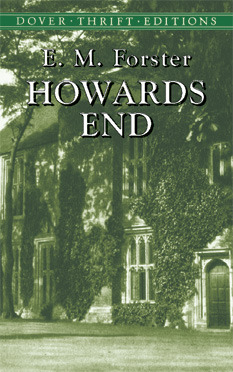

This book did not pull me in like Maurice and A Passage to India did, but the allegories won me over. Eventually.

Rather than being a novel about characters and their individual fates, Howards End is like a mirror made of fractured pieces that show the truth about society in small details and in the lack of a full picture.

“The poor cannot always reach those whom they want to love, and they can hardly ever escape from those whom they love no longer. We rich can.”

If this is what you take away from it, you’ve not read the same book I did. No, my experience is closer to these two quotes:

“The poor are poor, and one’s sorry for them, but there it is.”

and

“There are just rich and poor, as there always have been and always will be.”

Aside from the monetary aspects, it’s always sad to read about a woman who sacrifices so much of herself for companionship and deludes herself to being in love. Yet, maybe the true tragedy lies not in the characters and their fate, but in the people who criticise Margaret for her choice and fail to see that women of today still marry their Mr Wilcoxes. Maybe the the most poignant of it is that they never ask why.

Tuesday, 20 August 2013

A Passage to India by E. M. Forster

Synopsis:
It is India in the year 1924 or thereabouts. After a mysterious incident during a visit to the Marabar Caves, Dr Aziz is accused of assaulting Adele Quested, a young Englishwoman. As he’s brought to trial the fragile structure of Anglo-Indian relations collapses and the racism inherent to colonialism is exposed—a theme which still has powerful, dangerous realities today.


This is a biased review: I am too blinded by the beautiful language and awestruck by the reach of the story and its implications.

Dr Aziz is quite far from a likeable character. He is thoughtless, he has a high opinion of himself and definite opinions of others. He also copes with the English authority by the means of humour. He laughs at them and lets them laugh at him. Dr Aziz meets Mrs Moore in a mosque when he scolds her about keeping her shoes on. When it becomes clear that she’s not wearing any footwear, apologies are made and an honest dialogue begins. That discussion comes to an end when Dr Aziz has escorted Mrs Moore back to the Club into which Indians aren’t allowed.

Through Mrs Moore Dr Aziz meets Ms Quested—a newcomer to India like Mrs Moore—and ends up escorting them both to the Marabar Caves. It is at the caves where something happens.

Like so often in real life, even today, it’s never made perfectly clear what exactly happens at the caves. All that is known is that Ms Quested fled from the scene quite upset and that Dr Aziz is to blame. Or maybe not. He claims he’s innocent and Ms Quested isn’t quite sure herself what happened, but she’s the victim and beyond reproach. She’s a naïve young woman but more importantly she’s an Englishwoman and he’s an Indian.

Watching the events unfold was like watching a documentary from the year 2013. I’m serious, nothing’s changed in ninety years. When a white woman is attacked the dark man is to blame. He’s guilty until proven innocent and maybe not even then. The courts may let him go but that’s a failure on their part not evidence of his blamelessness.

It’s still true today that while individuals may bridge that gap between the races and become friends, society as a group almost never does. Old prejudices die hard.

While the legacy of colonialism is quite foreign to me, I could still identify with Adele Quested because she’s a woman. She’s someone who wants to see the best in people and ends up making a horrible mistake. She’s also the one whose word weighs least when it comes to the crime she’s the victim of. As soon as she’s uttered one accusatory word, the men take over. The Englishmen. They’ve arrested, put Dr Aziz on trial, and judged him before the first hit of the gavel. Dr Aziz is guilty and thus every Indian is. The English are better. Even the women but who listens to the women? Certainly not Dr Aziz who is furious to be accused by someone so ugly.

Contradictions. This book is full of contradictions, but so are people. I just wish we’d learned to know better by now.

Tuesday, 9 April 2013

Rameau's Review Archive: Maurice by E. M. Forster

Rameau's ramblings: I mentioned in the introduction post that I would be bringing over my old reviews one or two a week. Today, I'm going to start with a brilliant book I read fell in love with last month. A five star review is always a good example on how to render me speechless. 

Originally published on Goodreads March 17th 2013.


Synopsis:
Set in the elegant Edwardian world of Cambridge undergraduate life, this story by a master novelist introduces us to Maurice Hall when he is fourteen. We follow him through public school and Cambridge, and on into his father's firm, Hill and Hall, Stock Brokers. In a highly structured society, Maurice is a conventional young man in almost every way, "stepping into the niche that England had prepared for him": except that he is homosexual.


Maurice Maurice by E.M. Forster

You know that moment you and start a book you’ve been wanting to read but haven’t. Maybe you’ve had trouble finding a copy of it or maybe all the hype around it has turned you off or maybe you’re not quite sure you’ll like the book simply because of who wrote it and when and why. And then you fall head over heels in love.

Yeah. That.

Whenever I read a classic, I prepare myself for the inevitable disappointment. In my experience, too many of the great works of literature only represent some form of change in the history of written words and the society that influenced them rather than being good books. If there is any true deeper meaning on the pages of a classic, it’s usually buried under too many decades or centuries of years passed for me to understand.

That wasn’t the case here. For every layer I discovered there were at least two I missed and there’s nothing I love better than subtle complexity, obvious to see for those who’d only look.

It wasn’t just the story describing and showing what life was like a hundred years ago for a young man, what it was like to fall in love and know it could cost him everything, it was the writing I fell in love with. The way Forster uses words to say exactly what he means to and more. How elegant it is.

Maurice was written on the cusp of The Great War and it tells a story of a world long since lost. It shows a young man growing up to take his place in society as he’s expected, and finding himself fundamentally queer in a time when homosexuality was still a crime in Britain. That law is the reason the manuscript remained unpublished for 57 years until after Forster’s death.

I wasn’t even recommended the book; it was the film I saw raved about. When I have the option, I usually prefer to read the book first and see the film second. Having now both read the book and seen the film, I have to say I prefer Forster’s words over the acting of James Wilby, Hugh Grant, and Rupert Graves. And I liked the casting despite Wilby being nothing like the Maurice I imagined until that last scene with Grant.

You’ll notice that I haven’t actually said anything about the story or the characters and that’s because it’s better if you go in blind without expectations. Skip the introductions, acknowledgements, notes on further reading, skip everything and read E. M. Forster’s own words. Read Maurice.


ETA: This blog is being featured at Book Bloggers International today - feel free to visit, say 'hi' and you'll make our day!