
Showing posts with label one brilliant book. Show all posts

Tuesday, 20 August 2013

A Passage to India by E. M. Forster

Synopsis:
It is India in the year 1924 or thereabouts. After a mysterious incident during a visit to the Marabar Caves, Dr Aziz is accused of assaulting Adele Quested, a young Englishwoman. As he’s brought to trial the fragile structure of Anglo-Indian relations collapses and the racism inherent to colonialism is exposed—a theme which still has powerful, dangerous realities today.


This is a biased review: I am too blinded by the beautiful language and awestruck by the reach of the story and its implications.

Dr Aziz is quite far from a likeable character. He is thoughtless, he has a high opinion of himself and definite opinions of others. He also copes with the English authority by the means of humour. He laughs at them and lets them laugh at him. Dr Aziz meets Mrs Moore in a mosque when he scolds her about keeping her shoes on. When it becomes clear that she’s not wearing any footwear, apologies are made and an honest dialogue begins. That discussion comes to an end when Dr Aziz has escorted Mrs Moore back to the Club into which Indians aren’t allowed.

Through Mrs Moore Dr Aziz meets Ms Quested—a newcomer to India like Mrs Moore—and ends up escorting them both to the Marabar Caves. It is at the caves where something happens.

Like so often in real life, even today, it’s never made perfectly clear what exactly happens at the caves. All that is known is that Ms Quested fled from the scene quite upset and that Dr Aziz is to blame. Or maybe not. He claims he’s innocent and Ms Quested isn’t quite sure herself what happened, but she’s the victim and beyond reproach. She’s a naïve young woman but more importantly she’s an Englishwoman and he’s an Indian.

Watching the events unfold was like watching a documentary from the year 2013. I’m serious, nothing’s changed in ninety years. When a white woman is attacked the dark man is to blame. He’s guilty until proven innocent and maybe not even then. The courts may let him go but that’s a failure on their part not evidence of his blamelessness.

It’s still true today that while individuals may bridge that gap between the races and become friends, society as a group almost never does. Old prejudices die hard.

While the legacy of colonialism is quite foreign to me, I could still identify with Adele Quested because she’s a woman. She’s someone who wants to see the best in people and ends up making a horrible mistake. She’s also the one whose word weighs least when it comes to the crime she’s the victim of. As soon as she’s uttered one accusatory word, the men take over. The Englishmen. They’ve arrested, put Dr Aziz on trial, and judged him before the first hit of the gavel. Dr Aziz is guilty and thus every Indian is. The English are better. Even the women but who listens to the women? Certainly not Dr Aziz who is furious to be accused by someone so ugly.

Contradictions. This book is full of contradictions, but so are people. I just wish we’d learned to know better by now.

Thursday, 8 August 2013

Thick as Thieves by Tali Spencer

Synopsis:
After Vorgell the barbarian fucks himself with a unicorn horn, he ends up in a cell with Maddog, a pretty young thief. It’s lust at first sight for Vorgell—but honestly, he can’t help it. Unicorn horn is a potent aphrodisiac, and now he can’t stop thinking about sex. Luckily, Madd is one male witch who knows how to put Vorgell’s new magical body to good use when he tricks Vorgell into a kiss that helps them escape.

Vorgell may desire sex in general—and Madd in particular—but Madd has no intention of being screwed by a man twice his size. He has problems of his own, including an enchanted collar that causes him to desire his most hated enemy. He wants that collar off as soon as possible, but that requires stealing a basilisk egg from the castle they just escaped.

Drawn together by lust and magic, the two men join forces and soon find themselves up to their necks in witches, wizards, and trouble. Vorgell and Madd might just be perfect for each other, but first they have to survive long enough to find out.

After reading the very first line of the blurb, I knew I had to read this book. If you haven’t read it yet, here’s why:

After Vorgell the barbarian fucks himself with a unicorn horn, he ends up in a cell with Maddog, a pretty young thief.

If that right there isn’t the hook that’s grabbed you, I don’t know what is. It promises a unicorn horn dildo, a barbarian, and a thief. What else could you possibly ask from a fantasy m/m story? Witches and Wizards? It has those too. Creative place names and adventures? Likewise. Witty one-liners and loveable characters? Done and done. You can also add adorable, deadly pets on the list. I’m not even going to complain about the female characters.

It’s true that the world-building has men in somewhat a disadvantage and that most women are hostile towards Madd in the beginning, but as the story progresses the reasons are revealed. Those reasons are real, based on characterisations and the story history, not flimsy deus ex machinas.

Everyone is flawed and no one is simply the best in anything. Even Vorgell has his difficulties. They’re average people by their own standards with individual fears and desires. They have limitations and rules they must follow. There’s death and suffering too. And significantly fewer inappropriate erections than you’d expect from a book with a sex magic inflicted cock. That’s another testament to a strong characterisation.

Don’t misunderstand me, there’s sex. There’s oral and anal, but in the end it’s not the driving force of the story. It’s a convenient set up. One that surprises you again and again with its implications. Or maybe that’s just me. I can be slow at times.

Be careful with this book. It pulls you under, makes you slightly uncomfortable—in the good way—and has you holding in your laughter. If you’re lucky you’re in a place where you don’t have to hold it in and you can make as much noise as you want. And no, I don’t think it’s just me.

I highly recommend you read Thick as Thieves.


Saturday, 20 July 2013

The Heiress Effect (Brothers Sinister #2) by Courtney Milan

Synopsis:
Miss Jane Fairfield can’t do anything right. When she’s in company, she always says the wrong thing—and rather too much of it. No matter how costly they are, her gowns fall on the unfortunate side of fashion. Even her immense dowry can’t save her from being an object of derision.

And that’s precisely what she wants. She’ll do anything, even risk humiliation, if it means she can stay unmarried and keep her sister safe.

Mr. Oliver Marshall has to do everything right. He’s the bastard son of a duke, raised in humble circumstances—and he intends to give voice and power to the common people. If he makes one false step, he’ll never get the chance to accomplish anything. He doesn’t need to come to the rescue of the wrong woman. He certainly doesn’t need to fall in love with her. But there’s something about the lovely, courageous Jane that he can’t resist…even though it could mean the ruin of them both.


Trust Milan to turn another historical romance cliché on its head. No, it’s not an inexplicable déjà vu, yes, I’m repeating myself again.

Jane Fairfield doesn’t want to get married. It’s not that she doesn’t want to fall in love and have a family, it’s that the family she has—her sister—is more precious. Having been neglected and starved for parental love and care, Emily and Jane are each other’s worlds. Well, there’s some bad literature involved too, a girl can’t avoid that not even in the 19th century. Or they would be if Emily’s guardian would let them. The Fairfield girls have little choice but to wait and count the days until Emily’s majority and freedom.

It’s just that a promise and Jane’s enormous fortune make achieving this goal a little bit difficult. Here’s where the mountains of lace come in. Jane was never brought up to be a proper lady and now she’s taking those liberties she has taught herself to the extreme to protect herself, her fortune, and her autonomy. That is to say she wears horridly tasteless gowns (some do like bright colours, even I, occasionally) and doesn’t shut up like a proper lady should (not—which, good for her—but is expected to). She’s smart and capable, but she’s also been coddled in a way. No one has taught her how to be ruthless. She’s about to learn.

Oliver is ambitious. He has everything Jane doesn’t: A loving family and a thorough education he means to use. He wants a career in politics (which makes me question his intellect and attractiveness to be quite honest) and he wants to change the world. He knows how to be ruthless, when to take a punch and when to walk away, and that has left its mark on him. Nope, we’re not talking about visible scars either, unless you count the freckles, which my mother does every summer just to annoy me.

Both Jane and Oliver are well off. They’re not starving and though they have their challenges, they’ve found ways to cope. Neither recognises that in this link or circumstances it’s them in danger of breaking. They both need saving before they lose themselves.

I admired how proactive Jane was. She didn’t stand still and wait someone to come rescue her, she faced the danger and rescued herself. It was a treat especially now that I’ve read theCarhart books. She was the one who found a solution for Oliver’s problem. She was the one who discovered the strength to play dirty. Jane recognised Oliver’s doubts and adapted but only to a degree her self-worth would let her. And in the end her choices forced Oliver to adapt.

As I saw Jane conquer one obstacle after another, I was left wondering whether there’d be left anything for Oliver to do. Sure he had the important task of negotiating a new law, but on a more personal level he appeared inert. I didn’t get it until I did. The flinching, it’s what I’ve learned to do. Not from fights, but talking. I simply don’t have the passion and strength to do it like I used to and I’ve learned to pick my moments. I understood the importance of Oliver reclaiming that part of himself. I also chalked it up to different tempers and theatrics. Partly.

The rest of it were the genre dictated expectations, which I’m also blaming for the epilogue. Too nice a bow for the story. Maybe that moment of absolutely happiness had been earned, but I think Jane and Oliver would have been better—more real—without it.

This being a romance novel I have my little gripes too. I’m definitely not a fan of the euphemisms even if it’s virginal Jane describing the scene. However, that doesn’t explain why Oliver would ever refer to his penis as his member (of parliament). And let’s not forget the slight ridiculousness of how their short-lived affair began. It should have been Jane who interrupted them, not the rain.

There’s also something that takes this book a step beyond the typical romance. Milan gives Emily a voice to show just how capable she is and to highlight another less talked of historical fact: Immigration. As surprised as I was to see the time taken to develop this side of the story, it fit well into the rest of the narration.

On a technical level, this is one of Milan’s successes. The text flows and plot is balanced. There weren’t any of those weak moments that plagued The Duchess War.

There weren’t any violent mood swings this time, only some deep laughs, but I loved it all the same.


Thursday, 6 June 2013

Rameau's Review Archive: The Casual Vacancy by J. K. Rowling

Originally posted on Goodreads January 31st 2013.

Synopsis:
A BIG NOVEL ABOUT A SMALL TOWN ...

When Barry Fairbrother dies in his early forties, the town of Pagford is left in shock.

Pagford is, seemingly, an English idyll, with a cobbled market square and an ancient abbey, but what lies behind the pretty façade is a town at war.

Rich at war with poor, teenagers at war with their parents, wives at war with their husbands, teachers at war with their pupils ... Pagford is not what it first seems.

And the empty seat left by Barry on the parish council soon becomes the catalyst for the biggest war the town has yet seen. Who will triumph in an election fraught with passion, duplicity and unexpected revelations. 


The Casual VacancyThe Casual Vacancy by J.K. Rowling

Unpopular opinion reporting to duty.

The writing is not as polished as some I’ve read, the editor could have exercised a sharper scalpel at times, and the ending felt like a bit too tidy a bow: A single would have sufficed instead of a double.

But. It’s funny I use that word to justify a five star rating, but here it is:

Rowling is unmatched in her storytelling abilities. I’m sure there are others who can spin a yarn from as many—or more—threads as she does, but none come to mind right now. I positively despised all the characters, but I adored the complexity of them and the story that tied them together.

This isn’t only an unpopular opinion, it’s an unhelpful one. There are others who’ll gladly dissect the lives and events of unhappy Pagfordians for you, and there are others who’ll speculate on how this book fits in with others Rowling has written. I’m not one of them. All I can say is, that if you keep an open mind, if you void your expectations and whatever associations the name Rowling conjures, this book has the potential to amaze you.

Or not. It’s definitely not for everyone.

I, however, loved the last line.


Friday, 24 May 2013

Rameau's Review Archive: American Love Songs by Ashlyn Kane

Originally posted on Goodreads September 2nd 2011.


Synopsis:
Jake Brenner has too many wild oats to sow to fall in love-or so he claims. Besides, he's much too busy with his band, the Wayward Sons, to go looking for romance. His reticence has nothing to do with his embarrassing crush on Chris, the band's lead singer and Jake's erstwhile best friend. But that was before enigmatic wanderer Parker McAvoy signed on as the band's new lead guitarist.He can only deny his attraction to sweet, dorky Parker for so long before the urge to do something about it becomes impossible to ignore. The trouble is, Parker knows all about Jake's philandering ways-and oh, yeah, he's not gay. Or so Jake thinks until a string of related events provides encouraging new insight. Can he convince Parker to overlook his colorful past and give him a chance? Or will this love song fade out before it even begins?(

American Love SongsAmerican Love Songs by Ashlyn Kane

I've read nearly a hundred books this year. Some of those have been decent, several I can call good, and a handful were really great. But there's been only one book that's lingered in my mind like this. Until now.

Jake Brenner is a twenty year old college drop out of his own volition. He chose music and the band, or more accurately, he chose Jimmy, his best friend, and Chris, his long time crush, over school. After a drunken mishap the band is forced to find a new guitarist and Jake a new roommate.

In walks Parker McAvoy, a mysterious musical genius, who finds a his place with them after a long drifting period. And he quickly finds his way into Jake's heart too.

I spent two days in a reading haze immersed in these boys' lives. I cried, I laughed, and I felt my heart tumble. The characters swept me along with them on this amazing journey from uncertainty and anonymity to certainty and fame. I watched these characters grow and accept change like too few people do.

Most of all, I enjoyed the writing. It didn't drag me down with false bravado, but carried me through the scenes and showed me their emotions effortlessly. The characters stayed true to themselves and their actions made sense, even Parker's whose motives weren't revealed until the end.

And you know how I'm always complaining about the annoying point of view changes usually between first person voice and third limited, well, it turns out it doesn't matter one bit when it's done right. From the beginning the story is scattered with Jake's blog entries and occasional emails, which feel like just extension to the dialogue. Jake's voice is clearest in his postings.

I read the ebook, but I'm still eyeing the hardcover. It's that good.


Tuesday, 7 May 2013

Rameau's Review Archive: What the Librarian Did by Karina Bliss

Originally posted on Goodreads December 13th 2012.


Synopsis:
Is Rachel Robinson the only one on campus who doesn't know who Devin Freedman is? No big deal except that the bad-boy rock star gets a kick out of Rachel's refusal to worship at his feet. And that seems to have provoked his undivided attention. Devin, the guy who gave new meaning to the phrase "sex, drugs and rock 'n' roll." Devin, the guy who somehow becomes wedged between her and the past she's kept hidden for years. 

It's up to this librarian to find out firsthand just how "bad" he really is. Because her secret--and her growing feelings for a man who claims he's bent on redemption--depend on his turning out to be as good as he seems. Which is really, really good.


What the Librarian DidWhat the Librarian Did by Karina Bliss

This review can also be found on Book Girl of Mur-y-Castell-blog.

I may or may not have found my new favourite author.

There’s a reason Harlequin Superromances sell so well in Finland, better than Blaze or any other kinky ultra hot sex series or imprint. The impact of naked skin kind of evens out when you get used to seeing it regularly in the sauna. And we have those long winter nights and comfy blankets in our beds… anyway, it’s all about the story.

Here, two adults in their thirties meet at a point in their lives that isn’t particularly auspicious for romantic entanglements. One desperately wants a family but isn’t ready to commit to a man to have it, and another is trying to build a new start for his life. It’s a good thing then that they don’t know anything about each other and can discover together what the future holds for them. But as I said, the timing isn't the best possible and their past mistakes are about to catch up with them.

I made a list of all the things I loved about this book and it’s as disorganised as are my thoughts, still. I loved the wit and humour Bliss infuses her text with. Jokes are a delicate thing to write especially when the audience doesn’t necessarily share the cultural context with the author, but here:

”It wasn't that he had a five o'clock shadow at nine-thirty in the morning that screamed 'bad boy.' To Rachel's eyes, that simply made him scruffy.”


"Anyone could see she had a conscience. That must be painful for her."


”’I’m not offended. You're not my type, either.'
Perversely, he was piqued. 'Not a nerd, you mean?'
Her eyes narrowed. 'Not housebroken.’”


Look at that and tell me it’s not funny even without the context. I dare you.

I loved the fact that Rachel and Devin didn’t succumb to the insta-lust/love/attraction that’s a plague in modern romances. They were actually slightly antagonistic before building a tentative friendship with the option for more. Their romance was the slow burn kind with push and pull to keep them balanced. One gave the other took, and then they switched places. Truths were shared and actual smarts were displayed. I loved that both Rachel and Devin acted like adults. They weren’t perfect but they owned up to their mistakes and were determined to face the consequences.

One thing I absolutely hate in romance novels is the plot twist involving an artificial, prolonged misunderstanding. It was delightfully absent from this book and it all comes back to characters acting like real adults. Even in their most idiotic moments, they remained true to their characterisations instead of changing to fit the whims of the plot.

As for the reason why I now have a “can-I-has-a-Devin” shelf, let’s just say—without spoiling the book for everyone else—that the man knows the right things to say. (Yes, I’m aware that a woman wrote him.) He has brilliant scenes with Rachel and another character where he expresses his unwavering love, devotion, and trust in her. Once he’s in, he’s in. He’s made up his mind and he won’t let her insecurities drive him away, and he trusts her to figure it out eventually.

I’ll need to read that other book by Bliss I bought on the Harlequin Christmas sale. Then I’ll know if I’ll be adding another author on my list of favourites.


Thursday, 2 May 2013

Rameau's Review Archive: Unraveled (Turner #3) by Courtney Milan

Rameau's ramblings: What can I do to help kick off the Romance May? Give you another Milan review! Naturally.

Originally posted on Goodreads December 14th 2011.


Synopsis:
Smite Turner is renowned for his single-minded devotion to his duty as a magistrate. But behind his relentless focus lies not only a determination to do what is right, but the haunting secrets of his past—secrets that he is determined to hide, even if it means keeping everyone else at arm’s length. Until the day an irresistible woman shows up as a witness in his courtroom…

Miranda Darling isn’t in trouble…yet. But she’s close enough that when Turner threatens her with imprisonment if she puts one foot wrong, she knows she should run in the other direction. And yet no matter how forbidding the man seems on the outside, she can’t bring herself to leave. Instead, when he tries to push her away, she pushes right back—straight through his famous self-control, and into the heart of the passion that he has long hidden away…


Unraveled (Turner, #3)Unraveled by Courtney Milan

Having read Unveiled and Unclaimed both, I knew what I was getting myself in for. That's why this review is littered with comments about the anxious wait I was made to suffer until self-published Unraveled was released. You'd think the author would have the decency to write something bad to make it up to me, to make my part as reviewer easier, but no. Damn you Milan, how dare you make me love Smite Turner even more than I thought I would? And Miranda Darling and Ghost? How dare you!

Of the three Turner brothers Smite is the most scarred. His skin may be intact, but inside he carries the weight of the water that once nearly crushed and suffocated him. Inside he's an impenetrable fortress that stands alone under the storms of his nightmares. Inside he's cold, but far from dead.

Ghost, the puppy, may have started the thawing, but it takes a blazing sun like Miranda Darling for Smite to forget himself and break the barriers he's erected just to be able to function. For two decades he's spent simply existing, but when Miranda flattens him with few sharp remarks Smite finds himself wanting to live again.

She's naive yet worldly as only a child grown amidst actors can be. She's a survivor, but not hardened through and through. She has a sharp tongue and wicked mind, but she's also loyal and too trusting. She's a ray of sunshine that lights up the room, but will scorch if faced directly. Miranda is just the right woman to get under Smite Turner's skin.

What starts with a lie and on the grimy streets of Bristol, moves to shining marble halls and into a bedroom. While they are discovering new physical boundaries, an unexpected accord forms between the two lovers. Miranda finds herself attracted to a decent man and Smite opens up to her in a way he hasn't been able to do with anyone else.

I could quote the whole book and it would make more sense than this review so far.

What you need to know is that Smite is a diligent magistrate in Bristol with an unerring memory. He recognises Miranda and stops her from committing perjury, he also follows her to warn her not to try that particular trick in his court again. What Smite doesn't realise is that Miranda has her own set of problems and very little choice. She's bartered her life and skills to the Patron for personal protection for herself and the boy living with her.

Smite might be able to remove Miranda from the dirty and sooty streets, but he can't free her from her obligations. And here, Milan surprises positively. Instead of hiding her troubles and trying to deal with them by herself, Miranda faces Smite and confides in him risking everything now dear to her. Of course this doesn't stop Smite from reacting rather stupidly, but he has the baggage to excuse it.

Despite the slight feel of repetition in the beginning–which might be because I kept putting the book down and rereading to get where I'd left off–the text carried me through the story like a gentle way pushing me to the shore. The way Milan writes makes days feel like hours and weeks feel like years. By the time I finished reading the last chapter I couldn't believe how far both characters and their extended families had come. It felt like I had read the first pages a lifetime ago instead of few hours.

I know I'm forgetting something important–like the laughs–but for the life of me I can't think of anything else without spoiling the journey. This is the best I can do for a five star review and I know it's not nearly enough.

P.S. If anything, this story shows you how important a comma can be.


Thursday, 25 April 2013

Rameau's Review Archive: Unclaimed (Turner #2) Courtney Milan

Rameau's ramblings: This will be listed under second opinions, but technically this is the first opinion and the review that got Anachronist reading historical romance. Go me!

Originally posted on Goodreads September 20th 2011.

Synopsis: 
Her only hope for survival...
Handsome, wealthy and respected, Sir Mark Turner is the most sought-after bachelor in all of London and he's known far and wide for his irreproachable character. But behind his virtuous reputation lies a passionate nature he keeps carefully in check...until he meets the beautiful Jessica Farleigh, the woman he's waited for all his life.
Is to ruin the man she loves...
But Jessica is a courtesan, not the genteel lady Sir Mark believes. Desperate to be free of a life she despises, she seizes her chance when Mark's enemies make her an offer she can't refuse--seduce Mark and tarnish his good name, and a princely sum will be hers. Yet as she comes to know the man she's sworn to destroy, Jessica will be forced to choose between the future she needs and the love she knows is impossible.


Unclaimed (Turner, #2)Unclaimed by Courtney Milan

Why should you read this?

Because it's a historical romance of two people coming together and surpassing social and personal obstacles. You need more convincing do you?

Let's see. There's a virgin, there's a seduction, and there's a defamation that'll separate the two lovers. Not sold yet?

Well, he's the one with an untarnished reputation and virtue to protect, and she's the experienced lover who'll teach him to know better.

That did it, oh, good. Just in case...

Sir Mark has written a book about chastity and to his disbelief it's taken a life of its own. He's become the darling of the public and an unwilling role model for men in search of new challenges. He's also become the target of envy and resentment. Someone wants to see Sir Mark's good name in the gutter and they're willing to pay for it.

Enters Jessica, the experienced courtesan who longs for freedom. She doesn't want to sell her body to survive anymore. All she needs is enough money to break free and make a quiet life of her own far away from the city. She grabs the opportunity with both hands and prepares for one last tryst.

Sir Mark is immediately attracted to the mysterious widow Jessica pretends to be, but he's not ready to succumb to her charms quite so easily. After all he's battled his yearnings for nearly thirty years and there have been other temptations. Nothing quite like this though.

What follows is a delicious tale of two people circling and trying to outsmart each other. It's a seduction in the best sense of the word. It's a seduction of the mind as well as the body and the erotica is far from gratuitous. It's actually earned.

It isn't until near the end when the reader has all but abandoned hope for Sir Mark and Jessica that they do come together and admit the extent of their feelings for each other. After all, there's more than love involved; there's respect and dignity to consider.

Milan's writing is solid as she slowly guides the couple together. She takes her time introducing the characters and explaining just what makes them so unique especially considering the setting. Milan doesn't skirt around sex scenes, because she's afraid to write them, she simply ensures they fit in with the plot - questionable word choices and all.

Yes, an actual plot in a romance novel, can you imagine? So, what are you waiting for? Go, read, and enjoy the slow burn.

I received a copy of this book from the publisher through NetGalley.


Tuesday, 9 April 2013

Rameau's Review Archive: Maurice by E. M. Forster

Rameau's ramblings: I mentioned in the introduction post that I would be bringing over my old reviews one or two a week. Today, I'm going to start with a brilliant book I read fell in love with last month. A five star review is always a good example on how to render me speechless. 

Originally published on Goodreads March 17th 2013.


Synopsis:
Set in the elegant Edwardian world of Cambridge undergraduate life, this story by a master novelist introduces us to Maurice Hall when he is fourteen. We follow him through public school and Cambridge, and on into his father's firm, Hill and Hall, Stock Brokers. In a highly structured society, Maurice is a conventional young man in almost every way, "stepping into the niche that England had prepared for him": except that he is homosexual.


Maurice Maurice by E.M. Forster

You know that moment you and start a book you’ve been wanting to read but haven’t. Maybe you’ve had trouble finding a copy of it or maybe all the hype around it has turned you off or maybe you’re not quite sure you’ll like the book simply because of who wrote it and when and why. And then you fall head over heels in love.

Yeah. That.

Whenever I read a classic, I prepare myself for the inevitable disappointment. In my experience, too many of the great works of literature only represent some form of change in the history of written words and the society that influenced them rather than being good books. If there is any true deeper meaning on the pages of a classic, it’s usually buried under too many decades or centuries of years passed for me to understand.

That wasn’t the case here. For every layer I discovered there were at least two I missed and there’s nothing I love better than subtle complexity, obvious to see for those who’d only look.

It wasn’t just the story describing and showing what life was like a hundred years ago for a young man, what it was like to fall in love and know it could cost him everything, it was the writing I fell in love with. The way Forster uses words to say exactly what he means to and more. How elegant it is.

Maurice was written on the cusp of The Great War and it tells a story of a world long since lost. It shows a young man growing up to take his place in society as he’s expected, and finding himself fundamentally queer in a time when homosexuality was still a crime in Britain. That law is the reason the manuscript remained unpublished for 57 years until after Forster’s death.

I wasn’t even recommended the book; it was the film I saw raved about. When I have the option, I usually prefer to read the book first and see the film second. Having now both read the book and seen the film, I have to say I prefer Forster’s words over the acting of James Wilby, Hugh Grant, and Rupert Graves. And I liked the casting despite Wilby being nothing like the Maurice I imagined until that last scene with Grant.

You’ll notice that I haven’t actually said anything about the story or the characters and that’s because it’s better if you go in blind without expectations. Skip the introductions, acknowledgements, notes on further reading, skip everything and read E. M. Forster’s own words. Read Maurice.


ETA: This blog is being featured at Book Bloggers International today - feel free to visit, say 'hi' and you'll make our day!

Thursday, 6 September 2012

Review: Purge by Sofi Oksanen

Book info:
Form: e-book, pdf format
Genre: contemporary fiction
Target audience: adults


Synopsis:

You can call this book a tale of two sisters and indeed, it reminded me of all these folk songs about sibling rivalry. Ingel and Aliide, two Estonian peasant girls, had a very bad luck of falling for the same German boy. Ingel was very pretty, even beautiful, and whatever she did, she did it always better than other girls. Aliide was less pretty and less gifted, completely overshadowed by her perfect sister. The boy in question, Hans Pekk, chose Ingel. They married, were very happy and soon they had a little baby girl, Linda. Despite that fact Aliide never stopped loving Hans; her torment made her slowly ruin her own life and the life of her closest relatives, with a little help from the Russian communists who were simply great at wreaking havoc and ruining people’s lives whenever they went.

The novel starts when elderly and widowed Aliide, living alone in a half-deserted Estonian village, finds a strange girl near her house. The girl needs help very badly – she is hungry, filthy and it is obvious she’s been beaten regularly. In spite of her initial fear Aliide empathizes with the girl  too much to ignore her; she invites her inside, gives her a bath, some fresh clothes and food. The girl is called Zara and it seems she is running from the cruel Russian Mafia men. Gradually, as the story unfurls, you find out it was hardly by accident that Zara wandered to Aliide’s house; she sought out that woman because they are actually related. Still at first Zara tells a lot of lies, only later revealing a very disturbing and sad truth about herself and her situation. It makes Aliide reminisce about the difficult times under the Soviet rule – ironically nothing changed. Her own youth was full of horrible experiences as well, similar to those of young Zara,. Will these two women help each other? Will they understand each other’s decisions? Will they become family again?

My impressions:

I was very deeply moved by this book; as a result my review is much more personal and a bit different than usual. I felt connected to it on more than one level. 

Believe me or not but it was a book which kept me awake at night and gave me nightmares (a very rare occurrence). It was a book that reminded me of some simple truths, namely that life is a bitch and sometimes you simply cannot do anything about it. One stupid decision might ruin your future and sometimes no decision is needed at all because, no matter what you do, your life will be ruined anyway – it’s your fate, karma, politics, war, or other stupid circumstances completely beyond your control. It was a book that made me want to howl with rage and cry.

It was a book that portrayed love at its cruelest and most beautiful. It made me pet my dog for hours because animals, seen from some aspects, are far better than humans – they never judge you by appearances and, as long as you treat them well, they will pay you back with love and lasting attachment. It was a book which, like ancient tragedies, was able to trigger a haunting catharsis, a purge promised in the title. Have you read or seen “Atonement”? Compared to this one, “Atonement” seemed to me just like a child’s prattle, nothing more. Because sometimes you can’t atone for your sins, no matter what you do.

It was a book I couldn’t stop reading even though I had more pressing tasks at hand. I got sucked into it and, although I was very uncomfortable from time to time, I didn’t want to leave till the last word. 

Final verdict:

Heartrending. Incredibly sad and wise. Hauntingly beautiful. The plot and the characters are like an accident waiting to happen – you can’t divert your eyes even though nobody forces you to watch. Highly recommendable but not a comfortable read. Still easily the best book I’ve read this year. I don't know when I will be able to read another book.


Monday, 23 April 2012

Review: Quicksilver by Neal Stephenson (The Baroque Cycle 01)


Book info:
Form: e-book, Kindle format
Genre: historical ficition, sci-fi
Target audience: adults


Synopsis:


The story opens in 1713 when Daniel Waterhouse, a former Puritan and natural philosopher (as scientists were then called) living in the Massachusetts Bay Colony, finds himself invited back to England, where a dispute has arisen between Newton and Leibniz over exactly who developed calculus. Yes, he is that Dr Daniel Waterhouse who has founded "The Massachusetts Bay Colony Institute of Technologickal Arts" (or, as it is known today, MIT). As Daniel undertakes his voyage, leaving his wife and son behind, we go back forty years to his youth, when, as a student, he watched his classmate Isaac Newton develop into an obsessive and eccentric genius. Newton is so absorbed by his work (mathematics, light, even alchemy, an idea still taken seriously then, you name it) that he would neglect food and proper sleep if it weren't for Daniel's care. Daniel practically serves as the young genius's butler during their school days although it was supposed to be the other way round (Daniel, as a richer student, had a right to employ poorer boys, called sizars, as his personal servants). This section takes first 340 pages give or take.
Then we move into "King of the Vagabonds," which shifts the novel's focus from the lives of English high society to society's dregs. Jack Shaftoe is the vagabond of the title, an orphan whose earliest career involved dangling from the legs of men sentenced to hang in order to quicken their deaths. As an adult he wanders the continent, eventually falling in with an army battling the Turks at Vienna. Here he rescues Eliza, who had been sold as a concubine to a Turkish prince. Jack and Eliza travel together for a time, until they reach Amsterdam. Here, Eliza proves to have a strong mind for business and money management, and she remains in Amsterdam — quickly turning into a European financial center thanks to the Dutch East India Company — while Jack (who is slowly losing his mind from syphilis) continues to France.


Portrait of Gottfried Leibniz (1646-1716), Ger...
Portrait of Gottfried Leibniz (1646-1716), German philosopher (Photo credit: Wikipedia)
The final section of the book, "Odalisque," brings Daniel's and Eliza's story threads together. Daniel has re-established contact with Newton, whose studies are veering away from the purely scientific into the metaphysical following his completion of the Principia Mathematica, while on the continent Leibniz has finally published his calculus. Eliza's reputation as a financial wizard, meanwhile, has brought her into contact with some of the most powerful people from Holland, England, and France. She finds herself ensconced at Versailles, managing the finances of virtually everyone there, which gives her unprecedented contact with people who would ordinarily be off limits to one of her lowborn class. Meanwhile, she has become a confidant first of the Duke of Monmouth (whose rebellion in England against James II fails miserably), then of William of Orange (whose succeeds), and of Leibniz, to whom she writes of her escapades in cipher.

What I liked:

I felt this first part tried to capture one of the pivotal periods not merely in European history, but one which ultimately shaped the course of the modern world as we know it. 17th century as a period cannot and shouldn't be underestimated. In the field of science, there were Newton's discoveries, as well as the first formal instance of politics and science going hand in hand with the Royal Society. The financial markets of Europe at this time set the stage for the stock exchanges that propelled economies the world over today. I found myself gasping several times when I rediscovered such obvious truths here. It was a mental challenge but also something truly enjoyable. What were Renaissance alchemists but hackers, rooting around in and trying to reprogram systems of matter? Modern cryptanalysts and programmers have their intellectual roots, too, in work done by wigged mathematicians of centuries past. The idea of a modern computer was most probably invented by Leibniz. The learned discourses of Waterhouse, Newton, Leibniz, Hooke et al contains the germs, sometimes even the clear outlines, of future scientific discoveries. Daniel refers to "a kind of net-work of information", a long time before the OED's first record of such a figurative use of "net-work" (by Coleridge in 1816, talking about property). One letter from Leibniz more or less invents Einsteinian special relativity and implies the celebrated equation e=mc2; elsewhere someone proposes gravitation as the distortion of spacetime avant la lettre; and there is a buried joke about the improbability of anyone ever believing in the idea of particles which we now know as neutrinos.I am not surprised this book was awarded 2004 Arthur C. Clarke Award. Stephenson’s prose I found very fluid and readable even when he described difficult topics; his gift can draw the reader in and can even make those knotty scientific and mathematical theories palatable.
 
His novel offers up a wide range of characters, all of them deserving a separate book, like Isaac Newton, Gottfried Wilhelm von Leibniz, Robert Hooke, John Wilkins, Samuel Pepys, Christiaan Huygens, the Duke of Monmouth, Benjamin Franklin, and Louis XIV himself. All of them in Stephenson's hands become living, breathing, remarkable men, not merely the kinds of stuffy cardboard portraits so often found in historical novels. You hardly know who to look first at and who to like best. It is a feast rarely found in other novels.
Isaac Newton Dansk: Sir Isaac Newton Français ...
 Sir Isaac Newton. (Photo credit: Wikipedia)

As a backdrop to the birth of modern science, Stephenson presents the House of Stuart and its
 courtiers. Drake Waterhouse, Daniel’s father, is killed by Charles II himself, and Daniel makes the acquaintance of a number of future courtiers while attending Cambridge. They are colourful fellows, interesting to read about but also ones you would run from as fast as you could if you met them in real life.
It seems that the main character of the book is the Quicksilver, a mysterious substance which can represent several ideas. It’s one of symbols of alchemy, which is slowly being replaced by verifiable science; but it is also a symbol of Mercury, the messenger, who in the guise of the mysterious Enoch Root passes messages between members of the nascent scientific community in America, England and on the European continent. 


Finally the sense of humour. I loved it when great men in English politics and science, normally fighting brutally with each other (Newton and Hooke would become bitter enemies) confided in Daniel, helping to guide his career to greater heights just because they perceived him as a harmless nonentity among true giants.  If you like clever palace intrigue and the unique style of wit that only emerges from Britain you will be in seventh heaven. Usually I laugh that hard only while watching the better episodes of  Black Adder or Monty Python. Remember, laughter is good for your health.

What I didn’t like:


A replica of Newton's second reflecting telesc...
A replica of Newton's second reflecting telescope of 1672 presented to the Royal Society. (Photo credit: Wikipedia)
As any 900 page work of historical fiction this is a daunting, demanding book. Long, twisted, with several POVs and the narration switching from first person present to third person past in no time. No, it is not for everyone. There were parts which I found boring like the early history of European banking and coin-minting. It's probably not possible for a book so long to go its whole length without a few longueurs or to keep you entertained the whole time. Well, I managed to finish it and I didn’t regret doing so but it’s up to every reader to determine whether the good parts are worth persevering. The answer will depend to some extent on the reader's taste in historical fiction. Those who prefer it straight and full of anachronisms might balk at Stephenson's  attitude and laissez-faire when it comes to sticking to the historical accuracy. Characters and the narrator often knowingly use modern slang (at one point Charles II is called "a foreign-policy slut"), and there are numerous little contemporary jokes such as a reference to "canal rage" in Venice - gondoliers are increasingly involved in violent altercations, which some take to be "a symptom of the excessively rapid pace of change in the modern world" - or when Enoch Root offers a Grantham apothecary a cup of tea, which the latter considers "inoffensive enough, but I don't think Englishmen will ever take to anything so outlandish" (in fact I  LOVED that scene but I know some people might frown).

Final verdict (short and sweet):


After a break I will read the rest. For sure. I loved it, despite some boring parts and the fact that it was a very long novel. While reading such books you feel your brain cells rejoicing and multiplying. For the sheer effort of writing something so long and so good I proclaim it to be...


Enhanced by Zemanta

Thursday, 5 January 2012

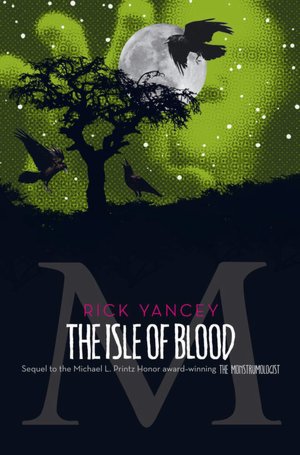
Review: The Isle of Blood (The Monstrumologist #3) by Rick Yancey

Book info:
Form: e-book, Kindle format
Target audience: allegedly YA but I would say adult (more about it in my review)
Genre: horror, adventure, psychological


Synopsis:

Pellinore Warthrop is sent from England a very strange object, called a ‘nidus’ or nest. Allegedly it is made by one of the most unique monsters on earth, a kind of a dragon called Typhoeus Magnificum, aka the "Holy Grail of Monstrumology", a creature so elusive nobody has seen it dead or alive yet. Its nest is also very toxic to humans – a mere touch and you are infected. Small wonder the unwilling courier who brought it to the doctor falls ill and has to be killed. As you can guess it was not a normal illness and it is highly contagious. Before he dies he attacks poor Will and the boy loses his index finger – well, better that than  lose your sanity and life, right?

Doctor Warthrop, definitely shaken by the fact that he had to chop off his faithful apprentice’s finger with a butcher’s knife to save him, this time decides to go to London with somebody else. It happens a perfect companion presents itself as if conjured out of thin air – his name is Thomas Arkwright, he reveres Warthrop as the biggest monstrumologist alive, he knows pretty much about monsters, he is young, fit and eager. Frantic Will is left behind with von Helrung’s niece and her family. It seems he has finally a chance to enjoy a normal life but the situation is unacceptable to him from the very start. Will looks for a way to join his doctor because he clearly thinks he doesn’t belong anywhere but by his side.

Soon enough, unable to rest and fueled by the logical reasoning Warthrop has thaught him, Will finds out that Arkwright is most probably not the man he claimed to be. Then a message comes from England, announcing Warthrop’s death…and Arkwright returns alone, with a clearly made-up story of Pellinore’s demise. After an interrogation session no real agent would be ashamed of, Von Helrung, Will and another monstrumologist, called Torrance form a rescue team and go to London to investigate. What will they find? Monsters, as usual, but what monsters? Will’s journey will take him even further, to Socotra, the Isle of Blood, where human beings are used to make nests and blood rains from the sky. Will his loyalty, bravery and humanity pass the ultimate test?

What I liked:

Forget the "Young Adult" categorization as in this case it is very misleading. I am an adult female reader who doesn’t like most of YA fiction and I loved these books, finding them definitely more suited for older audience. Rick Yancey's Monstrumologist series is one of the masterpieces but, like such books, it defies pigeonholing. Let me only tell you that it should appeal to anyone who loves great storytelling and is not too squeamish when it comes to gory details. I loved the monsters populating these books and I couldn’t avert my eyes even when bits and pieces of human bodies flied around in the form of a blood rain.

There is one more thing. Reading the third part of this series I had a very strange feeling because every wish I expressed after previous parts came true. After the second part I wanted to see Jack/John Kearns/Cory again and here you go, Kearns is back in a peripheral but vital role as a prankster and hunter extraordinaire. I wanted to have more female characters and we get the intrepid Mrs Bates, who dares to sing Will lullabies, and her daughter Lilly, who dares to kiss him and gives him her photo. I enjoyed the philosophical undercurrents and here we get more of it as well. It was as if the author communicated with me beforehand. Weird, to say the least of it. I’ve never enjoyed such a phenomenon before.

The character of Will is in the main focus of the third part. The relations between him and his master have never been more complex. Will finally understands why his services are so “indispensable” to Warthrop; their mutual bond is one of the most compelling dynamics I’ve found in contemporary books.

The boy has grown up and I don’t mean only physical development. He thinks and plans on his own. He can stand up to the doctor and anyone else, taking independent, sometimes very difficult decisions. Of course at some levels he still remains a child – a child feeling very lonely and bereft to add – but he can overcome his weaknesses. The writer uses different adults in the story to give us impressions of what Will Henry might become, depending on his choices. Will he be like Mr. Bates, a successful financier and a proper gentleman with his little, happy family? Will he be one of the cold, calculating monster hunters who delight in the game of killing more than anything else? Will he be one of the scholars working behind the scenes and hoarding over the treasures of the monstrumologist secret society? Finally, will he become a ruthless monster like Kearns or a more humane monster like Warthrop?

The Isle of Blood, just like the other Monstrumologist novels, begins with the frame of Yancey editing a collection of folios written by the real Will Henry about his adventures. But this time, the investigation becomes more personal than ever - our tenacious narrator digs deeper into Will Henry's life and tries to figure out exactly who and what he was. There are scenes that will shock the reader that are made even more powerful as they are seen through Will's ever observant but so youthful eyes.

Let me also say how much I  appreciated the fact that Arthur Conan Doyle and especially Arthur Rimbaud were among the secondary characters of this book!

What I didn’t like:
SocotraSocotra via Wikipedia

???

Final verdict:

There is not a dull sentence to be found in any one of the three novels but if you prefer maudlin teen romance novels, stay away; this series is not for you. Where is the fourth part btw? I know the author has planned it and I will preorder it asap. Can a reader pay a bigger compliment than begging for more?
"We are hunters all. We are, all of us, monstrumologists". I quite agree - I've just bagged some great books...

Some quotes to share the joy:

""Miss Marks, you see, makes her living by... entertaining young, and not so young, sailors...or any other members of the armed forces, or civilians, who enjoy...being entertained by ladies who...entertain." He cleared his throat." (isn't Warthrop, discussing the oldest profession with his young apprentice, a sweetie?)

""What did I learn, sir?" The breeze was delicious upon my face. I could smell the sea. "I learned a poet doesn't stop being a poet simply because he stops writing poetry.""


"I don't know if you are a spiritual man but - "
"Not often," said the monstrumologist, urging Conan Doyle toward the lobby doors. "Hardly ever. No - just once. I was three or four and my mother caught me deep in a conversation with God." He shrugged. "I have no memory of it. God might."


Enhanced by Zemanta

Thursday, 15 December 2011

Review: Unraveled by Courtney Milan (Turner #3)

Book info:
Form: Kindle e-book
Genre: historical romance
Target audience: adults


Synopsis: 

“ ‘Well’, Miranda said. ‘It’s a sweet tale about kittens and puppies and rainbows and love.’ “

If I were cruel I would leave you only with that quote (loc. 4736) which is great, true, cynical and deceptive at the same time. Officially it is a romance novel but it also reminded me of Eugene Sue and Jane Austen – not bad authors to be compared to!

Miranda Darling is a gifted girl like no other. She has been raised among actors and had a fairly happy childhood. Unfortunately she was soon left alone because her father couldn’t get over the death of her mother. Not only alone but also burdened with another child, Robbie, abandoned by an actress and left to her tender care.

Now they try to survive in Bristol’s slums watching each other's back. Miranda sew and make wigs but it is hardly enough to make the ends meet. She is under the paid protection of a shadowy crime master called the Patron - in return she must use her acting talents whenever they are needed. For example in a court. There she catches the eye of Smite Turner, one of the magistrates with total recall, a sense of justice and a logical mind which is like a knife all blade (Rabindranath Tagore, I owe you!). You can figure out the rest…their romance will be not only inevitable but also very funny…wait, I almost started the next section without being aware of it!

What I liked:

The sense of humour. I found it the biggest asset. I really laughed out loud at least several times reading this one, you must admit not a mean feat for a romance book. There were plenty of highly entertaining scenes – let me just list the best ones: the first visit to a theatre with a mistress in tow, a night in a country inn with the same mistress who pretends to be your wife (Mr and Mrs Dashwood – any Austen fan will howl with laughter!!!), a ‘date’ in a prison and a supper afterwards…overall whenever Miranda showed her freckled face and her mop of red curls things immediately got interesting – well-done! Not to mention an underestimated, humble punctuation mark which here was tantamout to love...or lack thereof. I will try never to forget a comma any more!

All in all the above-mentioned lead female character (ladies first) was sensible, clever, resourceful and as level-headed as I like. In fact Miranda Darling is currently my favourite romance heroine. Why? She speaks her mind. She knows what she wants. She uses every opportunity to get it. No stupid secrets, no hasty decisions, no hysterical regrets or useless crying the morning after, when you cannot change anything anyway. She knows when to say ‘no’, she knows when to say ‘yes’…that’s my girl!

Smite Turner was a perfect Introvert who’s been through a lot and has to deal with it. In my humble opinion the author rendered his character in a great way, making him a really three-dimensional romantic nerd (no kidding – his sentimentality quota are the best proof!). If only there were more of such romantic heroes I would read these books more often…

Now perhaps you wonder: what about the baddies? I am proud to say that the baddies here are…not exactly bad. They are human and sympathetic (I can’t say more without spoiling you so let’s stop here) so closer to real life than you could reasonably expect in such a novel. Once again I was very pleasantly surprised.

The narration was so good that I devoured the book during one evening – not because I wanted to know what would happen (it is a romance book with a  pretty much predictable plot – they fall in love/lust/ go to bed/ have some troubles/ reunite and/or marry) but because I was so entertained that I didn’t want to stop.

Let me add that, aside from a number of hot and heavy make-out scenes, there is also unexpected depth and emotion in this story. These characters are layered and feel very real so this book pushed a number of buttons for me.

Finally the research behind the book (it is a historical romance from the 19th century) was flawless – the ship, the petty court records, everything fitted. Ms. Milan – I truly appreciate!

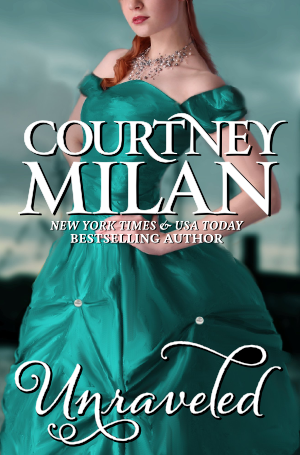
Cover art

The dress and the colours are nice, I love this deep emerald -blue, but I doubt Miranda would appreciate a portrait of her when about 3/4 of her face are invisible...

What I didn’t like:

Well, you know me. I am yet to find a flawless romance book but this one came very close indeed. One negative remark - the ending could have been a bit more bitter-sweet but still it was very amusing, mainly because of the cynical Miranda.

Final verdict:

I actually had to design a new button for this one. Let it speak for itself.