Book info:
Form: e-book, Kindle format
Genre: very dark fantasy
Target audience: adults
Synopsis:
Honorous Jorg Ancrath has never exactly wanted to be a mere king but, as a mountainous strip of land falls into his hands he takes the crown and never looks back. A future emperor has to know his priorities, right? One step at a time...
Currently, in order to clear the path to his empire, he must defeat two Princes of Arrow, brothers Orrin and Egan. Many prophecies declare that a Prince of Arrow will be the next Emperor, able to unify the kingdoms and bring much-needed peace; the fact that one of the brothers marry Katherine of Scorron, Jorg's beloved, only adds to his determination.
Meanwhile Jorg himself has to marry for political reasons - without allies even he can't dream of keeping his modest crown for long. He is surrounded by enemies, visible and invisible ones; one of them, Sageous, can even invade his dreams. Finally faced by an enemy many times his strength Jorg knows that he cannot win a fair fight. Fortunately playing fair was never part of Jorg’s game plan.
What will happen during King Jorg's wedding day battle? Something spectacular, you might be sure of it.
What I liked:
I am glad to say young Jorg has matured a lot in the second installment. Compared to the previous part he became positively mellow. Not that he's become a nice, flawless hero of course, but, compared to his previous self, that of a deranged, murderous child full of angst and something even darker, there was noticeable improvement.
There were several clever scenes in this book, most of them involving the clash of the "new-old" technology (like a nice Colt gun or a watch) with medieval artefacts. One of them reminded me strongly of Indiana Jones movies and therefore made me smile.
After reading this one I admit I am even more curious what happened to the Builders and why the humankind had to return to the level straight from the Middle Ages when it comes to material culture. Oh and little Miana, Jorg's betrothed, is an interesting creature, definitely worth more place in the next book.
What I didn't like:
I admit the whole story lost a bit of momentum. Constant jumps forward and backward in the plot line were a bit bothersome, especially at the beginning, before you get into the rythm of the narration.
Also the POV of Katherine was, in my humble opinion, not such a great idea; in most of her diary entries the girl simply didn't have anything important to say and when she finally did, she disappeared (a spoiler, highlight to read or skip) most probably killed during the big blaze which consumed the Prince of Arrow's army. I hope she will stay absent - she was getting annoying with her "I-hate-Jorg-I-love-hating-Jorg-so-much-that-I-almost-love-him" soliloquy.
Final verdict:
Not bad continuation of an interesting series but I found it weaker than the first part. Well, the ending will be decisive. By the way my review of the first part, Prince of Thorns, you can find here.
Showing posts with label fantasy. Show all posts
Wednesday, 12 September 2012
Monday, 7 May 2012
Review: The Fixer: A Lawson Vampire novel by Jon F. Merz
Book info:
Form: e-book, Kindle format
Genre: fantasy, vampire detective story
Target audience: adults
I borrowed a digital version of this book from my friend - thank you very much, pchlaszachrajka!
Synopsis:
When a bad,
big, psychotic vampire called Cosgrove returns to Chicago, one thing is sure:
there will be blood and murders galore. Cosgrove doesn’t disappoint his
faithful allies and enemies - soon enough the Council, a body supervising all vampires
living in that area, condemn him to death. Any death but the sooner the better.
Lawson, one of vampire Fixers (so kind of law enforcers) and his Control (so kind of boss) McKinley
are given the order to find Cosgrove and drive something made of wood straight
through his dark, scheming heart. The balance must be preserved and there is no
balance with such psychos as Cosgrove.
Unfortunately
killing him is easier said than done. Firstly, nobody knows what Cosgrove looks
like now. Then our baddie has an interesting plan of his own and plenty of
other vampires are cooperating with him secretly. When Lawson’s best friend is
murdered in a club there’s no looking back, though, especially when a female assassin
Lawson falls in love with, Talya, joins the hunt and is kidnapped as a result.
Will vampires manage to clean their ranks? How many lives will it cost? Will
humans finally find out the truth about vampires?
What I
liked:
This novel was highly
readable, I really was sucked inside the plot and the more I read the more I
wanted to know about our sad vampire protagonist. Lawson was an
interesting character mainly because he was so flawed - an experienced law enforcer who is hardly
fearless and has a very unpleasant fund of memories- anyway that’s what made
this story work for me. The world Lawson lives in is dangerous but he didn’t
choose his life, it chose him, and, while he would have chosen differently, he
doesn’t waste a lot of time pining over it either. Well, being so very flawed
and in love he whines a bit but not too much.
Talking about the love interest of the main lead I must mention Talya, a
big asset of this book. She is an Asian girl – half Chinese, half Kazakh –
which I found original. She used to work as a KGB secret agent and now she is a
freelancer assassin, also something you hardly expect from a ‘damsel in
distress’, usually met in such books. She has a brain of her own and she knows
what she wants – another feature I appreciate in my heroines.
Apart from that Merz did, in my opinion, a
wonderful job of setting the fighting scenes. They seemed real and gory but not
overly so. I also enjoyed several mentions of Musashi Miyamoto, a Japanese swordsman and rōnin and bushido, the code of samurai. I like Japanese culture very much and it was like a ‘hello’ from a distant friend.
What I
didn’t like:
This novel
was published for the first time in 2002. That’s exactly ten years ago. It
makes itself felt. In other words if you look for a terribly original premise, keep looking because you are bound to be
disappointed by this one.
My other
complain is that this book could really do with some more extensive editing. I’m not a native English speaker and still I noticed
some strange mistakes: e.g. a faulty sentence structure like "I knew your
reaction would be worth coming out in this miserable rain for" or an
occasional redundancy of word choice, like " Her hips ground in to my face
as she rode my face..." (and it was
supposed to be one hot scene, imagine that!) A rookie writer mistakes, more
often found in low-quality fanfic nowadays than in officially published books
(although there are exceptions to this rule).
Now my main complaint. I really couldn’t swallow that Lawson, a
centenarian and a vampire with a several
decades spent as a black Ops veteran, was from time to time so incredibly sloppy
with his detective work. First he readily told his love interest, a human woman after
all, that their mutual quarry is a vampire when the mere existence of vampires
was supposed to be the biggest secret. He often took really poor operative
decisions, allowing the main baddie to escape with ease and flourish. Ok, he
was in love, but honestly, you should have expected a better control from such
a professional. Also on several occasions Lawson describes himself as reacting
"like a fourteen year old boy" to Talya. Well, doesn’t it sound
silly? His background and training is given as lengthy, Marine/special forces
tough, dangerous and pretty comprehensive but for all of his training Lawson
doesn't seem to know what to do in a tight spot and allows situations to worsen
through his own failure to deliver.
Final verdict:
The world building was interesting but not
especially original. The characters were complex but not very captivating.
Still I want to give this series one more chance. Idealistic, I know...
Labels:
book review,
detective story,
fantasy,
Jon Mertz,
Lawson Vampire novel,
vampires
Sunday, 29 January 2012
Review: Theft of Swords (The Riyria Revelations 01, 02) by Michael J. Sullivan
Book info:
Form: pdf e-book
Genre: fantasy
Target audience: fantasy fans young and old
Synopsis (mostly from Goodreads):
Can a self-serving thief and an idealistic swordsman survive long enough to unravel the first part of an ancient mystery that has toppled kings and destroyed empires in order to keep a secret too terrible for the world to know? And so begins the first tale of treachery and adventure, sword fighting and magic, myth and legend
Form: pdf e-book
Genre: fantasy
Target audience: fantasy fans young and old
Synopsis (mostly from Goodreads):
This book was originally self-published in two parts, entitled The Crown Conspiracy and Avempartha.
Royce Melborn, a skilled thief-for-hire, and his mercenary partner, Hadrian Blackwater, make a profitable living carrying out dangerous assignments for conspiring nobles, often double-crossing them in the meantime. One day, however, they accept a deceptively easy and too-profitable-to-be-true job. All they have to do is to pilfer a famed sword, preventing a death of an innocent man. Their earnings will assure them a comfortable winter. Well, nothing is as dangerous as a good deal in the form of a good dead especially offered at very short notice. Soon enough they find themselves in royal dungeons, framed for the murder of the king and trapped in a conspiracy that uncovers a plot far greater than the mere overthrow of a small dynasty of a tiny kingdom.
Can a self-serving thief and an idealistic swordsman survive long enough to unravel the first part of an ancient mystery that has toppled kings and destroyed empires in order to keep a secret too terrible for the world to know? And so begins the first tale of treachery and adventure, sword fighting and magic, myth and legend
What I liked:
First let me tell you that this novel was constructed like a solid bit of good architecture - the right proportions, accents laid out properly, the right number of characters, everything in perfect order. Small wonder I couldn't stop reading it till the very end. The plot progressed smoothly and was quite engaging, the world building was original and interesting, mentioning magicians, elves, half-elves and dwarves. I loved the cast of secondary characters, especially Princess Arista, Alric, her younger brother and the heir apparent, Myron, a monk librarian with eidetic memory and of course my lovely pearl of a baddie, Archibald Ballentyne - young, handsome, rich, full of himself and... a total jerk! Well done!
What's more commendable the author avoided several traps which often plague such stories. When a princess is saved, her saviour doesn't fall in love with her (thanks goodness!) and she doesn't fall in love with him. When a young, spoilt and rather dumb prince is made a king he, surprisingly, tries to be a good monarch and he actually manages that with a little help of his friends. No insta-love, no unbelievable happy ending!
The comic relief came in the form of Myron who had lived a completely secluded monastery life since he was four and then, all of a sudden, was forced out of his shell to explore the world and its wonders. I enjoyed every scene with him!
What I didn't like:
I found the two main protagonists, Hadrian and Royce, a bit too two-dimensional. Hadrian is Mr. Social Skills and Mr. Muscle (no pun intended lol!) Royce is Mr. Break-and-Enter and Mr. Strategist. All good and clear but too schematic. I must add that their amazing lack of cynicism was also sometimes too obvious to swallow. Ok, Royce at least tried to be sensible, while Hadrian...he often acts like a noble knight in a shiny armour, riding that spotless white horse which doesn't exist. You can say I am jaded but here I missed some dark fantasy grit. Real thieves and thugs are far more mercenary and cruel, far less influenced by those "woe me, pity me" stories. Well., maybe it will make more sense in the next installment - I do hope for more character development as it was definitely hinted here!
My last quibble - there were some small info-dumps in this novel which almost, ALMOST made me bored. Fortunately the author managed to keep them relatively short. What's more, the knowledge was put to use soon afterwards so it made sense after a while.
Final verdict:
There is nothing like a decent fantasy book to soothe your nerves and make you happy after a long day of hard work. Yes, I will continue to read this series and I recommend it to every fantasy fan. It is entertaining, it is well-written and it doesn't contain graphic violence.
Final verdict:
There is nothing like a decent fantasy book to soothe your nerves and make you happy after a long day of hard work. Yes, I will continue to read this series and I recommend it to every fantasy fan. It is entertaining, it is well-written and it doesn't contain graphic violence.
Labels:
book review,
fantasy,
Michael J. Sullivan,
Riyria,
Theft of Swords
Tuesday, 20 December 2011
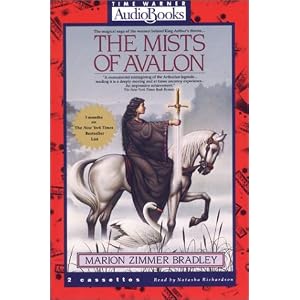
Review: The Mists of Avalon by Marion Zimmer Bradley
Book info:
Form: e-pub file
Genre: fantasy, Arthurian legends
Target audience: adults
Synopsis:
The magical legend of King Arthur is vividly retold through the eyes and lives of the women who wielded power from behind the throne. I could have written much more but there is really no point of it. I bet you have heard about King Arthur, his unfaithful but beautiful wife, Gwenhyfar, his best friend, Lancelot, who was also his wife’s lover, his Knights of the Round Table, the Graal, Escalibur etc. You will find everybody and pretty much everything in this book. Do not expect to recognize these character and items, though.
What I liked:
- the logic
I’ve never read a more logical version of the Arthurian legends. You know, they tend to contradict each other as they were added throughout the ages, time and again, refreshed, bent to the current literary tastes, sanitized or made more gory etc. Ms Zimmer Bradley tells the Arthurian legends in a way which makes you think “gosh it could and SHOULD have happened this way!” (of course as long as you're willing to suspend disbelief enough for the magical elements of the story).
- the main female lead
It is our old, good Morgaine la Fey but presented in a way which I have never experienced before. She is usually shown as one of the villains. Here everything seems to be different, with her being a priestess of the Old Religion of Druids, oath-bound to perform certain rituals and defend her faith…such explanation was so brilliant in its simplicity and so watertight that I could forgive Morgaine anything – even incest and leaving her own child in the tender care of her not so tender and virtuous aunt. You might cringe but still you understand why.
- the way women are presented
I must say I clearly see why some people say that Zimmer Bradley broke new grounds with this book, in terms of feminist re-imaginings of the classics. She didn't just put Morgaine la Fey or her auntie Morgause in leather bustiers, and have them shoot sex arrows at men around. She changed the form itself, using a new language to utterly subvert the ideas of women's literature, in which the heroine was usually shown as a silly pretty thing, sitting in a kitchen or in a living room and chatting about others all day round. Gwenhyfar is the closest to that model and she is hardly a positive character here, not with her religious bigotry, blind obstinacy, lack or strategic thinking or any thinking at all.
- the baddies
You know, I love three-dimensional villains and here I didn’t have to look for them long and hard – in fact EVERY character of this book could be called a villain at some point, even Morgaine or Arthur, not to mention Lancelot, Mordred, Morgause and Gwenhyfar. Sir Mordred, the Arthur’s killer was shown as an incredibly handsome young knight with a sense of humour (a bit skewed but still) and a great chip on his shoulder (well, you can imagine how big only when you find out who his parents were). Even if you hated him sometimes (he was hardly a saint because it is a book about people, not saints) you still couldn’t admire him a little bit for his force of character and cunning. Overall the lines between good and evil are much blurred; all the characters are well-drawn in depths both good and bad, flawed and noble, completely and ultimately human.
- the religious conflict
I’ve always missed that theme, which I find very interesting – how Christianity overcame the old pagan beliefs. Here it is shown in full and if it is not true it is at least well-told. Once again I found it impossible not to root for Morgaine's Avalon, not only because I knew it was destined to recede into the mists forever, but because it was matriarchal, and so much more comforting to me than the narrow-minded and mysoginistic version of Christianity prevalent during those times. One is sure - Romans didn’t improve things for women spreading Christianity, not in the slightest. On the other hand both Morgaine and Gwynhefar you could fairly describe as religious fanatics, willing to kill for their beliefs and they both struggled with what they had to give up to push their agenda.
- the celtic mythology...
What I loved the most was the portrayal of the rites and powers of Avalon based on the beliefs on ancient Druids... and the way the land of Avalon could only be found by certain people (sometimes by accident!) in the mists. It simultaneously occupied the same island as Glastonbury, where nuns and priests lived, but was somehow on the other side of a veil....and eventually became "lost" to time.
What I didn’t like:
- the sheer length of this book
It was one long read and I suppose it would have been loads better if it was shorter. There were whole sections which I found simply boring. Who needs a full description of a long day spent on singing, spinning and embroidery? Especially with Gwynhefar as a host? A good editor should have intervened.
- prevalent sadness
It is not one of these novels which will cheer you up, make you smile and jump with joy at the end. I had many sad, pessimistic thoughts, swirling round my brain like autumn leaves in a dark, windy, rainy evening. Some chapters were so nostalgic that I had to stop reading for a while and get a grip on myself. The life of most characters was difficult, full of sorrows and pain; nobody seemed to get what they want and even if they were happy for one moment, then next moment usually made them utterly devastated. I must admit that after a while it started to chafe. Still I managed to finish the book so perhaps it wasn’t that bad…what do you want, with the Celts…
- sex
Haven’t I written time and again that sometimes less is more? It seemed to me that the author tried to cram too much of those scenes to emphasize the fact that sex is nothing bad and should be enjoyed rather than punished, especially if both parties are consenting adults (well, more or less adults, you know, we deal with the Middle Ages here). Whereas the message is more than right I think I could have got it without half of that hot content, especially when a rape and incest was involved. The author, in my humble opinion, took sometimes too many liberties with the original story. Arthur pushes Lancelot and Gwynhefar into bed together and once even takes more or less active part in their frolics…Lancelot admits that sometimes he is not sure who he loves better, his queen or his king…not to mention Morgause who has as many lovers as it pleases her till the very end...and somehow nobody suffers from these tell-tale embarrassing diseases. Well, the book was written in the 80’s that explains a lot…
Image via Wikipedia
Final verdict:
I would NOT recommend this book for someone looking for an Arthurian tale sensu stricto but if you like old legends presented with a modern twist and told in a coherent, logical way you will like it for sure, despite the size and the sadness of the whole novel. I really enjoyed reading it as an adult, as a teen I think I would have just loved it.

Form: e-pub file
Genre: fantasy, Arthurian legends
Target audience: adults
Synopsis:
The magical legend of King Arthur is vividly retold through the eyes and lives of the women who wielded power from behind the throne. I could have written much more but there is really no point of it. I bet you have heard about King Arthur, his unfaithful but beautiful wife, Gwenhyfar, his best friend, Lancelot, who was also his wife’s lover, his Knights of the Round Table, the Graal, Escalibur etc. You will find everybody and pretty much everything in this book. Do not expect to recognize these character and items, though.
What I liked:
- the logic
I’ve never read a more logical version of the Arthurian legends. You know, they tend to contradict each other as they were added throughout the ages, time and again, refreshed, bent to the current literary tastes, sanitized or made more gory etc. Ms Zimmer Bradley tells the Arthurian legends in a way which makes you think “gosh it could and SHOULD have happened this way!” (of course as long as you're willing to suspend disbelief enough for the magical elements of the story).
- the main female lead
It is our old, good Morgaine la Fey but presented in a way which I have never experienced before. She is usually shown as one of the villains. Here everything seems to be different, with her being a priestess of the Old Religion of Druids, oath-bound to perform certain rituals and defend her faith…such explanation was so brilliant in its simplicity and so watertight that I could forgive Morgaine anything – even incest and leaving her own child in the tender care of her not so tender and virtuous aunt. You might cringe but still you understand why.
- the way women are presented
I must say I clearly see why some people say that Zimmer Bradley broke new grounds with this book, in terms of feminist re-imaginings of the classics. She didn't just put Morgaine la Fey or her auntie Morgause in leather bustiers, and have them shoot sex arrows at men around. She changed the form itself, using a new language to utterly subvert the ideas of women's literature, in which the heroine was usually shown as a silly pretty thing, sitting in a kitchen or in a living room and chatting about others all day round. Gwenhyfar is the closest to that model and she is hardly a positive character here, not with her religious bigotry, blind obstinacy, lack or strategic thinking or any thinking at all.
- the baddies
You know, I love three-dimensional villains and here I didn’t have to look for them long and hard – in fact EVERY character of this book could be called a villain at some point, even Morgaine or Arthur, not to mention Lancelot, Mordred, Morgause and Gwenhyfar. Sir Mordred, the Arthur’s killer was shown as an incredibly handsome young knight with a sense of humour (a bit skewed but still) and a great chip on his shoulder (well, you can imagine how big only when you find out who his parents were). Even if you hated him sometimes (he was hardly a saint because it is a book about people, not saints) you still couldn’t admire him a little bit for his force of character and cunning. Overall the lines between good and evil are much blurred; all the characters are well-drawn in depths both good and bad, flawed and noble, completely and ultimately human.
- the religious conflict
I’ve always missed that theme, which I find very interesting – how Christianity overcame the old pagan beliefs. Here it is shown in full and if it is not true it is at least well-told. Once again I found it impossible not to root for Morgaine's Avalon, not only because I knew it was destined to recede into the mists forever, but because it was matriarchal, and so much more comforting to me than the narrow-minded and mysoginistic version of Christianity prevalent during those times. One is sure - Romans didn’t improve things for women spreading Christianity, not in the slightest. On the other hand both Morgaine and Gwynhefar you could fairly describe as religious fanatics, willing to kill for their beliefs and they both struggled with what they had to give up to push their agenda.
- the celtic mythology...
What I loved the most was the portrayal of the rites and powers of Avalon based on the beliefs on ancient Druids... and the way the land of Avalon could only be found by certain people (sometimes by accident!) in the mists. It simultaneously occupied the same island as Glastonbury, where nuns and priests lived, but was somehow on the other side of a veil....and eventually became "lost" to time.
What I didn’t like:
- the sheer length of this book
It was one long read and I suppose it would have been loads better if it was shorter. There were whole sections which I found simply boring. Who needs a full description of a long day spent on singing, spinning and embroidery? Especially with Gwynhefar as a host? A good editor should have intervened.
- prevalent sadness
It is not one of these novels which will cheer you up, make you smile and jump with joy at the end. I had many sad, pessimistic thoughts, swirling round my brain like autumn leaves in a dark, windy, rainy evening. Some chapters were so nostalgic that I had to stop reading for a while and get a grip on myself. The life of most characters was difficult, full of sorrows and pain; nobody seemed to get what they want and even if they were happy for one moment, then next moment usually made them utterly devastated. I must admit that after a while it started to chafe. Still I managed to finish the book so perhaps it wasn’t that bad…what do you want, with the Celts…
- sex
Haven’t I written time and again that sometimes less is more? It seemed to me that the author tried to cram too much of those scenes to emphasize the fact that sex is nothing bad and should be enjoyed rather than punished, especially if both parties are consenting adults (well, more or less adults, you know, we deal with the Middle Ages here). Whereas the message is more than right I think I could have got it without half of that hot content, especially when a rape and incest was involved. The author, in my humble opinion, took sometimes too many liberties with the original story. Arthur pushes Lancelot and Gwynhefar into bed together and once even takes more or less active part in their frolics…Lancelot admits that sometimes he is not sure who he loves better, his queen or his king…not to mention Morgause who has as many lovers as it pleases her till the very end...and somehow nobody suffers from these tell-tale embarrassing diseases. Well, the book was written in the 80’s that explains a lot…
Final verdict:
I would NOT recommend this book for someone looking for an Arthurian tale sensu stricto but if you like old legends presented with a modern twist and told in a coherent, logical way you will like it for sure, despite the size and the sadness of the whole novel. I really enjoyed reading it as an adult, as a teen I think I would have just loved it.
Sunday, 18 September 2011
Mini review: Aftermath (Sirantha Jax 05) by Ann Aguirre
Book form: mobi (Kindle) format ebook
Author: Ann Aguirre
Title: Aftermath
Genre: sci-fi/fantasy/romance/space opera
Target audience: adults
Synopsis
(if you haven't read the previous parts you might be spoiled, it is a series after all, sorry):
Sirantha Jax went AWOL and managed to rearrange the beacons, making the Grimspace quite unrecognizable to anybody but herself. She saved her whole civilization from the invasion of murderous, flesh-eating Morguts but also over 600 innocent people died, stranded in Grimspace because of her intervention. Now she has to undergo a trial for it - and her life might be at stake.
March and Velith are helping her find a good lawyer but ultimately it's her personal fight to stay sane and to tackle the survivor's guilt which matters the most. March leaves before the trial begins; he has to look for his orphaned nephew. It is evident he and Jax are growning apart almost despite their best efforts to stay close to each other. After Sirantha's release she and Velith Il- Nok travel to Gehenna where they say their good-byes to Adele, a friend of both. We get to know more about Vel's past romance with Adele. After some time of rest Sirantha wants to do something positive to counter-balance all the deaths, caused by her. She has two concrete projects on her mind.
The first one concerns a little Mareq creature called Baby-Z. It was another casualty, killed accidentally by Sirantha, but his DNA sample was preserved. Now it is being cloned in order to return it to its home. The other project concern Loras - a La'hern so a kind of elf who comes from a race which doesn't have a will of his own anymore due to human intervention. Sirantha promised to help him and now is financing the whole research which might lead to finding a cure for all La'hern.
All nice and good but will it be enough?
What I liked:
This one was truly a character-driven adventure. Yes, you got it right and yes, it is possible; at least Ann Aguirre can make it happen. Almost all her characters are fully-fledged and seem completely alive and still they get plenty of action! Easy? Well, not exactly...
We finally get more information about March, Hit, Adele, Doc and March's nephew, but most of all Vel. Sirantha’s path from an anti-heroine and a boobs-flashing rebel to a self-aware, courageous, mature woman is very impressive. The best thing is she owes a lot of her newfound dedication and maturity to the strong, loyal bounty hunter, Velith, who looks like a big bug in a chitin body but is one of the best aliens I've encountered in sci-fi books - really the more you know about him the more you cherish him. He is wise, supportive, undemanding, able to defend himself, full of good ideas and loyal - could you wish anything more in a prospective partner? So what he isn't exactly human-handsome?
What's more, Ann Aguirre is an amazing story teller - she can keep you occupied all the time. She started with this crazy sci-fi Grimspace world but what she really has given us are unforgettable characters, a fantastic, very original vision and a gripping story. It can appeal to lovers of different genres.
If you don't have anything terribly against this mix of genres do read this series, it is worth it! I just hope the final part will be as good as the frist five!
Author: Ann Aguirre
Title: Aftermath
Genre: sci-fi/fantasy/romance/space opera
Target audience: adults
Synopsis
(if you haven't read the previous parts you might be spoiled, it is a series after all, sorry):
Sirantha Jax went AWOL and managed to rearrange the beacons, making the Grimspace quite unrecognizable to anybody but herself. She saved her whole civilization from the invasion of murderous, flesh-eating Morguts but also over 600 innocent people died, stranded in Grimspace because of her intervention. Now she has to undergo a trial for it - and her life might be at stake.
March and Velith are helping her find a good lawyer but ultimately it's her personal fight to stay sane and to tackle the survivor's guilt which matters the most. March leaves before the trial begins; he has to look for his orphaned nephew. It is evident he and Jax are growning apart almost despite their best efforts to stay close to each other. After Sirantha's release she and Velith Il- Nok travel to Gehenna where they say their good-byes to Adele, a friend of both. We get to know more about Vel's past romance with Adele. After some time of rest Sirantha wants to do something positive to counter-balance all the deaths, caused by her. She has two concrete projects on her mind.
The first one concerns a little Mareq creature called Baby-Z. It was another casualty, killed accidentally by Sirantha, but his DNA sample was preserved. Now it is being cloned in order to return it to its home. The other project concern Loras - a La'hern so a kind of elf who comes from a race which doesn't have a will of his own anymore due to human intervention. Sirantha promised to help him and now is financing the whole research which might lead to finding a cure for all La'hern.
All nice and good but will it be enough?
What I liked:
This one was truly a character-driven adventure. Yes, you got it right and yes, it is possible; at least Ann Aguirre can make it happen. Almost all her characters are fully-fledged and seem completely alive and still they get plenty of action! Easy? Well, not exactly...
We finally get more information about March, Hit, Adele, Doc and March's nephew, but most of all Vel. Sirantha’s path from an anti-heroine and a boobs-flashing rebel to a self-aware, courageous, mature woman is very impressive. The best thing is she owes a lot of her newfound dedication and maturity to the strong, loyal bounty hunter, Velith, who looks like a big bug in a chitin body but is one of the best aliens I've encountered in sci-fi books - really the more you know about him the more you cherish him. He is wise, supportive, undemanding, able to defend himself, full of good ideas and loyal - could you wish anything more in a prospective partner? So what he isn't exactly human-handsome?
What's more, Ann Aguirre is an amazing story teller - she can keep you occupied all the time. She started with this crazy sci-fi Grimspace world but what she really has given us are unforgettable characters, a fantastic, very original vision and a gripping story. It can appeal to lovers of different genres.
What I didn't like:
Well, the book seemed to me divided artificially into two parts: the trial of Sirantha and her trip to planet Mareeq, to deliver Baby-Z2 to his parents. I wish both parts were longer and more developped; that way Jax's story arc was just too extended. Also sometimes I was a tiny bit annoyed by all these messages and letters.
The cover: cheeesy...definitely worse than the content, believe me.
Final verdict:
Aguirre says that Jax is going to get her HEA (happily ever after) in the last book (Endgame) that's going to be published next year - that seems clearly to indicate some sort of resolution with March. I'm very interested to see how this one works out and how other mysteries will be solved like the real identity of Edun or the fate of Jael (no, I don't think he died in prison, b*****d).
Labels:
Aftermath,
Ann Aguirre,
book review,
fantasy,
romance,
sci-fi,
Sirantha Jax,
space opera
Subscribe to:
Posts (Atom)