
Form: e-pub file
Genre: fantasy, Arthurian legends
Target audience: adults
Synopsis:
The magical legend of King Arthur is vividly retold through the eyes and lives of the women who wielded power from behind the throne. I could have written much more but there is really no point of it. I bet you have heard about King Arthur, his unfaithful but beautiful wife, Gwenhyfar, his best friend, Lancelot, who was also his wife’s lover, his Knights of the Round Table, the Graal, Escalibur etc. You will find everybody and pretty much everything in this book. Do not expect to recognize these character and items, though.
What I liked:
- the logic
I’ve never read a more logical version of the Arthurian legends. You know, they tend to contradict each other as they were added throughout the ages, time and again, refreshed, bent to the current literary tastes, sanitized or made more gory etc. Ms Zimmer Bradley tells the Arthurian legends in a way which makes you think “gosh it could and SHOULD have happened this way!” (of course as long as you're willing to suspend disbelief enough for the magical elements of the story).
- the main female lead
It is our old, good Morgaine la Fey but presented in a way which I have never experienced before. She is usually shown as one of the villains. Here everything seems to be different, with her being a priestess of the Old Religion of Druids, oath-bound to perform certain rituals and defend her faith…such explanation was so brilliant in its simplicity and so watertight that I could forgive Morgaine anything – even incest and leaving her own child in the tender care of her not so tender and virtuous aunt. You might cringe but still you understand why.
- the way women are presented
I must say I clearly see why some people say that Zimmer Bradley broke new grounds with this book, in terms of feminist re-imaginings of the classics. She didn't just put Morgaine la Fey or her auntie Morgause in leather bustiers, and have them shoot sex arrows at men around. She changed the form itself, using a new language to utterly subvert the ideas of women's literature, in which the heroine was usually shown as a silly pretty thing, sitting in a kitchen or in a living room and chatting about others all day round. Gwenhyfar is the closest to that model and she is hardly a positive character here, not with her religious bigotry, blind obstinacy, lack or strategic thinking or any thinking at all.
- the baddies
You know, I love three-dimensional villains and here I didn’t have to look for them long and hard – in fact EVERY character of this book could be called a villain at some point, even Morgaine or Arthur, not to mention Lancelot, Mordred, Morgause and Gwenhyfar. Sir Mordred, the Arthur’s killer was shown as an incredibly handsome young knight with a sense of humour (a bit skewed but still) and a great chip on his shoulder (well, you can imagine how big only when you find out who his parents were). Even if you hated him sometimes (he was hardly a saint because it is a book about people, not saints) you still couldn’t admire him a little bit for his force of character and cunning. Overall the lines between good and evil are much blurred; all the characters are well-drawn in depths both good and bad, flawed and noble, completely and ultimately human.
- the religious conflict
I’ve always missed that theme, which I find very interesting – how Christianity overcame the old pagan beliefs. Here it is shown in full and if it is not true it is at least well-told. Once again I found it impossible not to root for Morgaine's Avalon, not only because I knew it was destined to recede into the mists forever, but because it was matriarchal, and so much more comforting to me than the narrow-minded and mysoginistic version of Christianity prevalent during those times. One is sure - Romans didn’t improve things for women spreading Christianity, not in the slightest. On the other hand both Morgaine and Gwynhefar you could fairly describe as religious fanatics, willing to kill for their beliefs and they both struggled with what they had to give up to push their agenda.
- the celtic mythology...
What I didn’t like:
- the sheer length of this book
It was one long read and I suppose it would have been loads better if it was shorter. There were whole sections which I found simply boring. Who needs a full description of a long day spent on singing, spinning and embroidery? Especially with Gwynhefar as a host? A good editor should have intervened.
- prevalent sadness
It is not one of these novels which will cheer you up, make you smile and jump with joy at the end. I had many sad, pessimistic thoughts, swirling round my brain like autumn leaves in a dark, windy, rainy evening. Some chapters were so nostalgic that I had to stop reading for a while and get a grip on myself. The life of most characters was difficult, full of sorrows and pain; nobody seemed to get what they want and even if they were happy for one moment, then next moment usually made them utterly devastated. I must admit that after a while it started to chafe. Still I managed to finish the book so perhaps it wasn’t that bad…what do you want, with the Celts…
- sex
Haven’t I written time and again that sometimes less is more? It seemed to me that the author tried to cram too much of those scenes to emphasize the fact that sex is nothing bad and should be enjoyed rather than punished, especially if both parties are consenting adults (well, more or less adults, you know, we deal with the Middle Ages here). Whereas the message is more than right I think I could have got it without half of that hot content, especially when a rape and incest was involved. The author, in my humble opinion, took sometimes too many liberties with the original story. Arthur pushes Lancelot and Gwynhefar into bed together and once even takes more or less active part in their frolics…Lancelot admits that sometimes he is not sure who he loves better, his queen or his king…not to mention Morgause who has as many lovers as it pleases her till the very end...and somehow nobody suffers from these tell-tale embarrassing diseases. Well, the book was written in the 80’s that explains a lot…
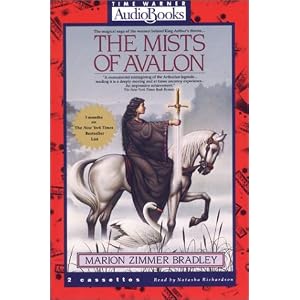
 Image via Wikipedia
Final verdict:
I would NOT recommend this book for someone looking for an Arthurian tale sensu stricto but if you like old legends presented with a modern twist and told in a coherent, logical way you will like it for sure, despite the size and the sadness of the whole novel. I really enjoyed reading it as an adult, as a teen I think I would have just loved it.


This appears to be something I would read if it wasn't so long. I like it when authors take an old traditional story and put a unique twist on it. If a writer can do that and keep me entertained, I'm usually sold. Great review as well.
ReplyDeleteThanks Lena *blush*. Unfortunately the book is really long - I warn you, it might take you several days even if you are a quick reader. You can always skip this and that though ;).
ReplyDeleteHonestly, I never liked the old Authurian legends. I never could stand Gwenivere. But then again, that made sense since she was supposed to be a model for us women to follow (gagging noises). So, even though I didn't like Gwen in this version either, at least it made more sense. I loved Morgaine in this version and unlike you I'd recommend it to those who like Arthur legends. Those that are looking for the Christianity connection... uh no, but those who enjoy the legends... yes. Always 2 sides to a tale and this one told it better. :D
ReplyDeleteI remember the movie, yup lots of sex there too. I just do not want it here for some reason.
ReplyDeleteAnd the book is too long!
I have watched the movie, I have done my bit
Melissa I've read some very harsh reviews of this one and these people usually hated the way Ms Zimmer Bradley transformed the original stories (if there are such) in her book.
ReplyDeleteI never could stand Gwenivere. But then again, that made sense since she was supposed to be a model for us women to follow (gagging noises).
A model to follow, Gwen? Nah...I've always wondered what men saw in her? Oh, wait, I know, her intellect ;).
Blodeuedd, now, when you commented, you certainly did your bit ;D.
ReplyDeleteSouinds entertaining - and an author who manages to give a new twist to an old, old story must be doing something right.
ReplyDeleteEntertaining it was, Tracy, thank you!
ReplyDeleteI tried to read this one years ago but I thought it was too heavy handed about the goddess stuff and preachy. I set it aside and haven't felt tempted to return to it.
ReplyDeleteIt was a bit heavy handed at times but not too much for me. Well, Morgan was a priestess...
ReplyDeleteI read this when I was a teenager and loved it. I don't remember many of the details now, though.
ReplyDeletecarol it can happen to everybody!
ReplyDelete