Showing posts with label horror. Show all posts

Wednesday, 7 August 2013

Review: Death Sentence by Mikkel Birkegaard

I won this novel on Mel's Random Reviews blog, written by awesome Mel who didn't hestiate to send a huge parcel full of books abroad -thank you once again, you rock!

Book info:
Form: paperback
Genre: crime fiction, horror, mystery with Scandinavian flavour
Target audience: adults

Synopsis (from Goodreads):
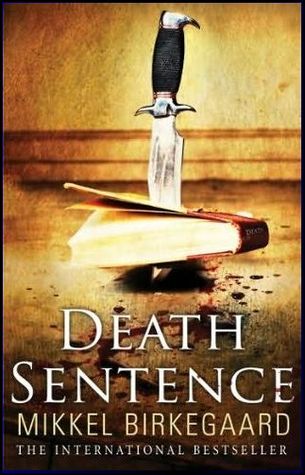


A murder commited on paper, safely within the confines of a novel, is one thing. To see that sane crime in the real world, is something else entirely...

Frank Føns is a successful crime writer. His novels, famed for their visceral descriptions of violent death, have made him a household name. But now someone is copying his crimes. For Frank what once seemed a clever, intriguing plot twist has suddenly become a terrifying, blood-spattered reality.

Frank unwittingly swaps his role of writer for detective. He must find out who is using his fiction to destroy his life, and why. What had once been a game is now a matter of life and death.

In fiction, the bad guy always gets caught, but in real life there is no such guarantee. And as Frank knows, no one is promising him a happy ending...

My impressions:

The central character, Frank Føns, is a Danish writer of violent crime novels - in fact very explicit torture scenes, full of bloodshed and gore, are his brand name mark. Frank's first person narration (allegedly we are reading his autobiography of sorts) was quite compelling - it was an unusual plot device,  a crime novel author telling us about his life, career, inspirations and books while trying to solve a 'real' crime mystery and to put his life in order, feeling that somehow he is losing his grasp more and more. You see, when Frank thinks he more or less has found the balance anew somebody starts to murder people around him, copying exactly the methods described so accurately in his novels. First these are highly unpleasant individuals who die, like a corrupted cop with penchant for paedophilia, but then the mysterious murderer endangers the life of one of Frank's daughters and the whole problem takes a new, far more sinister meaning. Frank decides the only way to put a stop to what he feels he started is to become a detective himself and try to catch the killer -- a solitary and dismal task at best.

The parts I enjoyed the most? There were the chapters in which the author asks whether or not writers need to take some kind of responsibility for the work they produce. For example, there is a scene in which Frank reluctantly tells his publisher about the death in the marina mimicking a scene in his latest, not even published book, In the Red Zone. The publisher's response was to see if the investigation could be held back from the press so that the release of the story would coincide with the book launch, since the news would act as publicity and boost sales. It makes Frank feel guilty - the dead woman used to be his lover after all. Finally, there is the question of whether or not it is possible for others to keep an author's personal identity separate from his or her fictional creations.

What's more...the writing is easy to slip into –anyway the translation from the Danish seemed flawless to me. The ending was a bit frustrating but I enjoyed the ambiguity and the unsolved mystery of it. Overall it was a  well-crafted novel - difficult to put down and original. Of course it could have been better. :) What went wrong?

My first rather negative remark and a warning: if you are in any way squeamish, do not open this book. Some description of tortures Frank quotes from his own novels sounded pretty gruesome and the last part included a passage really difficult to swallow which seemed to me a bit unnecessary to boot, as if the author simply wanted to prove that he could.Then I found the lackadaisical approach of the Danish police rather unbelievable. Also the fact that Frank was so unwilling to approach any police officer and present his doubts was a bit far-fetched (but I grant it, fully understandable from the main protagonist's POV if you assume he was metally ill). Finally let me say that I would enjoy this book far more if it included a more believable psychological profile of the main character. It's true, the author unravels what is in Frank's head that causes him to write the books he does, as well as the effect his writing has on those around him. Yet, after Frank's tragic family story is revealed and he spirals down into his personal decline, fueled by alcohol and drugs, I had a feeling that he is a guy who never really gets it, at least not until it is too late and I found it puzzling a bit. Because he was supposed to be such a clever, imaginative, intelligent cookie.

Final verdict:

Death Sentence is a book that moves around on the spectrum between crime and horror, but is ultimately closer to horror. The resolution is unlikely to satisfy a pure mystery fans, but there is plenty to enjoy along the way. I found the fragments dealing with Frank's career and writing process the best. Overall I liked it better than Stieg Larsson's trilogy and I would put it on the same level as Jo Nesbo and Camilla Lackberg. Would I read another book by the author? Yes, I think I would.

Enhanced by Zemanta

Tuesday, 23 April 2013

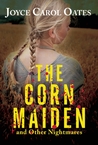
Rameau's Review Archive: The Corn Maiden and Other Nightmares by Joyce Carol Oates

Rameau's ramblings: This was the first Joyce Carol Oates novel I ever read.

First posted on Goodreads November 6th 2011.

Synopsis:
Marissa is a beautiful, sweet, but slow 11-year-old. Judah, an older girl from the same school, has led Marissa to a secluded basement. Remaining an unaware hostage for days, Marissa grows weak as Judah prepares to sacrifice her to the Indian legend, the Corn Maiden. 
 

The Corn Maiden and Other NightmaresThe Corn Maiden and Other Nightmares by Joyce Carol Oates


First of all, if you don't like nightmares and don't want to be scared and repulsed by the horrors ordinary people do, don't read this. Since I'm one of the slightly skewed people who enjoy reading about the darker side of the human nature, I actually enjoyed the book and most of the short stories within.

I got lost in the pain and desperation Marissa's mother felt when she found her daughter missing and her world unravelling under the scrutiny of the authorities and the public. I felt the confusion as the innocent teacher agreed to help the police only to find himself in the centre of a witch-hunt. And I even found a sliver of understanding and the pity for the kidnapper.

All this happened within the first short story and more was to come with the others thanks to Oates' writing. She managed to keep me turning the pages even when I was annoyed with her choices both for the characters and the effective writing. Somehow Oates managed to make third limited past tense seem more immediate and gripping than most authors manage with first person present tense.

The Corn Maiden and Other Nightmares is an acquired taste, and since this is my first encounter with Joyce Carol Oates' work, I can only assume the same goes for the rest of her work. It's going to take a while for me to explore this theory further though.

I received an Advanced Readers Copy from the publisher through NetGalley.


View all my reviews

Thursday, 10 January 2013

Movie review: The Cabin in the Woods by Drew Goddard

Directed by Drew Goddard
Genre: Mystery and suspense horror
Written by Joss Whedon and Drew Goddard

Cast:
Dana: Kristen Connolly
Jules: Ana Hutchinson
Holden: Jesse Williams
Curt: Chris Hemsworth
Marty: Fran Kranz


Synopsis:

Five college students, Dana, Jules, Holden, Curt and Marty, want to spend a weekend far from the civilised world, in the middle of nowhere. Curt's cousin owes a cabin in the woods near a small lake which seems like a perfect location. They arrive there, explore the old building and find a creepy basement with all kinds of 'toys', a hand-written diary among them. When Dana reads some Latin verses from it she seals their destiny. Bad things are going to happen soon and they've just chosen how they are going to die. Or maybe not?

My impressions:

This is a movie best seen with a minimum of foreknowledge, so I'll try to spoil as little as possible while explaining why I liked this one.

First of all there are two interwoven narratives taking place simultaneously: the one in the woods with the kids goofing around and another, at a secret bunker of the military-industrial complex, where two beleaguered company men, along with a large cadre of technicians, accountants, interns, and various other drones, are hard at work, doing—well, something spooky and definitely secret, perhaps even illegal. Soon enough you are not sure whether the whole premise is a practical joke, invented by some goverment people, or something more sinister.

 It is obvious Whedon and Goddard revel in toying with audience expectation, messing with archetypes, taking genres, chewing them up (while biting that tongue in their cheeks) then spitting them back out again in some glisteningly new form. For the most part it’s a hoot, tailor-made for those out there who like to whoop at the kills rather than vicariously drench themselves in primal terror and gore. The dialogue is sharp, poking good-natured fun at horror traditions with a twist. I admit that the spooky underground corridors, chilly vision of the future and skilful blending of horror with social comment recall a bit Stanley Kubrick’s The Shining and 2001: A Space Odyssey.

Now about the ending. The Cabin In The Woods ends up as the more biting satire on the entertainment industry, man’s appetite for violence and older people’s love-hate relationship with youth. Let me also assure you that I’m not spoiling anything by saying that. It’s clear from very early on that our two boffins are desensitised workers in an entertainment machine that regards human life as something that can be cavalierly ended in order to appease the audience.Who and what that audience is, the movie leaves teasingly uncertain until a big guest star cameo reveals all — but it may not be the answer you’re expecting.

Final verdict:

Is The Cabin in the Woods a great film? Of course not. But it is a devilishly cunning entertainment, being about 20-30 IQ points brighter than you expect it to be, a fun ride to an unknown direction. It’s much cleverer and more mature than The Hunger Games, but it’s about very similar things. If you want to enjoy it, though, DO NOT watch the trailer (that's why I don't publish one here.)
Enhanced by Zemanta

Monday, 30 July 2012

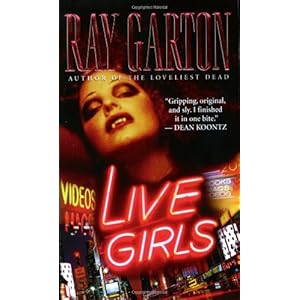
Review: Live Girls by Ray Garton

Book info:
Form: e-book, pdf
Genre: vampire horror
Target audience: definitely and only adults

Synopsis:

Something is rotten in the city of New York.  People are found dead but their blood is missing. Corpses disappear from mortuaries. Ordinary, decent men keep returning to a certain seedy sex peep-show called Live Girls. The police know nothing and do even less.

When Walter Benedek, a respectable, middle-aged reporter working for the New York Times, finds his  sister and niece dead his world falls apart. He decides to spend the rest of his holiday looking for their potential murderer – his brother-in-law, Vernon Macy.  Vernon was last seen near Live Girls but Walter is strangely unwilling to go inside that establishment – he has a hunch and he is very healthily afraid.  Still while hanging around  he accosts Davey, a young, naive assistant editor who doesn’t hesitate to enter.  Davey has been dumped by his latest good-for-nothing girlfriend  and haven't been promoted as he expected to - small wonder he tries to enliven his life by looking for some new experiences. A visit to an obscure peep-show? Why not? Plenty of people do it every day, right?

Soon enough Benedek and Casey, Davey’s friend and colleague, notice the man is changing and not for the best. He is losing weight. He becomes unhealthily pale. He doesn’t want to eat anything unless it is a piece of really rare meat…and he can’t stop thinking about Anya, the stripper that entertained him at Live Girls. 

What I liked:

This book was first published in 1987 so exactly  twenty five years ago. Taking it into account I was surprised how fresh it was. The vampires tended to be of the older, Bram Stoker kind – beautiful but  dangerous and rather unfriendly when it comes to the humankind – but it suited me fine. In fact the further a vampire is from the sick Twilight vision the better I like the book.  I also appreciated the fact that the author balanced nicely the advantages and disadvantages of being a vampire. So yes, you can live far longer than humans but you are very allergic to garlic, you should avoid ‘bad’ blood (e.g. tained with drugs) and certain illnesses. There’s no such a thing as free lunch, right?

The pair of main protagonists (Davey and Casey) were likeable enough but I must admit I preferred Davey (more about Casey in ‘dislikes’ section). He is a dynamic character with as many good as bad features. He is weak, he likes to play a hero and rescue different ladies who then exploit him and leave. He never notices and even if he does he wants to believe in his version of events – deluded and naïve until he gets bitten one time too many. Let me also add that, showing Davey’s unhealthy obsession Garton makes interesting points about why men let different ‘vampires’ (metaphorically speaking of course) drain themselves dry.

Finally the whole world building was done in an interesting way. The two main female baddies, Shideh and Anya, were those beautiful, sexy, ruthless vampire beasts everybody loves to hate but for me the ‘monster vampires’, creatures which were foolish enough  to drink ‘poisoned’ blood were the most interesting idea here and a great touch although also the most creepy. It is a horror story after all.
There was a lot of sex scenes in the story, pretty explicit at times (hetero and lesbian) , but when you write about bad  vampires who run a peep-show and a nightclub, I think that's unavoidable. Some  scenes might be disturbing and even a little bit disgusting  (erotic dance with a cross, mind you, performed by vampires, biting male patrons’ penises or sucking the menstruation blood out of someone, yuck, but hey, if you remember 50 Shades you shouldn’t be that shocked).

What I didn’t like:

First of all let me tell you that it was sometimes very annoying how long it took Walter Benedek and Davey to recognize what they were dealing with. Nowadays, every person who watches TV and/or reads popular literature would cry ‘vampire alert!’ after just one or two pages. It was so plain obvious that almost funny but I don’t consider it a real flaw.  Once again you should take into account the age of this novel - I bet some of its adult readers are younger than it is. Reading it you only become aware that all these shows like ‘From Dusk Till Dawn’ or ‘True Blood’ do nothing more than refresh and copy, in a more or less successful manner, the old ideas. Perhaps painful but true – neither of contemporary authors has invented the vampires. Or anything else.

What really got to me was the character of Casey. For an independent, strong heroine she was sometimes almost too stupid to live. An example? Casey finds out that Davey visited Anya again to have sex. She reproaches him saying: ‘if you wanted to get a blow job you could ask me. You know I am clean.’ Oh dear, girl, such an advanced stupidity should be punishable by law.

First of all, you might be as clean as a virgin but Davey is most certainly not - there was nothing about him using condoms and  you know pretty well what company he used to keep, right? All of his ex- girlfriends were tramps to say the least of it, the fact that he played a white knight didn’t mean he was also a monk. Now he’s visited that stripper several times and you still think he didn’t have any occasion to catch anything nasty? Secondly, in your case it really sounded out of character. You are supposed to be a respectable, sensible girl and what respectable girl would offer something like that ? Ok, you can be a modern woman without inhibitions but still you are not a prostitute, right? Not yet, anyway (no, not telling  more, it would be a spoiler). Finally, my dear, if you are such an experienced and blase creature who can offer her friend oral sex in a very offhand manner you should have known as well that it is really not all the same who performs these services, at least not to Davey.  He is the faithful one and he is infatuated with Anya. Haven't you noticed?

Final verdict:

A very steamy and gritty but surprisingly good horror vampire novel with just few mistakes. Old school but better than many contemporary clones. I always like it when an author takes a great number of  commonplace myths about the vampires and turns them on their head. It was the nicest part of this read.

Tuesday, 27 December 2011

Review: The Monstrumologist (#01) by Richard Yancey

Book info:
Form: epub file, e-book
Genre: YA horror and adventure (officially at least)
Target audience: everyone


Synopsis:

An elderly resident of an old people’s home called William James Henry, dies in his sleep. He claimed he was born in 1876 which would make him a 131-year old man in the moment of his death but nobody believes him. His notebooks are lent to the narrator/the author.

That’s how, after a short intro, we are plunged into a story within a story, featuring a first person narration of younger Will Henry who describes one event that shaped his entire life. Will was an orphan, taken in by Pellinore Warthrop (guess why Warthrop was given such a strange first name and you will find out a lot about him), a man of wealth, a scientist, a doctor and the titular Monstrumologist. He felt responsible for the boy as he used to employ Will’s father and they were friends. Will works for the doctor  in a capacity of a personal assistant and a servant.

One day a grave robber visits doctor Warthrop, showing him his unusual find – two bodies, one of a young girl and the second not quite human, intertwined in a kind of embrace. Doctor is known for a particular interest in different oddities and he usually pays for such curio well. It turns out the grave robber happened to dig out a predator called anthropophagus and his unlucky victim. The dissection of both bodies leads to very alarming conclusions – in short it seems that there are more Anthropophagi around and the whole population of New Jerusalem is being endangered. How have such monsters wandered to the USA, though, as they can’t either swim or fly and their original habitat is situated in hot, faraway places like Africa or New Zealand?

Doctor Warthrop and his young assistant will have to solve that mystery really post haste – soon enough a pastor and almost his whole family are slaughtered by the hungry monsters. The local authorities are anxious to stop anthropophagi at all cost but will they manage to do it on their own? What will be discovered in the process?

What I liked:

Despite all these monsters, blood, slaughter and intestines flying around it is not a scenario for any Hollywood B movie (well, perhaps after dumbing it down a lot…). It is a slightly philosophical story, best summarized by these two Nietzsche quotes:

“Battle not with monsters, lest ye become a monster, and if you gaze into the abyss, the abyss gazes also into you.”


In other words leave the monsters alone and...let them kill you and yours as they please?

“All things are subject to interpretation; whichever interpretation prevails at a given time is a function of power and not truth.”

Hmmm...no politician would be ashamed of such a statement...

Anthropophagi, as presented here, originated in works of Herodotus and Pliny the Elder. I always appreciate when the author bases his story on ancient texts and does it in an intelligent manner – the effects are more often than not interesting, at least to me. Let me also assure you that the anthropophagi (literally man eaters) are hardly the biggest monsters around. The worst baddies, as usual, are humans, particularly one man. A very handsome and intelligent man to boot, called dr. Jack Kearns or Richard Cory (among other names he uses and not without a very good reason). Let me present him in more detail - the quote below is his description from the novel:

“He was quite tall, well over six feet, the man standing on the doctor’s doorstep, athletic of build and handsome in a boyish way, with rather fine features and stylishly long flaxen hair. His eyes were an odd shade of gray; in the glittering lamplight they appeared nearly black, but later, when I saw them in daylight, his eyes took on a softer shade, the ashy gray of charcoal dust or the hue of an ironclad warship. He wore a traveling cloak and gloves, riding boots and a homburg hat set at a rakish angle. His mustache was small and neatly trimmed, golden like his mane of hair, so diaphanous it appeared to float above his full and sensuous lips.”

If his physique made you think he must still be somehow a positive character, you are in for a very big surprise. The man is deeply immoral, maybe even a psychopath. He is also nice to look at (even according to other men), very fit, undoubtedly well-muscled, intelligent, cynical, witty, and cunning. If only he cares he can daze you with his pearl-white smile, straight from a toothpaste ad, and entertain you with his educated banter. Yes, he can quote the Bible and Shakespeare from memory, he knows Nietzsche personally and he claims he’s influenced some of his theories. You definitely shouldn’t judge him by appearances, though, and only at the very end you find out enough facts about him to form a viable and definitely negative opinion. Without spoiling you the pleasure of such discovery let me just say I wouldn’t leave my dog in the tender care of such an individual – not even for a minute or two. The construction of such a character is not easy and this one was extremely well done, I really haven’t met a more enticing and more dangerous baddie for a long time, especially in a YA book. Lonely and obsessed dr. Warthrop and poor, young and equally lonely Will pale in comparison but of course they would be a far safer and nicer company.

What’s more? The book was highly readable, the narration flowing smoothly, its pace lively and well-planned. All mysteries were solved and nicely tucked away at the end but still I think there is a sequel and of course I would like to read it even without any ugly cliffhanger.

Finally the cover is really fitting and well-designed despite being a bit gruesome...

What I didn’t like:

Just one complaint - the book didn’t feature one single female character worth mentioning. Women are positioned only in the background as decorations or props. I know that we speak here about a backwater society from 19th century but still…I wish there was one strong woman presented among all these men.

Final verdict:

Despite the fact that Mr. Yancey didn't hesitate to make this story gruesome and in places downright stomach-churning I enjoyed it very much indeed. I loved the characters, I loved the writing and the philosophical undercurrent of the novel; it was really surprising it was published as a YA horror story. I would like to read the rest of the series now!

A riddle:

Look at this pic of a nice little anthropophagus (poppy if you like diminutives):


Isn't it a beauty? As you noticed it is built almost like humans or big apes with one distinctive difference – it lacks a head. Its eyes are on its shoulders and its teeth-filled mouth - right in the middle of its chest. Now try to guess where the anthropophagi have their brain? 

Highlight the text below if you want to know the right answer! 

Their brain is situated right above their crotch, in the lower abdomen ;). A very fitting place don’t you think? Making all those nice brain idioms far more ...scenic ;p