 |
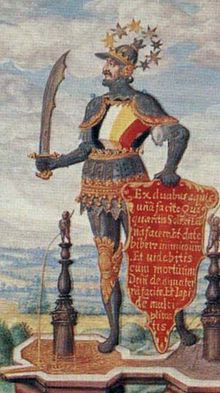
A knight representing the Great Work
(look at his colourful breastplate) |
Alchemy 101 or a crash course for curious and busy J
Alchemical manuscripts and books are often richly illustrated, showing many symbolic figures with obscure meanings. Alchemy used symbols figuratively and allegorically, not just to represent an idea but to extend it and reveal its wider implications. For example, there is a considerable use of animal symbolism, the green lion, the black toad, the double headed-eagle, the serpent seizing its tail - various human figures, the old dying king, the white queen, the knight - as well as stylised forms of apparatus in which these figures interact. There are, of course, also simple signs used to notate various alchemical substances and processes, but the symbolism used in alchemy went much further than the mere use of special signs.
It is important to realize that there is no such a thing as a fixed, rigid alchemical language or system of symbols. The problem is that different alchemists used the same symbol in different ways, and even within the same work an individual symbol can have many meanings. Although there are core 'meanings' to some symbols, their significance must be read from the context in which they appear. This can make the study of alchemical symbolism a frustrating experience for those who expect only fixed meanings for different symbols. Instead we must go along with the individual alchemists, read their texts, try to enter into their view of the world, and beware importing or projecting our own perceptions of their symbols or rushing to a quick judgment of their meaning.
Symbols must be seen as part of the whole emblem, not as isolated elements.
To make things even more difficult alchemists made use not only of chemical symbols, but also for a great deal of Roman and Greek mythology. They combined many concepts into a language that would express what they experienced. They created images, and used myths and allegories. The emblem sequences show the evolving alchemical process as a drama, a theatre of symbols, and one must sense the underlying process in order to understand the symbolic sequence. In this way alchemical figures are allegorical, and indeed we often find alchemists using complex allegories to explain their processes.
Here are some symbols, most often met in alchemical texts:
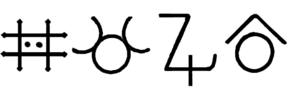 Four different alchemical symbols for just one element, zinc, via Wikipedia How not to get lost?
Alchemical goals
Why people used these symbols and what do they want to achieve? Basically they saw their flaws and wanted to get better. On the most primitive level they were poor and wanted to become rich but for most of disciples of this art alchemy was about a search to understand nature, the cosmos, man. Religious and scientific principles were not separated as it is done now, into different scientific branches, because in past ages people realized that everything is connected. Some people say that laboratory alchemy was only kind of early chemistry and they are right to a certain extent. By trial and effort alchemists did find new chemical substances and created several chemical processes but true laboratory alchemy starts where matter gets manipulated beyond mere chemical reactions. Transmutation into gold, for example, is believed to be possible, but not by mere chemistry (scientists of course would tell you it is utter rubbish from their point of view). Those who have accomplished it, and verified by those present, were very few. An alchemist who was able to produce gold from other metals, was considered an advanced spiritual being who had achieved spiritual transformation first. Without spiritual insight into the hidden energies of nature, laboratory alchemy is a waste of time.
Philosophical alchemists are only interested in the spiritual side of the Great Work because hermetic or philosophic alchemy is about the transformation of oneself. That is only possible if one understands the true nature of oneself, and the firm understanding that one is in essence a divine being. Man as he is born is the product of Nature. However man can improve himself to become more than Nature. He is able to manifest his true divine potential, by transmuting his common, every day nature into the full divine nature that he really is (and so becoming a kind of living philosopher’s stone). There are many ways to do this. Over the course of history people in different cultures have stumbled on different practices to accomplish this.
Roughly the process of that spiritual and personal transmutation is described as the Great Work of Alchemy or magnum opus. It is a series of four stages represented by colors.
§ nigredo, a blackening or melanosis
§ albedo, a whitening or leucosis
§ citrinitas, a yellowing or xanthosis (sometimes omitted altogether)
§ rubedo, a reddening, purpling, or iosis
These colors were gradually replaced by the four elements: earth, water, fire, and air with their qualities of hot, cold, dry, and moist which corresponded to the three colors black, white, and red.
The blackness, often rendered as a black dragon, symbolized the initial state of chaos, the prime matter. Out of this prime mater came everything. On this rest the theory of the conjunction, union, of things, such as the union of opposites, or male and female. Within this union of metals there was the assumption that the based metal dies and the more precious one was resurrected. Or it was thought to come back as a thing of many colors, sometimes described as a peacock's tail. Eventually this hypothesis led to the adoption of the color of white which was considered to contain all colors.
Here the first main goal of the process was reached, the metal had changed to its silver or moon state, which many alchemists considered the final goal; but it was not, because the metal still has to be elevated to its gold or sun state. The albedo is, allegorically speaking, the daybreak, but not until the rebedo is reached there can be true sunrise; this is the extra step required. Originally the transition from albedo to rebedo was accomplished by citrinitas, a stage which was later omitted. This was done in a very high, intense fire. The red and white are the King and Queen who, at this stage, celebrate their "chemical wedding."
The alchemical process was described originally as the process of the transmutation of metals, which branched out in various directions. The broadest description of this process is the best because no two alchemists would give you the same description. For a philosophical alchemist, though, the essence of the Great Work is plain and simple: the purification of your awareness. The alchemical images show that the Great Work is a personal and spiritual
process, and not just laboratory chemistry. The basis of all spiritual practices is the elimination of unwanted emotions and thoughts. Without this any practice will fail.
Some alchemical manuscripts mention twelve operations of the Great Work, although they are not always given in the same order or name. These twelve operations are sometimes compared with the twelve signs of the Zodiac, the Zodiac being used as a symbol for the progression of the Great Work. They were also connected to the Twelve Labours of the Hercules or twelve Apostles.
Here is an example of twelve operations in the hermetic sense, just to give you an idea about the terminology the alchemists used. The description is taken from the 18th century Dom Pernety's Dictionnaire mytho-hermétique. No, don’t try these at home, in your kitchen, or even in the garage. J
Calcination: in chemical alchemy it meant intense heating (as with inorganic materials) to a high temperature but without fusion in order to drive off volatile matter or to effect changes (as oxidation or pulverization). What remains is a fine, dry powder. The fire or calcinations is a purging whitening fire. The example of such a process: the heating of limestone Ca CO3 or slaked lime Ca(OH)2 to produce quicklime CaO, calx vita. When water is added quicklime can generate heat. In philosophical alchemy it means often the reduction of the bodies to their first principles without destruction of their seed virtues.
Coagulation: it is a cooling process which turns a liquid into a solid, the inseparable union of the fixed and the volatile into one mass that is so fixed that it can withstand the most violent fire, and that it can communicate its fixedness to the metals that it transforms. Some texts (The Turba Philosophorum) give a recipe for coagulation: “ Take quicksilver, coagulate in the body of magnesia in lead or in suphur which does not burn. If mercury is amalgamated with another metal, the amalgam solidifies.” Easy and clear, isn’t it? ;)
Fixation: fixating the volatile is an ongoing process that starts from the moment of Blackness throughout Whiteness, and with Redness fixation has attained its maximum degree.
Dissolution: the reduction of a body to its primal matter, or elemental principles.
Digestion: almost all the operations can be reduced to the term digestion, because this is what happens during the entire time in the vase. Digestion is basically a term used to make a tincture.
Distillation: when the matter ascends it will fix the volatile afterwards. It is a continuous circulation.
Sublimation: Purification of the matter by means of dissolution and reduction to its principles. It is a purification and making more subtle of all terrestrial and heterogeneous parts, and giving them a perfection from which they were deprived, or rather to release the chains that kept them in prison and prevented them from growing.
Separation: the effect of the dissolution of the body by its solvent. This separation happens when the matter becomes black; then the separation of the elements begin. That blackness changes into vapor; this is the earth that becomes water. That water condenses and falls back onto the earth, and makes it white; that whiteness is the air. After whiteness redness comes, that is air that becomes fire. This separation is not different from the dissolution of the body and the coagulation the spirit.
Incineration: action where more and more mercury is added to the matter which is becoming sulfur, be it to multiply it, be it to make the perfect elixir.
Fermentation: Which the Philosophers call properly fermentation, is the elixir operation. It does not suffice to complete the big work, to push the work to the red color. The projection will be in vain if the stone is not fermented. The work at the red color phase is a sulfur or a very subtle earth, very warm and dry from this sulfur it is necessary to create a second one, that next will be able to be multiplied into infinity. This sulfur multiplies itself from the same matter of which it has been created, by adding a small part of the first one, and fermenting this all with the red or white yeast, according to the intention of the Artist.
Multiplication: operation of the Great Work during which the powder of projection is being multiplied, be it in quality, or quantity into infinity according to the liking of the Artist. It consists in redoing the already done operation but with more exalted and perfected substances, and not with the previous rough materials.
Projection: The Hermetic Philosophers call their projection powder, a powder which is the result of their Art, that they project in very small quantity onto the imperfect metals in fusion, by means of which they get transmuted in gold or silver, according to the degree of its perfection. One needs to know that in the projection the entire metal on which one projects the powder, will not transmute completely in silver or gold, if the powder was not well purified before it was thrown in the mix.
 |
| Alchemical symbols of different elements |
Finally the last symbol I would like to describe: the peacock’s tail. It is a later addition to the alchemical symbols. The colours of the tail manifest themselves on the matter during the operations of the philosopher’s stone. Usually the peacock's tail stage is placed after the raven (Blackness, first stage), and before the swan (Whiteness, second stage). The third (or the fourth) stage of Redness is represented by the phoenix.
I hope it wasn't too long or too complicated. In the next part I will present shortly some famous alchemists and their work.
Sources:
http://occult-advances.org/greatwork.shtml
http://www.purplehell.com/riddletools/alchemy.htm