Showing posts with label alchemy. Show all posts

Friday, 31 August 2012

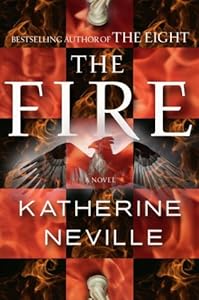
Review: The Fire by Katherine Neville

Cover of "The Fire: A Novel"
Cover of The Fire: A Novel
Book info:
Form: pdf, e-book
Genre: alchemy and chess-related thriller
Target audience: pretty much everyone interested in the topic


Synopsis:

The Fire is actually a sequel to Katherine Neville’s The Eight published some twenty years ago and reviewed by me last year. The Fire, like The Eight, follows two timelines, one past (in this case 1822) and one present (2003).

Alexandra Solarin (Xie) was twelve years old in the autumn of 1993. She was being accompanied by her father, Aleksandr Solarin on a chess tournament in Zagorsk Monastery, Russia. This young chess prodigy was to play against a similarly young boy from Ukraine named Vartan Azov in the very final game of the tournament. Shortly before the game, the girl bumped into a local woman who – without Alexandra realizing it – slipped a cardboard placard into her pocket; a symbol that bore “a small illustration of a flying bird set inside an Islamic eight-pointed star, and three words printed in Russian…” that meant “Beware the Fire”. Later in the monastery, Aleksandr saw a sculpture known as “The Black Queen”. Sensing danger, Aleksandr fled the tournament with his daughter to find the woman who slipped the cardboard with the symbol earlier, but as soon as he spotted her, Aleksandr was shot in front of his young daughter.

Ten years later, with the sudden and mysterious disappearance of her mother, Cat Velis, Alexandra realizes that the Game in search of the scattered chess pieces has evidently started again… As Alexandra reunites with her arch nemesis, Vartan Azov, they must join forces on an adventure to solve the puzzle and save their lives.

The second thread of the plot takes place in the 19th century Albania. Haidee, the young daughter of a powerful Ottoman ruler, embarks on a dangerous mission – she has to smuggle a valuable relic out of her native country and deliver it safely into the hands of a stranger. Still she and her companion, Kauri, are captured by pirates and sold at a marked in Fez. Will they be able to fulfill their mission?


What I liked:

Katherine Neville’s The Eight was a good novel and for more than one reason: the narration was convoluted without being incomprehensible, it jumped in time and space still remaining logical and fun, the author used different alchemical elements and ideas and tied them up with the plot in an ingenious manner. As soon as I was able to get the sequel I decided to read it but I admit that my expectations were high. Perhaps too high…you know the curse of the sequels: somehow they are rarely as good as the first parts. This sequel, additionally, can hardly be called a stand-alone.

In structure and elements, The Fire has much in common with The Eight: characters in each period are playing a high-stakes game related to a chess set that once belonged to Charlemagne. At the end of the first novel, the players learned that the board and pieces contained the formula for the elixir of life; here it's discovered that the board may hold more abstract information about natural order and balance -- the Big Picture, it's called at one point, the Original Instructions at others. Whatever it is, it still seems worth killing for.

Overall if you haven’t read The Eight, then I highly suggest you read it first. Otherwise, you’ll get its magical story distilled in a few paragraphs of dry summary, and by only reading The Fire you’ll probably think “The Game” is pretty pointless as well – somehow Neville never manages or bothers to demonstrate what’s actually at stake, or even introduce any real drama or urgency to Alexandra’s quest (Haidee’s story is woefully relegated to serious back burner status). 

 The story brings you on a journey throughout the Middle East and it is jam-packed with historical references – on the Ottoman empire, Lord Byron, Napoleon, chess strategies, the Basques, the Mages the Sufism and more. It was nice. Still it was less dazzling than the first part, reminding me slightly (ONLY slightly) of The Da Vinci Code with the break-neck adventures and puzzle-solving frenzy.

What I didn’t like:

I despised the predictability of that one. The villains never dared to hurt any of the positive characters in a permanent manner and you KNEW they wouldn't dare perhaps because they were as cardboard-thin as it is only possible; the romantic interest of Alexandra could be spotted from a mile off  and the romance itself was far more schematic that in the first part. There was less chess more running around and looking for clues, Dan Brown style.

Part of the interest here was the way that Neville layers and repeats motifs. For example, in the book's historical narrative - set in the 1820s - another party of eight gathers to discuss the game, including Napoleon's mother, Letizia Bonaparte, and Lord Byron. But if the plot is a giant chess game, it's odd that none of the pieces gets taken; in both the historic narrative and the modern one, the characters just shuffle around the board spaces, staring menacingly before moving on. There is a lot of talk about the white team and the black team but the one person who emerges as a “villain” cannot even be taken seriously. And Xie's chess blindness seems a permanent affliction, since she rarely seems to know what's going on. Don’t get me wrong, Alexandra is a sympathetic character but she’s never proactive – she merely reacts to situations during the entire book and tries do defend herself. Perhaps this had something to do with her favorite chess strategy – The King Indian Defense – but practically, it was highly frustrating.

Final verdict:

Neville has certainly done her research, and if you like conspiracy theories, complex riddles, and the fictional integration of real historical personalities like Lord Byron and Thomas Jefferson, then this might be up your alley. For me though, it was a bit too repetitive and schematic.  Much of the background information sounded  as dry and impersonal as a Wikipedia entry, and the characters delivering it were often pretty lifeless. I don’t regret reading it but I was hardly swept away by it.


Enhanced by Zemanta

Saturday, 8 October 2011

A brief history of alchemy - part three

Page from alchemic treatise of Ramon LlullA page from alchemy treatise of Raymond Lully via Wikipedia
People behind alchemy from antiquity to 14th century


There have been many prominent alchemists across the world and throughout ages. I don’t doubt the life of every single one of them could be a basis of a fat, big novel. I know at least several hundred books have been written about the most famous of them. I don’t intend to write an essay as long as a book so I will present just several of alchemists from different countries and the description of their lives and deed will be rather short.

Alchemy always seemed related closely to religion; maybe because of that the common people rather feared its practitioners as adepts of secret arts and partakers of dangerous knowledge. The term “occult” often heard with the connection to alchemy is a classic example of that lack of understanding. Whereas the correct definition is: hidden from the eye of the understanding, secret, concealed, unknown (from the Latin word occultus  meaning clandestine, hidden, secret) plenty of people would add “satanistic” or “devilish” or at least “unchristian” to it. Christian authorities have generally regarded occultism as heretical whenever they met this term. It should be observed, however, that those who were object of these fears didn’t always resent them, at times even encouraging such misunderstandings to increase their own sense of power and perhaps also their security. Offending a magician can be, after all, a risky business, better to be avoided.

The art of alchemy went downhill during Roman times, along with a general decay of Greek learning. After A.D. 100 virtually nothing new was added, and there was a rising tendency to turn to ever-more mystical interpretations of the earlier writers.The first important worker in Greek-Egyptian khemeia that we know by name was Bolos of Mendes (c.200 B.C.), a town in the Nile delta. In his writings, he used the name Democritus so that he is referred to as "Bolos-Democritus" or sometimes as the "pseudo-Democritus".
Bolos devoted himself to what became one of the great problems of khemeia, the changing of one metal into another and, particularly, the changing of lead or iron into gold (transmutation). Bolos, in his writings, apparently gave the details of techniques of making gold, but this may not actually have represented fakery. It is possible to alloy copper with the metal zinc, for instance, to form brass, which has the yellow color of gold. It is quite likely that the preparation of gold-colored metal would be the equivalent, to some of the ancient workers, of forming gold itself.


Finally I found out how come the Roman emperor Diocletian was so set against alchemy. The reason was prosaic – he believed in one aspect of it. Many chemists throughout the centuries have striven to find the technique for producing gold. Some, however, undoubtedly found it much easier and far more profitable merely to pretend to find the technique and to trade on the power and reputation this gave them. This sort of fakery continued right on into modern times. Diocletian perhaps thought that there is no smoke without fire and he feared that the adepts of alchemy might successfully produce cheap gold and swamp the markets with it, destroying the already shaky economy of the declining Empire. All alchemical scriptures were destroyed to make it impossible.

The other problem was that, with the later rising tide of Christianity, such “pagan knowledge” was frowned upon to say the least of it. For example the Alexandrian Museum and Library were badly damaged as a result of Christian riots after A.D. 400. The art of alchemy being a discipline for few and with its close relationship to the ancient Egyptian religion, was simply undefendable and had to virtually go underground. Or elsewhere.

 From a book written by Edward Chalmers Werner, a late member of the Chinese Government's Historiological Bureau in Peking comes this quotation from old Chinese records: "Chang Tao-Ling, the first Taoist pope, was born in A.D. 35 in the reign of the Emperor Kuang Wu Ti of the Hari dynasty. His birthplace is variously given as T'ien-mu Shan, Lin-an-Hsien in Chekiang, Feng-yang Fu in Anhui, and even in the "Eye of Heaven Mountain." He devoted himself wholly to study and meditation, declining all offers to enter the service of the state. He preferred to take up his abode in the mountains of Western China where he persevered in the study of alchemy and in cultivating the virtues of purity and mental abstraction. From the hands of the alchemist Lao Tzu, he received supernaturally a mystical treatise, by following the instructions in which he was successful in his match for the Elixir of Life."

In the seventh century, however, the Arabs came on the scene. When their conquering armies took over vast areas of western Asia and northern Africa they also invaded Egypt (A.D. 641) and after quick victories occupied the land; over the next years they inflicted the same fate on all Persia. That’s why the preservation and extension of Greek-Egyptian alchemy were for five centuries (until A.D. 1100) in the hands of the Arabs. Traces of this period remain in the number of chemical terms that are derived from Arabic: alembic, alkali, alcohol, carboy, naphtha, zircon, and others.
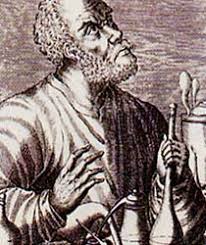


Geber
The best of Arabic alchemy came at the start of the period of their domination. Thus, the most capable and renowned of the Muslim alchemists was Jabir ibn-Hayyan or Abou Moussah Djfar-Al Sell (c.760-c.815), who was known to Europeans, centuries later, as “Geber"He lived at the time when the Arabic empire (under Haroun-al-Raschid of Arabian Nights fame) was at the height of its glory. His writings were numerous and his style was relatively straightforward compared to other alchemists but still…from his style of writing we derive the word “gibberish”. Many of the books bearing his name may have been written by later alchemists and attributed to him and it seems only three remain to posterity: The Sum of the Perfect Magistery, The Investigation of Perfection, and his Testament. He described ammonium chloride and showed how to prepare white lead. He distilled vinegar to obtain strong acetic acid, which had been the strongest acid known to the ancients. He was the first to mention such important compounds as corrosive sublimate, red oxide of mercury and nitrate of silver.
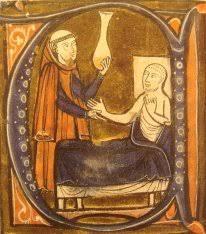

Al Rhases
About the same time, Al Rhases, another Arabian alchemist, became famous for his practical displays in the art of transmutation of base metals into gold. Al Rhazes wrote a number of treatises, the most important of which became known as Liber Secretorum Bubacaris, in the western world, and was regarded as a foundation work for centuries. Rhases started the process of disconnecting the science and empiricism from archaic formulas and numerology, in an attempt to study physical processes outside the confines of divine will. Although Rhases still incorporated many of the overall concepts and the archaic and esoteric language of earlier alchemists, he studied substances and compounds in isolation and divined their natures, rather than trying to fit them into elegant theories and sweeping generalizations.


This included trying to fit the substances into groups and classifications according to their properties. In his book, Sirr al-asrar book, he listed the ingredients as follows.
  1. Earthly Substances:
  2. The Spirits: Mercury, sulphur, arsenic sulphate, ammonia
  3. The Bodies: Gold, silver, copper, iron, lead, tin
  4. The Stones: Iron pyrites, iron oxide, zinc oxide, malachite, turquoise, arsenic oxide, lead sulphate, gypsum, glass
  5. The Vitriols: Black, alum, green, red, yellow, white
  6. Borax
  7. The Salts
  8. Vegetable Substances:
    • Rarely used and believed to be the domain of physicians
  9. Animal Substances: Hair, brain, bile, blood, milk, urine, eggs, horn, shell
In addition, Razes pointed out that many other substances could be derived from these basics, including lead oxide, verdigris, caustic soda, copper oxide, cinnabar (mercury (II) sulphide), and zinc oxide.
Razes was meticulous in his documentation, and listed the apparatus that he used for his research. Again, most of these, such as crucibles, alembics and a range of distillation equipment as well as various furnaces and smelting equipment. Certainly, His ‘Book of Secrets’ bears a remarkable resemblance to a modern laboratory manual in the way it lays out and collates the datIn the tenth century the Arabs enjoyed the reputation of having the most learned scientists of his age - another great alchemist of that century, Avicenna, whose real name was Ebu Cinna can be another proof of their domination. Born at Bokara in 980 A.D., he was, however, the last of the Egyptian alchemical philosophers of note.


During the 13th century a lot of changes occurred as the balance of power began to shift from the Islamic world to a Europe emerging from the Dark Ages and displaying the first glimmerings of the Renaissance. Great minds, such as Roger Bacon and Robert Grosseteste, were heavily influenced by Classical texts obtained from Byzantium as the Crusades enveloped the Eastern Mediterranean, but an increasing amount of material traveled from Andalusia. Spain was then the most developed country, a real melting pot of new and old theories. Europeans learned that the Arabs possessed books of great learning which had been translated from the Greek originals - the works of Aristotle, for instance - as well as their own productions, such as the works of Avicenna. They decided to put that knowledge to good use.


Of the thirteenth-century literature, a work called Tesero was attributed to Alphonso, the King of Castile, in 1272. William de Loris wrote Le Roman de Rose in 1282, assisted by Jean de Meung, who also wrote The Remonstrance of Nature to the Wandering Alchemist and The Reply of the Alchemist to Nature. Peter d'Apona, born near Padua in 1250, wrote several books on Hermetic sciences and was accused by the Inquisition of possessing seven spirits (each enclosed in a crystal vessel) who taught him the seven liberal arts and sciences. He died upon the rack.


A page from a manuscript with the portrait
of Villanova
Among other famous names appearing about this period is that of Arnold de Villeneuve or Villanova, whose most famous work is found in theTheatrum Chemicum. He studied medicine in Paris but was also a theologian and an alchemist. Like his friend, Peter d'Apona, he was accused of obtaining his knowledge from the devil and was charged by many different people with magical practices. Although he did not himself fall into the hands of the Inquisition, his books were condemned to be burnt in Tarragona by that body on account of their heretical content. Villanova's crime was that he maintained that works of faith and charity are more acceptable in the eyes of God than the Sacrificial Mass of the Church!


The authority of Albertus Magnus (1234-1314) is undoubtedly to be respected, since he renounced all material advantages to devote the greater part of a long life to the study of alchemical philosophy in the seclusion of a cloister. When Albertus died, his fame descended to his "sainted pupil" Aquinas, who in his Thesaurus Alchimae, speaks openly of the successes of Albertus and himself in the art of transmutation.

Raymond Lully (or Ramon Lull) is one of the medieval alchemists about whose life there is so much conflicting evidence that it is practically certain that his name was used as a cover by at least one other adept either at the same or a later period. The enormous output of writings attributed to Lully (they total about 486 treatises on a variety of subjects ranging from grammar and rhetoric to medicine and theology) also seems to suggest that his name became a popular pseudonym. Lully was born in Majorca about the year 1235, and after a somewhat dissolute youth, he was induced, apparently by the tragic termination of an unsuccessful love affair, to turn his thoughts to religion. He became imbued with a burning desire to spread the Hermetic teachings among the followers of Mohammed, and to this end devoted years to the study of Mohammedan writings, the better to refute the Moslem teachings. He traveled widely, not only in Europe, but in Asia and Africa, where his religious zeal nearly cost him his life on more than one occasion. Lully is said to have become acquainted with Arnold de Villanova and the Universal Science somewhat late in life, when his study of alchemy and the discovery of the Philosophers' Stone increased his former fame as a zealous Christian.


According to one story, his reputation eventually reached John Cremer, Abbot of Westminster at the time. After working at alchemy for thirty years, Cremer had still failed to achieve his aim, the Philosopher's Stone. Cremer therefore sought out Lully in Italy, and having gained his confidence, persuaded him to come to England, where he introduced him to King Edward II. Lully, being a great champion of Christendom, agreed to transmute base metals into gold on the condition that Edward carry on the Crusades with the money. He was given a room in the Tower of London for his work, and it is estimated that he transmuted 50,000 pounds worth of gold. After a time, however, Edward became avaricious, and to compel Lully to carry on the work of transmutation, made him prisoner. However, with Cremer's aid, Lully was able to escape from the Tower and return to the Continent. Records state that he lived to be one hundred and fifty years of age and was eventually killed by the Saracens in Asia. At that age he is reputed to have been able to run and jump like a young man.

In England, the first known alchemist was Roger Bacon, who was a scholar of outstanding attainment. Born in Somersetshire in 1214, he made extraordinary progress even in his boyhood studies, and on reaching the required age joined the Franciscan Order. After graduating Oxford, he moved to Paris where he studied medicine and mathematics. On his return to England, he applied himself to the study of philosophy and languages with such success that he wrote grammars of the Latin, Greek, and Hebrew tongues.

Although Bacon has been described as a physician rather than an alchemist, we are indebted to him for many scientific discoveries. He was almost the only astronomer of his time, and in this capacity rectified the Julian calendar which, although submitted to Pope Clement IV in 1267, was not put into practice until a later papacy. He was responsible also for the physical analysis of convex glasses and lenses, the invention of spectacles and achromatic lenses, and for the theory of the telescope. As a student of chemistry, he called attention to the chemical role played by air in combustion, and having carefully studied the properties of saltpeter, taught its purification by dissolution in water and by crystallization.

Indeed, from his letters we learn that Bacon anticipated most of the achievements of modern science. He maintained that vessels might be constructed that would be capable of navigation without manual rowers, and which under the direction of a single man, could travel through the water at a speed hitherto undreamed of. He also predicted that it would be possible to construct cars that could be set in motion with amazing speeds ("independently of horses and other animals") and also flying machines that would beat the air with artificial wings.


It is scarcely surprising that in the atmosphere of superstition and ignorance that reigned in Europe during the Middle Ages, Bacon's achievements were attributed to his communication with devils. His fame spread through western Europe not as a savant but as a great magician. His great services to humanity were met with censure, not gratitude, and to the Church his teachings seemed particularly pernicious. The Church took her place as one of his foremost adversaries, and even the friars of his own order refused his writings a place in their library. His persecutions culminated in 1279 in imprisonment and a forced repentance of his labors in the cause of art and science.


Among his many writings, there are two or three works on alchemy, from which it is quite evident that not only did he study and practice the science but that he obtained his final objective, the Philosopher's Stone. Doubtless during his lifetime, his persecutions led him to conceal carefully his practice of the Hermetic art and to consider the revelation of such matters unfit for the uninitiated. "Truth," he wrote, "ought not to be shown to every ribald person, for then it would become most vile that which, in the hand of a philosopher, is the most precious of all things."

During the fourteenth century, the science of alchemy fell into grave disrepute, for the alchemists' claim to transmute metals offered great possibilities to any rogue with sufficient plausibility and lack of scruple to exploit the credulity or greed of his fellowmen. In fact, there proved to be no lack either of charlatans or victims. Rich merchants and others greedy for quick gain were induced to entrust to the alleged alchemists gold, silver, and precious stones in the hope of getting them multiplied, and Acts of Parliament were passed in England and Pope's Bulls issued over Christendom to forbid the practice of alchemy on pain of death. (Although Pope John XXII is said to have practiced the art himself and to have enriched the Vatican treasury by this means.) Before long, even the most earnest alchemists were disbelieved. For example, there lived about this time the two Isaacs Hollandus (a father and son), who were Dutch adepts and wrote De Triplici Ordinari Exiliris et Lapidis Theoria and Mineralia Opera Sue de Lapide Philosophico. The details of their operations on metals are the most explicit that had ever been given, yet, because of their very lucidity, their work was widely discounted. It seemed to simple to be true. Yet the simplicity, not any occult gibberish, was the key to the future. In the next part I will try to present the achievements of modern alchemists and their meaning for science.


Sources:

http://occult-advances.org/greatwork.shtml
http://www.purplehell.com/riddletools/alchemy.htm
Enhanced by Zemanta

Saturday, 1 October 2011

A brief history of alchemy- part two

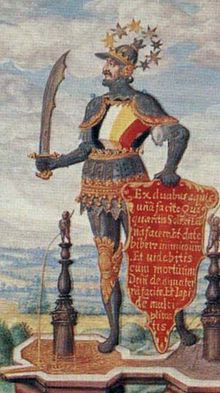
A knight representing the Great Work
(look at his colourful breastplate)
Alchemy 101 or a crash course for curious and busy J

In the first part, posted last week, I presented the origins of alchemy; now the time has come for the real nitty-gritty. First, I would want to warn you – alchemy is a topic in which you can easily drown for days, if not months and there are different reasons why, some of them explained below. That's why I was able only to brush against the most basic notions. My main aim was to keep the whole part relatively short and readable. However, if you want to find more info about anything particular, please, just follow links, provided in sources below the essay or google the term. 

Alchemical symbols 

Alchemical manuscripts and books are often richly illustrated, showing many symbolic figures with obscure meanings. Alchemy used symbols figuratively and allegorically, not just to represent an idea but to extend it and reveal its wider implications. For example, there is a considerable use of animal symbolism, the green lion, the black toad, the double headed-eagle, the serpent seizing its tail - various human figures, the old dying king, the white queen, the knight - as well as stylised forms of apparatus in which these figures interact. There are, of course, also simple signs used to notate various alchemical substances and processes, but the symbolism used in alchemy went much further than the mere use of special signs.

It is important to realize that there is no such a thing as a fixed, rigid alchemical language or system of symbols. The problem is that different alchemists used the same symbol in different ways, and even within the same work an individual symbol can have many meanings. Although there are core 'meanings' to some symbols, their significance must be read from the context in which they appear. This can make the study of alchemical symbolism a frustrating experience for those who expect only fixed meanings for different symbols. Instead we must go along with the individual alchemists, read their texts, try to enter into their view of the world, and beware importing or projecting our own perceptions of their symbols or rushing to a quick judgment of their meaning. Symbols must be seen as part of the whole emblem, not as isolated elements.

To make things even more difficult alchemists made use not only of chemical symbols, but also for a great deal of Roman and Greek mythology. They combined many concepts into a language that would express what they experienced. They created images, and used myths and allegories. The emblem sequences show the evolving alchemical process as a drama, a theatre of symbols, and one must sense the underlying process in order to understand the symbolic sequence. In this way alchemical figures are allegorical, and indeed we often find alchemists using complex allegories to explain their processes.

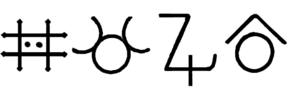
Here are some symbols, most often met in alchemical texts:

Various alchemical symbols for zincFour different alchemical symbols for just one element, zinc, via Wikipedia How not to get lost?


Alchemical goals


Why people used these symbols and what do they want to achieve? Basically they saw their flaws and wanted to get better. On the most primitive level they were poor and wanted to become rich but for most of disciples of this art alchemy was about a search to understand nature, the cosmos, man. Religious and scientific principles were not separated as it is done now, into different scientific branches, because in past ages people realized that everything is connected. Some people say that laboratory alchemy was only kind of early chemistry and they are right to a certain extent. By trial and effort alchemists did find new chemical substances and created several chemical processes but true laboratory alchemy starts where matter gets manipulated beyond mere chemical reactions. Transmutation into gold, for example, is believed to be possible, but not by mere chemistry (scientists of course would tell you it is utter rubbish from their point of view). Those who have accomplished it, and verified by those present, were very few. An alchemist who was able to produce gold from other metals, was considered an advanced spiritual being who had achieved spiritual transformation first. Without spiritual insight into the hidden energies of nature, laboratory alchemy is a waste of time.


Philosophical alchemists are only interested in the spiritual side of the Great Work because hermetic or philosophic alchemy is about the transformation of oneself. That is only possible if one understands the true nature of oneself, and the firm understanding that one is in essence a divine being. Man as he is born is the product of Nature. However man can improve himself to become more than Nature. He is able to manifest his true divine potential, by transmuting his common, every day nature into the full divine nature that he really is (and so becoming a kind of living philosopher’s stone). There are many ways to do this. Over the course of history people in different cultures have stumbled on different practices to accomplish this.

Roughly the process of that spiritual and personal transmutation is described as the Great Work of Alchemy or magnum opus. It is a series of four stages represented by colors.
§                    nigredo, a blackening or melanosis
§                    albedo, a whitening or leucosis
§                    citrinitas, a yellowing or xanthosis (sometimes omitted altogether)
§                    rubedo, a reddening, purpling, or iosis

An Alchemical Laboratory, from The Story of Al...Alchemical laboratory via Wikipedia
These colors were gradually replaced by the four elements: earth, water, fire, and air with their qualities of hot, cold, dry, and moist which corresponded to the three colors black, white, and red.

The blackness, often rendered as a black dragon, symbolized the initial state of chaos, the prime matter. Out of this prime mater came everything. On this rest the theory of the conjunction, union, of things, such as the union of opposites, or male and female. Within this union of metals there was the assumption that the based metal dies and the more precious one was resurrected. Or it was thought to come back as a thing of many colors, sometimes described as a peacock's tail. Eventually this hypothesis led to the adoption of the color of white which was considered to contain all colors.

 Here the first main goal of the process was reached, the metal had changed to its silver or moon state, which many alchemists considered the final goal; but it was not, because the metal still has to be elevated to its gold or sun state. The albedo is, allegorically speaking, the daybreak, but not until the rebedo is reached there can be true sunrise; this is the extra step required. Originally the transition from albedo to rebedo was accomplished by citrinitas, a stage which was later omitted. This was done in a very high, intense fire. The red and white are the King and Queen who, at this stage, celebrate their "chemical wedding."

The alchemical process was described originally as the process of the transmutation of metals, which branched out in various directions. The broadest description of this process is the best because no two alchemists would give you the same description. For a philosophical alchemist, though, the essence of the Great Work is plain and simple: the purification of your awareness. The alchemical images show that the Great Work is a personal and spiritual process, and not just laboratory chemistry. The basis of all spiritual practices is the elimination of unwanted  emotions and thoughts. Without this any practice will fail.

 Some alchemical manuscripts mention twelve operations of the Great Work, although they are not always given in the same order or name. These twelve operations are sometimes compared with the twelve signs of the Zodiac, the Zodiac being used as a symbol for the progression of the Great Work. They were also connected to the Twelve Labours of the Hercules or twelve Apostles.


Here is an example of twelve operations in the hermetic sense, just to give you an idea about the terminology the alchemists used. The description is taken from the 18th century Dom Pernety's Dictionnaire mytho-hermétique. No, don’t try these at home, in your kitchen, or even in the garage. J


Calcination: in chemical alchemy it meant intense heating (as with inorganic materials) to a high temperature but without fusion in order to drive off volatile matter or to effect changes (as oxidation or pulverization). What remains is a fine, dry powder. The fire or calcinations is a purging whitening fire. The example of such a process: the heating of limestone Ca CO3 or slaked lime Ca(OH)2 to produce quicklime CaO, calx vita. When water is added quicklime can generate heat. In philosophical alchemy it means often the reduction of the bodies to their first principles without destruction of their seed virtues.


Coagulation: it is a cooling process which turns a liquid into a solid, the inseparable union of the fixed and the volatile into one mass that is so fixed that it can withstand the most violent fire, and that it can communicate its fixedness to the metals that it transforms. Some texts (The Turba Philosophorum) give a recipe for coagulation: “ Take quicksilver, coagulate in the body of magnesia in lead or in suphur which does not burn. If mercury is amalgamated with another metal, the amalgam solidifies.” Easy and clear, isn’t it? ;)


Fixation: fixating the volatile is an ongoing process that starts from the moment of Blackness throughout Whiteness, and with Redness fixation has attained its maximum degree.


Dissolution: the reduction of a body to its primal matter, or elemental principles.


 Digestion: almost all the operations can be reduced to the term digestion, because this is what happens during the entire time in the vase. Digestion is basically a term used to make a tincture.


Distillation: when the matter ascends it will fix the volatile afterwards. It is a continuous circulation.


Sublimation: Purification of the matter by means of dissolution and reduction to its principles. It is a purification and making more subtle of all terrestrial and heterogeneous parts, and giving them a perfection from which they were deprived, or rather to release the chains that kept them in prison and prevented them from growing.


Separation: the effect of the dissolution of the body by its solvent. This separation happens when the matter becomes black; then the separation of the elements begin. That blackness changes into vapor; this is the earth that becomes water. That water condenses and falls back onto the earth, and makes it white; that whiteness is the air. After whiteness redness comes, that is air that becomes fire. This separation is not different from the dissolution of the body and the coagulation the spirit.


Incineration: action where more and more mercury is added to the matter which is becoming sulfur, be it to multiply it, be it to make the perfect elixir.


Fermentation: Which the Philosophers call properly fermentation, is the elixir operation. It does not suffice to complete the big work, to push the work to the red color. The projection will be in vain if the stone is not fermented. The work at the red color phase is a sulfur or a very subtle earth, very warm and dry from this sulfur it is necessary to create a second one, that next will be able to be multiplied into infinity. This sulfur multiplies itself from the same matter of which it has been created, by adding a small part of the first one, and fermenting this all with the red or white yeast, according to the intention of the Artist.


Multiplication: operation of the Great Work during which the powder of projection is being multiplied, be it in quality, or quantity into infinity according to the liking of the Artist. It consists in redoing the already done operation but with more exalted and perfected substances, and not with the previous rough materials.


Projection: The Hermetic Philosophers call their projection powder, a powder which is the result of their Art, that they project in very small quantity onto the imperfect metals in fusion, by means of which they get transmuted in gold or silver, according to the degree of its perfection. One needs to know that in the projection the entire metal on which one projects the powder, will not transmute completely in silver or gold, if the powder was not well purified before it was thrown in the mix.


Alchemical symbols of different elements


 Finally the last symbol I would like to describe: the peacock’s tail. It is a later addition to the alchemical symbols. The colours of the tail manifest themselves on the matter during the operations of the philosopher’s stone. Usually the  peacock's tail stage is placed after the raven (Blackness, first stage), and before the swan (Whiteness, second stage). The third (or the fourth) stage of Redness is represented by the phoenix.


I hope it wasn't too long or too complicated. In the next part I will present shortly some famous alchemists and their work.


Sources:

http://occult-advances.org/greatwork.shtml
http://www.purplehell.com/riddletools/alchemy.htm
Enhanced by Zemanta

Wednesday, 21 September 2011

A brief history of alchemy - part one

Photo Credit: Gerik Zayatz, Creative Commons
Toth with the head of an ibis
Everything begins in Africa...

I love alchemy. To my own surprise I found out not so long ago, writing a review of a book with alchemy elements, that I haven't tackled this subject yet. I was thinking about changing that as soon as possible and here you go: this essay starts a series in which I will try to explain my infatuation - why alchemy, mentioned  in scientific or fictional books, makes me always very interested and excited.


Alchemy is a very old art and/or science but its origins are, surprisingly, traceable. I love etymology so please, bear with me. The word “alchemy” itself offers an explanation too good to omit. It found its way to English from the Old French “alquimie” and the Medieval Latin’s “alchimia” but its real source is Arabic and ancient Greek. Both languages renders it respectively as al-kimia (الكيمياء) and chemia (χημία). It might be derived from a version of the Egyptian name of that African country, which was, in turn, based on the Ancient Egyptian word kēme (hieroglyphic Khmi, black earth, so a fertile ground of the Nile plains as opposed to deadly bare desert sands). There is another school of thought, deriving the word from the Greek chumeia meaning “mixture” and clearly referring to the act of mixing drugs so a kind of ancient pharmaceutical industry or the word khumos, meaning 'fluid'. Of course, as it is often with such ancient terms, the etymology problem still remains open. Personally I would incline towards the Egyptian derivation. Let me explain why.

As every student learning ancient history knows, Egyptians used to mummify their deceased in order to ensure them an eternal afterlife. They were very proficient in these techniques and I believe such practices gave rise to chemical knowledge far surpassing our wildest guesses. What's more, there was a great Egyptian adept king, named by the Greeks “Hermes Trismegistus” (so Hermes the Thrice Great) who is supposed to be the very founder of alchemy. We know preciously little about him – he seems to be a Hellenistic Egyptian mix of Hermes the Greek god guiding the souls to the Underworld (called also a psychopompos, conveyor of souls) and Thoth the Egyptian god of record keeping, wisdom and scripture. Toth was one interesiting character by the way - he served as the vizier (prime minister) to Re or Ra, King of the gods, being  Mr. Science, the Answer Man, and divine Secretary-in-Chief of the Egyptian pantheon. A nerd but also a trickster (his other animal symbol was a baboon) and a god of magic (professor Dumbledore from "Harry Potter" would seem like just a local amateur conjurer compared to him).
Hermes leading Euridice back to Hades

Small wonder Hermes Trismegistus was considered a deity of its own. Reputedly he lived about 1900 B.C. and he was highly celebrated in the ancient word for his wisdome and skill in the operation of nature (thus such a grand name). Unfortunately, from the works attributed to him, only a few fragments survived to our time. Everything because of one Roman emperor.

 The third century A.D. seems to have been a period when alchemy was widely practiced, but also during that century, in the year 296, Emperor Diocletian (a very bad guy for early Christians too) sought out and burnt all the Egyptian books on alchemy and the other Hermetic sciences, and in so doing destroyed all evidence of any progress made up to that date. I am not sure why he did it. We do have some pieces and excerpts from the Emerald Tablet , the Asclepian Dialogues and the Divine Pymander. They were preserved in the Latin language by Fianus (?) and translate into other languages in the sixteenth century.

The famous Emerald Tablet (Tabula Smaragdina) of Hermes is the primary document of alchemy. There have been various stories of the origin of the tract, one being that the original emerald slab upon which the precepts were said to be inscribed in Phoenician characters was discovered in the tomb of Hermes by Alexander the Great. I assume the adjective “emerald” concerns the colour, not the material. Most likely the tabled was etched on a sheet of green glass (also a very costly thing at that times) or perhaps a slab of jade or other green semi-precious stone. Real emeralds simply never come that big and ancient people didn't know how to identify them in a fault-proof way. Of course that fact never prevented spreading the "real emerald" legend. In the Berne edition (1545) of the Summa Perfectionis, the Latin version is printed under the heading: "The Emerald Tables of Hermes the Thrice Great Concerning Chymistry, Translator unknown. The words of the secrets of Hermes, which were written on the Tablet of Emerald found between his hands in a dark cave wherein his body was discovered buried."

From that document comes the famous alchemical rule, saying “That which is above is from that which is below, and that which is below is from that which is above, working the miracles of one.” The other rule states that “all things were from one” so “the structure of the microcosm is in accordance with the structure of the macrocosm. Taking into account our current state of science you must admit these were quite revolutionary, truly modern ideas. I should also mention the fact that there are many versions of this short document: Isaac Newton, Georgio Beato, Sigismund Bacstrom, Madame Blavatsky, Idres Shah, Dennis W. Hauck each of them rendered it a bit differently; if you want to compare these just follow this link.

Artist's impression of the Emerald Tablet
The goals alchemists are universally famous for were the transmutation of common metals into Gold or Silver and the creation of a “panacea” or remedies that supposedly would cure all diseases and prolong life indefinitely. Some of alchemists also tried to find a universal solvent but often such goals were intertwined. Of course these were not the only uses for the discipline they remain the ones most documented and well-known. Many fiction authors used the quest for the Philosopher’s Stone, a legendary substance that was believed to be an essential ingredient for either or all of those goals, as a linchpin of their stories. They also popularized the picture of an aged, slightly sinister, black-robed wizard, brooding over the crucibles and alembics to discover the formula for the Elixir of Life. However, alchemy has been something far more than an outlet for a few eccentrics who liked to play with occult in their dotage. Men and women who proclaimed themselves alchemists were concerned with things spiritual rather than temporal such as riches and gold. Their writings and the accounts of their lives prove that they were inspired by a vision of perfect human society, freed from disease and the limitations of warring faculties, both mental and physical. To appreciate and understand their visions, it is necessary to trace the history of their philosophy. I will try to give you a rough guide in the next part and I promise to keep it as short as possible. I hope you will enjoy it!

My sources:


Saturday, 30 April 2011

Review: The Eight by Katherine Neville

· Paperback: 624 pages
· Publisher: Ballantine Books (June 23, 1997)
· Language: English
· ISBN-10: 9780345419088
· ISBN-13: 978-0345419088
· Genre: adventure-fantasy-romance- thriller-historical fiction mix
· Target group: YA and adults


Synopsis:


Katherine Neville published her debut novel The Eight in 1988 and, as far as I know, gained a following almost instantly. After reading it I understand why. This complex historical fiction thriller still resonates with the audience after more than 20 years. Well, it resonated with me no problem as I love history, alchemy and any stories related to it. This book was a real feast, adding some chess tricks to the mix.

The plot consists of, basically, two main stories and many shorter interjections, told by different secondary characters. The first story is set in the 1972, when a New York City computer expert, Catherine Velis, is sent to Algeria on what appears to be a punishment job assignment. Catherine is the first woman employed by a very well-known financial audit company and she did the unimaginable – she dared not to listen to some informal suggestions of her superior who, most probably, took a bribe to influence her work. Bad, bad girl. Soon enough, Catherine is approached by a number of mysterious characters – a Russian chess grandmaster, a soothsayer and some of their friends - and is unwillingly caught up in a deadly game of chess, first as a pawn, then as a more important figure. Her job in Algeria turns into the adventure of her life, during which she finds her true love, plenty of occult knowledge about the beginning of human civilization and much much more.

The second story, set in 1790s (the French Revolution), is narrated from the point of view of a young French nun called Mireille. As her nunnery in Montglane is in grave danger Mireille along with her cousin Valentine are on a mission to scatter the many pieces of the famous Charlemagne chess set to prevent them from being found and assembled. The Montglane chess set, like Tolkien's "The One Ring", has mystical powers, and must be prevented, by an innocent, from falling into the hands of those who represent evil and anarchy. The person who manages to assemble the set will have an incredible power in his or her hand. Small wonder a number of prominent historical figures, including Robespierre, Napoleon, Katherine the Great and her son, prince Paul, strive to find as many figures as they can, no matter the cost. Mireille must additionally take care of her son, Charlot but she is one strong woman and she finds help in unexpected places.

What I liked:

Plenty. As I mentioned above, I find alchemy an incredible subject and here it was treated with respect, even if that respect was a bit superficial. Apart from that the book touched upon a lot of self-referential "strange loops", like the Fibbonacci series, Bach's music, the Moebius strip (the symbol for infinity and the number eight), to name a few. It's also extremely metaphorical in nature, borrowing from Lewis Carroll I suppose. The complexity of the plot is really on a high level but somehow the narration never loses the entertaining factor so you don’t feel like a complete idiot even if you don’t understand some terms or are not a chess player.

The quality of Katherine Neville's writing is impeccable. I found out that this author is well-known for travelling a lot, researching her stories to the tiniest detail, which is evident in the plot – unlike Dan Brown’s stories, this one can be treated almost like a travel guide. As for the characters, especially Catherine and Mireille, they are strong, independent women made of flesh and blood – I love such female characters and I get a kick out of it every time. The many secondary real-life characters ( Rousseau, Voltaire, Richelieu, Willam Blacke, Willam Wordsworth and Andre Philidor to quote just the most important ones) who appear in the novel are not simply thrown in to show that the author knew their names and their historical role. Instead, they all play an integral part in the story.

At the very core of The Eight, however, is chess. Anyone who plays chess will soon realize that the entire plot can be tracked on a chess board, as the characters are all pawns, playing under different colours. There are not a lot of people who will not have fun figuring out on whose sides Catherine and Mireille are - and who wins in the end.

What I didn’t like:

I had some small reservations.

The first: too many historical characters knew and coveted the chess set of Montglane throughout ages. How come nobody came and claimed it, even if it meant murdering the poor nuns? It simply didn’t sound realistic after a while.

The second: it seems that nobody today is NOT involved in the global intrigue associated with the Montglane Chess Set, from a simple manservant to a Minister. How come it is still a secret?

The third: some dialogues would need more editing.

The fourth and the last one: a convertible Rolls Royce Corniche driving 1000 miles across the desert? With a broken roof? No way!!! Just look at it!
First-generation Rolls-Royce Corniche Photogra...Image via Wikipedia

Final verdict:

Even readers with no interest in alchemy and chess will be entertained by this fantasy-adventure. I am looking forward to reading its sequel, ‘The Fire’.


Enhanced by Zemanta