
Showing posts with label Song of Scarabeus. Show all posts

Wednesday, 17 April 2013

Rameau's Review Archive: Song of Scarabaeus (Scarabaeus #1) by Sara Creasy

Rameau's Ramblings: This was one of our Scoundrel reads for Blodeuedd's blog and thus doesn't only qualify as a second opinion but as a third.

Originally posted on Goodreads on February 14th 2013.


Synopsis:
Trained since childhood in advanced biocyph seed technology by the all-powerful Crib empire, Edie's mission is to terraform alien worlds while her masters bleed the outlawed Fringe populations dry. When renegade mercenaries kidnap Edie, she's not entirely sure it's a bad thing . . . until they leash her to a bodyguard, Finn—a former freedom fighter-turned-slave, beaten down but never broken. If Edie strays from Finn's side, he dies. If she doesn't cooperate, the pirates will kill them both.

But Edie's abilities far surpass anything her enemies imagine. And now, with Finn as her only ally as the merciless Crib closes in, she'll have to prove it or die on the site of her only failure . . . a world called Scarabaeus.

Cover art by Christian McGrath. 
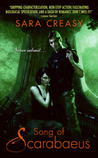


Song of Scarabaeus (Scarabaeus, #1)Song of Scarabaeus by Sara Creasy


It’s really difficult for me to improve on what’s been said about this book already. Just go look at Anachronist’s or AH’s reviews and you can consider yourself fully informed.

For me, the difficulties in the beginning of the book weren’t due to the language fitting for science fiction. I could adjust well enough to cyphs, tecks and streams, but I objected to the undefined acronym jargon. Throw BRAT’s and CCU’s at me all you want but tell me what they mean—Biocyph Retroviral Automated Terraformer and Crib Colonial Unit respectively by the way. It’s one of the first Finnish lessons about analytic writing I remember from school: Define your acronyms. I imagine something similar has been taught to native English speakers around the globe.

I appreciate that Creasy was avoiding infodumping by revealing these critical details later within the story. I appreciated the full on immersion to the world-approach but I do think she took it a step too far with the acronyms. For everything else it worked just fine. The fresh angle on familiar scifi concepts such as terraforming and cyborgs as well as the limited third person voice from Edie’s point of view kept the story focused on the events and gave just enough clues about the other characters for me to fill in the rest. Active imagination does have its perks.

Being someone as close to anti-musical as it is possible for a human being to be, I loved Creasy likening coding to composing. Edie talks about making notes and creating harmonies like a true virtuoso would. It was just another aspect of interconnectedness this author utilised.

In her review, Anachronist mentions the episodic nature of the adventure. While I can see why she would, it didn’t bother me at all. It felt like the natural rhythm of someone who needs to rest between periods of extreme activity. She also mentions the romance being practically non-existent and it being a compliment, and I have to agree. What evolves between Edie and Finn feels organic and real, and the obstacles Creasy sets for them towards the end are enough to feed the UST (Unresolved Sexual Tension) hungry readers for a long time.


Friday, 22 March 2013

Review: Song of Scarabaeus by Sara Creasy

Book info:
Form: pdf ebook
Genre: sci-fi, space opera
Target audience: adults

Synopsis
Edie,  a young but very gifted cypherteck, is kidnapped by a group of rovers- pirates from the space. As she can plug in and manipulate the biological tools that the Crib uses to terraform new worlds they want her skills to help them salvage material from the planet she called Scarabaeus - and sell those to less fortunate worlds of the Fringe for a lot of cash. What they don't know is that the planet is the very sight of Edie's worst failure and deepest secret. A world she wanted desperately to preserve from terraforming.

Finn, a former freedom-fighter turned slave (lag), is assigned as her bodyguard; as a cypherteck Eddie can be assassinated by eco-rads who are hunting mercilessly  people like her, and she is on a ship where no one can be trusted. They are tied by a mental leash that will kill him if she dies. If she doesn't cooperate, the pirates will kill them both. Edie is determines to cut this leash and save them but soon enough she finds it is almost impossible, not if she wants Finn to survive. She must play along, revisit Scarabeus and find a mysterious infojack who had created that leash and is her only hope to have it removed. Will she manage to do it on time, though?


What I liked:
I have to admit Song of Scarabaeus started off slowly. It was sometimes difficult to wade through all sorts of technological terms to keep track of the world building. Words like cypherteck, datastream, wet-teck interface, and biocyph retroviral automated terraformer (or BRATs for short) were thrown at me, making me wonder why I had picked up this book and whether it was switched with a tech nerd vocabulary. Then I adjusted and my reading was progressing more smoothly. Mind you it didn't feel like infodumping but there was a LOT to know.

The concept is intriguing as well – a human who can change planets with a mere thought, mentally chained to a killer who must protect her or die. Brilliant.Finn and Edie, the heroine, are tied together by a "leash" that will cause Finn's head to explode if he gets too far from Edie. It was an amazing plot device, making all those silly insta-love or insta-lust twists unnecessary. Still don't let yourself be swayed by the blurb or the cover art, describing this one as a sci-fi romance of a kind ( this time it is a compliment). Let me assure you that the romance was practically non-existent. The characters did share a strong bond, they cared for each other, and they occasionally had some real moments of heat, but the closest thing to a romantic interlude in the first 150 pages quickly got shut down by the heroine.

Also Scarabaeus the planet and its creepy inhabitants were excellently portrayed. It would be quite a challenge for any ambitious sci-fi movies director but the results could be astounding.

Finally I found Ms. Creasy's storytelling ability really gripping - I was able to finish the novel in two evenings despite the initial problems.
What I didn't like:
The structure of the novel is somewhat episodic - to the point that it seems like reading a script for an television series. No, it is not a compliment in my view. Kidnapping – one episode. Coming on the ship – another episode. Lag escape – another episode. And so on. Not to mention those blasts from the past that happen in Edie's dreams or rather nightmares.

Because we only got one POV, I felt we spent a lot of time in the heroine's head, as she navigates what's happening to her and what's going to happen. I felt like the relationships she formed with other characters, not only with Finn, were only superficially developed if developed at all.

Apart from that the world building which at first promised me exotic planets and aliens didn't deliver, nor really. You see, two thirds of the book takes place on the ship called Hoi Polloi .The problem is that it’s a very plain ship, in full accordance with its name (meaning 'ordinary, simple people, the commoners' in Greek). It has no odd aspects, it’s never bombarded by asteroids, it never loses propulsion. It’s just a ship. The rover crew of the ship had potential, but neither Haller nor the captain ever mature into the full fledged villains.

Finally one more carping: Song of Scarabaeus? Really? In my humble opinion that's a terrible title! When I heard about the book the first time I was sure it would be actually about Egypt!
Final verdict:
This book will totally do it for you if you like SF with biotech elements and evolutionary biology. I liked it despite its flaws - it’s unique, it’s SF, it has a female protagonist. We don’t get many of those.