Tuesday, 16 November 2010

Wishful Wednesday 17 November


The meme is hosted by Brooke Bluestocking Guide.


 Welcome to Wishful Wednesday!


I know I know, I must be mad - another vampire story. Strangely enough it made me interested. Maybe because of a very good review posted by Melissa from i swim for oceans blog


Vampire predators run wild in this exciting steampunk adventure, the first in an alternate history trilogy that is already attracting attention. In 1870, monsters rise up and conquer the northern lands, As great cities are swallowed up by carnage and disease, landowners and other elite flee south to escape their blood-thirsty wrath.

One hundred fifty years later, the great divide still exists; fangs on one side of the border, worried defenders on the other. This fragile equilibrium is threatened, then crumbles after a single young princess becomes almost hopelessly lost in the hostile territory. At first, she has only one defender: a mysterious Greyfriar who roams freely in dangerous vampire regions.

Taken from GoodReads.

Saturday, 13 November 2010

Silent Sunday

Wednesday, 10 November 2010

Of porcelain and men


A formally laid table set with a Meissen dinne...Image via Wikipedia


Of porcelain and men

A story about the beginnings of Meissen porcelain


Once upon a time there were beautiful objects made of translucent, hard substance. Sometimes they were white, sometimes colourful but always very, very expensive as they were rare. They derived their name from old Italian porcellana meaning cowrie shell but also were called Bone china as they were produced by the Chinese. Nowadays you can buy porcelain in many shops around the world. When you look at it from a scientific point of view it is a kind of ceramic made by heating raw materials, generally including clay in the form of kaolin, in a kiln at high temperatures. Complicated a bit but after all nothing special. In the 17th and 18th century in Europe, though, the status of porcelain was totally different. Fine pieces of Bone china were so rare and sought-after that they were called white gold. The porcelain came from China as the Chinese invented the way to produce it long before Europeans, most probably during the Tang Dynasty period (618–906). With lack of fast ways of transport it was imported to Europe at horrendously high cost, often involving the loss of human life.Some monarchs had a thing for porcelain, though – they considered it the very symbol of the highest status, luxury and power. Here comes our second hero – a king who liked porcelain a bit too much. When you come to think of it, he liked good life a bit to much too. I give you His Majesty Elector Frederick Augustus I of Saxony (1694–1733) and King Augustus II of Poland a.k.a. Augustus II the Strong. He was the second son of Elector John George III, and Anna Sophie, daughter of King Frederick III of Denmark. At the time of Augustus's birth, his grandfather, John George II, ruled Saxony, Augustus's father, John George III, was only twenty-three and had already sired Augustus's elder brother, John George IV. There seemed to be little likelihood that the mew baby boy would ever have to be a monarch. Small wonder little Augustus grew to be a totally spoiled brat - his general disinterest in formal study and an early marked inclination to pursue pleasure hunting, soldiering, and womanizing were apparently tolerated by indulgent parents.


The fate decided to test him as a king, though, after a series of unpredictable deaths. After his grandfather died of plague (1680), his father of apoplexy (1691), and his brother of smallpox (April 1694), Augustus became unexpectedly the heir elector and then, in 1697, he decided to buy himself something larger, better suiting his own royal persona and he managed to become the king of Poland.Unfortunately for the new king, the Polish crown came at a steep price - Augustus had to spend lavishly on votes to ensure his electoral victory. In order to have enough money he pawned his jewels, and sold his rights to the duchy of Lauenburg. Seeing that it wasn’t enough, he levied oppressive taxes upon his Saxon subjects, the majority of whom were Lutheran. As you might guess it wasn’t the most popular move but those days no king asked people their opinion. While the election was costly, Augustus reasonably expected that Catholic Poland, a country twenty times bigger than his native Saxony, would provide lucrative markets for Saxon manufactured goods and was certain that his new title would enhance the status of the Wettin dynasty. From his point of view it was a perfectly wise and logical move. But he was broke. Before we progress let me describe what Augustus was like as a man.

August II the Strong KIng of PolandImage via Wikipedia


Perhaps it is not so visible in the portrait on the right but he was a tall, strapping fellow, weighing 260 pounds and enjoying every ounce of it, being known as the "Saxon Hercules”. His zest for life and love of hunting, fishing, parties and firework rivaled only his bulk. He was said to have arranged scraps with the biggest and toughest men he could find just to show off his muscles. He was also known to fight bears and bulls. Augustus often rode his horse through Dresden, with the reins in his teeth and carrying two urchins in each hand. I wonder where the said urchins came from and whether they were willing enough. One story tells of his horse throwing a shoe. The village blacksmith made a replacement. Augustus took the horseshoe in his hand and broke it in two to prove his strength. He then tossed the blacksmith a coin to pay for a new one. The blacksmith, not to be outdone, then bent the coin in his hand. Augustus laughed aloud and gave the blacksmith a third coin for the final horseshoe. As you see he was a public relations genius - Augustus didn't mind paying three times the price, since it made for a good story. I guess common folk simply loved this king, so close to their own idea of a rich, generous, powerful ruler, enjoying their own pleasures.


Augustus was also famous for his amorous adventures and many mistresses. He was said to have a luxurious court full of the most beautiful wanton women. Legends have it that he fathered more than 300 bastards but officially there were only 9 illegitimate children acknowledged by the king himself, all of them having high-born mothers. Count Karl von Pöllnitz published a biography of Augustus the Strong one year after his death, in 1734. He reported that the king had only one official mistress in Saxony (for nine years) and the second in Poland, after becoming the king of Poland. Moderation itself. Of course he couldn’t know about the unofficial ones. Or wouldn’t like to know.

Countess Maria Aurora von Königsmarck.Image via Wikipedia
Aurora von Konigsmarck

The king was officially married but he openly despised his Lutheran wife who was plain and didn’t want to renounce her faith in order to be crowned as the Queen of Poland. Instead of divorce she was given a palace of her own and asked to stay away. I bet the fact that she grudgingly obliged was a perfect excuse for taking all these lovers. Poor Augustus was so lonely…His favorite mistresses were Countess Cosel and Countess Maria Aurora von Königsmarck . The career and the fall of both women, but especially of Countess Cosel, is a good example of this king’s more cruel nature. When it came to disposing of a lover he wasn’t a gentleman, far from it. One time Countess showed her jealousy towards a daughter of a Warsaw mine merchant, with whom the king was rumored to have had an affair. She fell out of grace immediately. Augustus found another mistress, Countess Maria Magalena von Denoff, of Warsaw. She bore Augustus' son. Madame Cosel's spies told her so and she went to Warsaw to win the heart of her royal lover back but she was stopped and ordered to go away at the city gates. She persevered. Finally Augustus locked her up in a fortress until she died in 1765. She was imprisoned for forty-nine years even though Augustus himself died in 1733 and she pleaded for clemency time and again. Apparently the orders of the spiteful king were respected even after his death. Imagine how mean he sometimes must have been and how full of himself. There were rumours she dared to blackmail the king with a signed promise of marriage.
Another mistress was a Mademoiselle Dieskau, a strikingly beautiful girl. She had platinum blonde hair, blue eyes, fresh rose-petal skin, exactly like one of those little sweet porcelain shepherdesses. She was a virgin so Augustus II had to pay her mother a huge sum of money to have her in his bed. Well, he never spared money if he wanted pleasure. However he grew tired of the purchased girl very quickly, claiming that she was too “lifeless”, and sent her back. I haven’t found what happened to her afterwards but such a behaviour shows clearly how Augustus treated people who somehow stopped being useful to him. Like a porcelain figurine broken beyond repair.

It’s high time we introduced the third hero and returned to porcelain. You might risk a statement that if the king hadn’t been broke after purchasing the Polish crown and if he hadn’t been so fond of jewellery, the Meissen porcelain manufacture would have never existed. Around 1700, an apprentice chemist with the pharmacist Zorn in Berlin, Johann Friedrich Böttger, claimed to discover in private the "Alltinktur", a substance with which any disease could be cured and base metals converted into gold. His activities did not stay secret for long and soon he was regarded as an adept in alchemy. It seems that in his native Prussia, in the court of Freidrich Wilhelm I, people soon found out that he was just a braggart. Johann fled to Saxony where he was captured by Augustus II.

Poor lad was taken before Augustus himself and, although he tried to beg himself off, admitting that he couldn't do as he had boasted, the king, who always needed gold very badly with two kingdoms to rule, didn’t believe him. He took Böttger into his personal "protective custody". Böttger escaped, but was detained and taken back to Dresden. As you see you can never be too careful with your tongue unless you want to get out of the frying pan into the fire. Let’s remember that the 18-year-old Johann Böttger had committed no crime but still Augustus practically imprisoned him just in case. If gold was to be made, Augustus was taking no chances – he was determined to keep the secret and guard it like a big, bad greedy dragon.

Böttger was to work with Walther von Tschirnhaus, a scholar and chemist. Presumably by involving Böttger in his experiments, von Tshirnhaus spared him the fate that overtook former alchemist adventurers. Maybe he also noticed that Böttger, although mendacious, was talented nevertheless.. Böttger refused any cooperation till September 1707. He did not want to be involved with porcelain which he thought was von Tschirnhaus' business. Only when ordered by the king, Böttger started to cooperate. The king could be really nasty to people he didn’t need anymore, even if they were his own mistresses so there was no other option I suppose. Under von Tschirnhaus' supervision and with the assistance of miners and metal workers from Freiberg, they conducted experiments with different clays. After many years of work, both men ended up making first a porcelain-like pottery and then the real white porcelain.Tschirnhaus died at Dresden, in October 1708, from dysentery. Böttger had to continue the research on his own.

In 1708, a practical formula was produced and production began in the Dresden laboratories in 1709. The first pieces, red in colour and known as Böttger stoneware, went on sale at the Leipzig Easter Fair in 1710. It was a rare event. Augustus finished building a royal porcelain factory in Meissen in June the same year and the operation was transferred there.. By 1713, however, Meissen was producing delicate white porcelain and coloured glazes followed within the next few years. Augustus never made money from the factory as he bought most of the best pieces to add to his own collection and he never let sell the pieces produced in Meissen during his life.
Böttger, so unwilling at first, now was passionately proud of his creations. Yet he directed the Meissen factory from confinement in Dresden. He had the luxury of a free house in the fortress, but he couldn’t leave it unguarded. Augustus, a really tyrannical employer, remained resentful that he had been given porcelain rather than gold, finally released Böttger in 1714 but without the right of leaving Dresden. The prison just got larger and it was considered a favour. I just hope the man was proud of his achievement.
In 1719, Johann Friedrick Bottger, still in his early thirties, became extremely ill and died prematurely. Despite being quite young he looked like a man twice his age. The prolonged exposure to dangerous, corrosive substances undoubtedly deteriorated his health. You might say his death was a side effect of certain king’s porcelain addiction.
---
Meissen-Porcelain-VaseImage via Wikipedia

Sources:

http://www.angelfire.com/mi4/polcrt/AugustII.html
http://en.wikipedia.org/wiki/Porcelain
www.antique-marks.com
http:// bildhauerei-keramik.suite101.de

n

Enhanced by Zemanta

Monday, 8 November 2010

Review:The Wild Hunt by Elizabeth Chadwick

Review: The Wild Hunt by Elizabeth Chadwick

Mass Market Paperback: 361 pages
Publisher: Ballantine Books (July 20, 1992)
ISBN-13: 978-0345377241
Genre: historical fiction/romance


Synopsis:

Guyon FitzMiles, lord of Ledworth a son of a Welsh Marcher Barron (called so because their lands "march" with the borders of Wales) returns home from the court with some grave news. He’s been ordered by the slightly perverse king William II Rufus, to marry 16-year-old Lady Judith of Ravenstow, the heiress to great lands, coveted also by her evil uncle, Robert de Belleme. His father is less than pleased as he believes this ordered marriage is tantamount to a death sentence because of the inevitable war his son will have to fight with de Belleme. The king’s will is nothing to trifle with, though. Guyon himself is also sad for personal reasons – he has to kiss goodbye to his beloved Welsh mistress, Rhosyn, who is pregnant but refuses to live with him or under his protection.

Some girls at 16 are already physically mature - almost grown women - but lady Judith is still little more than a child. She is also deeply terrified of the physical aspects of marriage. As a very young girl she witnessed very rough treatment her mother received, being beaten and raped, often  in public, by her brutal oik of a husband now happily dead; Judith, not knowing her future lord, doesn’t hope for a better treatment for herself. However, in some people adversity builds strength and despite her young age, Judith is determined to stand up to her new husband, and not be a weakling.

Small wonder marriage turns out to be a difficult experience for both Guyon and Judith, with such a very rough start and such a burden of bad emotions, but fortunately Guyon proves to be not only an experienced lover but also a compassionate and patient partner. He is so moved by the terror of his child bride that he refrains from sex on their wedding night and also later he decides to wait until Judith matures, although they officially sleep in one bed. The problem is they have less and less time together to overcome the mutual distrust. The Welsh raid over the border, and Judith's uncle Robert de Belleme with his lackeys are always determined to make mischief, even during Judith’s wedding. Guyon’s life is seriously threatened more than once as he gets caught up in the plotting and battling so endemic at the royal court at the end of the 11th century and beginning of the 12th century; many dark deeds and many dark secrets will be unveiled before Judith and Guyon, now passionate lovers, triumph over their evil enemies.

What I liked:

This is Ms Chadwick’s first novel and I must say it wasn’t as bad as I expected it to be. I liked the fact that the plot followed parallel lines: the personal history of Judith and Guyon, and the history of 12th-century feudal England. I liked it as far as it went but I wasn’t enraptured by it. Also some characters were not bad – I mean here mostly two women, Rhosyn and Judith. Guyon's dog and Judith's cat were a nice addition to the narration. The cover design is really pleasant too.

What I didn’t like:

Anachronist turns into a mean nerd, sprouts horns and a tail

Ok, it is supposed to be a historical novel; in such books the author should, in my very humble opinion, try his/her best to do A LOT OF research and present the world as close to the epoch they’ve chosen as possible. Ms Chadwick chose 12th century England, but in her book we might find passages not being entirely in accordance with this setting.

For example Judith and Guyon both can read and write. Excuse me? These skills were not very popular even among the monarchs at that time. Apart from that one must ask: in what language they were taught and who has taught them? At the beginning of the 12th century the most common and often the only places where you could learn such skills were convents and monasteries; most probably you would be taught to write and read in Latin, the lingua franca of that age and many years to come. While the fact that Guyon, the heir of a rich baron, might have had his private tutor in the shape of a monk or a priest, wouldn’t surprise me much. It was unlikely but it could have happened. I couldn’t simply imagine Judith's obnoxious father squandering money on a teacher of that unworthy daughter of his, though. If you think I am going over the top, here’s more. After the murder of a Welsh merchant compassionate Judith writes a letter of consolation to his family and the letter is read also by Guyon’s mistress, Rhosyn, who later tells Guyon his wife didn’t sound childish in it anymore. Right. Hello, hello, Earth to the author, Earth to the author…time to return to the solid ground of reality. My first question is: in what language was the letter written? Latin? Welsh? Old French? Old Saxon? English? The most probable answer is Latin but then how come a simple Welsh wench or a family of a common Welsh merchant could read Latin? Who taught them for a change?

I also wasn’t entirely persuaded by the pair of protagonists, especially Guyon. Dear me, that guy could have never existed. EVER. Imagine a handsome 30-year-old man in full health, a former courtier who used to enjoy carnal pleasures to the full, sleeping with his nubile wife for a YEAR in the same bed and never touching her…some saints failed an analogical trial which lasted only ONE NIGHT. Although the life of a courtier was a highly stressful morsel of bread and the debauchery of the court was always rather on a higher level than ordinary standards, Guyon returns home practically unspoiled…he is simply too good to be true. And the scene in which he almost died defending a pair of pretty much unknown people just because it seemed the right thing to do…do forgive me my retching and enough of it. I think I made my point. I have to say the lack of experience shows in this book.

The final verdict:

As a recreational read it will do. I am still willing to try other books of Ms Chadwick; I’ve heard they are better. We’ll see.

Sunday, 7 November 2010

Silent Sunday

Friday, 5 November 2010

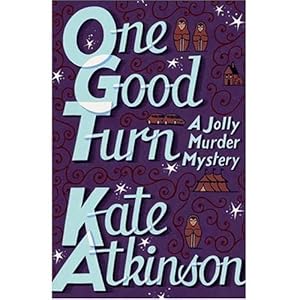
Review: One Good Turn by Kate Atkinson

Review: One Good Turn by Kate Atkinson

Publisher: Doubleday
Year:2006
Pages: 526
Cover of

Genre: crime mystery

Synopsis

If the title of this book reminds you of an old saying 'One Good Turn Deserves Another' you are perfectly right. On a beautiful summer day, crowds lined up outside an Edinburgh theatre witness an act of road rage: a tap on a fender makes a bald, baseball bat-wielding owner of the damaged Honda attack the other driver with the clear intention to smash his unworthy scull and batter him to death. Fortunately one of the onlookers dares to react, and he does it just in time to save the victim’s life, throwing at the perpetrator the first thing he could grab – his laptop. This is the good turn of the title which kicks off all the action.

The brave savior of the careless driver is called Martin. Professionally he is a fairly successful writer but privately - a shy, isolated, deeply unhappy man. Martin, when he isn't writing cheesy novels about the exploits of equally bland Nina Riley or fretting over a mysterious "Russian incident" that teasingly unfolds over the course of the novel, provides an opportunity for much fun at the expense of writers, their agents and the readers. He lets stay in his house a has-been comedian who wants to earn some money during the Fringe, and preys on Martin’s complete lack of assertiveness.

Another main character, Jackson Brodie, ex-cop, ex-private detective and a new millionaire, is also among the bystanders. His partner, Julia is one of the actresses performing in an avant-garde (read: horribly senseless) Fringe play, partly financed by Jackson; as Julia seems to be always busy Jackson has plenty of time to kill and nothing interesting to do. He finally finds his purpose in the shape of a body washed up on Cramond Island and then snatched back by the tide – a dead young woman without identity. Her death is somehow connected to the road rage incident and Brodie’s cop instinct makes him pick up the scent and follow it, although he is repeatedly told not to by the police officers.

The investigation thrusts Jackson into the orbit of Gloria, an elderly wife of a dishonest real estate tycoon; she has just found out that her husband had had a cardiac arrest in the arms of a beautiful Russian call girl and lies unconscious in hospital. Gloria also happened to be among gawping onlookers outside the theatre; she recognized the perpetrator but she doesn’t even think of going to the police; she has a plan of her own to implement now. Is it possible to arrange a fresh start in life when you are a 70+ housewife who’s just realized she had spent most of her best years with a wrong kind of man and her adult children couldn’t care less whether their mum is happy or not?

Then finally we meet Archie, the only son of DI Louise Monroe, who, with another teenager, treats shoplifting as a kind of extreme sport cum theatrical performance. His single working mother ends up investigating the case of Jackson's vanished corpse and finds herself fancying Jackson more than she ought. Will she finally find out about her son’s activities? Will she understand the fact that her son lacks parental guidance to say the least of it?

What I liked:

It was often repeated that Atkinson developed the plot of this novel in the manner of a matryoshka – one of most popular Russian souvenirs, consisting of a set of nestling wooden dolls, hollow inside, with the last solid one in the centre. Somehow I don’t agree with this comparison, maybe because I own several sets of charming matryoshkas myself and I am well aware how they work. I would rather say this novel is like an intricate pattern of a bigger picture or a maze. You follow some lines, then the others, not fully comprehending the whole until you enter a platform in the middle and can see the structure from above, finally understanding how all the strands come together into a single entity and how they are connected and intertwined.

Having said that I must admit that “One Good Turn” is an absolute joy to read. The author tells the story from many different POVs and we often read about the same event several times. The retelling, however, is done just to keep you guessing; not often enough to be redundant. It is also full of quiet, snappish, ironic humour – something I value highly in any book.

I loved the characters too. Each one was definitely unique and real. I could relate to bits and pieces of Gloria, Louise, Jackson and poor, introvert Martin. I loved getting into their heads and understanding their thoughts and emotions and I was really eager to learn the whole story of Martin's "incident" in Russia. Gloria had my sincerest sympathy too – the way she behaved in time of crisis was full of dignity and she kept her wits about her all the time. The ending included certainly several surprises for me!

Last but not least, I also enjoyed the pictures of the Edinburgh scenery that the author paints for her readers. I have been there for a short period of time one summer, just before the Fringe, and it was great to be able to place the characters on the streets that I have walked or the castle that I have visited. It does make a difference when you read about a city you actually know.

What I didn’t like:

My single complaint is about Gloria’s husband and the “Honda Man”, two villains of the piece. Contrary to the main characters, they are hardly three-dimensional, the first being unconscious all the time and the second being described only superficially whenever he pops up wielding his faithful baseball bat. Pity, I like the baddies well-rounded and complex.

The final verdict:

Definitely a position worth reading even if you are not fond of whodunits.

Enhanced by Zemanta

Tuesday, 2 November 2010

Reviewing a classic: Les Liaisons dangereuses (Dangerous Liaisons) by Choderlos de Laclos

About the author:

Pierre Ambroise Choderlos de LaclosImage via Wikipedia
Les Liaisons dangereuses (Dangerous Liaisons) is a French epistolary novel by Pierre Ambroise François Choderlos de Laclos (18 October 1741 – 5 September 1803), a French novelist, official and army general under Napoleon. “Les Liaisons dangereuses” will remain his most known novel, although he wrote poems and other novels as well. He also was a man who began a project of numbering Paris' streets and invented the modern artillery shell. During the French Revolution he was a diplomat and a commissar in the Ministry of War. Interesting creature. He married relatively late, in 1786, choosing a Marie-Soulange Duperré, 18 years his junior. I wonder whether he let her read his book.

Some quotes from “Les Liaisons dangereuses”:

"Truth to tell, the longer I live, the more I'm tempted to think that the only moderately worthwhile people in the world are you and I." 


"A man enjoys the happiness he feels, a woman the happiness she gives."

"Humanity is not perfect in any fashion; no more in the case of evil than in that of good. The criminal has his virtues, just as the honest man has his weaknesses."

Synopsis:

The first letter shows us a young, innocent Cecile de Volanges, aged 15, who, only recently brought out of a convent boarding school, is preparing herself for her incoming nuptials. Unfortunately her future husband, the Comte de Gercourt, put her in a very dangerous position – he had been a lover of Madame Marquise de Merteuil, a beautiful but immoral widow, and they didn’t part on friendly terms; to put it shortly he dared to cast her out. Madame de Merteuil doesn’t like being cast out and she is a woman who knows what she wants and how to get it. She plans a cruel revenge and asks her other ex-lover and a frequent associate in crime, the Vicomte de Valmont, for help. Meanwhile the Vicomte has set himself a more difficult task than corrupting young girls just out of school – he is determined to seduce the virtuous, very religious Madame de Tourvel. He plans it just to create a scandal and boast of another trophy in his rich collection of broken hearts and tarnished reputations. Madame de Tourvel is staying with Valmont's elderly aunt while Monsieur de Tourvel is away for a court case. Big mistake, monsieur.

Cécile makes involuntarily the whole revenge scheme a bit easier – she hasn’t met her future husband yet but she’s already managed to fall in love with the Chevalier Danceny, her music tutor. Madame de Merteuil and Valmont pretend that they want to help young lovers so that they can use them later in their own schemes. Chevalier Danceny has scruples about the romance with Cécile, though. Impatient Madame de Merteuil urges the Vicomte to seduce Cécile asap in order to exact her revenge on the Comte just in time. Valmont refuses, finding the task too boring and too easy, and preferring to devote himself completely to the cause of the divine Madame de Tourvel. Merteuil promises Valmont that if he seduces Madame de Tourvel and provides her with written proof, she will spend the night with him. Apparently she values her bed skills very high. Valmont, whose vanity was badly tickled, agrees.

He returns to the country house of his aunt expecting rapid success, but does not find Madame de Tourvel as easy a prey as his many other conquests. During the course of his pursuit, he discovers that Cécile's mother has written to Madame de Tourvel, warning her about the Vicomte’s bad reputation. What a pity she hasn’t warned her daughter instead. Valmont decides to avenge himself in seducing Cécile as Merteuil had suggested. Poor Cecile, not even being fully aware what’s happening to her, gets pregnant and then has a miscarriage right under the nose of her dear mum and Valmont’s respectable aunt. In the meantime, Merteuil, who doesn’t like idle life, takes young Danceny as a lover.

After a really long courtship interrupted only by nights spent in the arms of no longer so innocent Cécile, Valmont finally succeeds in seducing Madame de Tourvel. Unfortunately by that time he has really fallen in love with his victim. However, he is the last to acknowledge this fact, fooling himself and everybody around. Not Madame de Merteuil, though. Jealous Madame proves to be a lethal opponent. First she tricks him into deserting Madame de Tourvel by making him write her a truly outrageous letter and then she goes back on her promise of spending the night with him, knowing fully well who he would really prefer to be with. In response to that open defiance Valmont reveals that he prompted Danceny to reunite with Cécile, and abandon Madame de Merteuil herself – something she detests the most. Merteuil declares war on Valmont. She reveals to Danceny that Valmont seduced Cécile and practically schooled her in whoring. Danceny challenges Valmont and they duel. Valmont is fatally wounded, but before he dies he is reconciled with Danceny, giving him Madame de Merteuil’s scandalous letters. His final missile hits bull’s eye. Two of these letters are enough to ruin Madame de Merteuil’s reputation and also make her lose an important case, leaving her significantly poorer. What’s more, after a theatrical performance, during which she was publicly booed and ostracized, Madame de Merteuil falls ill (probably succumbing to a bout of smallpox) and, as the result, her face is left permanently scarred. She has to flee the country with jewellery stolen from her late husband’s family. I am sure in her challenged state Madame needed it more than them. The innocent victims (but is there really anybody left innocent? ) also suffer: hearing of Valmont's death, Madame de Tourvel dies from fewer (probably a nervous breakdown) in the convent where she had been educated as a young girl; also Cécile returns to her old convent, too ashamed and too disgraced to lead a normal life.


What I liked:

The story of two individuals who use sex to manipulate and humiliate other people was a scandal right after the first publishing. Even by today's standards, some of the scenes are shocking and this book used to be compared with the novels of the notorious Marquis de Sade. Small wonder it had been a best-seller even before that name was coined – allegedly 1,000 copies were sold in Paris in a month, an exceptional result for the times.

I loved the fact that it is an epistolary novel so a novel composed entirely of letters written by the various characters. This way the same event could be presented from two or even three different points of view, and readers could get to know plenty about the writers of the letters themselves. The narration pace is really splendidly balanced – not too fast, not too slow, keeping you interested till the very end. The plot is scandalous but it also brings up really serious, complex questions – how to raise children so they are not lured and abused by different predators without scruple, how to lead a happy, fulfilled life, how to arrange a successful marriage. The book speaks volumes about morality without being sanctimonious – not a mean feat.

Now about the characters. The main leads are as complex and well-rounded as you would wish. Madame Marquise de Merteuil has always been my favourite – you simply can’t help admiring her stamina and cunning, even if she was so openly corrupted and sometimes plainly evil. She was a woman living in a world governed by men, her range of choices was evidently limited despite the fact that she was an aristocrat – for instance she couldn’t pursue any professional career (and I don’t doubt she would make a perfect CEO or a politician, finding a more decent outlet to her energy) she had even little to say when it came to her personal wealth. Her revenge on men, although sometimes disgusting, is at least understandable. The main mistake seemed to be her fierce sense of independence. Had she been, say, a mistress of a king or a powerful duke, so still an immoral but less independent individual, she would have been judged less harshly by her contemporaries. Not to mention the fact that she wouldn’t have had financial troubles. The Vicomte is another story. He was a privileged, handsome, intelligent man from a family of means. Even though he could have made something good with his life, a career of a kind, he preferred preying on women and leading a layabout life of a libertine seducing weak or/and stupid for the heck of it. If you think about it, with hindsight you really understand the reasons behind of the French Revolution. Facing such an individual I would be the first to scream “les aristocrates à la lanterne!” (aristocrats to the lamp-post) despite his obvious charms. Small wonder Valmont ended up dead in all movie versions of this novel I’ve seen so far. He was too vain about his lifestyle to change and too damaged at the end to live on.

What I didn’t like:

The fact that such a disfiguring illness attacked Madame de Merteuil right after the public disclosure of her second machiavellian nature did seem a bit over the top…like an act of God. I would prefer her 'only' disgraced. However, when it comes to Madame I am heavily biased and I don’t try to hide this fact.

The final verdict:

This book has always been one of my all time favourites. I even read it in French. I recommend it to anybody.

The Marquise de Merteuil (Glenn Close) and the...Image via Wikipedia
Madame (Glenn Close) and the Vicomte (John Malkowitch)  in one of the better movie adaptations of this novel I've seen so far

Enhanced by Zemanta