
Showing posts with label Regency novel. Show all posts

Tuesday, 21 September 2010

Review: Faro’s Daughter by Georgette Heyer

Publisher: Sourcebooks
Year 2008
Pages: 285
ISBN 978-1-4022-1352-6

Synopsis:

Our main heroine is a young lady, Miss Deborah Grantham, who, being an orphaned child without her own personal fortune, happens to help her aunt run a gambling house. As you might guess it is an occupation that is not looked on with approval but at least you don't lead a boring, lone life. In fact pretty and viviacious Deborah drinks champagne every evening and has plenty of admirers. Young Lord Marblethorpe, is one of the most ardent ones and, to the utter distress of his aristocratic mother, plans to marry the girl as soon as he turns 21. Deborah, hardly pleased, tries to talk some reason into his young head although the marriage would solve most of her and her aunt’s problems – the truth is that deep down the girl remains a very decent person. She is forced by circumstances to be in company with rogues and gamblers but she is not enjoying their wickedness. However, who would believe her?

Lady Marblethorpe, considering the situation as serious, calls upon her nephew for help and thus we meet Max Ravenscar, a 35-year-old, extremely rich bachelor of " lean, harsh-featured countenance with an uncompromising mouth and extremely hard grey eyes". Definitely not a man to be trifled with. He likes boxing and horses;  he is also known as quite tight-fisted. After a short conversation with the distressed aunt he becomes absolutely confident that a monetary offer will be sufficient to free poor young Lord Marblethorpe from bad company and send a harpy like Miss Grantham on her way. He soon discovers, though, that Deborah is not an ordinary miss but a feisty Amazonian with plenty of backbone. The stage is set for a very funny battle of wits between two strong-minded and determined people. Small wonder it will end with two marriages.

What I liked:

The story is full of action and moves along at a cracking pace - there are mishaps and miscommunications, elopements, kidnappings, and, at only 285 pages, it makes for a quick and entertaining read. Ms Heyer was a meticulous researcher and each of her books will reveal its own snippets of historical and cultural knowledge and a little something that makes it unique. I do appreciate all these efforts but still, plot-wise, all Heyer novels do seem very similar. Sometimes it is a good thing though – you know what to expect.

What I didn’t like:

The repetitiveness of the plot. In Ms Heyer’s world if a young, well-bred, beautiful lady is in dire financial straits she must and will meet a rich bachelor and fall in love with him. There’s always a happy marriage at the end. If only real life was as simple as that…and where are stacked up all the hordes of ugly girls without money btw?

Apart from that I don’t particularly like the cover of my edition (posted above). Obviously the dress of the lady is totally wrong but even worse , why is this young woman playing a harp? Shouldn’t she be playing cards or a roulette instead? No character in the book played a harp EVER.


The final verdict:

This is my second regency romance by Georgette Heyer and I must admit that, unless you are an absolute and devoted fan, you have to be in the mood for the period and for comfortable “happy endings” to read books of Ms. Heyer. I don’t want to imply that personally I am never or hardly ever in such a mood but sometimes her romantic novels do seem just too maudlin for a modern woman. This one wasn’t bad but I did feel I have read something like that not so long ago…in short no surprise whatsoever. Still, plenty of fun.

Monday, 26 July 2010

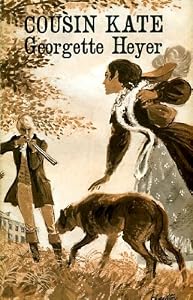
Review: Cousin Kate by Georgette Heyer.

Synopsis:
Cover of Cover of Cousin Kate

The plot of this book seems to be a cross between Mansfield Park and Pride and Prejudice by J. Austen with a dash of “Vanity Fair” by William Makepeace Thackeray.

Kate Malvern, the main heroine, is a daughter of a British officer, Major Malvern. She was born and brought up on the Iberian Peninsula during Napoleonic wars, 'following the drum'. At the beginning of the novel she finds herself in dire straits although not for the first time in her life. Her mother died when she was only twelve, her father was a victim of an accident not long ago and, being a gamester, he left his daughter a few trinkets and significantly more debts. After his death Kate was obliged to earn her living – not an easy task for a Regency period woman without any training. She was lucky to find a place as a governess but her luck didn’t hold too long - after the brother of her employer had proposed marriage and met with a refusal, she was fired. Now she is looking for a new ‘situation’ staying meanwhile with her former nurse, Sarah, now Mrs Nidd, whose husband owns a small inn in London.

Kate doesn’t lack brains, she is quite pretty and enterprising to boot, but these factors are actually hindrances in the career of a governess – rich families are afraid of pretty scheming women who might try to ensnare any eligible bachelor among their lot. Sarah, seeing that her beloved Miss Kate becomes quite desperate and wants to find any job, even as an ‘abigail’ (i.e. maid), decides to take matters into her able hands and write to the closest living relative of late Major Malvern – his younger sister, Minevra Broome of Staplewood. The letter, written without the knowledge of ambitious Kate who had opposed such a plan, achieved fantastic effects. Short afterwards Lady Broome presented herself personally in London, talked with her niece and proud Sarah, expressing the kindest concern when it came to the fate of her late brother’s only child, and invited Kate to Staplewood for the summer. It was an offer no impoverished orphan could refuse. What’s more, Minerva almost immediately started showering Kate with presents, repeating that she had always wanted to have a daughter. Soon enough her niece feels very much indebted to her – being a honourable girl she is determined to show her gratitude when the occasion demands it. However, she can’t even guess what she might be asked to do. After all her aunt, being such a rich lady, can’t possibly want anything from a penniless orphaned girl of twenty-four?

Staplewood is a great manor with a splendid park but the family which lives there is not especially happy. Sir Timothy Broome, the husband of Minevra, is a kind gentleman but rather feeble and their only son, Torquil, a very handsome boy of nineteen, is prone to sudden swings in mood and difficult to manage. Soon enough Kate meets another cousin, Philip Broome, who doesn’t like her aunt and seems to think ill of Kate too. Torquil enjoys her company very much but in a peculiar manner – once he even tries to strangle her for ‘fun’. Overall Kate feels rather let down. Although she doesn’t have to worry where to find money for food and shelter she lacks company and entertainment. There’s no busy social life going on in Staplewood – no dances or parties, even family dinners are a bit too formal. In the meantime Kate's aunt very indirectly tries to sound her niece out: what would she say if anybody offered her the undeniably lucrative 'position' of the future Lady Broome…the reason of Minerva's uncommon generosity is going to surprise Kate in a very negative way.

What I liked:

Certainly the main heroine was likeable enough as she was given plenty of Lizzie Bennett’s traits (from “Pride and Prejudice”). The narration was well-paced so I found myself riveted to the book very soon; in fact I finished it in one day! Apart from that the sense of period is superb indeed, especially when it comes to the language of lower classes. Mr. Nidd Senior is a treat every time he opens his mouth, Sarah too!

What I didn’t like:

Don’t expect the plot to surprise you - this book does sound a bit schematic, especially if you read any other Heyer romances. I also found it strange that after a week of very casual acquaintance any sensible man might feel obliged to propose to a girl…especially a dowryless girl. I am not especially fond of such rapturously romantic gentlemen but perhaps, being a woman who lives in the twenty-first century, I am somewhat spoiled.

The final verdict:

A nice, light, entertaining novel but nothing more – I can recommend it to any Austen fan, especially as a summer reading. I am curious about other books of this author - are they are similar?
Enhanced by Zemanta