Showing posts with label Jonathan Stroud. Show all posts

Sunday, 21 November 2010

Review: The Ring of Solomon by Jonathan Stroud

Hardcover: 448 pages
Genre: YA fantasy
Publisher: Doubleday Childrens (14 Oct 2010)
ISBN-13: 978-0385619158

Synopsis:

Remember the naughty djinn Bartimaeus? He is back. This book is a  prequel to the bestselling BARTIMAEUS TRILOGY, reviewed by me not so long ago.

In the novel we are transported in time to the court of the king Solomon in 950 BC Jerusalem. The said king rules because he owns a very powerful artifact – a golden ring, hiding a strong entity from the Other Place. No one has been as strong as him so far. He is surrounded by seventeen of the most powerful magicians from different countries – each and every one of them would like to bask in the glory of the famous king and also to cut a piece of this appetizing cake for him/herself. Magicians are, as usual, a very greedy, very selfish and very ambitious lot.

Bartimaeus is of course in trouble: not only had he eaten his previous master, which was considered a huge breach of good manners on the court, but he also managed to antagonize the new one, Khaba the Cruel, an Egyptian priest who took Bartimaeus as a servant soon afterwardsas a form of punishment. The insolent but witty djinn is now employed as a builder of the famous Jerusalem temple and then, because he offends the king even further portraying one of his many wives as a hippo in a skirt,  he is sent with other spirits to chase desert robbers. During that mission he saves the life of Asmira, a beautiful but deadly hereditary guard of the queen of Sheba. Asmira was sent by her queen to do the unthinkable - to kill king Solomon and steal the source of his power. It is a suicidal plan indeed - several marids had planned and failed to do so. She has to risk her life only because Solomon dared to propose to the queen for the fourth time in a row and then he asked for a very high tribute to be paid in frankincense. Is it really a good reason to die for? Bartimaeus thinks he should have eaten the girl and made her choices for her. Asmira will have to rethink her personal priorities and change her mind several times and Bartimaeus will help her throwing witty and sometimes philosophical remarks as he tries to save her from the worst - losing her personality.

What I liked:

As usual the book was written in a vibrant, fast-paced way; I wasn’t bored one single minute. Perhaps the plot was a bit predictable, especially for those who had read the trilogy before, but still each individual scene was a hoot. Bartimaeus's pranks and attempts to escape his magician controllers were very funny, especially those snarky footnotes scattered in-between. The sense of humour is always a very welcome feature, no matter what genre, and Mr. Stroud knows how to make you smile.

 I also liked Asmira - she reminded me a little of Kitty from the BARTIMAEUS TRILOGY – she was portrayed as one strong-willed, intelligent, passionate girl with sad experiences, a thoughtless superior and a hopeless mission. Stroud uses her to ask questions about the right choices in your own life, slavery and control. Her personal journey is well depicted and her changes are very subtle and real. What a pity not every suicidal assassin is paired with an intelligent and witty djinni.

What I didn’t like:

Although The Ring of Solomon is head and shoulders above the other young adult fiction I've read recently, I found it shallower than the original trilogy. Due to its length - it is just a single volume instead of three - The Ring of Solomon  simply feels like a watered down version of the previous series. I would like to read more about Solomon and his famous verdicts. I would like to know more about  the main baddie, Khaba and his past. In short, I would like more historical background. You can’t have it all, though…

The final verdict:


This novel can be enjoyed as a stand alone read or as an addition to the trilogy, mentioned before. I highly recommend it to those with children as something you can read together and discuss, or just as an exhilarating light read which will make these long black evenings pass by in a wink.

Sunday, 4 July 2010

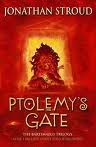
Review:"Ptolemy's Gate" by Jonathan Stroud

Review: Ptolemy’s Gate by Jonathan Stroud

Synopsis

In the final installments of the Bartimaeus series we finally find out the identity of  the previous rebellions' masterminds and why the djinni Bartimaeus was so partial to the form of a certain Egyptian boy. First things first, though.

SPOILER WARNING

If you haven’t read the first and the second part of this series yet and you value highly an unspoiled reading experience, it would be advisable to put off the lecture of this synopsis as it does contain several spoilers. I tried to limit them as much as possible but I had to mention some facts simply in order to keep the synopsis logical and coherent.

After unravelling the Golem plot against the Prime Minister successfully, Nathaniel/John Mandrake became even more powerful than before. Although only seventeen, he is now a fully-fledged, independent magician, the youngest ever Minister of Information (or rather Disinformation – honestly some his moves reminded me of the infamous Joseph Goebbels…), the member of the Council - in short one of the most influential people in magical London. He owns a delightful villa in a pleasant quarter, he commands several powerful djinni and minor magicians as well, he is constantly invited to parties and performances. What's  more, women court him and fawn on him, even those influencial ones, like Jane Farrar. Any teenager's paradise? Hardly. In fact, Nathaniel has never been so lonely and in a greater danger to boot.
The suave, ruthless and unerring John Mandrake persona suits him ill, although he is hardly avare of it. He must constantly watch his back - his colleagues wouldn’t spit on him if he were on fire. He is constantly overworked, having unofficially much more responsibilities than a mere propaganda job and, as the parties and theatricals are simply compulsory for every member of the government, he hardly finds one free moment to rest and think. What’s more, Nathaniel’s most precious slave djinni, Bartimaeus, is now as weak as a kitten due to the prolonged bondage to the material world. The young minister, afraid of many possible implications (Bartimaeus knows his birth-name and might spill the beans on him if summoned by another magician) desperately wants his slave-friend around all the time, although such a treatment might exhaust the djinni in question to death.
Rupert Devereaux, the Prime Minister and Nathaniel's immediate superior, is becoming more and more paranoid when it comes the his personal safety and the loyalty of other magicians. Instead of ruling the empire he sets his ministers at variance (so nobody gains the upper hand) and goes often to the theatre as the most popular magician-playwright, Quentin Makepeace, is his closest buddy. Devereaux clearly tries to forget about all troubles, even those he really shouldn’t forget for his own sake - the most dangerous rebellion is quietly brewing in the background again and its nature is so shocking that even the cleverest magicians couldn’t have predicted it. Or maybe they could, had they been a little bit less bigheaded and less occupied by their internal feuding.

The magical British empire is also in dire straits – the war with America is at a standstill, with more and more casualties every day. Normal people – the Commoners – have started to protest on the streets; they’ve had enough of war effort and magical exploitation, no matter what propaganda lies Mandrake's employees have been spreading around; what’s more, some Commoners, especially children, discover they have a kind of resilience to magical activities. Add to this the fact that one of the conspirators, who previously had taken an active part in both plots, haven’t been unmasked and imprisoned yet and you might understand why Nathaniel is so wound up.

Meanwhile Kitty, having now two false identities courtesy of the family of Hyrnek, works for an elderly magician, Mr Button during the day and as a barmaid at night. She hasn’t left London, although her friends would have made it easy for her; she has her own agenda - she wants to discover more about the nature of spiritual entities such as Bartimaeus. Kitty, having still  in mind her previous chat with the djinni, simply doesn’t understand why magicians enslave the sources of their power instead of cooperating with them peacefully. Is it really impossible (because too dangerous)? Haven’t anybody tried it before? Well, in fact there was one exception.
We are told more about the unique bond which used to link Bartimaeus and a boy-magician, Ptolemy, living in Alexandria  in the second century BC. Although just in his teens, Ptolemy had been more powerful than an ordinary wizard, consecrating all his life to studying the Other Place and spiritual entities, inhabiting it. He actually befriended his djinnis, asking them questions and never wanting their protection or any other services. He also visited the Other Place more than once - a feat no other magician has achieved so far. Uncharacteristically, Bartimaeus and other demons did plenty of things for him unasked, saving his life many times and helping ordinary people with their problems. Unfortunately Ptolemy became too absorbed in his studies to see a real danger approaching. His cousin, a drunken, blundering crown prince, jealous of the fact that Ptolemy was more popular among people of Alexandria than him, decided to murder the boy. Bartimaeus and other djinnis guarding Ptolemy, urged him to leave and hide but he turned their advice down as he couldn’t possibly leave his beloved library. When the worst came to the worst, the boy dismissed Bartimaeus in the final gesture of friendship (the djinni didn’t want to leave and, heavily outnumbered, would have been killed for sure) and died alone. To honour the memory of his only human friend so far, Bartimaeus often takes the form of the Egyptian boy while being summoned to the material world. Kitty, to her utter disbelief, is the first to discover why he does so.

Will Bartimaeus ever enjoy such a intimate relationship again? Will Nathaniel meet Kitty and finally thank her for saving his life? What will become of the British empire and its quarreling magicians?

What I liked:

It is a thrilling finale indeed. The chapters presenting the Bartimaeus’s point of view I found once again the best and the story of his friendship with young Ptolemy- very moving and inspiring. I also loved the fact that the author didn’t forget about one single character which had been introduced in previous books – for example we finally find out the name of the mysterious mercenary, so resilient to magic and instrumental in all of the rebellions attempted. I  fully appreciated the scene in which Jessica Whitwell (white-haired, cleverer version of Cruella) was the only government member who put up a fight and showed some backbone in time of crisis - her male colleagues just meekly accepted their fate. Now the ending…well, not every author would dare to end his or her successful series this way for sure - it was a huge surprise to me. Not revealing what happened to Nathaniel, Kitty and Bartimaeus, I just would like to say that after reading the whole series for the first time I was out of sorts for almost a week. On the other hand, I suppose this kind of ending was only too logical so after the rereading I think I am a bit more comfortable with it.

What I didn’t like:

Once again: I know it is a children’s series and there’s probably a set limit when it comes to the number of pages but in my very humble and biased opinion the author might have tried to show more of the Ptolemy’s personal history. He set this character well in time, that’s true, but kind of forgot about the real Ptolemys, a very colourful Greek dynasty with great narrative potential, which used to rule in Egypt after the era of pharaohs. Let me present a short excerpt of the historical background which, in my view, might have been exposed in the books more ( I based it on the Wikipedia entry, so it will be nothing fancy or too scholarly I assure you).

The uncle of the young Ptolemy from the book (let’s call him Ptolemy-magician for the clarity’s sake) would be no one else than Ptolemy VIII Euergetes II, nicknamed Physcon (“"Sausage", "Potbelly" or "Bladder") for his obesity. Nice, isn’t it? His complicated career started in 170 BC, when Antiochus IV Epiphanes invaded Egypt, captured his brother Ptolemy VI Philometor, the alleged father of Ptolemy-magician (btw the whole family wasn’t into fancy names so they needed nicknames to differentiate) and let him continue as a puppet monarch. Then Alexandria chose Ptolemy Euergetes as king. The evil and degenerated crown prince would be Ptolemy IX Soter II or Lathyros ("grass pea"). His story is practically an ideal material for a separate book (but perhaps not a children’s book when you come to think about it). At first he was chosen by his mum, Cleopatra III to be her co-regent (his father Ptolemy VIII wished that she would rule with one of her sons after his death and she complied), though she was more forced to choose him by the Alexandrians – apparently he was quite popular at the beginning. Continuing the tradition of pharaohs, he married his sister Cleopatra IV, but his mother pushed her out and replaced her with his younger sister Cleopatra Selene. Later, she claimed that he tried to kill her, and successfully deposed him, putting her favorite son Alexander on the throne to rule with her. However, she later grew tired of the now Ptolemy X and deposed him, putting Ptolemy IX back on the throne- quite a merry-go-round. She was soon murdered by Ptolemy X, who took the throne again. He was then killed in battle, and Ptolemy IX reigned until his own death. In Alexandria, Ptolemy IX, replaced the sarcophagus of Alexander the Great with a glass one, and melted the original down in order to strike emergency gold issues of his coinage. The citizens of Alexandria were outraged at this and soon after, Ptolemy IX was killed. As you see, the righteous wrath of people is something difficult to bear.

The final verdict:

All in all I love this series far better that “Harry Potter”. Neither of its parts really let me down – it is funny, inventive and well thought-out from the beginning to the very end. Trully magical.


Wednesday, 30 June 2010

Review: The Golem’s Eye by Jonathan Stroud


The review of “The Amulet of Samarkand”, the first part of this series, can be found here;

SPOILER WARNING

If you haven’t read the first part of this series yet and you value highly an unspoiled reading experience, it would be advisable to put off the lecture of this review as it contains several spoilers concerning the Amulet of Samarkand’s plot. I tried to limit them as much as possible but I had to mention some facts, notably the ending, in order to keep the synopsis logical and coherent.


It is said time and again that an opposition party and the same opposition party which has just won the election are two different things altogether. I suppose this remark is equally pertinent when it comes to people : if an underdog becomes a successful hero he/she must and should change. In what direction will the change go, though?

Synopsis

More than two years had passed since the rebellion of Simon Lovelace, prevented by Bartimaeus and Nathaniel. Our hero is now known solely as John Mandrake (his birth-name must be kept secret literally from everybody, friend or foe; in fact, apart from Nathaniel himself, only Bartimaeus knows it but he is in the Other Place). Instead of an undervalued, mistreated weedy boy of twelve we see suddenly a successful young man of almost fifteen, apprenticed to one of the most powerful magicians in the country, a prominent member of the government, Ms Jessica Whitwell. We had glimpsed this lady shortly in the previous book, torturing poor Bartimaeus in the Tower of London. She looks mighty like Cruella DeVill but she is far cleverer and definitely tougher. Her new apprentice tries to match her - Nathaniel is now fashionably dressed and lives in her spacious apartment near the Westminster enjoying such fantastic amenities as a walk-in wardrobe and a bathroom en-suite (swoon! I had to mention it! it was written by a guy about a teen boy!). He also becomes rather arrogant and full of himself. Small wonder, even the Prime Minister, Rupert Devereaux, is personally interested in his career (Nathaniel saved his life after all). Having received a stipend from the government, our protagonist was also employed in the Department of Internal Affairs, led by Ms Whitwell, and it is not a sinecure, far from it. Clearly Nathaniel has been earmarked for top jobs in the future. He is climbing the social ladder at great speed.

Not everything is exactly rosy, though. Nathaniel swiftly discovers that he has been transferred to an even more hostile environment than the household of his previous master - many magicians and apprentices hate him simply because they are deeply jealous of his privileged position and talent (no surprises here). He must watch his back (or make others watch it) constantly. Among such people he can’t make true friends – he has to deal with either temporary allies, more or less willing, or sworn enemies, more or less overt. That’s why he is missing his old pal Bartimaeus more and more with every passing day (he had to dismiss the djinn right after the demise of Lovelace, such had been their mutual agreement). True, he can have other magical entities at his disposal now but they are neither as intelligent nor as straightforward and truthful as his old companion. What’s more, Nathaniel still must produce outstanding results in order not to change from a rising star into a short-lived meteor. This time the task might seem a bit easier –  uncovering and eliminating an elusive group of Commoners, mostly children or teenagers, called the Resistance.
He had met them before and even has had a score to settle with them as they had mugged him, taking the last keepsake of his previous life, his hand-made scrying mirror. In this book, we get to know the Resistance a lot better. This small but efficient organization, led by a girl called Kitty Jones and an elderly man called Mr. Pennyfeather, is a group of people who had been hurt, neglected and/or injured by magicians, usually without any valid reason. Some of them had tried (and failed) to find justice in courts. As a result, they had got an awfully big grudge against the establishment; they don’t believe in the system anymore and some of them are immune to different forms of magic. It is, by the way, a perfect example how any dictatorship might create really formidable enemies just being too self-important to notice big tragedies of small folk. DIY foes, nothing less. On the other hand, it is also a showcase how your morale must deteriorate when you get too accustomed to committing crimes day in day out.

As the pressure mounts, Nathaniel becomes even more distracted by a series of terrifying attacks on the capital, performed by a very powerful being. Now everyone expects him, the golden boy, to solve the imbroglio and save the day; however, with enemies and traitors around, it certainly won’t be easy. Time to summon Bartimaeus again but will he be really happy, seeing this new Nathaniel, so similar in some aspects to his old nemesis Simon Lovelace?

What I liked:

The second part of this series I liked even better than the first. The introduction of Kitty and other Resistance people with their personal histories was a perfect addition to the plot, making the whole story more touching and believable. Mechanisms of power, described by Stroud, are dark, ruthless and tantalizing, in short taken straight from our political life - really something I enjoyed and appreciated as an adult reader. After all, nobody said children’s books must be dull and syrupy sweet. We also witness a dynamic development of the character of Nathaniel/John Mandrake and the Resistance members as well; although, from time to time we might not be sure whether to love or to hate them.

What I didn’t like:

Not enough of Bartimaeus (but it will change in the last book) and too many mediocre spiritual entities instead (with one prominent exception). Sure, those foliots and imps are funny but already their tricks have become a bit repetitive.

The final verdict:

A fantastic read. Witty, intelligent, lively.

Sunday, 27 June 2010

Review: The Amulet of Samarkand by Jonathan Stroud


The Amulet of Samarkand by Jonathan Stroud

Continuing my reviews of book appropriate for summer fun and lounging in the sun (but not only), I would like to present  the first part of the Bartimaeus trilogy. Reading the blurb you might think it’s just another clone of Harry Potter series. I am happy to announce at once that nothing could be further from the truth.

Firstly, the magical community, invented by Mr. Stroud, is definitely a  more mature and dangerous world. There are no schools of magic and wizards are rather made than born. It works like this: some children aged five are freely given up by their parents to follow the magical training. They come from all walks of life. For their parents it means a large sum of money as compensation; small wonder there are always willing volunteers and the ads in newspapers provide even more encouragement. For children it means leaving their biological family forever, hiding, (at best - totaly forgetting) their real birth-name for security reasons, undergoing a series of tests and finally being allocated to the house of an adult wizard or witch who usually becomes their master or mistress for the rest of their training period. At twelve, the symbolic coming of age, they are allowed to choose a new name by which they will be known as a magician and a man (or woman). In return, they get a chance of becoming a member of the ruling class, living in relative comfort, maybe even making a brilliant career providing they are gifted and ruthless enough. 
Secondly, it is the duty of every witch and wizard to train an apprentice every now and then. Witches and wizards don’t have any children of their own as it used to have disastrous effects in the past, leading to competing dynasties and blood feuds. No exceptions. In fact, even without children they constitute a bunch of ambitious, mean, backstabbing careerists, only waiting around for any mistake of their colleagues – a typical pack of wolves. They don’t trust each other but they distrust the entities enslaved by them, their sources of power and glory, even more vehemently. It’s a constant tug-of-war - who will outwit whom. Magicians win most of time but sometimes they die (get eaten or dismembered or both). 
Finally Stroud introduces the fascinating workings of the 'seven planes' of spiritual world (magicians can see three of them only with special spectacles), the pecking order of magical beings, and the requirements of various spells and enchantments — plus the intrigue behind a group of non-magical commoners known as the Resistance.

Synopsis

The book starts with the presentation of the spiritual side of magic: the entities which enable wizards to perform the tricks of their trade. We meet one representative of these powers as we are ushered into a room where the temperature plunges dramatically, icicles form on the curtains and ceiling, and the scent of brimstone fills the air. Suddenly, the narrator reveals itself as the old and powerful djinn Bartimaeus, appearing in front of  a 10-year-old  apprentice, who has summoned him secretively in his room. The boy is called Nathaniel (but the djinn doesn’t know his name yet) and he lives in the household of a Junior Minister, Arthur Underwood; Nathaniel commands Bartimaeus to steal the Amulet of Samarkand from a hotshot upstart, Simon Lovelace as he nurses a grudge against him. Some time ago Lovelace, paying Underwood a visit, ruthlessly humiliated his apprentice in front of everyone present in the room, including one of the boy’s favourite teachers. Although officially masters are supposed to protect and defend their apprentices Arthur failed to do so, clearly afraid of the influential opponent. To add insult to injury he also punished the boy for trying to stand up to an adult, stronger wizard and endangering his position in the ministry. Outraged Nathaniel, a rather ambitious and  highly gifted pupil, decides to kick up secretly his magical training using books from his master’s library and pay Lovelace back. Summoning Bartimaeus is a part of his plan. However, the revenge backfires as the boy clearly has bitten more than he can chew. It's true that Bartimaeus proves to be more than up to the task set by his young master, but the act of stealing a powerful magical object sets in motion a lot of unpredicted events, catching Nathaniel and the djinn in a whirlwind of espionage, blackmail, murder, and finally a revolt. Apart from that, Nathaniel finds out that summoning beings as old and devious as Bartimaeus is one thing and controlling them is quite another. Will he be able to cooperate with the recalcitrant djinn and punish Lovelace for the committed crimes? Will his master help him?

What I liked:

The magical world created in this trilogy has a truly original touch - finally we see not only wizards performing awesome deeds but we are also informed about the source of their magic and its inner workings. You can even find here some subtle satire on real political parties and politicians. The whole storyline is also darker and edgier than other similar fare, remaining humorous and entertaining at the same time. The character of Bartimaeus is a powerful creation, sometimes even overshadowing poor Nathaniel and his fellow wizards and I must add we got  a very talkative and intelligent djinn – the footnotes of his chapters are one the most hilarious parts of the book!

What I didn’t like:

Sometimes the plot was too predictable. Fortunately not very often. It’s a children’s book after all!


The final verdict:

A highly addictive stuff - if you start reading the first part, you will want to read the rest for sure. Luckily the whole trilogy is available on the market so we don’t have to wait for ages for another installment. It would be unbearable, even though there are no cliffhanger endings here.