

Showing posts with label Catherine Fisher. Show all posts

Sunday, 8 August 2010

Review: Sapphique by Catherine Fisher

Review: Sapphique by Catherine Fisher

The book is the sequel to “Incanrceron" ,
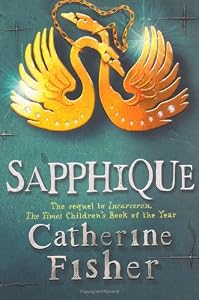
Cover of Cover of Sapphique
which I reviewed here.

Synopsis

In this part the alternating story lines between the Realm and Incarceron are much more distinct. Finn, an Incarceron prisoner who had escaped  with some help of Claudia, the Warden of Incarceron’s daughter, tries to get his kingdom back. Claudia believes that Finn is no other than Prince Giles, the lost son of the late king, abducted and imprisoned by his step-mother, queen Sia, in order to make room for her own progeny. John Arlex, the Warden of Incarceron, having tricked the queen into presenting Finn as the heir to the throne, removed himself temporarily from the scene. Now, his daughter is on her own to prove her point and make the rest accept Finn. Her belief is not widely shared to say the least of it, not even by Finn himself. Even Jared Sapient, her terminally ill tutor, doubts it, although he does what he can to re-open the portal to Incarceron and find some proof. Courtiers and aristocrats simply shun the newly-found prince as he is moody, taciturn and has no manners to speak of. What’s more, Finn himself seems to doubt this new persona more and more, as his memory hasn’t returned completely and his seizures and blackouts continue. Apparently the Realm is not going to be handed down to him (if it is really his) on a sliver platter. Apart from that, it turns out the world outside the prison is hardly a Paradise Finn had been expecting. Has he stepped out of the frying pan into the fire? Queen Sia hasn’t been idle either – once defeated, she is hell-bend on setting everything right again, staging a show with her own prince Giles as the main character. With two heirs apparent to choose from, who is an impostor and who is the real thing? Even Claudia has her moments of doubt. Is there any way of finding the truth?

Meanwhile inside the prison Finn’s oathbrother, Keiro, who, like Attia, Finn’s friend, was left behind, struggles to find his own way out. He believes Finn has forgotten about the oath and won't help them (or won't be let help them) to escape so he is after a mysterious artifact, the Glove of Sapphique, which, allegedly, might allow him to get the upper hand over Incarceron and be released. The rumour has it that the Glove is in the possession of a prisoner called Rix, a con artist and a vagabond, who travels with his troupe all over the prison to earn a living. Keiro makes Attia join that troupe and find out as much as she can about the Glove and its owner. They are running out of time, though, because Incarceron itself decided to abandon its prisoners, create a body and run away from it all - it's been feeling imprisoned without glimpsing the outside world. Unfortunately it means nothing more or less than death of all the people, inhabiting Incarceron. All the prison needs is the Glove. As Keiro doesn’t give a damn what happens to the others, it’s Attia’s job to make sure the Glove won’t fall into wrong hands. Will the Warden help her with that dangerous task? Whose hands are good and whose are wrong anyway?

What I liked:

Undoubtedly the storyline is a strong point of this series. The same verbal sleights of hand and creative story elements that made "Incarceron" so exciting a read are back in Sapphique; the authoress populates the prison with sentient beings that are unique and original. Nothing is as easy as it seems at the beginning of this dystopian tale and the main characters undergo huge changes to achieve their goals. I must admit this was one angst-filled novel, definitely darker than the first part but I liked it. The pace of narration was very quick, with enough twists and turns to keep you glued to the book right to the end.

What I didn’t like:

My concern is whether or not this is the real end of the story. I mean, it does resolve satisfactorily for all the main characters, but some of my questions remained untouched. I mainly think here about supporting characters like Queen Sia, the evil woman of the series. A powerful baddie should have been presented better in my view. Who and what was she? How did she manage to marry a king and become a queen in the first place? What gave her so much power and skills? Why did she decide to imprison rather than kill prince Giles? None of these was answered and it's a pity. I also feel there should be said more about John Arlex and his motives - why did he choose to return to Incarceron after all, knowing fully well the system was unstable?

Apart from that, I was expecting more character development; for example at the end of the book I still wasn’t completely sure what was the relationship between Jared and Claudia - was he a father-figure or a love-interest or maybe both? The same can be asked about Finn/Giles and Claudia - were they trully in love or were they just friends, allies and future married couple? I think (and hope) Ms. Fisher left an opening for a possible third book... that's my opinion.

ETA: The eyes of the Warden are still gray.


The final verdict:

If you haven't read Incarceron and Sapphique yet, start the series now and you won’t regret it. It is not flawless but it remains good and imaginative nevertheless.
Enhanced by Zemanta

Saturday, 17 July 2010

Review: „Incarceron” by Catherine Fisher

Review: „Incarceron” by Catherine Fisher

Synopsis


The book is the first part of a dilogy, set in a fantasy kingdom which used to be ruled by the Havaarna Dynasty. One of the rulers, king Endor, after a period known as the Years of Rage (a rebellion? a war?) had decided to improve his country by stopping the Time. No change, no stress for the monarch. In practice it meant imprisoning people in the artificial Era (by the look of it 17th century) by a set of rules called the Protocol although the country’s technology seemed to be far more advanced.  The orders of the king had forced people to hide all the sophisticated technology behind the Era décor, exactly as in a theatre. To make everybody perfectly happy the king also ordered a group of scientists, called Sapienti, to create an ultimate prison. The Sapienti came up with the idea of Incarceron, which was supposed to be not only a prison but also a kind and considerate guardian for the inmates, with health care, good working and living condition, the right entertainment etc. (yeah, sure, whatever). Seventy Sapienti agreed to inhabit the prison and supervise the criminals dumped there -they did it out of free will because they thought it would be a thrilling Experiment. More or less half of the kingdom's population, a fallout of the Years of Rage, have been sentenced to go to the prison pernamently. Incarceron was also given a life and personality of its own, becoming a kind of independent AI creation. It was sealed permanently then. Outside it has been attended to by a Warden of Incarceron, one of the most powerful people in the country. So far only one human has been rumoured to escape Incarceron and his name or nickname was Sapphique. Nobody knew how he had done it and whether it was true at all.

The narration shows the reader two points of view: one of a prisoner, called Finn, who believes he came to Incarceron from the outside, and the second of the current Warden’s daughter, called Claudia, who is being prepared to get married and become the next Queen.

Through Finn’s eyes we see that the prison is closer to hell than to the idealistic notions of the Sapienti who had created it. The place is horribly unpleasant, some inmates fight each other, forming pillaging bands; the life of prisoners is rather short as they often fall ill and nobody cures them. The prison, although efficient and sustainable, plays its wicked games with the prisoners too. It seems nobody controlls it anymore. In some cells, called Wombs of Incarceron, new inmates and strange animals are grown from recycled dead matter. Finn is believed by one of the local Sapienti, Gildas, to be cell-born and thus special. Gildas hopes Finn might even help him escape because the boy gets strange visions having a kind of epileptic fits from time to time. Finn’s oathbrother, Keiro, considers the whole escape a waste of time, though; like most of inmates he doesn’t believe in any outside world. It all changes when Finn finds a strange crystal object with a crowned eagle inside – the same symbol he has tattooed on his wrist. Perhaps his visions are something more than just figmentsof  imagination after all?

Following the chapters of Claudia we learn that the last Havaarna king died leaving his young son under the tender care of a step-mother, who (no surprises here) had also a child of her own, a boy called Caspar. Young prince Giles used to be betrothed to Claudia but when he was fifteen he had a riding accident and died. Now Caspar, the earl of Steen, is the heir to the throne. His mother, queen Sia, rules the kingdom till he reaches 18 and can be crowned. Claudia is going to marry Caspar very soon and be the future queen. Her father, John Arlex, the Warden of Incarceron, has been preparing her for that role since her birth. No expense was spared to turn Claudia into a perfect politician – intelligent, ruthless, pragmatic and cunning. Her tutor, Jared Sapient, imparted knowledge in such a way that Claudia enjoyed learning and soon became a real jewel among teenagers. However, she is not happy – although she lives in luxury her father treats her like an object, a tool to fulfil his ambition, and she starts resenting it more and more. Her fiance, Caspar, has always been a spoiled brat; at the age of seventeen he is already a dim-witted, brutish, drinking philanderer, who couldn’t even finish his education (well, why bother?). Little wonder Claudia is less than eager to marry him. She starts to investigate the accident of prince Giles and finds out that the heir apparent might be alive after all. Where could he be hidden, though? Wouldn’t a prison be an excellent place? Especially one you simply have no hope to escape?

What I liked:

The story is intricate but very well-told, with dynamic pace of narration and surprising twists now and then. I loved the fact that the two  worlds  presented - the prison and the kingdom – were actually so much alike. The imaginative scale of the authoress made reading this book a Rollercoaster adventure. The descriptions really worked for me - this book is an excellent movie material. What’s more, I found it very realistic that each of the characters had their dark side so close to the surface - Claudia is not just a young high-born girl and Finn is more complex than just a brutal prisoner. As they have to act, fight and lie to survive they change with the story. The ending is simply incredible - I haven't seen it coming for sure. All in all a very good read, not only for children.

What I didn’t like:

I don't want to pick holes in the plot as I haven't read the second part yet. Just let me tell you I didn't like the eyes of the Warden of Incarceron. Why? They changed colour through the book! Very disconcerting!

Page 70 (paperback edition) 'Crystal eagle, dark swan' part 6 :”His black eyes watched her closely”.
Page 382 'The Lost Prince' part 29 :”His grey eyes held hers and the light in them was keen and sharp”.

Perhaps in the second part we will be given a reason for the change. If not, the editor should be given a slap.

The final verdict:

I loved this book and I can't wait to get the second part!! Highly recommended!
Enhanced by Zemanta