

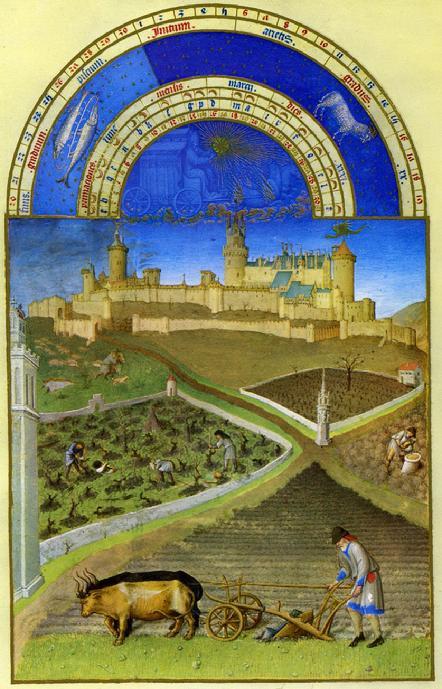
The Lusignan Castle of the Duc de Berry crowns the landscape parallel with the horizontal line of the oxen, plough and the peasant in the foreground. The road running from the two bottom corners divides the middle distance into four parts and the fields created in this way are further separated diagonally by low stone walls. Due to slight irregularities and to tiny details which absorb the spectator's attention and to the fact that the viewpoint is not in the centre but slightly to the left, this system of lines does not appear to be arid. Now my favourite detail: the dragon flying towards the castle. It was supposed to recall to his contemporaries the legend of the lady of the castle and its builder, Melusine.

The Island of the Lost was so called because it was only by chance any, even those who had repeatedly visited it, could find it. Here she reared her children, taking them every morning to a high mountain, from which Albany might be seen, and telling them that but for their father's breach of promise they might have lived happily in the distant land which they beheld. When the children were fifteen years of age, Melusine asked her mother particularly of what their father had been guilty. On being informed of the truth of the matter she conceived a design for being avenged on him. Engaging her sisters to join in her plans, they set out for Albany. Once there they they took the king and all his wealth, and by dint of her charms she shut her father away in an inaccessible part of the Brandebois mountains. On telling their mother what they had done she flew into a rage because they had taken vengeance without her. Pressine laid curses upon them all, with the worst of all reserved for Mélusine as the instigator of the plot. Meliot was to be imprisoned in an Armenian castle, Palatine in a mountain together with her father, while Mélusine was cursed to become a 'serpent from the waist down' every Saturday. This would be her fate until she met a man who would marry her under the condition that he never saw her on a Saturday. Like mother like daughter.
Mélusine left the Lost Island and began roaming the world where she passed through the Black Forest, and that of Ardennes, and at last she arrived in the forest of Colombiers, in Poitou, where all the fays of the neighborhood came before her, telling her they had been waiting for her to reign in that place. It just so happened at this time that Raimond de Lusignan, having accidentally killed the count, his uncle, with a deflected blow from his boar-spear was wandering that night in the forest of Colombiers. He arrived at a fountain that rose at the foot of a high rock. The local people called it the Fountain of Thirst, or the Fountain of the Fays, on account of the many marvelous things which had happened near it.
Raimond reached the fountain at the time when three ladies were diverting themselves there by the light of the moon — the principal one being Mélusine. Of course, her preternatural beauty and her impeccable manners quickly won Raimond's heart. She soothed him, concealed the deed he had done and married him on condition that he never try to find out what she did every Saturday- if he breached his oath he would forever be deprived of she who he loved so much. From her great wealth she created for him the castle of Lusignan right next to the Fountain of Thirst, where they had first seen each other.
Ten boys were born of their union but all were afflicted with strange physical defects. For example, one of Urian's eyes was in the middle of his cheek, and Geoffrey had a very long eye-tooth, which was why he came to be nicknamed Geoffrey Big-Tooth. But still Raymond's love for his beautiful wife remained unshaken.
 |
| Raymond walks in on his wife, Melusine, in her bath and discovers she has the lower body of a serpent. Illustration from the Jean d'Arras work, Le livre de Mélusine (The Book of Melusine), 1478. (Photo credit: Wikipedia) |
But one day Raimond could no longer contain his curiosity. For he had noticed that each of Mélusine's absences coincided with the apparently magical building of a castle, a monastery or a church. So he followed his wife into the cave to which she withdrew every Saturday. There he saw Mélusine in her true form: 'for the ovely form of Melusina ended below the waist where it became serpentine with scales of grey and sky-blue mixed with white bathing in a green marble tub'. Quite a sight you must admit ;). But it was not horror that seized him at the sight, it was infinite anguish at the reflection that through his breach of faith he might lose his lovely wife forever. When she realised she had been found out Mélusine wept and stretched out her arms, which turned into wings; finally, she disappeared into the air, uttering these words: 'One thing will I say unto thee; that thou, and those who for more than a hundred years shall succeed thee, shall know that whenever I am seen to hover over the fair castle of Lusignan, then will it be certain that in that very year the castle will get a new lord; and though people may not perceive me in the air, yet they will see me by the Fountain of Thirst; and thus shall it be so long as the castle stand in honor and flourishing — especially on the Friday before the lord of the castle shall die."
Source:


Depressing stories they came up with before
ReplyDeleteHow interesting! I'd heard of Melusine from my art history courses, but I had no idea the story was connected to Lusignan and the Duc de Berry. Great post!
ReplyDeleteThank you! In fact some scholars claim that the name Melusine is an abreviation of 'la mere de Lusignan'. She was more than anybody the creator of the whole family although there had been Lusignans before her of course.
ReplyDeleteWhat do you want, HEA sill wasn't invented ;).
ReplyDelete