
The German name for
Austria, Österreich, means
"Eastern realm", it derives from the word Ostarrîchi, which first appears
in the "Ostarrîchi document" of 996 but I don’t mean to bore you with historical details. It will be
just about my personal experience. During eight days (plus two days spent going
there and back) I
visited two cities (Vienna, Salzburg), some small towns like Innsbruck and
Hallstatt and a bit of Tirol, mainly the Alps and more precisely the High
Tauern near Grossglockner along
the High Alpine Road.
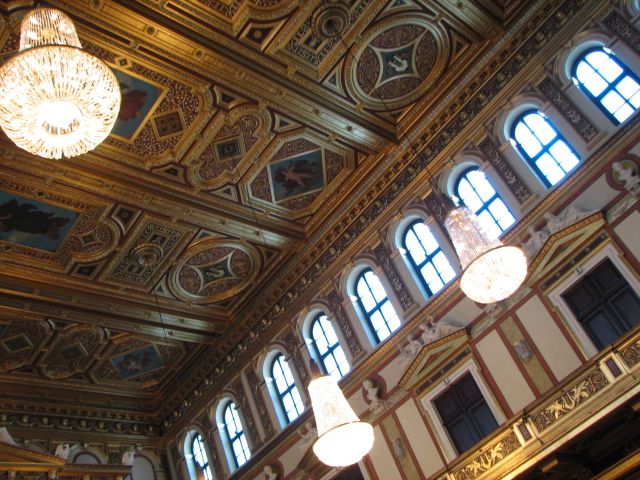
It is the capital of Austria – a big, multinational city full of tourist prime spots, historical or otherwise. Everybody knows Vienna so there is no need to write anything more. Yes, I saw the Danube, no, it wasn't blue at all. Apart from that famous river I wanted to visit the National Austrian Library located in the Hofburg Palace but it was closed due to some kind of renovation (not a brilliant idea, renovating a building right in the middle of the holiday season but what could be done). Still I was able to glance at some interesting buildings – the seat of Musikverein ( photo number two) and a very unusual tenement house designed by Hundertwasser (photo number one) among them. I must return there one day – I didn’t see Schönbrunn and plenty of museums, not to mention that library of course…

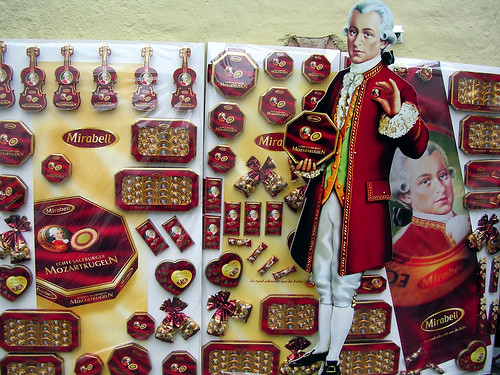
It’s all about Mozart here, not necessarily in a good way. Not that I don’t like Mozart music but here you get Mozart sweets and Mozart airport, Mozart house and Mozart gift shops full of ugly Mozart dolls, Mozart key fobs and Mozart mugs. Tacky t-shirts with an ugly Mozart. Do you want something to drink? Do not forget about Mozart – they won’t let you anyway. A Mozart here, a Mozart there, you will have a Mozart everywhere…after a while you can almost get sick seeing another Mozart-related monstrosity but you can’t escape. Not in Salzburg.
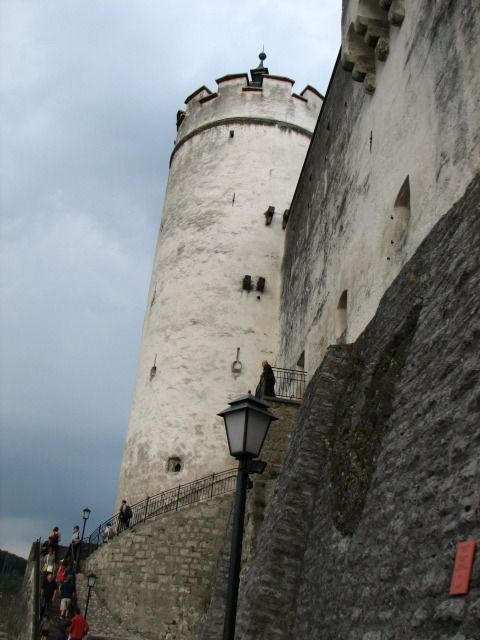 |
| Hohe Salzburg fortress |
If you are tired of Salzburg (easily done, believe me)
it is the nearest place where you can relax. Untersberg is a
mountain massif of the Berchtesgaden Alps that straddles the border between
Berchtesgaden, Germany and Salzburg.

It is easily accessible – it’s enough to take a public
transport bus (the ride from Salzburg lasts roughly 30 minutes) and a cable car
(10 minutes if there are no queues) to be transported straight into the peace
and quiet of one of the Alpine mountains. I really needed that after the Mozart
folly and two hours were enough to recharge batteries and prepare for more
urban sightseeing. The views were great, there were not so many fellow tourists and the sound of silence was simply priceless.
Oh and there is a nice legend connected with that place - allegedly Emperor Frederick
Barbarossa (of the Holy
Roman Empire) is asleep inside Untersberg, taken care
of by the "Untersberger Mandln", small dwarf-like creatures. His
beard is said to be growing longer and longer around a round table and to have
grown round two times. Myth says that when the beard has grown three times
around the table the end of world has come. Right
– I can hardly wait.
Innsbruck
A nice holiday resort in
the middle of the Alps – small but very cute, especially the town hall and the
old tenements around it. Painted in pastel colors of
green, yellow, pink and blue, the buildings reminded me of cupcakes, and the
white fluffy decorations made the icing on the cake.
It really had that medieval atmosphere so difficult to copy.
If you have some time to kill and you are nearby it is worth checking out. Its
landmark is the Golden Roof – a three-story balcony on the central plaza at the
heart of the Old Town. It was constructed for Emperor Maximilian I to serve as
a royal box where he could sit in state and enjoy tournaments in the square
below and the roof is covered by real golden tiles.
Krimml waterfalls
with a total height of
380 metres (1,247 feet) it is the highest waterfall in Austria. The falls are formed from the Krimmler Ache river and are
located near the village of Krimml in the High
Tauern National
Park in Salzburgerland. The waterfall begins at the Krimmler Ache at the top of
the Krimmler Achendal, and plunges downward in three stages. The upper stage
has a drop of 140 metres, the middle of 100 metres, and the lowest a drop of
140 metres.
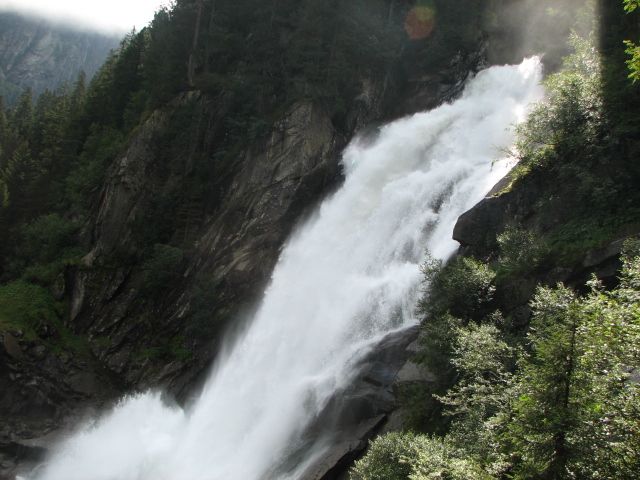
It is a really scenic and refreshing experience, especially when
the weather is nice. The paths are so comfortable that I saw even people with
prams and very small children, not to mention those brave elderly ladies with
walking sticks. Of course nobody forces you to go to the very top but let me
tell you, you will want to anyway. Still be warned – in the summer, especially
during the weekends, the path is rather crowded.
Hellbrunn
An early Baroque villa of palatial size, near Morzg, a southern district of the
city of Salzburg. It was built in 1613-19 by Markus Sittikus von Hohenems, Prince-Archbishop
of Salzburg, and named for the "clear
spring" that supplied its water gardens. Hellbrunn was only meant for use
as a day residence in summer, as the Archbishop usually returned to Salzburg in
the evening. Still that fact didn’t prevent him from splashing money around like water
– literally.

The villa is famous for its jeux d'eau ("watergames") in the
grounds, which are a popular tourist attraction in the summer months. These
games were conceived by Markus Sittikus himself; apparently he was a man with a
keen sense of humour and he liked to perform a series of practical jokes on
guests. Notable features include stone seats around a stone dining table
through which a water conduit sprays water into the seat of the guests when the
mechanism is activated, and hidden fountains that surprise guests while they
take part on the tour.

Other features are a mechanical, water-operated and music-playing
theatre built in 1750 showing various professions at work, a grotto
and a crown being pushed up and down by a jet of water, symbolizing the rise
and fall of power. At all of these games there is always a spot which is never
wet: that where the Archbishop stood or sat, to which there is no water conduit
and which is today occupied by the tour guide. As the weather was sunny and
warm, spraying was a lot of fun; however you should protect your camera. Near
the villa there is also the Zoo so both children and adults can spend there the
whole day without ever getting bored. I liked Hellbrunn very much – history and
amusement was balanced there in such a way that it made everybody happy.
Lichtenstein gorge
 A wonderful place and one
of the deepest gorges in the world (the fifth deepest if I remember correctly).
Perfect for a stroll with the whole family – even elderly people or/and kids
will manage. Just don’t forget your camera and wear good shoes as the wooden pathway can be pretty slippery and wet. The rock formations, carved by
water, are incredible (see the photo).
A wonderful place and one
of the deepest gorges in the world (the fifth deepest if I remember correctly).
Perfect for a stroll with the whole family – even elderly people or/and kids
will manage. Just don’t forget your camera and wear good shoes as the wooden pathway can be pretty slippery and wet. The rock formations, carved by
water, are incredible (see the photo).
Hallein salt mine
I expected something
different and I was disappointed. The main attractions of this mine are: a
rather smallish artificial lake and wooden rails on which you can slide down.
I’ve visited far more interesting salt mines in my own country. What’s more the
movie, which was supposed to present its history, was embarrassingly stupid
(the ‘famous’ German sense of humour, eh).
Hallstatt
A very small town squeezed between a lake and a mountain and famous
because of a salt mine (yes, another one) near which there were prehistoric
artifacts found. The market municipality was already inhabited in the 1st
millenium before Christ: during this period - the iron age - the civilization
apparently flourished there. When I
visited it was brimming with Asian tourists so it was difficult to enjoy
it; however the weather was fine and the views – breathtaking so I managed to
take some photos nevertheless.
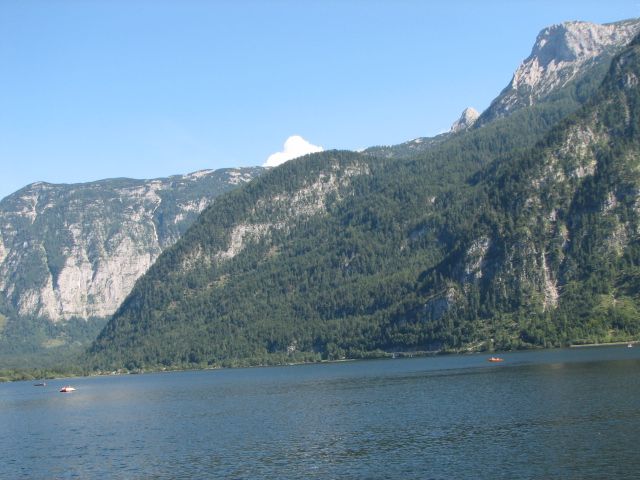
Why so many tourists from Asia, you might ask…well, not without a
reason. Imagine yourself that a Chinese corporation
designed an exact copy of this town that was built in the north of Hong Kong
and now plenty of Chinese want to see the original as well; I bet they want to
spot the differences or lack thereof. You can find out more about it all over
the Internet, for example here:
High Alpine Road
If you want to see the
Austrian Alps in full comfort, admiring them from the window of your car or
your coach it is the perfect place . The views are really breathtaking, you can
make a few stops (there are special parking bays along the road) to get outside
and take a picture or two and you won’t even break out into a sweat, quite the
opposite in fact – even in the summer don’t forget about some warmer clothes. I was there in August
and it was like 9 degrees Centigrade despite the fact that the weather was nice
and sunny. I must admit, though, that it felt weird. I am not a fan of
sightseeing the mountains while only looking through the window, I felt like a
cheat. There is nothing like trekking especially if you can meet some lovely Alpine cows.
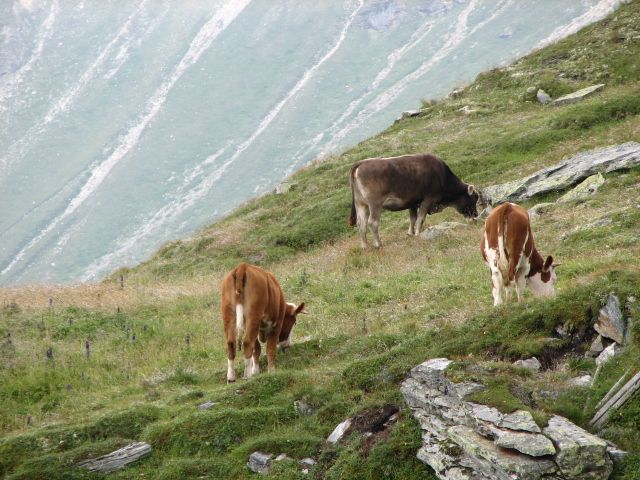
Ice caves in Werfen near Salzburg
(Eisriesenwelt Werfen)
The caves are impressive
– big, cold and icy ( only plus 3 degrees Centigrade inside). A guided tour is
possible only during the warmer part of the year, I was told that in the winter
the trail leading to them is too dangerous and inside there is only -15
degrees. Imagine spending an hour or so in such a temperature while moving
slowly along a rather narrow flight of wooden, slippery stairs. In the summer,
though, they are certainly worth visiting providing that you arrive early to
avoid horrible queues to the cable car. One more tip - you can't take photos inside the caves (that's why I had to google that one)

Hohenwerfen castle

It used to be a typical
medieval defence construction – made of local stone on a hill, rather small,
inaccessible, uncomfortable to live in. Nowadays the bastion, enlarged and
renovated several times over the centuries, functions as an ‘adventure’
fortress. There are guided tours showing its weapons collection, the falconry
museum as well as a stylish fortress tavern (expensive but what can be done, it
is so stylish you must visit it). The historic Falconry Centre offers daily
flight demonstrations by various birds of prey. They last about 45 minutes and
are really impressive – even merely admiring the various birds like falcons,
eagles and buzzards so close would be a great experience, watching them in
action was simply awesome. Literally everybody was awed, adults, kids, even
some dogs ;p.
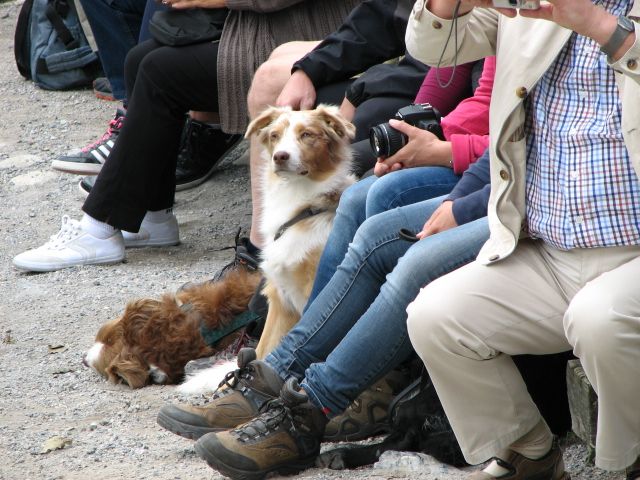
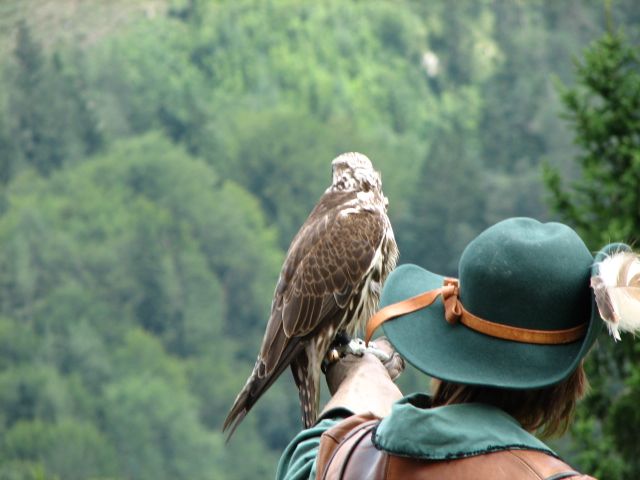
One naughty female eagle put on a real show – she didn’t want to
return to her handler for quite a while and sat perched on one of the turrets
looking very pleased with herself. Only a huge chunk of a chicken leg persuaded
her to listen to the commands, the trainers got truly impatient with her. It
was obvious it hadn’t been premeditated but it was fun to watch. Nobody will tell
a big, bad eagle what to do… unless you carry a tasty morsel of flesh in your
gloved hand.
Bad Ischl and Kaiservilla
This little spa town,
situated in the southern part of the Upper Austria is famous mainly because
Franz Joseph and his wife, Elizabeth of Bavaria (Sissi), owned a villa here –
it was a wedding present from the Archduchess Sophia, the mother of Franz. They
got engaged there and the Kaiser liked spending his free time among those walls whenever he
could.

Franz Joseph described it
as "Heaven on Earth". He granted a nearby mansion to his 'official' mistress, Katharina
Schratt, so her house could be easily reached via a hidden
footpath. The grounds and parts of the residence are now open to the public
although it remains in the hands of the Habsburg family so it is private. As I’ve written three
essays about the last Habsburgs (Be careful what you wish for...especially if you wish you were a king. Requiem for an Empress and her son, the Crown Prince Riders on the Storm) I wanted to visit the villa very badly. I wasn’t disappointed although the
numerous antlers on the walls in practically every room made me squirm – Franz
Joseph loved hunting and he murdered a lot of innocent animals living nearby
for sport. He even had some of them stuffed and put inside glass cabinets. I am really not fond of that man.
The villa itself is an
elegant building with nice, original interiors. Inside, you can admire a copy of one of
Sissi’s dresses (the pic below, showing it, is also from Google, you can't take photos in the villa), plenty of oil paintings, furniture and other imperial souvenirs. By the way, all the rooms are connecting so you come from one straight into another, there are no corridors - a characterisitc trait of older buildings.
I would like to return to Austria one day. Now I know what to avoid and what I would like to see for the second time - more Alps, more museums, less Mozart-pimping. ;)


No comments:
Post a Comment
Thanks for stopping by - I always appreciate if you share your thoughts!
Note: only a member of this blog may post a comment.