

Monday, 5 August 2013

Lay Death At Her Door by Elizabeth Buhmann


I received a complimentary electronic copy of this book from the publisher in return for an honest review. That fact didn’t influence my review in any way.

Book info:
Genre: crime mystery, psychological thriller
Target audience: adults
Form: e-book, pdf 

Synopsis:

After being raped and witnessing a murder of her lover Kate Cranbrook, a 20-year-old college girl, sent a man to prison. The wrong man. She lied during the trial because it was the most convenient way out. She had to protect her secrets even if it meant committing perjury. She had learned during a difficult childhood in Kenya that sometimes you have to be mendacious and ruthless in order to survive and achieve your goals. Then, deeply traumatized, she lived in seclusion with her father for two decades, isolated, bored, afraid. Now she thinks she's had enough. She is 42 and she wants to put her life in order – keep her landscaping job, become more independent, find a nice man, marry, be happy. She is also given a splendid occasion - new evidence exonerates her victim. Unfortunately it also means that her role in the trial is being examined anew - the last thing she would wish.

 Kate tries to think of a good defence line; she claims that in the darkness and confusion she must have mistaken her attacker's identity. She is lying – again – but at least now she dares admit that truth to herself. Still the local community might never forgive her for putting an innocent man to prison for twenty years even if she is a white woman, he is a black man and they live in Virginia. Kate would like nothing better than to turn her back on the past, but she is trapped in an invisible stand-off with the real killer. What will it take to get rid of him?

Soon enough another dead body practically shows up on her doorstep. Kate comes to the realization that someone definitely wants to stir up the hornet's nest and draw the attention of local police to her shadowy past. Will anybody be able to see through her lies and help her before it's too late?

My impressions:

It was a story which grabs you with the first words and keeps you interested until you finishes it. It is a dark and twisted tale which I loved exploring. It presents an interesting, intelligent heroine, flawed to a great extend, who likes toying with the reader but also honestly recalls her own past mistakes because she feels her time is running out. Kate is a manipulative character, full of wit and ready to play on the sympathy of others. As the novel progresses, you starts to doubt her words but, at the same time, you are eager to find out the truth. The relationship with her father is increasingly disturbing and after a while, somewhere in the middle of the story, it simply becomes impossible to believe that all of the bits and pieces she told you will ever make sense. But they will, shockingly so, at the very end. Still it won’t be pleasant.

The character of Kate was constructed flawlessly. Firstly let me say how enjoyed a woman who is beautiful, cunning, rich and guess what? She doesn’t have a retinue of available men fawning on her and worshipping the ground beneath her feet. No love triangle, no love affair, nothing and not for the lack of trying, mind you, quite the contrary in fact. It was so refreshingly normal and right. Let me illustrate her situation with one quote. Kate comments bitterly on her friends' advice:

“Why don’t you marry, Kate? You could have anyone you wanted.”

I hate it when people say that. It isn’t true. No matter how beautiful you are, how intelligent and talented, no matter how accomplished, even if you have money, it is never true that you can have anyone you want. And the worst problem is that sometimes there simply isn’t anybody. In books and movies, there is always a likely man for the taking. In real life, there isn’t always.”


I instantly warmed to her after such words even if, from the very beginning, I was sure she hid too many dark secrets inside to be a truly innocent and decent girl. As the novel is written in a form of a diary or a memoir, the first person narration allows us to look deep inside Kate’s mind and find many shadowy wardrobes full of rattling skeletons. Although Kate tries her best to exonerate herself of what she's done, a completely understandable and a very human thing to do, nothing erases the stain that has been left on her - and she is completely aware of it. She used to be a thoughtless little brat who behaved as if she had every right to own the world. She's done things she's not proud of, all in the name of survival. She was selfish, ruthless and greedy. She lied a lot and she did it so skillfully that sometimes she almost believed in her own lies. Now she must reap what she has sown.

Final verdict:

This novel was a real pleasure to read; I started it just to get the taste of the narration and, after a short while, I couldn’t let it go. It kept me awake late at night because I simply had to reach the final page and find out what role Kate played in all this. I won’t forget this story and its heroine for a long time – I think it’s the highest praise any book can get. Thank you, Ms Buhman, for this great story! I would like you to continue!

Saturday, 3 August 2013

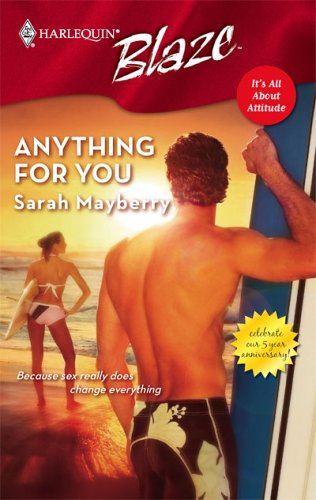
Anything For You by Sarah Mayberry

Synopsis:
The world according to Sam Kirk has just turned upside down. His best friend and business partner, Delaney Michaels, has returned from vacation a new woman... a gorgeous, hot new woman. Suddenly Sam is thinking entirely inappropriate thoughts about his buddy. Worse, with Delaney's changed look, she's abandoning their friendship in pursuit of the picket-fence dream. It's a nightmare come true. Then one night finds them tangling in the sheets.

It should feel wrong, wrong, wrong... instead, it feels very right. And now Sam knows exactly what he'd do to keep his best friend: absolutely anything.(


Sam Kirk and Delaney Michaels are in love. He just doesn’t know it yet. She’s known it since she was fourteen but has managed to convince herself that he won’t ever return her feelings, so why bother telling him. No, instead of talking to him, she’s going to run away.

That’s the conflict of this story.

I guess in certain circles it could be viewed as romantic to wait for the other person come to the right conclusion by himself, but when you’re tired of waiting and decided on leaving him without saying a word? Nope, that’s just cruel. To his credit Sam says so at one point before promptly ruining the moment with sexual innuendo. I could understand Delaney deluding herself while they were still stuck in the platonic gear, but the moment she decided to make a change, telling him should have become step one. Or step two. Any step before quitting her job, selling her flat, and telling him she never wanted to talk to him again.

Preferably after the second time they had sex and before she went to her enabler sister who came up with the brilliant plan of weekend of sex to get Sam out of Delaney’s system. And the scoundrel knew it would backfire.

There’s nothing wrong with Mayberry’s writing; the story just didn’t work for me. Two hundred pages of miscommunication fuelled angst and sex, and a two page resolution dropped the otherwise entertaining narrative just below my meh line.

Friday, 2 August 2013

Cute Plant From Hell (but hey: devils can be useful too)

Do you recognize this plant?


  • It has wide, light-green, heart-shaped leaves with a truncated base, 7–14 cm long and 5–12 cm broad, with an entire margin. 
  • While hollow, reddish stems may reach a maximum height of 3–4 m each growing season without any problem, it is typical to see much smaller plants in places where they sprout through cracks in the pavement or are repeatedly cut down. 
  • You see, cutting down makes it only STRONGER. 
  • Flowers which are small, cream or white, are produced in erect racemes (so arranged singly along an elongated unbranched axis, as in the lily of the valley) 6–15 cm long in late summer and early autumn.
 So, do you recognize it? If your answer is still no, you are lucky. However it is very possible that you have seen that murderous beauty  and you haven't known that you actually met one of these superplants which can survive no matter what.. 
Detail of the stalk
Detail of the stalk (Photo credit: Wikipedia)

Japanese knotweed (Fallopia japonica, syn. Polygonum cuspidatum, Reynoutria japonica) is a large, herbaceous perennial plant, native to eastern Asia - Japan, China and Korea.The species has been so very successful elsewhere that it has been classified as invasive  in several countries. In fact it is listed by the World Conservation Union as one of the world's 100 worst invasive species. Why?

Ponder over this. It grows everywhere. More specifically, it grows through everywhere.The invasive root system and strong growth of this plant can damage concrete foundations, buildings, flood defences, tarmac roads, paving, retaining walls and architectural sites. It can also reduce the capacity of channels in flood defences to carry water.It forms thick, dense colonies that completely crowd out any other herbaceous species. Its resistance is really amazing. Rhizomes of Japanese knotweed can survive temperatures of −35 °C and can extend 7 metres (23 ft) horizontally and 3 metres (9.8 ft) deep, making removal by excavation extremely difficult. 

English: Japanese knotweed ; (Species: Fallopi...
Flowers of Japanese knotweed   (Photo credit: Wikipedia)
The plant is also resilient to cutting, unless it is done repeatetively and combined with herbicide treatments. Otherwise it is vigorously resprouting from the roots in no time. Studies have shown that a 1cm section of rhizome can produce a new plant in 10 days - a true record. Rhizome segments can remain dormant in soil for twenty years before producing new plants.The most effective method of control is by herbicide application close to the flowering stage in late summer or autumn. Still who would want herbicide-soaked soil in their backyard or anywhere else? The herbicide treatment may have to be used for at least three years before Japanese knotweed stops growing back. Even when the plant seems to be completely eradicated any soil removed from the area is likely to have dormant rhizome and must be disposed of as described within the knotweed code of practice. Which means you'll spend a lot of time and money to get rid of this.

How has it found its way to our backyards? Japanese Knotweed was introduced as an ornamental plant by the freaking Victorians in 1825. Allegedly it was shipped from Japan. It looked cute, its flowers smelled cute, it must have been cute. right? The great garden-writer William Robinson recommended it warmly in The Wild Garden of 1870 for its “large and noble tufts of lively green, which increase in beauty from year to year”. Yeah, I've always known that the aliens would conquer our planet in one week if only they presented themselves in a form of sweet, fluffy bunnies.Already by the 1880s, gardeners had become alarmed by the plant’s invasive tendencies. As you might guess it was already too late.
Several invasive species of knotweed form larg...
Several invasive species of knotweed form large thickets like this (Photo credit: Wikipedia)

Funnily enough this monster has a second, also very interesting face. Scientists are reporting that Japanese knotweed could hold the answer to the oil crisis and provide a sustainable, clean source of energy. The plant’s ability to generate massive amounts of energy is simply uncanny - by pyrolysing knotweed rhizomes in low temperature ovens, the gas and hydrocarbon fuels generated are only slightly lower in yield than some brown coals.

That horrible plant might also restore your health. Yes, you read it right. The leaves and shoots are edible and the roots contain resveratrol which has been identified as a potent flavonoid. How can it be helpful?  

 Extracts from Japanese knotweed rhizomes have been used in traditional Chinese medicine for centuries. Resveratrol decreases the viscosity of the blood and acts as anticoagulant to thin blood, effective in treating cardiovascular disease by reducing thrombosis and embolisms that can block arteries and lead to myocardial and cerebral infarctions (Wang et. al, 2002). Resveratrol has been found to reduce tumor volume, tumor weight, and lung metastasis; it  inhibits cancer cells without harming the liver. Studies indicate the most beneficial use to be in pancreatic, breast, and ovarian cancers.

If you are overweight this plant can be also your friend.To date, resveratrol is the most potent natural compound able to activate SIRT1, mimicking the positive effect of calorie restriction. (Alcaín FJ, Villalba JM April 2009). Daily consumption of 1/2 teaspoon of the tincture, first thing in the morning, provides approx 500 mg of resveratrol which may prevent aging by protecting cellular DNA from free-radical damage. That's not all. Japanese Knotwood root is known to aid the central nervous system and kill Lyme bacteria. To inhibit the growth of staph, strep, E. coli, and salmonella the dosage is 1/2 tsp. of the tinctured root first thing in the morning, mid-day and at bedtime. To inhibit the growth of influenza type A, ECHO virus, and herpes simplex, the dosage is 1/2 tsp. of the tinctured root first thing in the morning, mid-day and at bedtime. 

Just in case: I am not a doctor and I found this info on the Internet which is the source of such theories like the one about the British Royal Family who, according to some people, are a bunch of big, ugly lizards from space. Contact somebody professional if you have any health problems and you want to try this plant's roots in your therapy.

Alternatively you can also eat this ugly invader. Yes, I am dead serious now, that monster is edible. Related to rhubarb, it’s very sour and may act as a laxative the way rhubarb does, so use it sparingly at first. Most importantly, be sure that any harvesting of Japanese knotweed does not result in its spread. Never add knotweed to your compost or send it to municipal compost center - in many countries it is against the law and you might be sued. So, what exactly can be done with it? I found you one yummy recipe.

DANDY KNOTWEED MUFFINS
The best time to gather young knotweed shoots, up to about 8 inches, is in early spring (the larger ones are tough and stringy). Some people peel the outer skin off the shoots, but that can be tedious, and if you’re not careful, you may peel too much off.

Makes 16 large muffins

Japanese knotweed stalks to measure 2 cups, minced
1.5 cups flour
0.5 cup dandelion flower petals, stripped from their base (do not include any green parts)
1 teaspoon baking powder
1 teaspoon baking soda
0.5 cup softened butter
1 cup light brown sugar
2 eggs
1 teaspoon vanilla
1 cup sour cream or yogurt
green food colouring or fresh spinach juice (if you like them organic)


Snip off the pointy tops of the knotweed stalks and mince.
Combine flour, dandelions, baking powder, and baking soda in a small bowl.Cream 0.5 cup butter with 1 cup brown sugar until fluffy. Beat in eggs one at a time and then add the vanilla. To this mix, alternately fold in the sour cream, dry ingredients and colouring until blended. Fold in the knotweed pieces. Divide the batter into greased muffin forms.

Bake at 350˚F for 15 to 20 minutes, until the muffins test done in the center proves they are ready.

You can decorate it with some cream at the top.

Enhanced by Zemanta

Thursday, 1 August 2013

Rameau's Review Archive: Shades of Desire by Virna DePaul

Rameau's ramblings: Gah, this was horrible. Originally posted on Goodreads on May 20th 2012.
 
Synopsis:
WHAT SHE CAN'T SEE COULD KILL HER. 

Natalie Jones is the lucky survivor of an elusive killer who preys on young women and then disappears from view. And since her harrowing ordeal, the once gutsy photojournalist has remained isolated in her home, paralyzed by fear and her failing vision. 

Special Agent Liam "Mac" McKenzie has scars of his own. But despite his efforts to ignore the attraction that simmers between him and Natalie, he needs her help to catch a predator. Soon, they will forge a tentative alliance-charged with desire. Through a soft-focus lens, Natalie dares to envision a future with Mac beyond the investigation...never guessing that the clues hidden within her photographs are drawing them into an explosive confrontation with a madman.

Shades of Desire (SIG, #1)Shades of Desire by Virna DePaul

I started this book thinking of giving it a solid three stars and hoping for the fourth. Instead of something extra, I found all the plot threads of a promising premise slipping through my fingers until only thing left was bitter disappointment.

Let's start with the characterisations. What characterisations? The characters do and react as it suits the scene and situation rather than following some internal compass that guides them through life even with the needle improperly calibrated. To this moment I can't tell you what Natalie or Mac is supposed to be like. I can tell you the events that supposedly helped to make them who they are because I read the infodumps, but based on their actions showed in this book they remain a mystery to me.

Because of the poor characterisations, the pacing doesn't work either. It's not as bad a situation in the beginning where the focus is on the investigation, but when Natalie and Mac meet, it soon unravels into their incomprehensible instant attraction. Of course they don't really spend time getting to know each other like normal people would, but they snipe at each other to add to the tension, I suppose. The evolution of their relationship is minimal to the point that their sexual encounter feels like it's coming out of the blue even though all the trope warning signs are there. This is because majority of the book Natalie and Mac are apart.

The book is written in third limited with alternating points of views from the hero and heroine and the villains of the story. Yes, that was a plural. At first those glimpses into the criminal psyche were the part I enjoyed reading, but then all subtlety was thrown out and replaced with full-scale infodumping.

This isn't a character driven storyline. This reads like a book that had a mapped out structure before the characters were shoehorned into it. It leaves the distasteful feeling of forced plot progression. Things don't develop naturally, but they are poked and prodded to the right direction by obvious deus ex machinas. I guess it could have been better, had the quality of the writing been good enough to distract from these obvious flaws. Though, I must admit, even then this book wouldn't have made on my favourites shelf.

In my status updates I mentioned the lack of research or feel of it. I might have been overly harsh, but the fact remains that I didn't feel like whatever research had been done did shine through the text. Random titbits about the everyday life of a blind person were thrown in, but they weren't integrated into the text to help bring Natalie's character alive. This, once again, highlights the problematic characterisation.

There's one, highly spoilerish thing I must mention. If you plan on reading this book, don't click to open the tags. I mean it. (view spoiler)[Natalie has supposedly had her tubes tied when she was twenty-five-years-old. I admit I was speed reading at this point, but nowhere was it mentioned that she had to go through a rigorous process to get the operation. There's no mention of psychiatric appointments or reluctant doctors. I don't know if things truly are so different on this side of the pond or if it's simply a failure on the authors part.

I point this out, because my mother's friend was deadly afraid of getting pregnant and giving birth. She had had her tubes tied at the earliest opportunity after the doctors agreed to do it. She didn't have any children and she'd just turned forty. As she lay on the table they still kept asking her if she was sure she wanted to go through with it.

No way do I believe Natalie could have had her tubes tied that young and easy. She would have had to meet with a counsellor of some sort and as afraid as Natalie was about going mad like her mother I doubt she'd agreed to it. And had she, I highly doubt the counsellor would have green-lighted the operation (hide spoiler)]
.

I received an Advanced Readers Copy of this book from the publisher through NetGalley.


Wednesday, 31 July 2013

Movie review: The Life of David Gale by Alan Parker

Directed by Alan Parker
Release date: 2003
Screenplay: Charles Randolph
Cast: Kevin Spacey, Kate Winslet, Laura Linney, Gabriel Mann, Matt Craven, Rhona Mitra
The Life of David Gale
The Life of David Gale (Photo credit: Wikipedia)

Summary:

"The Life of David Gale" tells the story of a professor of philosophy and a famous opponent of capital punishment who, in what he must find an absurdly ironic development, finds himself on death row in Texas, charged with the rape and murder of Constance Harraway (Laura Linney), a woman who was not only his fellow activist but also one of his few real friends. The whole plot revolves about David’s brilliant academic career and his swift, steep fall, right into the arms of degrading unemployment, alcoholism and despair, with a divorce and even more painful estrangement from his little son as seasoning.

While in prison, David Gale, understandably a very bitter man who's lost literally everything, decides to tell his version of events and to protest his innocence to a reporter named Bitsey Bloom (Kate Winslet), summoned especially to Texas. They are given a limited amount of time, two hours every day in a short, 72-hour period right before the impending execution. Very soon – apparently during the first session- Bitsey becomes more or less convinced of David's innocence. She is joined in her investigation by her eager intern Zack (Gabriel Mann), and they become aware that: a) Gale’s attorney is a shifty fellow who won’t lift his little finger if he doesn’t have to and, it seems, he doesn’t care b) they are being followed everywhere in a pickup truck by a gaunt-faced man in a cowboy hat, who is either a right-wing death-penalty supporter who really killed the victim and framed David or somebody sinister else. Will they manage to prevent the worst – a judicial murder of an innocent – against all odds?

My impressions:

This movie was recommended to me by Rameau (thank you!) and its online blurbs read really well: an interesting plot about a complex man with a cause, an important cause to boot, a film starring plenty of great actors and actresses and set in Texas (yeeehaaaw!). What could go wrong? Unfortunately quite a lot but let’s start with the positives.

I really liked David Gale as portrayed by Kevin Spacey. He was a truly three-dimensional character, a man with many vices and demons, a brilliant scholar, very human and never ashamed to admit it, cruelly punished for his own cleverness. Spacey has exactly the right amount of understated earnestness to make such a character work effectively; actually it seemed that the role was too easy for him, especially if you remember his other creations. I believe this kind of role he could play in his sleep. Spacey's finely honed performance was coupled with those of Kate Winslet and Gabriel Mann who did their bits well – no fireworks but good, believable performances nevertheless.

The movie is set in Texas, a delightful location as it is the very US state which, in a good year, all by itself, carries out almost half of the executions in America. Death Row in Texas is like a machine. It’s no longer about human life and sanctity thereof, it’s about efficiency of getting rid of those pesky criminals. Faced with such a soulless, bureaucratic machine , Gale knows very well he has just a few days to prove his innocence before he's sent for some short, sharp, shock treatment in the big, uncomfortable chair. And here all my problems began. Told in flashback, "The Life of David Gale" started piling up more and more clicheed red herrings than a fishmonger. As the plot twists are ironed out for the revelatory finale, it's clear that there's actually a lot less to this than meets the eye. The man in the cowboy hat – why did they need him to behave in such an outrageous way? It was beyond silly as it screamed 'guilty' from a great distance. And that lawyer? He screamed “guilty” in every frame as well and guess what? He was! (not a big spoiler, really). Where is the subtlety and subterfuge? As though Parker felt the film's point was in danger of being missed, he spelled it out for us at critical moments with the use of text. Words such as 'Guilty', 'Innocent', 'Lust' 'Power' and 'Desire' flash up on screen, serving little purpose other than take you out of the drama and remind you that you're in the hands of a calculating director.

Finally my biggest complaint. I am sure the filmmakers believe their film is against the death penalty but, contrary to them, I believe it supports it. In my eyes the ending discredited the opponents of that penalty as unprincipled fraudsters, shifty and ruthless like (or even more than) your average politician or lawyer. In other words (spoiler, highlight to read) the final revelation on the videotape registered during the so-called murder, when we see it was in fact a suicide, was to me like a punch in the gut. Surely David Gale knew that Bitsey Bloom couldn't keep it private without violating the ethics of journalism and sacrificing probably the biggest scoop of her career so it served no functional purpose except to give a cheap thrill to the audience and make you doubt everything, the noble 'no-death-penalty' cause included. If you are against the killing you are not supposed to kill yourself or force anybody else to kill - it sounds like a logical premise, right? I was left stupefied that somebody as intelligent as David and his fellow activists had ever agreed with such a plan. Congratulations on shooting your cause movie in the leg, Mr. Parker because no, with such an ending I don't think it was deliberate.

Final verdict:

I would call this movie an excellent example of lost opportunities - an unconvincing, dishonest and leaden political message drama that takes a stand against capital punishishment, but does its cause more harm than good . It could have been something epic and it is merely average. What a pity. Still I do not regret having watched it.
Enhanced by Zemanta

Tuesday, 30 July 2013

Trial by Desire by Courtney Milan (Carhart #2)

Synopsis:
SHE CANNOT FORGET THE FIRE HE IGNITED ...

In the three years since her husband left her, Lady Kate Carhart has managed to forge a fulfilling life for herself. But when Ned Carhart unexpectedly returns, she finds her tranquility uprooted --- and her deepest secrets threatened. Though she has no intention of falling for Ned's charms, Kate can no longer deny the desire that still burns in her heart.

OR THE PROMISE OF HIS LOVE ...

Ned is determined to regain his wife's trust by using unbridled seduction. But just as Kate surrenders to Ned's passion, her carefully guarded past threatens to destroy her. Now Kate must place her faith in the only man she's ever loved, and the only one who has ever betrayed her ...


Quite disappointing.

I’d been saving this book, so I could savour it whenever I felt like I needed to read a really good romance novel. After the last couple of months, it felt like it was time.

Trial by Desire is a sequel to Proof by Seduction and although the couple set up is much more believable than in its prequel, the romance itself isn’t.

A scandal forced Ned and Kate to marry, but it was clear that both of them—Ned—at least needed to grow up in leaps and bounds for them to earn their (believable) happy ever after mandated by the genre. Milan’s solution is to send Ned away soon after the nuptials for three years and let him grow up into a capable man abroad.

Ned does grow up. When he comes back he’s a changed man and his reunion with his estranged wife is promising. Of course there are the familiar tropes keeping them apart: Miscommunication and a caricature villain. I’m wretchedly disappointed in the villain’s characterisation as the early promise of a multilayered characterisation for the domestic abuser is never realised. He has his internal logic that justifies the abuse but the reader is never shown why he thinks that way. Other than it’s assumed the period explains men’s attitudes towards women.

Even so, one man wanting his runaway wife back isn’t what stands between Ned and Kate and their happiness. It’s Ned himself. Milan tackles an important issue by making Ned bipolar—I assume that’s the correct diagnosis—and showing people have battled with mental illness before they had names for them. As admirable as it is to see Ned find his own solution for his mood swings, it doesn’t change the fact that his dogged insistence to cope on his own is what destroys the romance. The constant repetition of his desire to be the hero and secrets kept until the very end, don’t make him good husband material. He may have learned to stand on his own feet, but Ned doesn’t believably learn to lean on his wife, which leaves their marriage a sham.

Worse than Ned’s inability to transform from an independent man into a half a married couple, is how Kate’s plot is handled. She’s supposed to be saving battered wives from their husbands and an early feminist who learns to win her own battles, but time and time again Ned rushes to her rescue. He saves her both from a physical and a juridical attack. He’s the one who comes up with the final solution. Having read Kate’s story makes me appreciate Margaret and Jessica and all the other Milan heroines that much more.

The writing itself is uneven—which still occasionally true for Milan’s novels—and the story is boring. There are hideous amounts of telling and horrible smut euphemisms I wish never to see in a romance book again. Milan kept me engaged with the story at times but only at times.

I feel like I’ve read the worst Milan has to offer and I can go back to waiting for her next book. At least I know most of these novice mistakes won’t be repeated quite as blatantly ever again.

Monday, 29 July 2013

Review: In The Woods (Dublin Murder Squad 01) by Tana French

Cover of "In the Woods"
Cover of In the Woods
Book info:
Form: pdf
Genre: crime mystery, contemporary fiction, psychological mystery
Target audience: adults

Synopsis (from Goodreads):
As dusk approaches a small Dublin suburb in the summer of 1984, mothers begin to call their children home. But on this warm evening, three children do not return from the dark and silent woods. When the police arrive, they find only one of them, a boy called Adam Ryan, gripping a tree trunk in terror, wearing blood-filled sneakers, and unable to recall a single detail of the previous hours.

Twenty years later, the found boy who changed his name into Rob Ryan, is now police detective on the Dublin Murder Squad. He keeps his past a secret because it is the most convenient for his career. He still doesn't remember anything but soon he will have to face the demons of his past. When a twelve-year-old girl is found murdered in the same woods, he and Detective Cassie Maddox—his partner and closest friend—find themselves investigating a case chillingly similar to the previous unsolved mystery. Now, with only snippets of long-buried memories to guide him, Ryan has the chance to uncover both the mystery of the case before him and that of his own shadowy past.

What I liked:

I am happy to say I liked a lot. Firstly the narrative voice of Tana French is completely captivating - atmospheric, funny, intelligent without being patronizing. Secondly the author managed to omit many template mistakes. Imagine yourself a book without a love triangle. Imagine a book in which two main characters, a young man and a young woman at the beginning of their career, simply befriend each other, without any sexual context, and continue that friendship almost to the very end. Imagine that Rob Ryan, the narrator, can be deliciously honest about his own shortcomings, saying something like this:

"What I am telling you, before you begin my story, is this - two things: I crave truth. And I lie."

There is also Cassie Maddox, who not only thinks and acts like an intelligent human being but also is a dropout psychology student so perfectly able to analyze herself and the others. If only those others listened to her and believed in her best intentions...

The friendship between her and Rob Ryan is at the heart of the story, interwoven with Rob's childhood trauma and the ongoing investigation concering a murder of a 12-year-old Katharine Devlin, an aspiring ballet dancer. I found that thread really refreshingly original. I was so pleased it wasn't the case of an insta-love or insta-lust but something far more mature and real, something beautiful and true. Of course the fact that their frienship is doomed from the beginning because Rob admits he destroys every relationship, sexual or otherwise, due to his childhood drama or maybe a flaw of his character, adds to it a dash of nostalgia. Let me quote him once again:

"And then, too, I had learned early to assume something dark and lethal hidden at the heart of anything I loved. When I couldn't find it, I responded, bewildered and wary, in the only way I knew how: by planting it there myself."

Well, I don't know about you but that quote I found simply heartrending. How not to like such a character?

Finally let me add that the attention to police procedural detail was exquisite. I was really surprised Ms. French hasn't worked as a cop herself.

What I didn't like:
This book won the Edgar Award for best debut novel but it doesn't mean it is perfect. Don’t read it for the mystery part. In fact I found the criminal puzzle the weakest as I was able to spot the main culprit without any problems somewhere in the middle of the investigation and I am not the brightest fictional crime solver around, even old, good Agatha Christie always managed to mess with my head (fortunately I loved every minute of it)

Also don't read it if you like everything nicely solved and explained in your books because plenty of questions will be left unanswered. If I were to choose an alternate title for this book (and yes, it is a bit spoilerish) could be: Complete Lack of Any Clear Explanation About What Really Happened In The Woods. It didn't bother me much; I admit that monsters living inside our heads are rarely exposed or explained and that's why they are more interesting and terrifying than any real creature you can meet. Those kids might have been taken by the Pooka or the slavers or the elves or Doctor Who - children disappear apparently for no reason all the time and some of the cases are never going to be solved. I am ok with that and if you share my outlook you'll be fine as well.

Also, as you might guess, do not expect any easy HEA anywhere. It is not a fairy tale.

Final verdict:
Go, read it!Enhanced by Zemanta