Showing posts with label historical fantasy. Show all posts

Friday, 12 April 2013

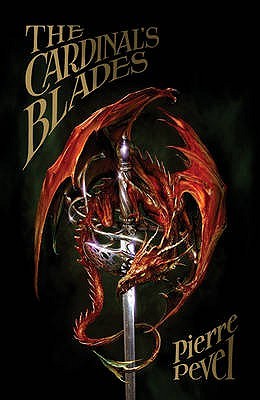
Review: Cardinal’s Blades by Pierre Pevel (Les Lames du Cardinal 01)

Book info:
Form: odf, e-book
Genre: Historical fantasy
Target audience: YA and adults who like such stories

Synopsis: 

Imagine France of Louis XIII as described by Alexandre Dumas – a land of flashing blades, swishing caps, duels, beauties and intrigues- but with real dragons, wyverns, drac thugs and dragonnets.

After a five year hiatus Cardinal Richelieu summons ex-captain La Fargue. Previously one of his most trusted tools, now  La Fargue is an ageing, embittered and disillusioned man, not especially keen to return to Richelieu’s service. Our Cardinal blackmails and threatens him because he needs La Fargue and his small unit of the best mercenaries in France, formerly known as Cardinal’s Blades, to return to service.

They have to stop the Spanish order of Black Claw. The Black Claw, consisting of half-dragon royalty and their descendants, wants to establish a kind of outpost in Paris and slowly gain the upper hand over the Kingdom. They are very secretive and cautious and officially France cannot afford a new enemy so the mission of the Blades might prove far more complex than it seems at first glance. Still La Fargue cannot fail – the life of his only daughter depends on his efforts. He gets mixed into the double and the triple game between Richelieu and vicomtesse de Malicorne, the head of the Black Claw residing in Paris. Will he be able to save his daughter and France from the evil dragons?

What I liked:

The mere idea of seventeen century Paris with Richelieu and musketeers appealed to me very much – it was fresh and original. Let me also add that the author built the fictional world with utmost care, describing the Parisian streets in a very vivid way and making me wish for a dragonnet pet instantly. The action’s pretty frenetic and if you like such books you will be more than satisfied – you’ve got swordfights a-plenty, rooftop battles and lots of visits to inns which end in a brawl, point-blank shootings and galloping horses.

I also liked the fact that, unlike maudlin heroines of Mr. Dumas, here women played an active role, fighting, plotting and thinking independently; although I didn’t see them as often as I wished I would, I was more or less satisfied with their performance.

Let me also add that the last scene was very promising - something which might incline me to read the second part of the series as well. Pével certainly knows how to throw in a dramatic revelation right at the end.

What I didn’t like:

I know it is a swashbuckling novel with the action being its raison d'etre but I sorely missed character building here, especially that there were some really promising heroes: like Saint-Lucq, or Agnes, the intrepid baroness or vicomtesse de Malicorne, a charmingly dangerous dragon in a skin of a beautiful woman.

Instead you get something like an extensive collection of character clichés -  a battle hardened captain with a secret; a dashing womanizer; a good humoured, hard drinking old soldier; a brooding half-breed assassin; a prodigal Spanish swordsman; a strong-willed token female thrown in for good measure so you don't drown in all this testosterone. The action jumps too abruptly from character to character so the readers lack time to bond with any of them. After a while they all seem two-dimensional, with an emphasis on cruelty and selfishness.

What’s more, in my humble opinion the author overused the ‘survival from death’ plot device, employing it so many times that it lost all its potential shocking value, making most of the fighting scenes downright silly after a while (when you are practically sure nobody will die, what's the point?).

Finally let me tell you that the English translator of this novel didn’t make a good job of it. There are too many mistakes - dangling participles litter every page, and pronouns referring to the wrong nouns can be found in almost every paragraph. I wasn’t impressed.

Overall if you like a plot that makes sense and relatable (or even distinguishable) characters, this is not a book for you. As far as I remember even in The Three Musketeers there was more characterization and depth.

Final verdict: 

I love sentient dragons in fiction - if I loved them a little bit less I would assess this novel much harsher. When it comes to the world building it really wasn’t bad but the lack of proper characterization spoiled it for me. I might pick the next part of the series to check whether it gets any better but I am not sure with what result.
Enhanced by Zemanta

Monday, 18 March 2013

Review: The Third Section (The Danilov Quintet 03) by Jasper Kent


Book info:
Form: pdf
Genre: historical fantasy
Target audience: adults


Synopsis (from Goodreads):

Russia 1855. After forty years of peace in Europe, war rages. In the Crimea, the city of Sevastopol is besieged. In the north, Saint Petersburg is blockaded. But in Moscow there is one who needs only to sit and wait - wait for the death of an aging tsar, and for the curse upon his blood to be passed to a new generation.

As their country grows weaker, a man and a woman - unaware of the hidden ties that bind them - must come to terms with their shared legacy. In Moscow, Tamara Valentinovna Komarova uncovers a brutal murder and discovers that it not the first in a sequence of similar crimes, merely the latest, carried out by a killer who has stalked the city since 1812.

And in Sevastopol, Dmitry Alekseevich Danilov faces not only the guns of the combined armies of Britain and France, but must also make a stand against creatures that his father had thought buried beneath the earth, thirty years before.

What I liked:

The third part of the series features two main characters, the children of Aleksei Danilov, Dimitry and Tamara. They are adults now, with their own families and careers, they don't know about each other's existence (up to a point anyway) and their only connection is the old enemy of their papa, a man who had to turn himself into a vampire in order to save his life. He used to hide under different nicknames and now he is called Yudin. Yudin lives and breathes revenge on Aleksei and anybody close to him. As you can guess the scope of this installment is more personal and domestic, rather than told within the vast events of the military and political crises of the first two books. But this one is equally involving.

Let me tell you that Tamara is one of the strongest female protagonists I've ever met. The story of her adult life is being slowly unravelled throughout the narration and when you finally find out how she was turned into a prostitute, lost her husband and children and then rebouded you have to respect her. She is a woman made of steel, independent, clever, intelligent and brave - finally an appropriate opponent for the demonic psychopath turned vampire who ruined her father's life. I really liked the way Tamara's character was constructed and the way the author slowly unveiled her strengths. Three-dimensional doesn't even start to cover it.

I have to admit her half-brother, Dimitry, was a less compelling character but still he managed to surprise me more than once with his choice of bedfellows. I also liked the fact that, despite his military career, deep at heart he remained a musician. However, the ending belongs completely to him - I don't want to spoil you so I must be rather vague with my remarks but let me assure you something happened to Dimitry which I wanted to happen to his father at least one installment ago and now I am so looking forward to the next book in the series because I am curious what Dimitry will do next, what side will he pick.

When it comes to Yudin/Iuda/Vassily Makarov a.k.a. the vampire I love to hate there is a section narrated by him that describes from his point of view what Aleksei did to him in the previous novel. Shot, drowned, in an ice-bound river, he did not die the human death and he despised every moment of it. Now he pulls strings in the tsar's intelligence bureau, known as the Third Section, continuing to plot the Zmyeevich's Great Scheme to control the Russian throne and planning his own revenge involving Aleksei's children and wife.

I also liked how the novel started. So often genre novels' prologues are vexatiously silly, but this prologue is not among those.We follow a young Englishman who managed to gallop out of the Crimea's Valley of Death. The action is taut and contained, and tells us what we will need to know later within the novel itself.

Finally let me say that I really appreciate the ingenuity with which the author answered an old question: why nobody can see a reflection of a vampire in a mirror (not even themselves).

What I didn't like:

Just one carping - I admit that the ending was a bit too melodramatic for such a great story. I am not a big fan of 'the deathbed goodbye' scenes and here you get two of them and rather close together. It was like a dissonant note; although I understand the author wanted to get rid of the older generation in a neat manner, making the place for the new kids to come, he could have diversified it a bit.

Final verdict:

A third generation of the Danilov family is gestating. Vampires remain on Russian soil. There will be blood and I hope I will love it even more because it seems Mr. Kent's novels are getting better and better with every installment. Now it is becoming one of my favourite vampire series. Seriously worth reading.

Tuesday, 26 February 2013

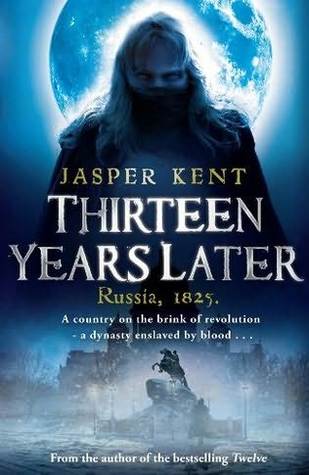
Review: Thirteen Years Later (The Danilov Quintet 02) by Jasper Kent

Synopsis (from Goodreads):

Aleksandr made a silent promise to the Lord. God would deliver him -- would deliver Russia -- and he would make Russia into the country that the Almighty wanted it to be. He would be delivered from the destruction that wasteth at noonday, and from the pestilence that walketh in darkness -- the terror by night.

1825, Europe -- and Russia -- have been at peace for a decade. Bonaparte is long dead and the threat of invasion is no more. For Colonel Aleksei Ivanovich Danilov, life is peaceful. The French have been defeated, as have the twelve monstrous creatures he once fought alongside, and then against, all those years before. His duty is still to his tsar, Aleksandr the First, but today the enemy is merely human.
However the tsar himself knows he can never be at peace. He is well aware of the uprising fermenting within his own army, but his true fear is of something far more terrible -- something that threatens to bring damnation down upon him, his family and his country. Aleksandr cannot forget a promise: a promise sealed in blood... and broken a hundred years before.

Now the victim of the Romanovs' betrayal has returned to demand what is his. The knowledge chills Aleksandr's very soul. And for Aleksei, it seems the vile pestilence that once threatened all he held dear has returned, thirteen years later.

What I liked:

First let me tell you that it is rare that a second part of a series is better than the first one. Still it can happen and I am delighted to say it happened here, at least in my humble opinion. The second installment of the Danilov Quintet series is set, in accordance to the title, 13 years after the Napoleonic invasion on Russia, during the Decembrists revolt. If you need to brush up on your history as I did -  In December of 1825 in St. Petersburg, a group of military officials staged a revolt against Tsar Nicholas I. These rebels were liberals who felt threatened by the new ruler's conservative views and they wanted his brother, Konstantin, to take over the throne. They were, however, quickly defeated by the tsar's forces. Sixty to seventy rebels died, and all that were captured were either hanged or exiled to Siberia. As a result of this revolt, Nicholas I implemented a variety of new regulations to prevent the spread of the liberal movement in Russia.

Aleksei Ivanovich Danilov once again is your guide in the shadowy world of imperial Russia's spies and secret societies. He is accompanied by his young son, Dimitry, who, according to his father's wishes, is about to join the Russian Army but if he were to decide he'd prefer to become a professional pianist and composer. I liked the fact that some chapters we witness through Aleksei's eyes and some are told from the Dimitry's point of view because it allowed the author to refresh his world build. Overall this novel is better written than the first one, with a more balanced conflict between the human and the vampire factions, more nuanced characterization and more historical background. Without spoiling you much I might say that Iuda a.k.a Richard Cain a.k.a Vassily Makarov is back again and Aleksei will have to deal with him on a definitely more intimate level than he'd ever wanted to. Iuda is a great creation and I was very glad that he returned in full force.

The mystery of the Romanov Betrayal and the Taganrog / Crimea chapters were a very interesting addition to the whole plot. Also the romantic angle of the two women in Aleksey life continues to be one of the highlights of the story so far, with additional elements/characters featuring in the background like the little daughter of Aleksei and Domnikiia, Tamara, or Aleksei's son, who was supposed to know nothing about the illicit Moskow affair of his dear daddy but, as it often the case with children, knew rather more than less. It was really nicely ballanced.

You also meet one great vampire character, called Kyesha. I admit it was the very character I was personally waiting for while reading Twelve - a complicated baddie who defies clear-cut division lines which had ruled Aleksei's life so far. Let me just tell me this: Aleksei will feel responsible for that particular vampire and will bond with him despite himself almost as if Kyesha was his long-lost friend.

What I didn't like:

I know that some editors pressurize authors to make every installment of a series a more or less stand-alone book but it is not a practice which I particularly like or appreciate. When the first hundred pages (so about one fifth of the whole novel) are spent catching up from the previous part I sometimes yawn angrily and sometimes skim waiting for the real fun to happen but never think 'gee, thanks for mentioning, good to be reminded of it, I've really forgotten about this or that!'. I've already worked out that some time had passed and usually if I like a series I read one part straight after the other (providing they are available).

I also admit I found the flow of the plot a little jerky between part’s two and three (it felt like the individual vampire story was being overly stretched out in order to fit with the historical drama.) Now something about the ending. It felt rushed, especially the outline of the Aleksei's fate after the revolt. It seemed to me that the author wanted to get rid of the poor old Aleksei post haste in order to have his son in the third part all on his own. I wasn't pleased by such a treatment but perhaps it paid off - I will be able to say so after reading the next installment.

One more problem and I have to mask it as a spoiler and it is connected with the vampires. According to Mr Kent as soon as a vampire dies his or her body turns into a pile of ash unless the vampire in question is really 'freshly created' or young. Now there is a scene at the end of the novel when (spoiler, highlight to read)  critically injured Iuda, in order to save his life, drinks blood of Kyesha, a vampire boy he killed a bit earlier. Iuda, a kind of mad scientist, saved his blood in a glass vial just in case and did so after Kyesha had drunk his contaminated blood as well, starting the change. Now my question is: if it was blood of a dead vampire why it didn't turn to ash like the rest of Kyesha's body parts, attached or not attached?

Final verdict:

One of better historical fantasy series with vampires I've read so far - of course providing that the next book won't be a big fat disappointment (but hey, Iuda might be featured again and I love following and hating that b*****d!). This series is a must if  you're a fan of the genre and generally a good quality entertainment even if you don't usually read historical fantasy .
Enhanced by Zemanta

Wednesday, 13 June 2012

Review: Chasing Midnight (Roaring Twenties series 01) by Susan Krinard


Book info:
Book format: paperback, borrowed from my local library
Genre: historical paranormal romance
Target audience: older YA and adults

Synopsis:

Allegra Chase was turned into a vampire by her father’s close friend. It was her only chance to live to the full and have some fun. As a teenager she fell ill (something sounding like a progressive muscular dystrophy) and, abandoned by her posh friends, boyfriend and even her mother, she was left to wait for her death in an empty house with only one servant. Small wonder that, being given the second chance, she took it without regrets and never looked back. Small wonder she doesn’t want to swear allegiance to anybody – be it a vampire, a human or a werewolf, even if it means she is an oddball in New York, considered a traitor or a dissenter. Who cares when you can hound Greenwich Village with your bohemian friends in tow, having the time of your life?

Griffin Durant’s parents and siblings, a whole family of werewolves, were killed by a fire when he was just 14. He was able to save only his little sister, Gemma. Then he was drafted and the First World War left his psyche horribly scarred even though he survived. Now Griffin, a wealthy bachelor living in Long Island NY, wants nothing more than forgetting who and what he is. He steers clear of the local pack or, in fact, any supernatural creatures and tries to find his sister a nice, respectable human husband. However a teenage girl during Roaring Twenties is able to stir trouble as efficiently as any of her contemporary peers – Gemma clearly doesn’t share the narrow outlook of her conservative older brother. She doesn't see a point.


Allegra and Griffin meet and have to cooperate because their friends get into serious trouble. Soon enough it becomes obvious that the disappearance of Margot De Luca, a friend of Allegra and a daughter of a local mafia boss and Malcolm Owen, a poor playwright and her beloved, is a part of a larger scheme of a truly sinister character. What will take to discover who really stands behind it?

What I liked:

At first I thought it was just another vampire novel with a kick-ass heroine but set at the beginning of the 20th century (that’s why the subtitle). After all vampire fiction is as common as muck nowadays. This one was a bit different, though.

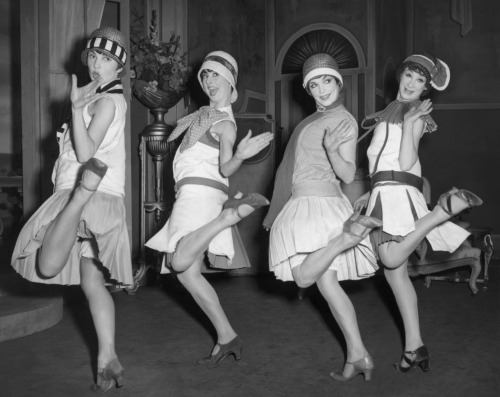
Maybe it was because of the period. Roaring Twenties in the USA (but not only of course) were the era of jazz, prohibition and mafia, the time of flappers, a "new breed" of young Western women who wore short skirts, excessive makeup, bobbed their hair, listened to jazz, drove automobiles (imagine that!) smoked, had casual sex and generally flaunted their disdain for what was then considered acceptable behavior. Allegra is such a flapper even if for slightly different reasons – she finds it an excellent way to express her love for freedom. Yes, she frequents speakeasies ( establishments that illegally sells alcoholic beverages), has a bunch of bohemian human friends and seduces men but only in order to drink their blood. This novel proves that a vampiress doesn’t have to wear black leather, wield a catana (or another sharp weapon) to be considered a kick-ass heroine. The strength of Allegra lies in her psychological make-up – she can think and she uses her brain, she is altruistic up to a point, she knows what she wants and she doesn’t hesitate to get it. Overall the vampires and werewolves of New York fit that period perfectly, bootlegging, fighting among themselves for supremacy, not unlike in any good mafia, or dreaming about the ultimate supremacy.

Psychological veracity was another feature I really appreciated. Allegra and Griffin are dynamic characters. They fall in love almost at first sight but it takes time before they are able to overcome their own limitations and prejudices. Griffin is shocked by Allegra’s free manners and independence, not to mention the fact that werewolves despise vampires. Allegra cannot believe Griffin wants to suppress his natural instincts of a predator and expects the same from his sister. It takes them long to see that they are really very much alike, even longer to trust each other at all. They don’t jump to bed instantly, their relationship rings true and is a pleasure to follow – in my opinion it was a real highlight of the story. I liked little Gemma and her clumsy attempts to imitate Allegra as well, it was a good move to make her play a bigger role than that of a supporting damsel in distress.

The world building was ok – perhaps not very original or especially prominent but still interesting enough to add to the story.

What I didn’t like:

I admit the plot had its weaknesses, especially at the end. In my opinion everything is resolved far too slickly during one bloody showdown; then main leads and their friends get their orange blossom- scented HEA, bad people kill each other, summertime and the livin’ is easy…at least in Long Island.

I was especially surprised when the elders of the pack, who had an excellent opportunity to fleece poor Griffin, willingly reduced their claim by half because…they feared too much money might have a degenerative effect on the werewolves. Excuse me? You are a bunch of brutal mafiosos and all of a sudden there are no greedy people among you? Have you had an epiphany of a sort? It would be far better if Griffin, a rich, clever businessman after all, found a legal loophole or drove a really hard bargain and snatched a part of his money back. But he, poor puppy, was too busy being in love or saving his beloved Allegra and the pack had to take pity on him…a bit too good to be true, don’t you think? Especially that he and the pack were hardly on friendly terms…

That's how Allegra might
look like...indomitable!


I am also not a fan of the cover art. Seriously, the book is about Roaring Twenties, such a colourful period, and instead of flappers dancing charleston or mafia boys shooting each other they put just a blue face with amber eyes and a were in the background...I would never pick it up just because of the cover. Look how many nice, period-related pics I was able to find in a matter of minutes! I think each of them would be better than the original cover!

Final verdict:

It was a really nice surprise – I liked this book better than I thought I would. It was far more intelligent than your ordinary vampires-and-werewolves story and the setting won me over. I recommend it to people who like their  paranormal romance with  historical flavour, some nice backstory and a HEA guaranteed! BTW there are two more books of this series but it seems each of them features a different set of characters so I suppose you can easily read them as stand-alones. I am definitely going to try at least one more!

Wednesday, 4 April 2012

Review: The Dragon’s Harp by Rachael Pruitt (Era of Dragon’s: The Lost Tales of Gwenhwyfar series #01)

This book was provided by the author's publisher via my lady Blodeuedd's excellent blog in return for an honest review. I haven't been compensated for writing the said review in any way and the fact that the book came free of charge didn't influence me either.   


Book info:


Format: e-book, Kindle
Genre: historical fantasy
Target audience: older YA and adults


Synopsis:

The novel is set in northern Wales during the 5th century CE and its narration follows the coming of age of a young Ordovici princess of Dinas Emrys, Gwenhwyfar. It is the first person narration – elderly Gwen tells the story of her life to a serving girl. Yes, she is the future wife of Arthur and Merlin/Emrys is actually her uncle but she is also a small, unruly, stubborn girl, much loved and surrounded by her family. She grows up in very uncertain times so soon enough must face harsh reality of war, plunder, murders, rape and betrayal. Will she find her inner strength to fight for her integrity and for those she loves? Will she dare to develop her unusual gifts to oppose dark, greedy druids and witches? Will Merlin, forever busy abroad, allegedly tutoring an important young princeling in the South, finally find time to help her?

 What I liked:

 Firstly and foremostly I loved the fact that the author really, truly did her homework concerning the period she wrote about. Mind you she did it with passion and it was felt. The narration rang true, the life of little Gwenhwyfar seemed as historically correct as it was only possible - I couldn’t help smiling e.g. when I stumbled on the Chi Ro symbol early Christians used most likely instead of a crucifix or a cross. 5th century Wales is presented as a real place, without idealizing the living conditions or problems its inhabitants faced. I am a sucker for good historical fiction, firmly based on the remnants and relicts from the appropriate era and here it was clear Ms Pruitt is a real history junkie who digs deep and is creative with her findings! It was a pleasure!

 I liked the red dragon, called Cymry (guess why such name was given to it ;p) which I suppose is a nice symbol of the magical aspect of the book. It wasn’t overdone but impressive enough, more like a natural magic than something flashy and loud. Bad druids and good druids seemed a very sensible idea –after all nobody said Julius Caesar, who gave them a very bad opinion in bulk writing his memoirs, was the most objective source of knowledge. They were his enemies and he was clearly afraid of them.

 I liked how Celtic women were made almost as powerful as their husbands if not actually more dangerous than any warrior. Gwen, just a child and then a teen, is presented as a kick-ass princess, not some whimpering bimbo or a shallow twit whose flirtatious was led to the destruction of Camelot.; her Grandma, Rhiannon, is actually even better! Also Sari, a slave girl from an Arabic country turned seer, and Hrwych, Gwen’s nurse and friend, were a very nice addition!

 Now something about the baddies: they were really good as well, both men and women who, in the end, happened to be one big ‘loving’ family! The main villain, Maelgwyn, Gwen’s other uncle, is handsome and rotten to the core – what a bliss!! – but his daughter is actually even better (or rather worse) a piece of art, nothing less, and of course as cute as a button! I am looking forward to meeting them again! Mind you it is a novel written clearly with a more mature audience in mind – not a fairy tale for children. There is one especially disturbing scene of an attempted rape (the victim being a minor) and then the would-be rapist is punished in a really ugly, brutal way – consider yourself warned.

 Finally the cover art is lovely! Those red curls and this dagger!

 What I didn’t like: 

 At first I couldn’t relate to Gwen. Not really. Only later, when she stopped behaving like a spoiled brat I warmed to her a bit. I think Lleu, her father’s ward and her main squeeze in this part, was a far more interesting, although secondary character. Well, it might change. I started reading this novel not being aware that it is a beginning of a series – there will be four more books or so I found out! Now I want more! Is there any justice? None!

 Final verdict: 

 A charming story, very unlike any novel based on Arthurian cycle I’ve read so far. I only hope the whole series will be as original and entertaining till the very end. Writing all five parts on the same high level – that’s a real challenge! I recommend it to readers who like Arthurian cycle stories but told in a more contemporary and historical way, without completely inadequate knights in shining armours and damsels in distress and a heavy dress (thus the distress I suppose).