Showing posts with label read in 2013. Show all posts

Thursday, 29 August 2013

On the Jellicoe Road by Melina Marchetta

Synopsis:
Abandoned by her mother on Jellicoe Road when she was eleven, Taylor Markham 17, finally confronts her past. Hannah, the closest adult she has to family, disappears. Jonah Griggs, moody stares and all, is back in town. If Taylor can put together the pieces of her past, she might just be able to change her future.


On the Jellicoe Road I’m a plot girl through and through, but there are certain authors that can make me sit down and read a book that’s pure character study and absolutely nothing else. Melina Marchetta is one of those authors. I love how she manipulates words. Sometimes, I still feel like crying myself to sleep over The Piper’s Son and Froi of Exiles only improved on the second reading.

On the Jellicoe Road is a different animal.

The stories of Taylor Markham, Jonah Griggs, Ben Cassidy, Narnie, Webb, Tate, Fitz, and Jude never really came together for me. Marchetta does try to fit all the puzzle pieces together in this disjointed novel, but even the best explanation falls flat when the reader doesn’t care about the characters. Of a character driven story.

See what I did there.

When I’m reading a character driven novel I need to be able to connect with the secondary characters if not with the—unreliable—narrator. Every fragmented scene was merely an anecdote that had happened to someone else, to people I don’t know or wish to meet. It was all so far, far away from me. I’m not talking about the fact that I live in Northern Europe and the author with her characters lives in Australia, I’m talking about the emotional connection that never was.

I did not care.

On a technical level I can admire what Marchetta was trying to achieve by indulging in non-linear storytelling and I wish there were more books like this—only better—to challenge readers of all ages. The problem is she’s not good enough author to pull it off. Neither was Hal Duncan, come to think of it, no matter what the award committees might think.

If the soul of a book is sacrificed at the altar of writing craft, the book fails.

On the Jellicoe Road fails.

Tuesday, 27 August 2013

Somebody Killed His Editor by Josh Lanyon (Holmes & Moriarity #1)

Synopsis:
Thanks to an elderly spinster sleuth and her ingenious cat, Christopher Holmes has enjoyed a celebrated career as a bestselling mystery writer. Until now. Sales are down and his new editor is allergic to geriatric gumshoes.

On the advice of his agent, he reinvents his fortyish, frumpy, recently dumped self into the sleek, sexy image of a literary lion, and heads for a Northern California writers conference to try and resurrect his career. A career nearly as dead as the body he stumbles over in the woods.

In a weirdly déjà vu replay of one of his own novels, he finds himself stranded in an isolated lodge full of frightened women—and not a lawman in sight. Except for J.X. Moriarity, former cop and bestselling novelist. The man with whom he shared a one-night stand—okay, maybe three—long ago. The man who wants to arrest him for murder.

A ruthless, stalking killer, or a hot, handsome ex-lover. Which poses the greater danger? It’s elementary, my dear Holmes! 


Christopher Holmes is a writer who writes mysteries a la Agatha Christie’s Ms Marple. Or he used to, apparently they’re not selling anymore. This is why he’s taking a break from his reclusion and going on a trip to a writers’ conference hoping to reinvent himself just enough to sell another book. Well, no. The reinvention is his editor’s idea, who along with everyone else in the hotel becomes a suspect the moment Christopher stumbles on a dead body. Also, there’s a storm.

It isn’t much of a mystery but Lanyon successfully kept me distracted with gossip and Christopher’s reheated love affair with another mystery writer J.X. Moriarity. Yes, you read that right and no, that’s not a typo. Lanyon isn’t paying homage just to Christie but to Conan Doyle as well.

Somebody Killed His Editor is written in Lanyon’s usual style, in first person voice, and is full of witty remarks and the kind of gaslighting an unreliable narrator causes. There is an attempt to sketch a few of the secondary characters in more detail but not quite enough for proper characterisation. The object of Christopher’s desires is left aloof and only mirrored in his reactions to J.X. I’m guessing the rest of the specifics are delivered in the sequel.

Other than that, there’s very little to say about the book. I enjoyed reading it but it wasn’t anything special. Still, I wouldn’t call it a meh-book either.

Saturday, 24 August 2013

Love Has No Boundaries: Short Stories & Short Reviews Part 3

These short stories were written as a part of the M/M Romance Group's "Love Has No Boundaries" event. Group members were asked to write a story prompt inspired by a photo of their choice. Authors of the group selected a photo and prompt that spoke to them and wrote a short story.


Deep in the CountDeep in the Count by Madison Parker

My rating: 4 of 5 stars

This came as close to perfection as I've seen a short story get in a long while. The plot and characterisations where there as were some of the details. I would've liked a bit more description, which I don't say often.


You Get Full Credit For Being AliveYou Get Full Credit For Being Alive by Cari Z.

My rating: 2 of 5 stars

You wouldn't think that a retired assassin falling in love would make for a good story, would you? Of course it would and thank heavens I'm not alone in thinking that. I enjoyed reading the beginning of this novella even with the gruesome details, but as the story progressed other little details started gnawing at my enjoyment.

I didn't think the tools and skills of the assassin's trade—namely wiretapping—were believable. Neither did I enjoy the bits of French dialogue that read like something I'd get from Google translate. Clunky at best—and I only know the basics of the language. And then there was the ending, which I can see being pleasing others was far from satisfactory for my taste. Such a shame.

The Brat WhispererThe Brat Whisperer by J.A. Rock

My rating: 3 of 5 stars

Somewhere between two and three stars. It's not a bad story at all, a character study of sorts with a dose of healthy BDSM. There's spanking and discipline, but those aren't really my thing and neither was there anything to elevate this above all the others. I'm tempted to round down due to that ending but I won't.

Dirty BoysDirty Boys by Kyle Adams

My rating: 3 of 5 stars

That was fun. Ridiculous but fun in a sweet, plotless, sex-addled-mind kind of way.


The Field of Someone Else's DreamsThe Field of Someone Else's Dreams by Amelia C. Gormley

My rating: 4 of 5 stars

That was really good. A story about a college student and an injured baseball player drifting, trying to decide what he wants or even dares to expect from the uncertain future. There's a secret boyfriend and there are difficult parents. Read it.

Thursday, 22 August 2013

Howards End by E. M. Forster

Synopsis:
The disregard of a dying woman's bequest, a girl's attempt to help an impoverished clerk, and the marriage of an idealist and a materialist — all intersect at an estate called Howards End. The fate of this country home symbolizes the future of England in an exploration of social, economic, and philosophical trends during the post-Victorian era.


This book did not pull me in like Maurice and A Passage to India did, but the allegories won me over. Eventually.

Rather than being a novel about characters and their individual fates, Howards End is like a mirror made of fractured pieces that show the truth about society in small details and in the lack of a full picture.

“The poor cannot always reach those whom they want to love, and they can hardly ever escape from those whom they love no longer. We rich can.”

If this is what you take away from it, you’ve not read the same book I did. No, my experience is closer to these two quotes:

“The poor are poor, and one’s sorry for them, but there it is.”

and

“There are just rich and poor, as there always have been and always will be.”

Aside from the monetary aspects, it’s always sad to read about a woman who sacrifices so much of herself for companionship and deludes herself to being in love. Yet, maybe the true tragedy lies not in the characters and their fate, but in the people who criticise Margaret for her choice and fail to see that women of today still marry their Mr Wilcoxes. Maybe the the most poignant of it is that they never ask why.

Tuesday, 20 August 2013

A Passage to India by E. M. Forster

Synopsis:
It is India in the year 1924 or thereabouts. After a mysterious incident during a visit to the Marabar Caves, Dr Aziz is accused of assaulting Adele Quested, a young Englishwoman. As he’s brought to trial the fragile structure of Anglo-Indian relations collapses and the racism inherent to colonialism is exposed—a theme which still has powerful, dangerous realities today.


This is a biased review: I am too blinded by the beautiful language and awestruck by the reach of the story and its implications.

Dr Aziz is quite far from a likeable character. He is thoughtless, he has a high opinion of himself and definite opinions of others. He also copes with the English authority by the means of humour. He laughs at them and lets them laugh at him. Dr Aziz meets Mrs Moore in a mosque when he scolds her about keeping her shoes on. When it becomes clear that she’s not wearing any footwear, apologies are made and an honest dialogue begins. That discussion comes to an end when Dr Aziz has escorted Mrs Moore back to the Club into which Indians aren’t allowed.

Through Mrs Moore Dr Aziz meets Ms Quested—a newcomer to India like Mrs Moore—and ends up escorting them both to the Marabar Caves. It is at the caves where something happens.

Like so often in real life, even today, it’s never made perfectly clear what exactly happens at the caves. All that is known is that Ms Quested fled from the scene quite upset and that Dr Aziz is to blame. Or maybe not. He claims he’s innocent and Ms Quested isn’t quite sure herself what happened, but she’s the victim and beyond reproach. She’s a naïve young woman but more importantly she’s an Englishwoman and he’s an Indian.

Watching the events unfold was like watching a documentary from the year 2013. I’m serious, nothing’s changed in ninety years. When a white woman is attacked the dark man is to blame. He’s guilty until proven innocent and maybe not even then. The courts may let him go but that’s a failure on their part not evidence of his blamelessness.

It’s still true today that while individuals may bridge that gap between the races and become friends, society as a group almost never does. Old prejudices die hard.

While the legacy of colonialism is quite foreign to me, I could still identify with Adele Quested because she’s a woman. She’s someone who wants to see the best in people and ends up making a horrible mistake. She’s also the one whose word weighs least when it comes to the crime she’s the victim of. As soon as she’s uttered one accusatory word, the men take over. The Englishmen. They’ve arrested, put Dr Aziz on trial, and judged him before the first hit of the gavel. Dr Aziz is guilty and thus every Indian is. The English are better. Even the women but who listens to the women? Certainly not Dr Aziz who is furious to be accused by someone so ugly.

Contradictions. This book is full of contradictions, but so are people. I just wish we’d learned to know better by now.

Saturday, 17 August 2013

Love Has No Boundaries: Short Stories & Short Reviews Part 2

These short stories were written as a part of the M/M Romance Group's "Love Has No Boundaries" event. Group members were asked to write a story prompt inspired by a photo of their choice. Authors of the group selected a photo and prompt that spoke to them and wrote a short story.

The Touch Of HopeThe Touch Of Hope by Brandon Shire

My rating: 3 of 5 stars

It's a really good story about two homeless teens, but the sex scenes almost ruined it for me.


Friends or Lovers?Friends or Lovers? by Sara York

My rating: 1 of 5 stars
"I want to feel that again. I've never felt that before. You were amazing. Like totally and completely over-the-top amazing.
Yeah. Not so much. This is a little pwp without either of the p's. It's simply without. Someone might disagree but I've blocked out the pathetic attempt at the porn from my mind.


Breathing SnowBreathing Snow by Dev Bentham

My rating: 4 of 5 stars

I liked this one. The author focused on the behind the scenes stuff and relationship development rather on the publicity side, which I would have liked to have seen more of. Snark is one way to my heart and there was a distinct lack of snark here. As for their competitors: Oh how I miss the days when we Finns didn't suck at keeping the doping secret ;) Nah. We've always been terrible at that.

TreasureTreasure by Kim Fielding

My rating: 4 of 5 stars

I'm rounding up to four stars. This is where the sickly weak bookworm gets his own story. Best of all, he doesn't he already lives in a fantastical world, which gives this gay version of Tristan & Isolde like meet cute it's own flavour.

I liked it, I really liked it but there were just one too many convenient lessons in Kit's past as well as packing accidents. The vocabulary was off, which I could have ignored had it been revealed that Kit was lying about certain things. And then there was the fact that the author was obviously a keen student in the school of euphemisms. *shudders*

Brandon's LaughterBrandon's Laughter by Ellen Holiday

My rating: 3 of 5 stars

I really liked this one but then again I do have a huge soft spot for anything angsty and borderline melodramatic. One of my pet peeves is the presence of lyrics in prose: I don't mind a line or two but a whole song no matter how original is too much. Some stories can overcome that crippling flaw but this one had a tad too sappy reunion and ridiculous ending for my taste.

Thursday, 15 August 2013

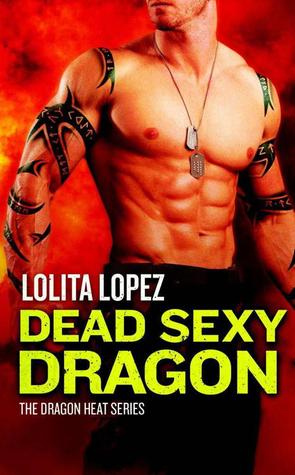
Dead Sexy Dragon (Dragon Heat #1) by Lolita Lopez

Synopsis:
The last thing dragon shifter Stig Wyvern needs is his dead friend’s kid sister showing up on his doorstep. He’s just minutes away from entering a mating phase. Sharing his isolated house with the young woman he’s desperately lusted after for quite some time is a recipe for disaster.

But Cora Cardenas has nowhere else to go. She’s in deep trouble with some really nasty people and Stig is the only one who can protect her. That he’s deliciously sexy and makes her tingle with the simplest of smiles is just a bonus.

Cora quickly realizes Stig is hiding something from her. To make matters worse, she’s plagued with breathtakingly naughty dreams starring a shadowed lover who bears a startling resemblance to her host. And just what the hell is going on down in the basement at night?

Stig needs to get Cora out of his house but his inner beast has other ideas. He’s found his mate and she’s not going anywhere...


Cora is on the run from a bad situation and the only place she can think to hide in is with her dead brother’s marine friend. How is she to know that said friend, Stig (sans the helmet), is about to go into a heat and be turned into a dragon against his will? Of course the two of them sharing a bathroom leads to sexy times, and because this is a novella it happens very quickly.


I’m sorry to say this didn’t work for me. Truly sorry, because my usual gripes are absent. There’s quite a bit world building with a long and complex history that promises to be expanded in the sequels. The main characters are pretty well sketched with dreams and fears of their own even if I had trouble believing an immortal being that keen on joining a war after another. Due to the length of it, the story is rushed but it remains logical and believable within its world’s rules.

No, this time it was the erotica part of the book that failed me. More accurately, the erotica vocabulary:

< highlight for spoiler>
core,
cum,
cunt,
folds,
mound,
pussy,
(honeyed) sex,
tummy

</spoiler>

…yeah, no. Because I couldn’t lean on the insta-lust crutch, I didn’t buy the insta-love angle either. I simply couldn’t enjoy roadrunner fast the romance. Too much of a stretch even for my active imagination.

It’s too bad, because had the smut adjectives and nouns been less repulsive to me, I’d have wanted to read more about the world Lopez has created.


I received an Advanced Readers Copy of this book from the publisher through NetGalley.

Tuesday, 13 August 2013

Broken Homes (Peter Grant #4) by Ben Aaronovitch

Synopsis:
Ben Aaronovitch has stormed the bestseller list with his superb London crime series. A unique blend of police procedural, loving detail about the greatest character of all, London, and a dash of the supernatural.

In the new novel DC Peter Grant must head south of the river to the alien environs of Elephant and Castle. There's a murderer abroad and, as always when Grant's department are reluctantly called in by CID there is more than a whiff of the supernatural in the darkness.

Full of warmth, sly humour and a rich cornucopia of things you never knew about London, Aaronovitch's series has swiftly added Grant's magical London to Rebus' Edinburgh and Morse's Oxford as a destination of choice for those who love their crime with something a little extra.


Broken Homes (Peter Grant, #4)
What the hell did I just read? Where’s the rest of it? I need the rest of it NOW!

On a more rational note, this is another better novel of the Peter Grant series. As ever, the strength of the writing and story lies on Peter’s narration and sarcastic voice, so if that hasn’t won you over by now, don’t expect the scattered plot threads to dazzle you. If you’re invested in the long plot, however, sit back and enjoy the ride.

The story is of the slow sort and reminiscent of Sherlock Holmes in a way that doesn’t make a good mystery novel. Not in the puristic sense. Too much is hidden for the readers to piece together the puzzle for themselves and they have to wait for the genius to guide them through the intuitive steps of logical deduction.

Broken Homes also suffers from the middle book syndrome but because this is the fourth in the series let’s call it the set up syndrome. Everything, and I do mean everything is set up for bigger things to come and even the explosions at the end aren’t enough to release the underlying tension. It feels like things are going to get a lot worse before they get better and Peter needs to improve on his policing as well as his magic lessons. And fast.

When’s the next book coming out again?

Saturday, 10 August 2013

Love Has No Boundaries: Short Stories & Short Reviews Part 1

These short stories were written as a part of the M/M Romance Group's "Love Has No Boundaries" event. Group members were asked to write a story prompt inspired by a photo of their choice. Authors of the group selected a photo and prompt that spoke to them and wrote a short story.

The Tail of a DogThe Tail of a Dog by Summer Devon

My rating: 4 of 5 stars

Cute. Told from the dog's point of view, and shows how two kind-hearted men find themselves through an unfortunate event. My favourite parts were where Javier was confiding in the dog, because people do talk to their pets and tell them things they wouldn't dream of saying to another human being.


Falling AwayFalling Away by Lisa Henry

My rating: 2 of 5 stars

It was written in third limited, so that's one good thing about it. It also had that good meh-like thing going on until it promptly fell flat on its face with that ending. I liked Dark Space, but this made me doubt whether I want to read The Island or not.


Smoky GlimpsesSmoky Glimpses by Nicole Forcine

My rating: 4 of 5 stars

Left me slightly weak in the knees. It's told in third person limited but Kaden's voice is clear and personal. Also it's a paranormal that left me wanting more of the story and the world.


Last First KissLast First Kiss by Piper Vaughn

My rating: 2 of 5 stars

It wasn't bad but neither was it anything especially good either. An angsty short story that touched subjects far too big for its ~10k word count. Especially because a third of it was dedicated to the sex. Friends to lovers trope.


#First Impressions #Second Chances#First Impressions #Second Chances by Heidi Belleau

My rating: 3 of 5 stars

Another friends to lovers story. It started out really well, then took a dip with the reveal, and only partially recovered. Cute but skimpy on the reality details.


Tuesday, 6 August 2013

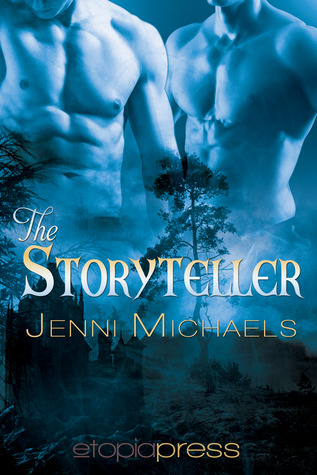
The Storyteller by Jenni Michaels

Synopsis:
Two men. One kingdom. A secret that could cost them everything...

Gareth has been bringing home strays to his thatch-roofed cabin since he was a young boy with his head in the clouds. Helping others is more than a hobby to him--the need to heal flows through his veins. Ellis is far from a helpless stray. His shoulders are broad enough to hold the weight of the kingdom that rests upon them. But when he's captured by slave traders, he finds himself in need of help from an unlikely ally, loath though he is to accept it. 

Neither of them expected to find the other, and neither of them meant to fall in love. It won't just change their lives--it could change the fate of an entire kingdom. And each will be forced to choose: gain everything he wants, or lose what the heart holds dearest...


Gareth lives alone in a small village in a small valley and he’s alone in the woods when a battered stranger faints at his feet. Softhearted healer that he is, Gareth risks breaking his back bringing the stranger to his cabin and tending to the strangers wounds. It’s not quite love at first sight but it is love after a fashion, so when stranger leaves, Gareth follows.

The title could refer to either of the main characters or a couple of the secondary characters introduced later when the past casts its shadow to the present.

This is a case of I wanted to like it more than I did.

I liked Kit and I liked Gareth, because they reminded me of other characters I’ve given my heart to. That is also the reason why I couldn’t round up the rating in the end. I couldn’t be quite sure if the story would stand on it’s own without the connections drawn to Merlin (BBC 2008) in my mind. There’s a knight, and there’s a physicians apprentice. There’s the tiny foster sister, there’s magic, there are four kingdoms instead of five… and there is my active imagination finding all these little “clues.”

The writing was well enough, maybe slightly too inexact for my tired mind. It’s either that or the editors were sleeping on the job. The disagreement at the end—and the characterisation that lead to it—felt somewhat manufactured and the resolution that followed was too quick. Still nice—nice is definitely a good word here—enough tale, at least for Merlin fans. Then again, why pay for a book when you can read stellar Merlin fanfic online for free.

Saturday, 3 August 2013

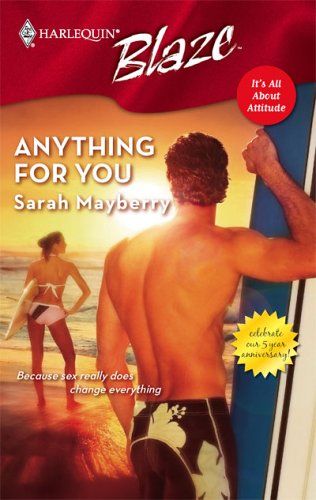
Anything For You by Sarah Mayberry

Synopsis:
The world according to Sam Kirk has just turned upside down. His best friend and business partner, Delaney Michaels, has returned from vacation a new woman... a gorgeous, hot new woman. Suddenly Sam is thinking entirely inappropriate thoughts about his buddy. Worse, with Delaney's changed look, she's abandoning their friendship in pursuit of the picket-fence dream. It's a nightmare come true. Then one night finds them tangling in the sheets.

It should feel wrong, wrong, wrong... instead, it feels very right. And now Sam knows exactly what he'd do to keep his best friend: absolutely anything.(


Sam Kirk and Delaney Michaels are in love. He just doesn’t know it yet. She’s known it since she was fourteen but has managed to convince herself that he won’t ever return her feelings, so why bother telling him. No, instead of talking to him, she’s going to run away.

That’s the conflict of this story.

I guess in certain circles it could be viewed as romantic to wait for the other person come to the right conclusion by himself, but when you’re tired of waiting and decided on leaving him without saying a word? Nope, that’s just cruel. To his credit Sam says so at one point before promptly ruining the moment with sexual innuendo. I could understand Delaney deluding herself while they were still stuck in the platonic gear, but the moment she decided to make a change, telling him should have become step one. Or step two. Any step before quitting her job, selling her flat, and telling him she never wanted to talk to him again.

Preferably after the second time they had sex and before she went to her enabler sister who came up with the brilliant plan of weekend of sex to get Sam out of Delaney’s system. And the scoundrel knew it would backfire.

There’s nothing wrong with Mayberry’s writing; the story just didn’t work for me. Two hundred pages of miscommunication fuelled angst and sex, and a two page resolution dropped the otherwise entertaining narrative just below my meh line.

Tuesday, 30 July 2013

Trial by Desire by Courtney Milan (Carhart #2)

Synopsis:
SHE CANNOT FORGET THE FIRE HE IGNITED ...

In the three years since her husband left her, Lady Kate Carhart has managed to forge a fulfilling life for herself. But when Ned Carhart unexpectedly returns, she finds her tranquility uprooted --- and her deepest secrets threatened. Though she has no intention of falling for Ned's charms, Kate can no longer deny the desire that still burns in her heart.

OR THE PROMISE OF HIS LOVE ...

Ned is determined to regain his wife's trust by using unbridled seduction. But just as Kate surrenders to Ned's passion, her carefully guarded past threatens to destroy her. Now Kate must place her faith in the only man she's ever loved, and the only one who has ever betrayed her ...


Quite disappointing.

I’d been saving this book, so I could savour it whenever I felt like I needed to read a really good romance novel. After the last couple of months, it felt like it was time.

Trial by Desire is a sequel to Proof by Seduction and although the couple set up is much more believable than in its prequel, the romance itself isn’t.

A scandal forced Ned and Kate to marry, but it was clear that both of them—Ned—at least needed to grow up in leaps and bounds for them to earn their (believable) happy ever after mandated by the genre. Milan’s solution is to send Ned away soon after the nuptials for three years and let him grow up into a capable man abroad.

Ned does grow up. When he comes back he’s a changed man and his reunion with his estranged wife is promising. Of course there are the familiar tropes keeping them apart: Miscommunication and a caricature villain. I’m wretchedly disappointed in the villain’s characterisation as the early promise of a multilayered characterisation for the domestic abuser is never realised. He has his internal logic that justifies the abuse but the reader is never shown why he thinks that way. Other than it’s assumed the period explains men’s attitudes towards women.

Even so, one man wanting his runaway wife back isn’t what stands between Ned and Kate and their happiness. It’s Ned himself. Milan tackles an important issue by making Ned bipolar—I assume that’s the correct diagnosis—and showing people have battled with mental illness before they had names for them. As admirable as it is to see Ned find his own solution for his mood swings, it doesn’t change the fact that his dogged insistence to cope on his own is what destroys the romance. The constant repetition of his desire to be the hero and secrets kept until the very end, don’t make him good husband material. He may have learned to stand on his own feet, but Ned doesn’t believably learn to lean on his wife, which leaves their marriage a sham.

Worse than Ned’s inability to transform from an independent man into a half a married couple, is how Kate’s plot is handled. She’s supposed to be saving battered wives from their husbands and an early feminist who learns to win her own battles, but time and time again Ned rushes to her rescue. He saves her both from a physical and a juridical attack. He’s the one who comes up with the final solution. Having read Kate’s story makes me appreciate Margaret and Jessica and all the other Milan heroines that much more.

The writing itself is uneven—which still occasionally true for Milan’s novels—and the story is boring. There are hideous amounts of telling and horrible smut euphemisms I wish never to see in a romance book again. Milan kept me engaged with the story at times but only at times.

I feel like I’ve read the worst Milan has to offer and I can go back to waiting for her next book. At least I know most of these novice mistakes won’t be repeated quite as blatantly ever again.

Tuesday, 23 July 2013

Rameau's Review Archive: Ender's Game by Orson Scott Card

Rameau's ramblings: This is one of those books everyone recommended to me and once again I'm the odd one out. Originally posted on Goodreads on March 21st 2013.

Synopsis:
Andrew "Ender" Wiggin thinks he is playing computer simulated war games at the Battle School; he is, in fact, engaged in something far more desperate. Ender is the most talented result of Earth's desperate quest to create the military genius that the planet needs in its all-out war with an alien enemy.
Is Ender the general Earth needs? The only way to find out is to throw the child into ever harsher training, to chip away and find the diamond inside, or destroy him utterly. Ender Wiggin is six years old when it begins. He will grow up fast.
But Ender is not the only result of the experiment. The war with the Formics has been raging for a hundred years, and the quest for the perfect general has been underway for almost as long. Ender's two older siblings, Peter and Valentine, are every bit as unusual as he is, but in very different ways.
Between the three of them lie the abilities to remake a world. If, that is, the world survives.


Ender's Game (Ender's Saga, #1)Ender's Game by Orson Scott Card

I am disgusted.

I am so thoroughly disgusted with this book that I can’t even logically explain my utter revulsion. Ender’s Game reads like propaganda, and the characters in it are living it. It wasn’t until I saw the comparison to Adolf Hitler that I thought of Hitler Junge, but it makes sense. These kids are brainwashed into becoming soldiers, killers, and they’re never given a choice.

Except it’s much worse than that. Ender actually learns to doubt, to disobey, to choose, and he chooses wrong. (view spoiler)[He chooses mass murder. To add insult to injury, he writes a book about it and gives voice to the voiceless, to the dead. (hide spoiler)] How is that different from any other conqueror rewriting the history to suit them?

If this were a normal review, I’d remark upon the failed, nonexistent characterisations, the lack of character growth or lessons learned, the lack of actual challenges overcome (how can he overcome anything when he never fails?), the lack of plot that isn’t told in short paragraphs as in passing. But this isn’t a normal review and I’m just going to link you to better articles about the story itself.


Saturday, 20 July 2013

The Heiress Effect (Brothers Sinister #2) by Courtney Milan

Synopsis:
Miss Jane Fairfield can’t do anything right. When she’s in company, she always says the wrong thing—and rather too much of it. No matter how costly they are, her gowns fall on the unfortunate side of fashion. Even her immense dowry can’t save her from being an object of derision.

And that’s precisely what she wants. She’ll do anything, even risk humiliation, if it means she can stay unmarried and keep her sister safe.

Mr. Oliver Marshall has to do everything right. He’s the bastard son of a duke, raised in humble circumstances—and he intends to give voice and power to the common people. If he makes one false step, he’ll never get the chance to accomplish anything. He doesn’t need to come to the rescue of the wrong woman. He certainly doesn’t need to fall in love with her. But there’s something about the lovely, courageous Jane that he can’t resist…even though it could mean the ruin of them both.


Trust Milan to turn another historical romance cliché on its head. No, it’s not an inexplicable déjà vu, yes, I’m repeating myself again.

Jane Fairfield doesn’t want to get married. It’s not that she doesn’t want to fall in love and have a family, it’s that the family she has—her sister—is more precious. Having been neglected and starved for parental love and care, Emily and Jane are each other’s worlds. Well, there’s some bad literature involved too, a girl can’t avoid that not even in the 19th century. Or they would be if Emily’s guardian would let them. The Fairfield girls have little choice but to wait and count the days until Emily’s majority and freedom.

It’s just that a promise and Jane’s enormous fortune make achieving this goal a little bit difficult. Here’s where the mountains of lace come in. Jane was never brought up to be a proper lady and now she’s taking those liberties she has taught herself to the extreme to protect herself, her fortune, and her autonomy. That is to say she wears horridly tasteless gowns (some do like bright colours, even I, occasionally) and doesn’t shut up like a proper lady should (not—which, good for her—but is expected to). She’s smart and capable, but she’s also been coddled in a way. No one has taught her how to be ruthless. She’s about to learn.

Oliver is ambitious. He has everything Jane doesn’t: A loving family and a thorough education he means to use. He wants a career in politics (which makes me question his intellect and attractiveness to be quite honest) and he wants to change the world. He knows how to be ruthless, when to take a punch and when to walk away, and that has left its mark on him. Nope, we’re not talking about visible scars either, unless you count the freckles, which my mother does every summer just to annoy me.

Both Jane and Oliver are well off. They’re not starving and though they have their challenges, they’ve found ways to cope. Neither recognises that in this link or circumstances it’s them in danger of breaking. They both need saving before they lose themselves.

I admired how proactive Jane was. She didn’t stand still and wait someone to come rescue her, she faced the danger and rescued herself. It was a treat especially now that I’ve read theCarhart books. She was the one who found a solution for Oliver’s problem. She was the one who discovered the strength to play dirty. Jane recognised Oliver’s doubts and adapted but only to a degree her self-worth would let her. And in the end her choices forced Oliver to adapt.

As I saw Jane conquer one obstacle after another, I was left wondering whether there’d be left anything for Oliver to do. Sure he had the important task of negotiating a new law, but on a more personal level he appeared inert. I didn’t get it until I did. The flinching, it’s what I’ve learned to do. Not from fights, but talking. I simply don’t have the passion and strength to do it like I used to and I’ve learned to pick my moments. I understood the importance of Oliver reclaiming that part of himself. I also chalked it up to different tempers and theatrics. Partly.

The rest of it were the genre dictated expectations, which I’m also blaming for the epilogue. Too nice a bow for the story. Maybe that moment of absolutely happiness had been earned, but I think Jane and Oliver would have been better—more real—without it.

This being a romance novel I have my little gripes too. I’m definitely not a fan of the euphemisms even if it’s virginal Jane describing the scene. However, that doesn’t explain why Oliver would ever refer to his penis as his member (of parliament). And let’s not forget the slight ridiculousness of how their short-lived affair began. It should have been Jane who interrupted them, not the rain.

There’s also something that takes this book a step beyond the typical romance. Milan gives Emily a voice to show just how capable she is and to highlight another less talked of historical fact: Immigration. As surprised as I was to see the time taken to develop this side of the story, it fit well into the rest of the narration.

On a technical level, this is one of Milan’s successes. The text flows and plot is balanced. There weren’t any of those weak moments that plagued The Duchess War.

There weren’t any violent mood swings this time, only some deep laughs, but I loved it all the same.


Thursday, 18 July 2013

Mind Fuck by Manna Francis (The Administration #1)

Synopsis:
There are no bad guys or good guys. There are only better guys and worse guys. One of the worse guys is Val Toreth. In a world in which torture is a legitimate part of the investigative process, he works for the Investigation and Interrogation Division, where his colleagues can be more dangerous than the criminals he investigates. One of the better guys is Keir Warrick. His small corporation, SimTech, is developing a "sim" system that places users in a fully immersive virtual reality. A minnow in a murky and dangerous pond, he is only beginning to discover how many compromises may be required for success. 

Their home is the dark future dystopia of New London. A totalitarian bureaucracy controls the European Administration, sharing political power with the corporations. The government uses violence and the many divisions of the feared Department of Internal Security to maintain control and crush resistance. The corporations fight among themselves, using lethal force under the euphemism of "corporate sabotage," uniting only to resist attempts by the Administration to extend its influence over them. Toreth and Warrick are more natural enemies than allies. But mutual attraction and the fight for survival can create unlikely bonds

I thought about giving this book five stars.

As the days and weeks went by and I failed to write a proper review, I realised I’d made the right decision. Mind Fuck is a really good book but it’s not extraordinary.

In the dystopic future there’s the Administration. There aren’t really any nations, just regional Administrations and corporations that control people’s lives. This is a world where everything is monitored unless it’s not—to protect business secrets—and where torture is legalised.

That’s where Toreth works: In Investigation and Interrogation, I&I. He goes through mountains of paperwork, adjusts drug dosages and on an occasion handles the more precise tools of the trade. He also has irregular one-night stands under assumed names in hotel rooms he charges his employer for.

All in all, it’s a good life. Then he meets Warrick.

Just as Toreth has sold his life to the Administration, Warrick has tied himself to the corporations. He’s brilliant and just as emotionally challenged as Toreth is, albeit in his own way. These two men, they get under each other’s skin and can’t quite get rid of one another. Logic and life experience dictates that they must, but a convenient murder mystery ensures they can’t.

Mind Fuck is as light on the erotica and BDSM as it is on the world building. Still, I got the feeling everything had been thought through and that the author is asking the reader to trust her while she properly introduces the characters. Looking at the long list of The Administration series novellas and novels there’s a lot left to explore. Still, I wouldn’t recommend this to the fans of pure dystopia as much as to the fans of slow-burn m/m. The world and the predictable mystery only serve as a pale background to the characters.

And the characters are wonderful. They’re neither perfectly healthy, normal, or anyone I’d want to know in real life, but they are interesting. Their relationship is interesting. Their struggle to discern reality from the artificial and will to survive their circumstances is interesting. This story is interesting

If you don’t mind a narrative where the third person limited voice occasionally slips into first or that the story draggs from time to time, this is a book worth reading.

Tuesday, 9 July 2013

World War Z: An Oral History of the Zombie War by Max Brooks

Rameau's ramblings: Blodeuedd and I had a little discussion about this book and you can find it on her blog later today. 

Synopsis: 
It began with rumors from China about another pandemic. Then the cases started to multiply and what had looked like the stirrings of a criminal underclass, even the beginnings of a revolution, soon revealed itself to be much, much worse. Faced with a future of mindless, man-eating horror, humanity was forced to accept the logic of world government and face events that tested our sanity and our sense of reality.

Based on extensive interviews with survivors and key players in the 10-year fight-back against the horde, World War Z brings the very finest traditions of American journalism to bear on what is surely the most incredible story in the history of civilisation.

Max Brooks lives in New York City but is ready to move to a more remote and defensible location at a moment's notice. His Zombie Survival Guidewas adopted as a required text by all of the world's basic military training programs during the recent global conflict.


Zombies are not my thing. I don’t squee every time I find a decent novel about them nor do I queue to see the horror films about them. Slow-moving rotting flesh in a romance plot is definitely not my thing either.

So it’s a good thing that this book isn’t about zombies at all.

Excuse me what? You splutter.

Yes, you read that right, World War Z isn’t really about zombies. It’s about the world and people in it, namely Americans. No, the citizens of the United States of America would be more accurate. This is an American novel about Americans today, or rather about U.S. and its inhabitants seven or ten years ago. Things don’t change that much in a decade though, so it still applies.

The slow-moving rotting flesh is just an ugly mirror that produces a surprisingly clear image. It allows the characters to look back and explain in gory detail who they were before the Great Panic and how they’ve changed for the better. It allows a suburban mom to explain how she viewed some latinos clean and rational opposed to all the rest. It allows a child who grew up during the ten year zombie war to explain how her materialistic priorities have changed. It allows a jaded young man to explain how he learned to appreciate an outdated institution or how another like him found value in real life as opposed to the cyber reality he’d been hiding in. It allows the foot soldiers to explore in depth how rigid command structures can be a hindrance before they learn to adapt and become a strength.

And that same distorted mirror allows the reader see what the characters themselves fail to understand: How a victory and change can make some things worse even when it fixes other problems. It allows the author to outsource his and the nations greatest fears to other faraway places that they’ve always been afraid of. Or how else do you interpret what Russia becomes after the war?

Brooks takes the reader around world, China, South Africa, a few places in Europe, Australia, Canada, and allows those countries to take responsibility for some of the atrocities and failures that end up dooming and saving the world. Setting it all up in the U.S. would have ignored the realities of travel in the modern world and it would have made the story near claustrophobic. It’s a funny word to use in this context but it applies. The bigger the picture Brooks paints the more specific the message and the intended audience are.

Usually, I detest first person voice storytelling and a step below that are the stories with multiple first person voices mixed in together. Usually. But here it works. Brooks couldn’t possibly make each and every voice distinct enough to stand on their own, but he litters just enough specialised vocabulary to make it palatable. The format does the rest. Because each and every character is telling their part in a larger story, their voices can’t stand out too much. The story needs to be cohesive for the message to get through:

The more things change, the more they stay the same. Even through a zombie apocalypse.

Saturday, 6 July 2013

Review: Tigers & Devils (Tigers & Devils #1) by Sean Kennedy

Synopsis:
The most important things in Simon Murray’s life are football, friends, and film—in that order. His friends despair of him ever meeting someone, but despite his loneliness, Simon is cautious about looking for more. Then his best friends drag him to a party, where he barges into a football conversation and ends up defending the honour of star forward Declan Tyler—unaware that the athlete is present. In that first awkward meeting, neither man has any idea they will change each other's lives forever.

Like his entire family, Simon revels in living in Melbourne, the home of Australian Rules football and mecca for serious fans. There, players are treated like gods—until they do something to fall out of public favour. This year, the public is taking Declan to task for suffering injuries outside his control, so Simon's support is a bright spot.

But as Simon and Declan fumble toward a relationship, keeping Declan's homosexuality a secret from well-meaning friends and an increasingly suspicious media becomes difficult. Nothing can stay hidden forever. Soon Declan will have to choose between the career he loves and the man he wants, and Simon has never been known to make things easy—for himself or for others.


When I saw that this book was written in first person voice, I almost stopped reading it. I’m glad I persisted.

Simon Murray, a football fan, a film critic, and a gay man tells a story of how he fell in love with a football player. You’d think that the celebrity bit would define the story, and it does, up to a point. However, I found that the description of how Simon falls in love and embraces a meaningful relationship meant more than the external challenges of dating a celebrity who lives in another city in Tasmania—as opposed to in Melbourne—because it defines his character.

The protagonist and the narrator of this story isn’t an easy man. He’s flawed and difficult to his friends who know and love him despite his aloofness. Simon is terrified of commitment and at the same time it’s what he envies in others and wants desperately for himself even if he won’t admit it. He’s as stubborn as he’s loyal and he hides his insecurities behind his directness. Most people would find that off-putting but for Declan Tyler™ it’s refreshing to find someone not bending over backwards to please him. It’s Simon’s foul mouth that tempts the big scary footballer to risk exposure.

They experience a whirlwind romance with the full advantages and disadvantages of an illicit romance as well as face the challenges of a more established relationship. That is to say they get to meat the parents and other assorted friends. The story covers a period over eighteen months and shows how someone inured to single life struggles to open up and to let someone else to share his life in full. There are misunderstandings but not counting the final one they’re not treated as prolonged romance clichés but tackled and dealt with.

Although I’d classify Tigers & Devils as a modern gay fairytale, Kennedy doesn’t shy away from the darker side of being out and proud. Both Simon and Declan experience heckling and insults, but it’s never explicit. Neither are the sex scenes by the way. Things aren’t glossed over per se; the focus simply is on Simon’s personal growth and evolving relationships. You know, on the important things.

I liked how Kennedy used little things to illustrate Simon’s character. For example, the reader see all the characters through Simon’s eyes and gets only the information he thinks is important about the people he meets. That is why the reader is as shocked to learn the reason for the other WAGs shunning Lisa as Simon is. Having said that, the adverbs were killing me. And the ending felt a tad drawn-out.

Thursday, 27 June 2013

Rameau's Review Archive: Counterpunch (Belonging #2) by Aleksandr Voinov

Originally posted on Goodreads on Feburary 8th 2013.

Synopsis:
Fight like a man, or die like a slave.

Brooklyn Marshall used to be a policeman in London, with a wife and a promising future ahead of him. Then he accidentally killed a rioter whose father was a Member of Parliament and had him convicted of murder. To ease the burden on the overcrowded prison system, Brooklyn was sold into slavery rather than incarcerated. Now, he's the "Mean Machine", a boxer on the slave prizefighting circuit, pummelling other slaves for the entertainment of freemen and being rented out for the sexual service of his wealthier fans.

When Nathaniel Bishop purchases Brooklyn's services for a night, it seems like any other assignation. But the pair form an unexpected bond that grows into something more. Brooklyn hesitates to call it "love"—such things do not exist between freemen and slaves—but when Nathaniel reveals that he wants to help get Brooklyn's conviction overturned, he dares to hope. Then, an accident in the ring sends Brooklyn on the run, jeopardizing everything he has worked so hard to achieve and sending him into the most important fight of all—the fight for freedom.


Counterpunch (Belonging, #2)Counterpunch by Aleksandr Voinov

This review can also be found on Book Girl of Mur-y-Castell-blog.

Imagine a modern Britain where at least two or three decades ago the politicians gave up on trying to keep up with the ever-growing prison population, chucked the fourth article of the Universal Declaration of Human rights, and started to commute life sentences into slavery. Now people are both born and condemned to it. And it’s not just in Britain, it’s all around the world.

Brooklyn Marshall was born free and worked hard to build a good life for himself. Then a simple mistake, an accident, at the job took all that away from him. He was made into an example and his life was no longer his own. Now he boxes because it’s better than getting shot at in a war zone, and he fucks and is fucked because he is told to. He is used. He’s chattel that can talk.

”You haven’t resigned yourself to slavery yet, have you?”
“No. And I never will.”


It’s cruel to give hope to a such man, but that’s exactly what Nathaniel Bishop does.

I’m not a fan of romanticising slavery, and I’m not a fan of any relationship that’s based on a severe imbalance of power, but I’m always curious to see if the author can make it work. If those obstacles of differing wealth, social status, and culture can be overcome believably. Realistically. Even in urban fantasy.

It works here because Brooklyn has never accepted his status as anything less than a human being. It works because both Brooklyn and Nathaniel recognise how wrong their situation is, and because both are fighters in their own way.

Much of the story focuses on the boxing—again, something I know nothing about—and how it reflects Brooklyn’s growth as a character. He’ll never see any of the winnings, but the fighting he does is for himself. He’s broken and beaten both in the ring and out, and he is affected by it, but he’s also a survivor. What doesn’t kill him makes him stronger, and the final fights show this vividly.

If I hadn’t struggled with the beginning of the story—it was good but not amazing—the ending would have earned Counterpunch its fifth star. Voinov opted out of the fanciful and kept it realistic.

P.S. The story includes triggers for <spoiler>    rape    </spoiler>.


Tuesday, 25 June 2013

Rameau's Review Archive: Skybound by Aleksandr Voinov

Originally posted on Goodreads January 13th 2013.

Synopsis:
Germany, 1945. The Third Reich is on its knees as Allied forces bomb Berlin to break the last resistance. Yet on an airfield near Berlin, the battle is far from over for a young mechanic, Felix, who’s attached to a squadron of fighter pilots. He’s especially attached to fighter ace Baldur Vogt, a man he admires and secretly loves. But there’s no room for love at the end of the world, never mind in Nazi Germany.

When Baldur narrowly cheats death, Felix pulls him from his plane, and the pilot makes his riskiest move yet. He takes a few days’ leave to recover, and he takes Felix with him. Away from the pressures of the airfield, their bond deepens, and Baldur shows Felix the kind of brotherhood he’d only ever dreamed of before.

But there’s no escaping the war, and when they return, Baldur joins the fray again in the skies over Berlin. As the Allies close in on the airfield where Felix waits for his lover, Baldur must face the truth that he is no longer the only one in mortal danger. 


SkyboundSkybound by Aleksandr Voinov

World War II fantasy love story between two men.

That’s the shortest summary I can think of for this lovely little novella. I don’t know enough about planes and I’ve mostly forgotten the details of war I learned on my history lessons to really gripe about the historical accuracy, but the weekend holiday, the family gamekeeper connections, and the ending did stretch my suspend disbelief abilities. That’s why there’s the word fantasy in my nine word summary.

And as the story didn’t wow me, three stars.