
Wednesday, 24 July 2013

Book discussion: Fire and Ice (Ice 05) by Anne Stuart

Today I am very happy to host Heidenkind from Truth, Beauty, Freedom and Books who kindly agreed to discuss one of Ice series novels penned by Anne Stuart.

Synopsis (from Goodreads):


In the wake of a failed love affair, brainy beauty Jilly Lovitz takes off for Tokyo. She's expecting to cry on her sister Summer's shoulder, then spend a couple months blowing off steam in Japan. Instead, she's snatched away on the back of a motorcycle, narrowly avoiding a grisly execution attempt meant for her sister and brother-in-law.Her rescuer is Reno, the Committee's most unpredictable agent. They'd met once before and the attraction was odd-- tattooed Yakuza punk meets leggy California egghead--but electric. Now Reno and Jilly are pawns in a deadly tangle of assassination attempts, kidnappings and prisoner swaps that could put their steamy partnership on ice.


Why did you read it?


Anachronist: Because I am insane - it explains everything so neatly, right? ;p Speaking seriously, I was in the middle of a very demanding technical project and I simply needed something different as a kind of counterbalance. What can be better than a suspense romance in Japan? Especially one featuring characters which I knew and liked from the previous part of this series (Ice Blue )? I roughly knew what to expect so I went, I purchase, I read. What about you, Heidenkind?


Heidenkind: I’m a huge Anne Stuart fan and I loved Ice Blue, which took place in Japan AND had an art historian heroine. So it kind of went without saying that I would read this book, even though I have to confess I didn’t remember either Reno or Jilly from Ice Blue (is it unreasonable to be annoyed when I’m expected to remember secondary characters? even remembering the main characters is asking a lot).


It would be fair to say that I was super-excited Stuart was setting another book in Japan.


How did you like it?


Anachronist: it wasn’t completely bad but I had a strange case of déjà vu - almost every twist and turn of the plot seemed to be repeated from the previous novels. The ups and downs of Jilly and Reno’s love affair were almost a direct reflection of the ups and downs of the romance of Jilly’s older sister, Summer, and her now husband, Takanashi, Reno’s cousin, from Ice Blue. It was as if the author was writing the same book over and over again - the details can change like the colours and flavours of ice cream,  but the more it changes the more it remains the same.


Heidenkind: The book DID feel really formulaic, although I enjoyed parts of it. I would disagree that Reno and Jilly are direct reflections of Takanasha and Summer, though--they’re just pale imitations of the original characters. Which quite honestly is ridiculous because they had their own personalities in Ice Blue.
I feel like Stuart didn’t spend as much time setting up this novel and making it work as a whole as she did with the previous three.


Did the setting work?


Anachronist: It did but I wish we were granted more Japan time, less stupid meandering to and fro.


Heidenkind: For real, I was SO annoyed when Jilly went back to ‘Merica. It’s kind of like in Pirates of the Caribbean, when they go back to the island and you’re like, “You could have finished this movie 30 minutes ago while you were on the island.” Never go back to the island. It’s a rule.


Anachronist: Right. Perhaps it was done with the American readers in mind. Some writers feel their book will be received more favourably if they add a dash of patriotism here and there.


If you were to describe the series in one sentence you would say:


Anachronist: only in a cheesy romance novel professional killers make good partners and/or husbands.


Heidenkind: James Bond if you got to bang him, and he fell in looooooooove.

What disturbed you the most?


Anachronist: I think the predictability of the plot, especially when it comes to the sex scenes. If you have read (and remember) the previous parts (like yours truly) you must admit they were completely devoid of any ‘wow’ factor - as schematic and formulaic as if the author used a simple ‘copy-paste’ technique while creating them. First base, second base, third base, repetition, somebody wants to kill you, repetition...he is a jerk, she is a brat, they quarrel, they cannot live without each other...boring.


Heidenkind: When you say the previous parts, do you mean the previous novels in the series? I don’t think Stuart’s novels in general are THAT formulaic, although this one definitely was. I don’t mind the formula, honestly, because usually it works with the character progression. But in Fire and Ice, it did feel artificial.


Anachronist: Yes, I meant the previous novels in the series. The first one I liked, the third one was ok, the rest...to tell you the truth I was too bored to read all of them.


What do you think of the main leads, Jilly and Reno?


Anachronist: They were simply watered down versions of Summer and Taka from part 3.
Pity, because I liked Reno in part 3 and also Jilly was kind of sweet with her bratty attitudes and independence. Here it was as if they all forgot who and what they used to be and behaved according to a well-known scheme. Jilly never unveils her nerdy side (she is supposed to be the family brainiac, right? An archeology student at Harvard? I would never guess) Reno, the bad boy and womanizer suddenly never even looks at another girl - it’s hard to believe he is the same guy who suggested to his cousin a threesome with Summer...


Heidenkind: VERY hard to believe, and I totally agree that it seemed like they lost their personalities between Ice Blue and Fire and Ice. I actually thought Jilly was super-annoying in Ice Blue, but I’m willing to be won over by her character, assuming she had a character here of course (she didn’t). Also, I’m a sucker for the spoiled rich girl/bad boy plot and I was really looking forward to Stuart utilizing that but she didn’t! Reno wasn’t a that much of a bad boy at all (am I really reading an Anne Stuart book right now?) and Jilly had a few moments of interest, but otherwise she was just in reactionary panic mode.

What about the HEA ending? Was it satisfying?


Anachronist: It was completely artificial - as if the author was forced to add those several k words against her better judgement because the editor insisted. Overall if I drank a glass of champagne every time Jilly’s life was endangered in this novel I would be permanently drunk for two-three days and the last chapters would send me completely over the top. Not to mention the fact that, with champagne prices, I would go bankrupt double fast.


Heidenkind: Seriously, a bottle of Veuve Clicquot costs $80! I also hated the ending. It was dragged out beyond belief. I especially hated the BBQ with all the previous characters, though, because of course I couldn’t remember who any of them were.


Do you enjoy reading those ‘family’ series, in which a bunch of different characters is presented in the first book and then some of them get their own installments to find/rediscover the love of their life?


Anachronist: I am not a fan of those, not really, although I do understand the appeal. It’s like with McDonalds - you know what to expect no matter where you are and more often than not you won’t be disappointed. It has of course good and bad sides. Good side: if you feel like reading romantic crap...er...novels, you know what to buy and there is 99% of chances you will choose right. Bad side: it is basically the same book rewritten over and over again so you get bored soon.


Heidenkind: I never understood the appeal of these “family” series, and honestly they kind of annoy me. I already mentioned I can never remember previous characters from a novel; and in addition to that, it seems like an excuse for a writer to produce a series of books like vomit that fall into the same formula without even the added annoyance of creating new characters. Laaaaaaaaazzzzzzzzzyyyyyyyyyyy.


That being said, the “Ice” series is hardly the worst example of this type of series. Actually, I think only Fire and Ice is a blip in an otherwise very good series.

Who would you recommend this novel to and why ?


Anachronist: Romance fans all over the world, but not those more demanding. Actually I suppose reading this one as the first of the series would make sense - everything else will be (slightly) better.


Heidenkind: I don’t think I would recommend this novel to anyone. Compared to most of Stuart’s work it’s a forgettable, throw-away novel, imho. If I was to recommend a Stuart book it would be Ice Blue, Ice Storm, or The Widow.


Anachronist: Ice Storm was better? Hmm...


Heidenkind: The one with Isobel? I thought that was a fun twist on the classic romantic suspense of the ‘60s, like an updated Mary Stewart novel.

Anachronist: I like twists. I might try that one.
Enhanced by Zemanta

Tuesday, 23 July 2013

Rameau's Review Archive: Ender's Game by Orson Scott Card

Rameau's ramblings: This is one of those books everyone recommended to me and once again I'm the odd one out. Originally posted on Goodreads on March 21st 2013.

Synopsis:
Andrew "Ender" Wiggin thinks he is playing computer simulated war games at the Battle School; he is, in fact, engaged in something far more desperate. Ender is the most talented result of Earth's desperate quest to create the military genius that the planet needs in its all-out war with an alien enemy.
Is Ender the general Earth needs? The only way to find out is to throw the child into ever harsher training, to chip away and find the diamond inside, or destroy him utterly. Ender Wiggin is six years old when it begins. He will grow up fast.
But Ender is not the only result of the experiment. The war with the Formics has been raging for a hundred years, and the quest for the perfect general has been underway for almost as long. Ender's two older siblings, Peter and Valentine, are every bit as unusual as he is, but in very different ways.
Between the three of them lie the abilities to remake a world. If, that is, the world survives.


Ender's Game (Ender's Saga, #1)Ender's Game by Orson Scott Card

I am disgusted.

I am so thoroughly disgusted with this book that I can’t even logically explain my utter revulsion. Ender’s Game reads like propaganda, and the characters in it are living it. It wasn’t until I saw the comparison to Adolf Hitler that I thought of Hitler Junge, but it makes sense. These kids are brainwashed into becoming soldiers, killers, and they’re never given a choice.

Except it’s much worse than that. Ender actually learns to doubt, to disobey, to choose, and he chooses wrong. (view spoiler)[He chooses mass murder. To add insult to injury, he writes a book about it and gives voice to the voiceless, to the dead. (hide spoiler)] How is that different from any other conqueror rewriting the history to suit them?

If this were a normal review, I’d remark upon the failed, nonexistent characterisations, the lack of character growth or lessons learned, the lack of actual challenges overcome (how can he overcome anything when he never fails?), the lack of plot that isn’t told in short paragraphs as in passing. But this isn’t a normal review and I’m just going to link you to better articles about the story itself.


Sunday, 21 July 2013

Review: The Heiress Effect (Brothers Sinister 02) by Courtney Milan

Book info:
Genre: Victorian romance, historical romance
Target audience: adults

Synopsis:

“Never before had so much money been put in the service of so little taste.”

Jane Fairfield is trying on a new dress. She knows she looks utterly ridiculous but she has no choice – that’s the way it has to be. Her hideous, expensive, ghastly attires, overflowing with lace and silk of any imaginable kind, are her only armour against the polite society. She must drive away any potential marriage candidate while pretending she is actively looking for a husband – no mean task when you are young, fresh and you have one hundred thousand pounds of dowry.

Still the happiness and well-being of Jane’s sister Emily, is at stake so Jane will go to any lengths to achieve her goal. Four hundred and eighty days – that’s how long she must endure, attending parties, spouting the most stupid, the most cheeky nonsense she can think of to practically everybody and bear the consequences. Everybody around calls her the Feather Heiress; they joke about her poor taste, brainless head and giggle behind their fans and tumblers when she opens her mouth. It doesn’t matter. Being dreadful is such a wearing work but she is prepared to suffer it to the bitter end.

Everything is going exactly according to her plan until she meets Olivier Marshall, an illegitimate son of a duke, a very ambitious young man, a future politician and possibly also a prime minister. She takes him for a servant. And then insults him some more, calling him ‘common’. And then she insults his father. Such a grave mistake but at that time Jane was unaware of the consequences of treating Olivier as if he was just a headless aristocrat. Will she manage to fend off Mr. Marshall like her other suitors – with brainless talk, horrible dresses and a complete lack of manners? Never trust a politician – that’s how I’ll end my synopsis. If you want to know more you must read this novel. ;p

My impressions:
Once again Courtney Milan proved that when it comes to challenging Victorian romance clichés she has no equals. In this novel you have your ordinary uncouth heiress who is invited to the parties only because she is filthy rich. However our heroine, not as stupid as everybody would like to believe, has her own secret agenda: she can’t marry for the sake of her beloved younger sister. She must fool her uncle Titus who would love nothing more than to get rid of tempestuous Jane for good. She must endure endless jokes and derision.

It worked surprisingly well, allowing Ms. Milan to add several deliciously funny scenes during which Jane, looking as if butter wouldn’t melt in her mouth, was offending in public everybody around her. Not to mention the fact that she deliberately dressed as if she wanted to test the sense of sight and colour recognition of all the present guests at the same time. Who would like such a wife: not only stupid and socially inept but also with a complete lack of any sense of colour coordination? And here I hit the first little snag because I believe plenty of men would gladly close their eyes, plug their ears and pocket both one hundred thousand pounds and their owner, no matter how uncouth or stupid she was. Add to that the fact that Jane was rather curvaceous and pretty and I believe her little ruse wouldn't work in real world at all, not even for a month, let alone for over a year. I bet a clever gentleman would outmaneuver her in no time, using the old, stupid Titus as a bait.

Now we get Mr. Olivier Marshall who, despite being an illegitimate son of a duke, wants to make a career in politics. He is of course aware of his disadvantages; he also knows that the right wife might help his prospects a lot. Unfortunately, he falls for our heiress, admiring her stamina, wits and stubbornness. Once again, the romantic cliché of a strong male delivering a weaker female from dire straits, social or otherwise, was inverted here: firstly Jane didn’t need delivering, not really, secondly she actually provided greater assistance to Olivier than the other way round. And, surprise, surprise, soon enough the gentleman got scared off because he’d never envisioned somebody as assertive and colourful in his life. He wanted a wren and he got a phoenix. What’s more, a darker, more opportunistic part of his nature was whispering in his ear dangerous ideas: perhaps the foolish heiress could be used to his advantage after all; she had trod on too many toes. If only he could persuade his conscience there is nothing wrong with humiliating her a bit so she stops pestering his aristocratic friends with her inanities. I liked that aspect of Olivier’s personality very much but, unfortunately, it wasn’t developed properly. Eh, the woes of romance fiction...

The secondary characters I liked the best. The romance between Emily, Jane’s little sister, and a certain Hindu student of law was unexpectedly sweet. Emily was an avid reader of popular adventure series penned by a woman which also sounded very original. Sebastian Malheur and Violet reappeared again and made me curious about their relationship to say the least of it (I try hard not to spoil you here so bear with me).

As I already mentioned Emily and her interracial affair...it made me do some research concerning the actual status of Hindu-English marriages in Victorian times and, although I agree it was completely possible, I have to say it sounded a bit unreal. Let me quote a fragment from a very interesting article (which can be found here) written by William Dalrymple who presented the results of his own (much more professional) research concerning that topic:

“This period of intermixing did not last: the rise of the Victorian Evangelicals in the 1830s and 40s slowly killed off the intermingling of Indian and British ideas, religions and ways of life. The wills written by dying East India Company servants show that the practice of marrying or cohabiting with Indian bibis quickly began to decline: from turning up in one-in-three wills between 1780 and 1785, they are present in only one-in-four between 1805 and 1810. By 1830, it is one-in-six; by the middle of the century, they have all but disappeared. Biographies and memoirs of prominent 18th-century British Indian worthies that mentioned their Indian wives were re-edited in the mid-19th century so that the consorts were removed from later editions. The mutiny of 1857 merely finished off the process. Afterwards, nothing could ever be as it was. With the British victory, and the genocidal spate of hangings and executions that followed, the entire top rank of the Mughal elite was swept away and British culture was unapologetically imposed on India.”

The Heiress Effect is set clearly after the Indian Rebellion of 1857 also known as the sepoy mutiny, so you can assess on your own the probability of an Indian-English marriage in India, let alone in London. Of course it is not a historical book, just my inner nerd had to be appeased. ;p

Finally the ending. I know, I know, romance and HEA are like a horse and carriage or rather like petrol and a car – virtually inseparable. Still the HEA in this one was, again, a tad too rushed and too perfect, at least in my opinion. We were never shown the struggle of adjusting and readjusting of any of the young couples. Pity.

Final verdict:
I liked this one more than The Duchess War but less than some of the Turner series novels which were simply brilliant. Overall I of course recommend it but I do hope the next part will be even better. I know it can be so.

One more remark. I want to use this opportunity to emphasize the fact that Courtney Milan is one of those authors who appreciate both positive and negative reviews. If you don't like her book you don't have to be afraid that, after expressing your opinion in public, you might be attacked by her/her friends online for your 'cheek'. What's more she encourages sharing her novels with friends, often publishing them without DRM. I really appreciate both approaches - thank you Ms. Milan for a bit of normalcy!

Saturday, 20 July 2013

The Heiress Effect (Brothers Sinister #2) by Courtney Milan

Synopsis:
Miss Jane Fairfield can’t do anything right. When she’s in company, she always says the wrong thing—and rather too much of it. No matter how costly they are, her gowns fall on the unfortunate side of fashion. Even her immense dowry can’t save her from being an object of derision.

And that’s precisely what she wants. She’ll do anything, even risk humiliation, if it means she can stay unmarried and keep her sister safe.

Mr. Oliver Marshall has to do everything right. He’s the bastard son of a duke, raised in humble circumstances—and he intends to give voice and power to the common people. If he makes one false step, he’ll never get the chance to accomplish anything. He doesn’t need to come to the rescue of the wrong woman. He certainly doesn’t need to fall in love with her. But there’s something about the lovely, courageous Jane that he can’t resist…even though it could mean the ruin of them both.


Trust Milan to turn another historical romance cliché on its head. No, it’s not an inexplicable déjà vu, yes, I’m repeating myself again.

Jane Fairfield doesn’t want to get married. It’s not that she doesn’t want to fall in love and have a family, it’s that the family she has—her sister—is more precious. Having been neglected and starved for parental love and care, Emily and Jane are each other’s worlds. Well, there’s some bad literature involved too, a girl can’t avoid that not even in the 19th century. Or they would be if Emily’s guardian would let them. The Fairfield girls have little choice but to wait and count the days until Emily’s majority and freedom.

It’s just that a promise and Jane’s enormous fortune make achieving this goal a little bit difficult. Here’s where the mountains of lace come in. Jane was never brought up to be a proper lady and now she’s taking those liberties she has taught herself to the extreme to protect herself, her fortune, and her autonomy. That is to say she wears horridly tasteless gowns (some do like bright colours, even I, occasionally) and doesn’t shut up like a proper lady should (not—which, good for her—but is expected to). She’s smart and capable, but she’s also been coddled in a way. No one has taught her how to be ruthless. She’s about to learn.

Oliver is ambitious. He has everything Jane doesn’t: A loving family and a thorough education he means to use. He wants a career in politics (which makes me question his intellect and attractiveness to be quite honest) and he wants to change the world. He knows how to be ruthless, when to take a punch and when to walk away, and that has left its mark on him. Nope, we’re not talking about visible scars either, unless you count the freckles, which my mother does every summer just to annoy me.

Both Jane and Oliver are well off. They’re not starving and though they have their challenges, they’ve found ways to cope. Neither recognises that in this link or circumstances it’s them in danger of breaking. They both need saving before they lose themselves.

I admired how proactive Jane was. She didn’t stand still and wait someone to come rescue her, she faced the danger and rescued herself. It was a treat especially now that I’ve read theCarhart books. She was the one who found a solution for Oliver’s problem. She was the one who discovered the strength to play dirty. Jane recognised Oliver’s doubts and adapted but only to a degree her self-worth would let her. And in the end her choices forced Oliver to adapt.

As I saw Jane conquer one obstacle after another, I was left wondering whether there’d be left anything for Oliver to do. Sure he had the important task of negotiating a new law, but on a more personal level he appeared inert. I didn’t get it until I did. The flinching, it’s what I’ve learned to do. Not from fights, but talking. I simply don’t have the passion and strength to do it like I used to and I’ve learned to pick my moments. I understood the importance of Oliver reclaiming that part of himself. I also chalked it up to different tempers and theatrics. Partly.

The rest of it were the genre dictated expectations, which I’m also blaming for the epilogue. Too nice a bow for the story. Maybe that moment of absolutely happiness had been earned, but I think Jane and Oliver would have been better—more real—without it.

This being a romance novel I have my little gripes too. I’m definitely not a fan of the euphemisms even if it’s virginal Jane describing the scene. However, that doesn’t explain why Oliver would ever refer to his penis as his member (of parliament). And let’s not forget the slight ridiculousness of how their short-lived affair began. It should have been Jane who interrupted them, not the rain.

There’s also something that takes this book a step beyond the typical romance. Milan gives Emily a voice to show just how capable she is and to highlight another less talked of historical fact: Immigration. As surprised as I was to see the time taken to develop this side of the story, it fit well into the rest of the narration.

On a technical level, this is one of Milan’s successes. The text flows and plot is balanced. There weren’t any of those weak moments that plagued The Duchess War.

There weren’t any violent mood swings this time, only some deep laughs, but I loved it all the same.


Friday, 19 July 2013

Movie review: The Host directed by Andrew Niccol and viewed by my fair lady Blodeuedd


Welcome Blodeuedd from Book Girl of Mur-y-Castell !!!

She agreed to review a movie for my blog and it is a movie I would never dare watch: The Host based on an infamous book of Stephenie Meyer, woo-hooo! She is a brave girl. What does she think of the movie? Was it better than the book? Let's check out!


Ana asked me to review The Host after I told her I watched this sorry excuse for a movie. And well if Ana asks you have to do what she wants.

It's not that the movie sucked, ok sure I sighed, rolled my eyes, laughed at it, but the scenery was nice and it had....sort of a good premise and potential. Oh and it was 100 million times better than the book. I tried to read the book but gave up at page 1 and tried to skim, but even skimming was boring. So the movie rocked the book.

Now what went wrong...everything! The story is about an alien and a human sharing a body and oh oh falling in love with different guys *head desk* Worst love triangle with 3 bodies and 4 minds ever. At one point the voice is all no no do not kiss him...eh, it's still your body stupid and you are still there, in a way you are kissing him. But yes I could go on and on, it was silly.

Right, so these are aliens who are so smart and have the best tech ever, but do they find the resistance? No. Instead they look for them. Oh god, let me laugh, looking with a flashlight. I would expect better technology searching for them. You are smart, figure it out.

Melanie Melanie, she is a special little snowflake. She has the strength to scream in Wanderer's head and even use the body. Isn't she the most special of them all. Then we have Wanderer, another little snowflake it seems. Sure we learn there is at least one other person but still. Special snowflakes lalala.

Melanie and Wanderer, 2 TSTL idiots. Wanda just blindly wanders off cos she is stupid. Yes let's go to the humans who want to kill you. And Melanie, does not want people to know she is inside Wanda..eh..excuse me? That makes no sense. The humans are stupid too, kill her at once! No, take her prisoner instead *head desk*. That they sure didn’t do with anyone else, but then Wanda is a special snowflake. She does not tell anyone that Mel is still inside her, instead a human falls in love with her. I still do not get it, I know it gives something to the sorry excuse of a plot to hide this fact but let's not forget that it makes no sense.

The world, le sigh. I had so many questions! More about the aliens, like who did they first take over? Sure they are logical but they take over and it means death. Are babies made? How will the world survive without babies? Are they like locust? They take over, eat everything and move on? But then I realized this was a Meyer book, so there is no world building.

The endings shows that yes maybe they humans will win. How the fuck they will manage that is another plot hole. They should not be able, but then the aliens are TSTL.

Wanda was also very forgiving. She had her lover boy so yes after being upset for a bit after the humans killed a bunch of aliens she moves on. The thing is I never saw the aliens as bad. They made perfect sense. This is a crap planet, we kill each other and destroy our world. The aliens made it better. The minute they are gone we would destroy each other again.


What to say then. If you liked twilight you will like this one. I would not recommend it though, it had too many roll your eyes moments and wtf? events. But I had to see it anyway, and I do not regret it, I always watch crap movies with this friend I have. It's our thing. So it won the bad awards. Congrats.

Thursday, 18 July 2013

Mind Fuck by Manna Francis (The Administration #1)

Synopsis:
There are no bad guys or good guys. There are only better guys and worse guys. One of the worse guys is Val Toreth. In a world in which torture is a legitimate part of the investigative process, he works for the Investigation and Interrogation Division, where his colleagues can be more dangerous than the criminals he investigates. One of the better guys is Keir Warrick. His small corporation, SimTech, is developing a "sim" system that places users in a fully immersive virtual reality. A minnow in a murky and dangerous pond, he is only beginning to discover how many compromises may be required for success. 

Their home is the dark future dystopia of New London. A totalitarian bureaucracy controls the European Administration, sharing political power with the corporations. The government uses violence and the many divisions of the feared Department of Internal Security to maintain control and crush resistance. The corporations fight among themselves, using lethal force under the euphemism of "corporate sabotage," uniting only to resist attempts by the Administration to extend its influence over them. Toreth and Warrick are more natural enemies than allies. But mutual attraction and the fight for survival can create unlikely bonds

I thought about giving this book five stars.

As the days and weeks went by and I failed to write a proper review, I realised I’d made the right decision. Mind Fuck is a really good book but it’s not extraordinary.

In the dystopic future there’s the Administration. There aren’t really any nations, just regional Administrations and corporations that control people’s lives. This is a world where everything is monitored unless it’s not—to protect business secrets—and where torture is legalised.

That’s where Toreth works: In Investigation and Interrogation, I&I. He goes through mountains of paperwork, adjusts drug dosages and on an occasion handles the more precise tools of the trade. He also has irregular one-night stands under assumed names in hotel rooms he charges his employer for.

All in all, it’s a good life. Then he meets Warrick.

Just as Toreth has sold his life to the Administration, Warrick has tied himself to the corporations. He’s brilliant and just as emotionally challenged as Toreth is, albeit in his own way. These two men, they get under each other’s skin and can’t quite get rid of one another. Logic and life experience dictates that they must, but a convenient murder mystery ensures they can’t.

Mind Fuck is as light on the erotica and BDSM as it is on the world building. Still, I got the feeling everything had been thought through and that the author is asking the reader to trust her while she properly introduces the characters. Looking at the long list of The Administration series novellas and novels there’s a lot left to explore. Still, I wouldn’t recommend this to the fans of pure dystopia as much as to the fans of slow-burn m/m. The world and the predictable mystery only serve as a pale background to the characters.

And the characters are wonderful. They’re neither perfectly healthy, normal, or anyone I’d want to know in real life, but they are interesting. Their relationship is interesting. Their struggle to discern reality from the artificial and will to survive their circumstances is interesting. This story is interesting

If you don’t mind a narrative where the third person limited voice occasionally slips into first or that the story draggs from time to time, this is a book worth reading.

Wednesday, 17 July 2013

Review: The Diabolist by Layton Green (Dominic Grey 03)

Book info:
Form: e-book, pdf format
Genre: paranormal thriller\crime mystery
Target audience: adults


Synopsis (from Goodreads):

In this gripping thriller, the bizarre murder of a Satanic priest in San Francisco draws Dominic Grey and Viktor Radek, private investigators of cults, to the scene. Witnesses claim a robed figure, seemingly able to appear and disappear at will, set fire to the priest. When the leader of another Satanic cult in Paris dies under similar circumstances, the case only grows stranger… and more dangerous.

Convinced that a charismatic New Age prophet is behind the murders, the investigators undergo a perilous journey into the world of the occult as they try to penetrate the prophet’s inner circle. From the catacombs of Paris to London’s nefarious East End, from the haunted walls of York to a monastic fortress in the Sicilian wilderness, the case plunges Viktor and Grey into a vortex of black magic, ancient heresies, and the dark corners of their own pasts.

The Diabolist is a chilling novel that not only pulsates with action and suspense, but also mines a trove of fascinating historical, philosophical, and paranormal research to probe some of our closest held beliefs. From the opening pages to the astonishing conclusion, this latest installment in one of today’s most original new thriller series is not to be missed.

My impressions: 

It is my third review of a Dominic Grey book and, although the novel is a perfect standalone, I do recommed reading the previous installments. If you are interested here are my old reviews of The Summoner (01) and The Egyptian (02) posted on this blog.

All of them feature the Czech religious phenomenologist Viktor Radek and his resourceful colleague, Dominic Grey. Think Sherlock Holmes and Watson, but in the Grey series, Sherlock prefers absinthe to cocaine, and Watson is an expert in jujitsu and lock picking. First two novels were self-published and very well-received. Personally I concidered them one of my best indie finds when it comes to paranormal thrillers. Now the author got a publishing deal with Thomas & Mercer - I admit I was curious whether it made the next installment better or worse, with the author enjoying (hopefully) a professional editorial help.

The Diabologist is a novel about two things - the nature of belief, and the dichotomy of good versus evil. Yes, it's a rip-roaring, pulse-pounding adventure, but actually I loved the most parts dealing with philosophical divagations about the concept of evil, and how it's defined (or justified) within the bounds of faith and belief in our society. It all begins with the mysterious deaths of two prominent religious figures but do not let the adjective 'religious' fool you - one is the head of the House of Lucifer and the other of the Church of the Beast. Both are condemned as heretics by an unknown magus and burnt. It turns out the public perception of a 'Satanist' is just as troubled and diverse as that of a 'Christian' faith and our two protagonists must navigate that maze in order to find the culprit because a murder is still a murder even if the victim had a rather unsavoury (and fully deserved) reputation.

The best, absolutely best parts of this novels are closely connected to professor Victor Radek, a 60-year-old Czech gentleman who loves absinthe a bit too much for his own good and is a religious phenomenologist. Every time he entered the scene, either reminiscing about his past or dealing with the ugly present, the whole book got more intelligent and interesting. He had so many awesome things to say about so many topics: Alastair Crowley, Zoroastrianism, the cults of Satan and/or Lucifer, definition of good and evil, theodicy (so divagations how come evil exists in a world created by a God who is an epitome of goodness and fairness) and whether real magic, black or white, exists.

The parts narrated from the pov of Dominic Grey were not bad either (he is the kick-ass guy who used to live in Japan so small wonder) but here I can repeat practically everything I wrote before: time and again I caught myself wishing our sweet hero had a bit more sense of humour, that healthy irony and distance which make people, real or fictional, so likeable. Unfortunately in this novel Dominic sounded as dour and boring as in the previous ones; sometimes simply boring, from time to time even stupid but never ever funny. There wasn't any other character provided for the balance and I wonder why. Would it be so difficult to make our Dominic fall for a moderately cheeky, funny girl, full of ironic wit? And as I've already mentioned falling in love...Anka, the Romanian beauty by his side, was my biggest disappointment and, in my opinion, the weakest character of this installment. In fact I think she is the weakest female character written by Mr. Green so far - mind you the previous two were hardly great. My main complaint? Apart from other things Anka sounded simply artificial. I felt as if the author, not knowing what to do, gathered several incongruous traits, threw them in together, shaked a bit and hoped they would result in an interesting female. Unfortunately they didn't want to glue together.

Ok, so we have a girl from Romania, a homeless orphan to boot, who feels in the UK at home and speaks fluent, idiomatic English. She says it's because she was raised by English-speaking nuns in an orphanage until her super-powers kicked in and she was proclaimed a devil worshipper and thrown out. Oooo-kay. Still it was just an orphanage…and she never mentioned how many years she spent there.

Then allegedly she moved to a small town and found a post of a librarian (sic! without practically any education!). During that time she self-taught herself a lot about occultism and other paranormal abilities (because small-town libraries, Romanian or otherwise, have so many occult books on their shelves, right?). And, of course she polished her English (speaking and practising with whom, I pray? A butcher? A baker? A homeless drunkard for the lack of the candlestick maker?). Mind you Anka was very beautiful, simply stunning, even compared to those elegant, pampered London ladies (and I do beg the author to show me where he found such ladies in London) but, apart from one evil man called Simon (or Darius) Azar, nobody got interested in making use of exceptionally good appearances of that girl. No goody-goody stranger, no mafia, no neighbour pimp, no model agency, not even a hopeless romantic. Were they all completely blind?

Finally the ending. It was the silliest, most schematic and Dan Brown-esque part, especially with Anka being disqualified from the position of a Dominic's girlfriend because: a) she lied to a complete stranger about her role in a certain cult (how dared she, this stranger being Dominic himself!) b) she killed with a knife another character (not saying who because it would be a spoiler, let me just assure you he was one manipulative jerk) c) she was looking remarkably ugly during the act of killing d) she was manipulated, probably even coerced, by a sociopathic cult guru into having sex with certain individuals while being videotaped (how dared she!). *Le sigh*. Such sins cannot be forgiven, right?

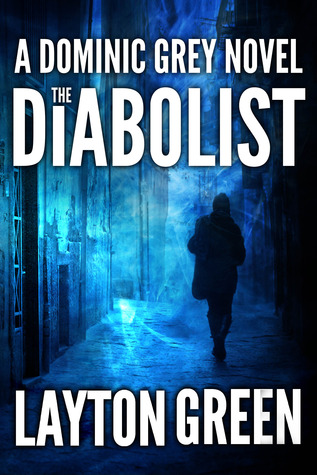
Still I loved some of the settings - Paris catacombs! Sicily! Cambridge! London! The cover is nice as well - I love those blue walls and sidewalks.

Final verdict:

Despite unreal female character one of best occult thrillers I've read this year. If Dan Brown was able to write such a book he would crow about it for the eternity and award himself a medal. It was fast-paced and decently researched, fully enjoyable. Yes, it had flaws but find me a flawless book.
Enhanced by Zemanta