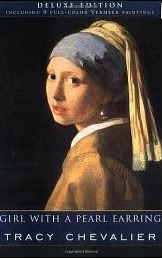


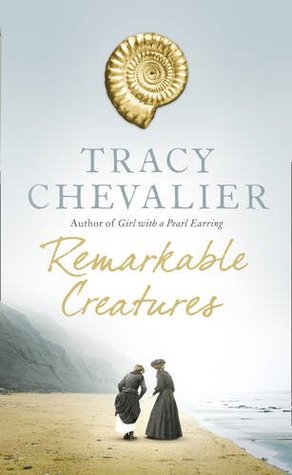
In 1810, a sister and brother uncover the fossilized skull of an unknown animal in the cliffs on the south coast of England. With its long snout and prominent teeth, it might be a crocodile – except that it has a huge, bulbous eye and a body with far more parts than your ordinary crock.
Remarkable Creatures is the story of Mary Anning, who has a talent for finding fossils, and whose discovery of ancient marine reptiles such as that ichthyosaur shakes the scientific community and leads to new ways of thinking about the creation of the world.
Working in an arena dominated by middle-class men, however, Mary finds herself out of step with her working-class background. In danger of being an outcast in her community, she takes solace in an unlikely friendship with Elizabeth Philpot, a prickly London spinster with her own passion for fossils.
 |
| Autograph letter concerning the discovery of plesiosaurus, from Mary Anning. (Photo credit: Wikipedia) |
The strong bond between Mary and Elizabeth sees them through struggles with poverty, rivalry and ostracism, as well as the physical dangers of their chosen obsession. It reminds us that friendship can outlast storms and landslides, anger and jealousy.
My impressions:
I took this one with me to the sea. I expected quite a lot from this book. I had every right to do so. After all we owe our knowledge of ammonites, bivalves, plesiosaurs, and other aquatic beasts of the era to these remarkable women, both historical figures, who hunted for and preserved fossils along England's Dorset coast. Mary Anning was more productive of the two as it was she who found the major specimens but it does not minimize the better-off Miss Philpot's many contributions, both emotional and financial, to the process. Overall those were two female fossil hunters in the early 1800s whose contributions to paleontology couldn't have been overlooked even by an extermely paternalistic society.
However, it was a slight disappointment, this one. As it was presented, it was perhaps a solid, well-made entertainment, about a subject most of us have never given a lot of thought to, but nothing exceptional.
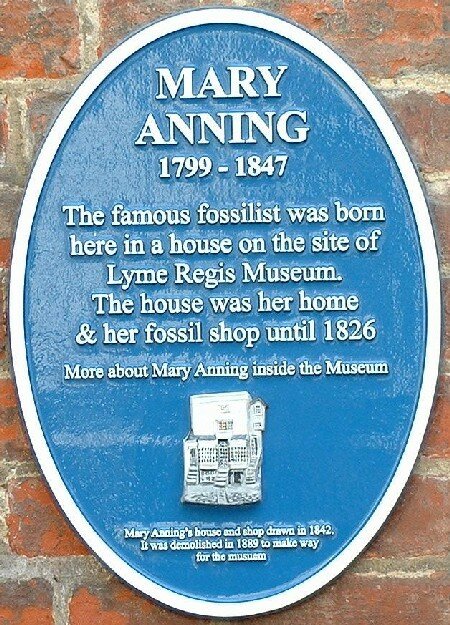
Partially I blame the narration. The first person voice is perhaps ok but two first person accounts of two different women, more than two decades apart and coming from different walks of life, should have been as different as chalk and cheese, right? Only they weren't. From time to time you are gently reminded that Mary is a daughter of a simple carpenter from a small town near the sea - mainly when she remembers to butcher one sentence out of three or says 'verteberry' instead of 'vertebrae' -but it was too little. Personally I felt that, whereas the narrative voice of Elizabeth came quite naturally to the author, that of the Mary was overshadowed by the older, more mature and better educated Miss Philpot. In fact I suppose a third person limited narration would work much better, at least in my case. It didn't help that there were too few scenes showing the incredible interaction that must have been established between those two; instead we are given a love affair between both of them and Colonel Birch, a man who first preys on their skills and exploits their infatuation in order to gather a nice collection of fossils and then does something rather out of character, (I won't spoil you here), unbearably altruistic and completely spurious, at least in my view.

The setting "Remarkable Creatures" is in the English town of Lyme Regis in the early 19th century. You might remember this quiet resort village from Jane Austen's "Persuasion". I was rather happy to revisit it, especially that here Ms. Chevalier managed to present both sides of that town, that of a joyful summer resort full of happy holidaymakers and of a winter hell hole where it is difficult to earn your living and suffer cold weather, rather well.
Final verdict:
I wanted to read a story about fossil hunting which triggered the tension between religion and science and challenged biased attitudes towards women. I was given a story of female friendship, rivalires and the woes and tribulations of being a spinster told through the lens of fossil hunting. It wasn't very bad but it wasn't brilliant either. The best part of the book in my opinion was the author's historical note at the end, telling us more about the later fates of her characters- rather remarkable in a negative way, isn't it? Meh, nuff said.