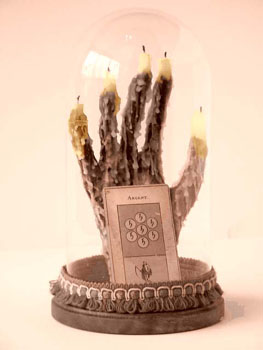



Have you read the Harry Potter series? If so, you might remember this magical device - a Hand of Glory- purchased by Drako Malfoy, Harry's nemesis, at Borgin and Burkes. Drako used it to escape from the Room of Requirement after using Peruvian Instant Darkness Powder to make it impossible for anyone to see him leave the room.
Impressive? Well, there is more to it. The various powers ascribed to a Hand Of Glory include the ability to immobilize anyone who looks at it, or unlock any door it comes across. It was traditionally used by thieves, since it allowed them to see in otherwise total darkness, open locked doors, and immobilize guards. In some dark magical ceremonies, Hands of Glory were reputed to have been used as the source of illumination. Imagine my joy when I saw this artifact featured on one of my favourtie blogs,TYWKIWDBI ("Tai-Wiki-Widbee") . I simply had to steal it:
Impressive? Well, there is more to it. The various powers ascribed to a Hand Of Glory include the ability to immobilize anyone who looks at it, or unlock any door it comes across. It was traditionally used by thieves, since it allowed them to see in otherwise total darkness, open locked doors, and immobilize guards. In some dark magical ceremonies, Hands of Glory were reputed to have been used as the source of illumination. Imagine my joy when I saw this artifact featured on one of my favourtie blogs,TYWKIWDBI ("Tai-Wiki-Widbee") . I simply had to steal it:
"The most notorious charm, the "thief's candle," found ready acceptance in most parts of Europe. The candle was fashioned from either an amputated finger or the fat of a human corpse, leading to the frequent mutilation of executed criminals. Favored, too, were fingers severed from the remains of stillborn infants - because they had not been baptized, their magical properties were considered more powerful. To enhance the candle's potency, the hands of dead criminals, known as Hands of Glory, were sometimes employed as candlesticks.
Not unknown were savage attacks on pregnant women whose wombs were cut open to extract their young. In 1574, Nicklauss Stuller of Aydtsfeld was convicted of this on three occasioins, for which he was "torn thrice with red-hot tongs" and executed upon the wheel... Burglars used these gruesome amulets to make certain that families remained asleep while homes were plundered... Before entering a home in 1586, a German vagabond ignited the entire hand of a dead infant, believing that the unburned fingers signified the number of persons still awake. Even in the late eighteenth century, four men were charged with unearthing the recently interred corpse of a woman and removing her fat for a thief's candle. Her husband had grown suspicious after fishermen, looking for bait, found an amputated hand along the seashore."
And this interesting bit of postulated etymology, from Wikipedia:
Etymologist W.W. Skeat reports that, while folklore has long attributed mystical powers to a dead man's hand, the specific phrase "hand of glory" is in fact a folk etymology: it derives from the French "main de gloire", a corruption of mandragore, which is to say mandrake. Skeat writes: "The identification of the hand of glory with the mandrake is clinched by the statement in Cockayne's Leechdoms, i. 245, that the mandrake 'shineth by night altogether like a lamp.'" (Cockayne in turn is quoting Pseudo-Apuleius, in a translation of a Saxon manuscript of his Herbarium.) The photo shows a specimen in the Whitby Museum.
The mummified severed human hand in Whitby Museum was discovered in the early twentieth century hidden on the wall of a thatched cottage in Castleton by a stonemason and local historian, Joseph Ford. He immediately identified it from popular stories of such objects as a "Hand of Glory". It was given to Whitby Museum in 1935 and is the only alleged Hand known to survive.
A Hand of Glory was supposedly the carefully prepared and "pickled" right hand of a felon, cut off while the body still hung from the gallows and used by burglars to send sleepers in a house into a coma from which they were unable to wake. In one version the clenched hand is used as a candleholder for a candle incorporating human fat, but in another (consistent with the Whitby hand) the outstretched hand has its own fingers lit. In this case should one of the fingers refuse to light it is a sign that someone in the household remains awake. In either case the light cannot be extinguished by water or pinching but only by blood or "blue" (skimmed) milk - the usual method in the tales.
Stories of the use of such hands became common across Europe, from Finland to Italy and Western Ireland to Russia in the last four hundred years. At least two were current in North Yorkshire, one relating to the Spital Inn on Stainmore in 1797 and the other to the Oak Tree Inn, Leeming, supposedly in 1824. The following shorter, but typical, version comes from Northumberland:
"One dark night, when all was shut up, there came a tap at the door of a lone inn in the middle of a barren moor. The door was opened, and there stood without, shivering and shaking, a poor beggar, his rags soaked with rain, and his hands white with cold. He asked piteously for a lodging, and it was cheerfully granted him; there was not a spare bed in the house, but he could lie on the mat before the kitchen fire, and welcome.
So this was settled, and every one in the house went to bed except the cook, who from the back kitchen could see into the large room through a pane of glass let into the door. She watched the beggar, and saw him, as soon as he was left alone, draw himself up from the floor, seat himself at the table, extract from his pocket a brown withered human hand, and set it upright in the candlestick. He then anointed the fingers, and applying a match to them, they began to flame. Filled with horror, the cook rushed up the back stairs, and endeavoured to arouse her master and the men of the house. But all was in vain - they slept a charmed sleep; so in despair she hastened down again, and placed herself at her post of observation.
She saw the fingers of the hand flaming, but the thumb remained unlighted, because one inmate of the house was awake. The beggar was busy collecting the valuables around him into a large sack, and having taken all he cared for in the large room, he entered another. On this the woman ran in, and, seizing the light, tried to extinguish the flames. But this was not so easy. She poured the dregs of a beer jug over them, but they blazed up the brighter. As a last resource, she caught up a jug of milk, and dashed it over the four lambent flames, and they died out at once. Uttering a loud cry, she rushed to the door of the apartment the beggar had entered, and locked it. The whole family was aroused, and the thief easily secured and hanged."
Stories of the use of such hands became common across Europe, from Finland to Italy and Western Ireland to Russia in the last four hundred years. At least two were current in North Yorkshire, one relating to the Spital Inn on Stainmore in 1797 and the other to the Oak Tree Inn, Leeming, supposedly in 1824. The following shorter, but typical, version comes from Northumberland:
"One dark night, when all was shut up, there came a tap at the door of a lone inn in the middle of a barren moor. The door was opened, and there stood without, shivering and shaking, a poor beggar, his rags soaked with rain, and his hands white with cold. He asked piteously for a lodging, and it was cheerfully granted him; there was not a spare bed in the house, but he could lie on the mat before the kitchen fire, and welcome.
So this was settled, and every one in the house went to bed except the cook, who from the back kitchen could see into the large room through a pane of glass let into the door. She watched the beggar, and saw him, as soon as he was left alone, draw himself up from the floor, seat himself at the table, extract from his pocket a brown withered human hand, and set it upright in the candlestick. He then anointed the fingers, and applying a match to them, they began to flame. Filled with horror, the cook rushed up the back stairs, and endeavoured to arouse her master and the men of the house. But all was in vain - they slept a charmed sleep; so in despair she hastened down again, and placed herself at her post of observation.
She saw the fingers of the hand flaming, but the thumb remained unlighted, because one inmate of the house was awake. The beggar was busy collecting the valuables around him into a large sack, and having taken all he cared for in the large room, he entered another. On this the woman ran in, and, seizing the light, tried to extinguish the flames. But this was not so easy. She poured the dregs of a beer jug over them, but they blazed up the brighter. As a last resource, she caught up a jug of milk, and dashed it over the four lambent flames, and they died out at once. Uttering a loud cry, she rushed to the door of the apartment the beggar had entered, and locked it. The whole family was aroused, and the thief easily secured and hanged."