
Showing posts with label Gail Carriger. Show all posts

Tuesday, 6 March 2012

Review: Timeless by Gail Carriger (Parasol Protectorate #05)


Form: e-book, Kindle edition
Genre: fantasy steampunk
Target audience: YA and adults who like such novels (like me)

Synopsis:

Lord Conall Maccon, the Alfa of London werewolf pack and his lovely perternatural wife, Alexia nee Tarabotti, are planning a visit to Egypt. They have to – a very old vampire queen from Alexandria, called Matakara, invited them along. If somebody like her bothers to send an invitation you simply can’t say ‘no’ – the consequences might be…well, bloody.

Matakara is especially interested in little Prudence, Alexia’s daughter and not without a good reason – the little girl can do more than she can say, especially using full sentences. In order to keep the real reason of their journey hidden, Alexia takes with herself her old friend Ivy Hisselpenny Tunstell with her lovely hubby, her twins and a part of their theatrical troupe. Ivy and Tunstell have a new play in their repertoire – a spectacular love story between a werewolf and a vampire queen. It fits only too well what will happen to them in Egypt…

What I liked:

Little Prudence and Biffy stole the show – they were two major highlights of this book. Prudence is not only a toddler who can change into a vampire and/or a werewolf, wreaking havoc and having a great time, she also hates baths and for a very good reason (I can’t tell, it’s a spoiler). Her parents and her foster parent, Lord Akeldama, are hardly a match for her - their hands are always full of this girl. A scary thought – Prudence will be a teenager soon. Speak about an ultimate parental challenge.

Biffy exceeded my wildest expectations – not only he managed to find his place in the pack (previously being rather more fond of vampires, I can’t tell more because it would be a spoiler) but also he found a new love interest and one of his abilities proved you shouldn’t judge a man by his cravat or by his waistcoat. I really appreciate such twists in fiction, especially when they are not entirely serious.

What’s more, I liked the setting of this one (Egypt) although I grieve to say it wasn’t explored to the full. More in the next section.

What I didn’t like:

It pains me to admit it but in my humble opinion the last installment of this series is also the weakest. It seems the author, who previously kept rather high writing standards, spoiling her readers mercilessly,  ran out of steam. On the one hand I do understand – it is the fifth Alexia novel after all, how many new things you can think of... On the other hand it is a pity – perhaps it would be better if the whole series was one-two books shorter.

First of all the steampunk factor, so deliciously explored in previous books, here is almost non-existent. An example: in the first part Alexia was attacked by deadly mechanical ladybugs and barely escaped. The whole scene was a hoot. Here the same ladybugs are nothing more than a toy for her two-year-old daughter (and some other equally childish adults as well). See the difference? Another example: in the first novel Alexia became a happy owner of a not very beautiful or stylish but otherwise extremely useful parasol. A very important accessory as it saved her life many times. In the last book her husband orders a substitute (as the first was destroyed) and Alexia uses it…once or twice – so barely at all, as if she didn’t need it anymore. Sad but true, substitutes never work.

Then Egypt. It is a perfect setting for such a fantasy steampunk novel: full of old ruins, mysterious monuments and intriguing secrets from the past. Our Alexia should have had plenty of fun there, right? Wrong. She gets dusty, goes up in a balloon and…she is thrown into the Nile. She sees the temple of Hatshepsut, half buried in the sand ( and very rightly so, it was excavated and restored only in the 20th century but still such a pity) and is promptly chased away. No pyramids, no sphinxes, just one old vampire queen and even she, the famous, horribly old, horribly scary Matakara, barely speaks or moves or kills. She dies. Kind of anticlimactic, you must admit.

Overall reading this one I felt a bit sad – it was supposed to be a glass of fine wine; unfortunately it tasted as if that wine was heavily diluted and then doctored a bit, sweetened and scented. Oh well, I’ve always knew ending a series is definitely more tricky than starting it.

I am also not a very big fan of the cover art. Why feature a sphinx or the pyramids if Alexia never gets close to them?

Final verdict:

If you liked the series like yours truly you will read the last installment anyway. Timeless wasn't very bad, especially compared to other books of this genre, but, compared to other Parasol Protectorate books I found it a bit wishy-washy.

Sunday, 10 July 2011

Summer mini review: Heartless by Gail Carriger (The Parasol Protectorate series 04)


Book info:

  • Mass Market Paperback: 400 pages
  • Publisher: Orbit; Original edition (June 28, 2011)
  • Language: English
  • ISBN-10: 0316127191
  • ISBN-13: 978-0316127196
  • Genre: paranormal fiction, romance, steampunk, 
  • Target audience: adults and not only...


Synopsis:

Alexia lady Maccon, nee Tarabotti, might be in her last months of  pregnancy but never indolent, inactive or bored. With a werewolf Alfa male for a husband and a single vampire extraordinaire for a best friend you can practically never have one  minute of peace. As if anybody would want one. 

An unknown ghost with short concentration span has just informed Alexia that somebody is plotting a regicide and certain vampires are still hell-bent on killing her unborn infant-inconvenience. To protect her unborn child she is going to do something unthinkable - let it be adopted even before it is born. And the happy foster parent will be... well, guess. :-)

One problem solved; now Alexia, still employed by Queen Victoria as a mujah, must do her utmost to prevent any regicide, especially that most likely a supernatural being is involved - more precisely a werewolf. The uncomfortable investigation will make her discover a lot about her husband's and her late father's past, always a dangerous thing when there are so many secrets to unveil...and so many sensitive toes to tread on. Prepare yourself for plenty of tea, treacle tart and some murderous teapots as well.

What I liked:

I don't try to conceal the fact that I am Gail Carriger's fan. Why I like her novels so much? Of course I might tell you that this book, like the previous ones, had very good plot with interesting twists and turns, a well-paced  narration which flows nicely, a strong, likeable heroine, a bevy of great secondary characters and so on. It would be all true but it wouldn’t make the whole series unique. So, what makes The Parasol Protectorate books really great and distinctly different from many other paranormal series? I tried to pinpoint some of the features in the list below:


  • The heroine is married and pregnant for the second book and still there is some well-balanced romance between her and her werewolf husband - go figure ;). No love triangle, no teenage angst, no third party involved.
  • The series is undoubtedly steampunk but without getting very violent or bloody or deadly serious. I would call it steampunk entertainment because it does entertain.
  • As I've already mentioned entertainment...the paranormal aspect is seasoned with a healthy dose of humour, that's why even vampires, ghosts and werewolves are palatable.
  • Generally Ms. Carriger's sense of humour appeals to me (which means I grin or even laugh like mad while reading her books)...forgive me if I repeat myself.
  • Comestibles like tea, treacle tart, sponge cakes and finger sandwiches make the book so incredibly appetizing to read that I get instantly hungry. Normally I am a poor eater so it is an advantage, no?
  • Secondary characters from previous parts are never forgotten; what’s more, they are also  given a chance to develop and become more and more three-dimensional with every part (I think here mainly but not only about Lord Akeldama, Madame Lefoux, Professor Lyall, Floote  and of course Alessandro Tarabotti, the long-deceased father of our dear Alexia; I can never get enough of him).
  • Finally Victorian London and its society is really nicely rendered here.
Quite a list, isn't it? Would you wish for anything more? Well, perhaps you would but it would be also rather foolish...;)

What I didn’t like:

I do admit that Madame Lefoux disappointed me a bit in this part with her mad scheme (a sensible woman and a scientist should have known better than resort to brute force even in very dramatic circumstances) and zombie porcupines never seemed half as funny as mechanical ladybirds, presented in part three but perhaps it’s only the old grumpy me.

Final verdict:

A lovely series with great steampunk accents which gets better and better. Definitely worth discovering and reading. What else could I say...I am looking forward to the next part – I’ve already pre-ordered it!


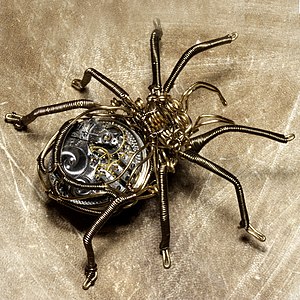
Steampunk Clockwork Spider Brass and Copper Wi...A mechanical spider via Wikipedia - I want one!


Enhanced by Zemanta

Friday, 15 October 2010

Review: The Parasol Protectorate series by Gail Carriger (Souless, Changeless, Blameless)

Review: The Parasol Protectorate series by Gail Carriger (Souless, Changeless, Blameless)

Content note: This review includes some mild spoilers for all of books of The Parasol Protectorate series, published so far (Souless, Changeless, Blameless), more or less along the lines of what you would find in the jacket blurbs. If you are highly spoiler-averse, you might want to skip the synopsis section.


Synopsis


The main heroine, Miss Alexia Tarabotti, is a well-bred and surprisingly well-educated spinster with highly independent personality – she is even-minded and calm but she knows perfectly well what she wants and she acts accordingly. Her family, consisting of a step-father, a silly mother and two even sillier half-sisters, doesn’t appreciate Alexia and openly frowns upon her bluestocking interests. After all her opinion hardly matter as she has no marriage prospects and more importantly, no soul – a trait inherited from her biological Italian father, the late Alessandro Tarabotti. So far you can call the story a supernatural Cinderella. Being soulless, referred to politely as preternatural, or impolitely as soul-sucker, her touch cancels out all of the supernatural attributes of vampires, werewolves, and ghosts. Preternaturals, especially female preternaturals, are extremely rare and so Miss Tarabotti’s nature is unknown to everyone outside of herself, the English supernatural community, and the relevant parts of Her Majesty’s Government, Queen Victoria including.

Alexia’s life takes an unexpected turn when a poorly dressed, uncouth vampire attacks her in a library and she kills him using her famous parasol. The Bureau of Unnatural Registry (BUR) is called in to investigate the incident, forcing Miss Tarabotti to renew her acquaintance with Lord Maccon, Earl of Woolsey, and Alpha of the London werewolves. As romance as much as mystery is at the heart of the series, Alexia and Lord Maccon fall in love with each other and get married at the end of the first part. 
In the second installment, Changeless, we see them already living together (a rare thing, the author didn’t shrink from describing a married couple!) and trying hard to adjust to their new situation and duties. Not that their life is peaceful and easy. Somebody tries, unsuccessfully, to kill Alexia as she follows Lord Maccon to his native Scotland, where he had departed rather suddenly one day after talking to a ghost. Alexia travels in a dirigible with one of her sisters, two friends and her faithful secretary, Floote. I must say the dirigibles (a.k.a. Zeppelins) were greater fun than the planes although they were also slower and the food was still awful.

Without giving off too much I must mention that at the end of the second part ludicrous allegations are made against our heroine, but nobody, let alone her husband, listens to her explanations. The worst thing is that she doesn't have a clue how to proceed either. Rational thinking seemed to have flown out the windows of that damp, mouldy Scottish castle, and the third part, Blameless, is about Alexia clearing her unjustly besmirched reputation and making her stubborn husband understand the depth of her attachment. Doing so, she is forced to travel to the native country of her father despite her delicate condition and the fact that all the vampires seem to be hell-bent on finishing her off. In Italy she partially uncovers some mysteries of her dad's childhood (he died in Alexia's infancy so she didn't know anything about him), his ties to Knights Templars and many other things, pleasant or unpleasant but always fascinating, not to mention pesto, the famous Italian delicacy.


What I liked:

All three books entertain through sharp wit, dry commentary, and an unusual array of paranormals but their biggest asset, in my opinion, lies elsewhere. This fantasy series is based on the premise that the separation of the Church of England from the Roman Catholic Church came about not because King Henry VIII wanted to have a fresher wife by his ample side but because he decided to integrate the supernaturals – namely vampires, werewolves, and ghosts – into English society. The supernaturals stopped being treated as natural enemies of the humankind and their skills were put to good uses with incredible success, creating thus the British Empire. Personally I found such a theory very original if not well-founded.

The romantic thread was presented equally well - the relationship between Alexia and Conall Maccon is so authentically awkward that it becomes nostalgically charming instead of boring. It was so nice to sit back and read about two people whose biggest obstacles were themselves.
I was also fascinated by the secondary characters – the development of Floote, Alexia’s butler/her father’s former valet, who has had much more history with the supernaturals/Templars than we’d known was riveting and the character Madame LeFoux as a liberated French woman in Victorian England was presented perfectly well. Not to mention the long-suffering Beta of the Woolsey pack, professor Lyall, a specialist in sheep.


What I didn’t like:

My only complaint is that we kept getting explanations about the alternative London world that Alexia exists in over and over again. It was slightly boring I must say. Several times, someone mentions Alexia’s odd state, and the effects thereof, and about how greatly disappointed her family was with her. All of this was given ample time and consideration in the first book, there was no need to repeat it in the sequels too.


The final verdict:

I think anyone not fundamentally opposed to the paranormal romance genre will find something, if not everything, to enjoy in Carriger’s series. Personally I am looking forward to reading the next installments (“Heartless” and "Timeless").