Tuesday, 26 February 2013

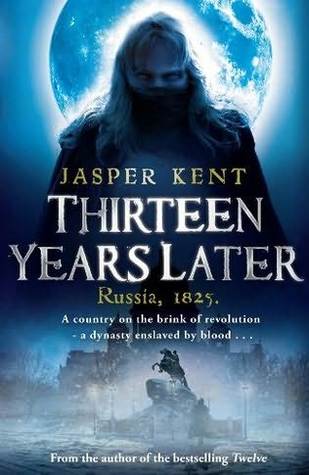
Review: Thirteen Years Later (The Danilov Quintet 02) by Jasper Kent

Synopsis (from Goodreads):

Aleksandr made a silent promise to the Lord. God would deliver him -- would deliver Russia -- and he would make Russia into the country that the Almighty wanted it to be. He would be delivered from the destruction that wasteth at noonday, and from the pestilence that walketh in darkness -- the terror by night.

1825, Europe -- and Russia -- have been at peace for a decade. Bonaparte is long dead and the threat of invasion is no more. For Colonel Aleksei Ivanovich Danilov, life is peaceful. The French have been defeated, as have the twelve monstrous creatures he once fought alongside, and then against, all those years before. His duty is still to his tsar, Aleksandr the First, but today the enemy is merely human.
However the tsar himself knows he can never be at peace. He is well aware of the uprising fermenting within his own army, but his true fear is of something far more terrible -- something that threatens to bring damnation down upon him, his family and his country. Aleksandr cannot forget a promise: a promise sealed in blood... and broken a hundred years before.

Now the victim of the Romanovs' betrayal has returned to demand what is his. The knowledge chills Aleksandr's very soul. And for Aleksei, it seems the vile pestilence that once threatened all he held dear has returned, thirteen years later.

What I liked:

First let me tell you that it is rare that a second part of a series is better than the first one. Still it can happen and I am delighted to say it happened here, at least in my humble opinion. The second installment of the Danilov Quintet series is set, in accordance to the title, 13 years after the Napoleonic invasion on Russia, during the Decembrists revolt. If you need to brush up on your history as I did -  In December of 1825 in St. Petersburg, a group of military officials staged a revolt against Tsar Nicholas I. These rebels were liberals who felt threatened by the new ruler's conservative views and they wanted his brother, Konstantin, to take over the throne. They were, however, quickly defeated by the tsar's forces. Sixty to seventy rebels died, and all that were captured were either hanged or exiled to Siberia. As a result of this revolt, Nicholas I implemented a variety of new regulations to prevent the spread of the liberal movement in Russia.

Aleksei Ivanovich Danilov once again is your guide in the shadowy world of imperial Russia's spies and secret societies. He is accompanied by his young son, Dimitry, who, according to his father's wishes, is about to join the Russian Army but if he were to decide he'd prefer to become a professional pianist and composer. I liked the fact that some chapters we witness through Aleksei's eyes and some are told from the Dimitry's point of view because it allowed the author to refresh his world build. Overall this novel is better written than the first one, with a more balanced conflict between the human and the vampire factions, more nuanced characterization and more historical background. Without spoiling you much I might say that Iuda a.k.a Richard Cain a.k.a Vassily Makarov is back again and Aleksei will have to deal with him on a definitely more intimate level than he'd ever wanted to. Iuda is a great creation and I was very glad that he returned in full force.

The mystery of the Romanov Betrayal and the Taganrog / Crimea chapters were a very interesting addition to the whole plot. Also the romantic angle of the two women in Aleksey life continues to be one of the highlights of the story so far, with additional elements/characters featuring in the background like the little daughter of Aleksei and Domnikiia, Tamara, or Aleksei's son, who was supposed to know nothing about the illicit Moskow affair of his dear daddy but, as it often the case with children, knew rather more than less. It was really nicely ballanced.

You also meet one great vampire character, called Kyesha. I admit it was the very character I was personally waiting for while reading Twelve - a complicated baddie who defies clear-cut division lines which had ruled Aleksei's life so far. Let me just tell me this: Aleksei will feel responsible for that particular vampire and will bond with him despite himself almost as if Kyesha was his long-lost friend.

What I didn't like:

I know that some editors pressurize authors to make every installment of a series a more or less stand-alone book but it is not a practice which I particularly like or appreciate. When the first hundred pages (so about one fifth of the whole novel) are spent catching up from the previous part I sometimes yawn angrily and sometimes skim waiting for the real fun to happen but never think 'gee, thanks for mentioning, good to be reminded of it, I've really forgotten about this or that!'. I've already worked out that some time had passed and usually if I like a series I read one part straight after the other (providing they are available).

I also admit I found the flow of the plot a little jerky between part’s two and three (it felt like the individual vampire story was being overly stretched out in order to fit with the historical drama.) Now something about the ending. It felt rushed, especially the outline of the Aleksei's fate after the revolt. It seemed to me that the author wanted to get rid of the poor old Aleksei post haste in order to have his son in the third part all on his own. I wasn't pleased by such a treatment but perhaps it paid off - I will be able to say so after reading the next installment.

One more problem and I have to mask it as a spoiler and it is connected with the vampires. According to Mr Kent as soon as a vampire dies his or her body turns into a pile of ash unless the vampire in question is really 'freshly created' or young. Now there is a scene at the end of the novel when (spoiler, highlight to read)  critically injured Iuda, in order to save his life, drinks blood of Kyesha, a vampire boy he killed a bit earlier. Iuda, a kind of mad scientist, saved his blood in a glass vial just in case and did so after Kyesha had drunk his contaminated blood as well, starting the change. Now my question is: if it was blood of a dead vampire why it didn't turn to ash like the rest of Kyesha's body parts, attached or not attached?

Final verdict:

One of better historical fantasy series with vampires I've read so far - of course providing that the next book won't be a big fat disappointment (but hey, Iuda might be featured again and I love following and hating that b*****d!). This series is a must if  you're a fan of the genre and generally a good quality entertainment even if you don't usually read historical fantasy .
Enhanced by Zemanta

Sunday, 24 February 2013

Review: Greywalker by Kat Richardson (Greywalker 01)

Book info:
Form: paperback, 341 pages
Genre: urban fantasy, detecitve story
Target audience: adults


Synopsis

Harper Blaine, a PI living with her ferret, Chaos, in Seattle, sometimes runs out of luck. One of such instances (a very agressive  debtor determined not to pay his debt) results in her being taken to a hospital  in a very bad  state of utter confusion - grevious bodily harm and such. When she comes to her senses (more or less) she finds out that she was clinically dead for approximately two minutes.  Ok, no big deal, it can happen in this line of work and if the paramedics still manage to resuscitate you it is fine, right? Wrong.

 Harper goes out of the hospital, determined to continue  earning her living and paying the outstanding bills when things start getting strange. It seems  she has developed the ability to see into the Grey, the purgatory-like  alternate reality in between here and the afterlife, full of  vampires, ghosts, and various creepy critters. Unfortunately for Harper, the creatures of the Grey have the ability to see her as well  and not all of them are exactly harmless or friendly. Will she be able to learn how to defend herself?

Back to the normal world. Soon enough Harper is having two new clients. A posh, middle class lady is looking for her missing son, a uni student, who's disappeared without most of his precious goods and chattels. The police don't want to investigate because a missing student is hardly a big deal. A strange foreigner is looking for old  pipe organs, once allegedly his possession, and wants Harper to find them for him. Nothing difficult for a PI, isn't it? Or maybe, just maybe, these two cases are somehow connected and far more complicated than they sound? 
What I liked:

I found this one in a bookshop with cheap sale books and somehow the blurb took my fancy so I bought it. The book one is not exactly new (it was released in 2006) but I admit I found it  a lot more unique than I expected.  The Grey, somewhere in-between the real land of the dead and the harsh reality... an intriguing concept  and the author didn't disappoint in that respect. The world building was a refreshingly different, and surprisingly coherent and let me tell you, it is no mean feat to achieve it with more and more  series being  increasingly oversaturated with vampires, werewolves, and intrepid female PIs. We have vampires and revenants and witches and ghosts all inter-twined in different ways – and even these simple labels rarely encapsulate the full power and variety of each being. 

Unlike the familiar heroine in the genre, Harper appears older and rather mature (however her age is not stated in the first installment so forgive me if I am wrong). I was so happy we were spared annoying wisecracks and fashion tips, not to mention shopping for clothes. Also the vampires, presented here, are more bloodthirsty and cunning than in your average paranormal romance. Yes, we get one Edward and one Alice but Edward is a manipulative, sadistic businessman and Alice is his biggest enemy - no Twilight traces. Which is good.

The plot I found interesting and well-spaced, although a bit slow at the beginning; still starting a book with the death of the main character is always an original  move. There is some romance but no insta-love or any such inanities.
What I didn't like:

I know it is the first book in the series and a debut novel to boot but it was sometimes weird that you don't learn anything about the main character except that she was attacked, died for two minutes, has shoulder length hair, lives alone and owns a ferret. Ferret was actually sweet and funny but she can't stand for the whole family, right? In my opinion such skeletal characterization makes Harper harder to relate to at first. It seems as if this book was a lot of set-up for other books, and that the author idn't have a clear picture of how she wanted to flesh out her main character. 

The narration also spends quite a lot of time on Harper blindly trying to figure out what the heck is going on with her and not believing other people (like one Irish witch called Mara) who try to help her. It was a bit irritating. From time to time (too often in my humble opinion) we get such a scene:

Harper: I don't want this Grey. It hurts!
Mara: Because you're fighting it. Accept it and it'll stop hurting.
H: But I don't want it. I want it to stop, to go away, to vanish! Shooo ugly monsters!
M: They won't go away and this can't be undone. Accept it and it will be easier.
H: But I don't want to be the Greywalker! I don't believe in it and I don't like the smell!
M: You must accept it. There is no other option.

*Harper glowers, pouts and storms out without another word*
*Hours pass and then they talk over the phone or in person and...*

M: I'm sorry I pushed you too strongly.
H: It's okay. I know you did me a favour.
M: Come along for a piece of cake and some good energy.

Yeah...did I say the heroine is mature? Scratch that. She is SOMETIMES mature and sometimes not.
Final verdict:

In my opinion Greywalker  has a potential to evolve into a good series. The good news is that you don't have to wait forever for the rest - as far as I know there are at least seven other novels available on the market.

If you're looking for an original spin on the standard urban fantasy tropes or a female-protagonist urban fantasy with a lot more action and a lot less romance, then this novel is worth taking a look at. It is nothing great but it will keep you entertained.
Enhanced by Zemanta

Friday, 22 February 2013

Review: Interred With Their Bones (Kate Stanley 01) by Jennifer Lee Carrell

Book info:
Form: pdf file
Genre: Shakespeare thriller(?)
Target audience: library and Shakespeare fans of all age
Synopsis

On the eve of the Globe’s production of Hamlet, Shakespeare scholar and theater director, Kate Stanley, gets a visitor. Her former eccentric mentor Rosalind 'Roz' Howard gives her a mysterious box, claiming to have made a groundbreaking discovery and now she needs Kate's help. Then the theatre catches fire, on the same date, June 29th, that the original Globe burned, and Roz is found dead. This begins a huge chase across England, the US and Spain to find a missing Shakespearean manuscript of one of his less known plays which might contain the information about the real identity of its author.
What I like:

Firstly and foremostly  I loved the fact that Jennifer Lee Carrell really knew what she was writing about. She is not one of these authors which make factual mistakes, leading their characters on a wild goose chase to places which don't exist. When she describes a library or a cave you can feel she was and worked there herself. After just a page or two It became obvious that her research and love of the subject is phenomenal. I found myself literally sucked into the various debates that I’ve been aware of through the years but never in detail:  the idea that Shakespeare didn’t actually write the books, that there are others who might be better contenders, that there are people who are adamant that only Shakespeare himself could create such magnificent work.

By and large the mystery surrounding the identity and works of William Shakespeare was something that completely captivated my mind because, in itself, it is a topic which has it all: love, murders, conspiracies, betrayal, theatre and history. I admit I never had enough of it, no matter whether it was presented as a lecture, delivered by one of the contemporary characters or as a blast from the past scene. In fact the chapters set at the time of Shakespeare, retelling the story of the Granvilles and Sheltons were superb -far better than the rest of the novel. I certainly learned a lot - about the code of Bacon and the writing of the King James Bible. But I did feel there were times when the history overwhelmed the story.

What I didn't like:

First let me remind my dear readers that I am a huge anti-fan of Dan Brown. Yes I love to hate all his books for a lot of different reasons, some of them good, some of them just visceral. The fact that the blurb of this one mentions The Da Vinci Code really put me off for some time. Still as Heidenkind recommended "Interred..." on her excellent blog I decided to give it a chance. I suppose a small part of me kept hoping that it would be better than any Brown production. Let's face it, few novels are worse than Dan Brown 'bestsellers', right?

Fortunately this one wasn't worse.

BUT.

If you took away the literary and historical mystery part I am sure my assessment would be a lot harsher.

Let me warn you: I found the adventure aspects of the book formulaic and  boring from time to time. The final outcome was highly predictable as I was able to guess the identity of one of the baddies very early on and it was one of those novels which make you sure that no matter what happens to the main protagonists they will survive in one piece because survive they must - there is a sequel on the shelves, winking at you.

Indeed, the outlandish way in which the author allowed the main characters to jump between the UK, America and Spain with ease (initially without any passports! why does the author never discuss how jetlagged they must have been by the end of this! ) and then they carry weapons around and successfully fool passport control as Kate goes on a journey between continents dressed up as a man on a forged document ...highly unbelievable! Added to this, the completely unreal simplicity with which British Law Enforcement operated within the USA was ridiculous.

 After a while the  characters started acting without any sense and the reasoning behind it was a kind of cop-out. The character development was uneven especially when it came to Ben Pearl, . The climax was unfortunately the choppiest part, full of "It wasn't me! I was working with her! Ok, just kidding, he was with me and I am not working with her! I was dead! Now she's dead!"

Final verdict:

Concept: great. Execution...it could have been better.This is definitely a light read for those who love theatre, literature, Shakespeare in particular, books and libraries. There are wonderful descriptions of library stacks and rare folios. I hate to say it but this novel is indeed close to being the “Da Vinci Code” for Shakespeare aficionados. Others would probably find it fairly boring. I blame, as always, Dan Brown, let him burn in hell.

Enhanced by Zemanta

Tuesday, 19 February 2013

Shakespeare Or Not Shakespeare? That Is The Question…


William Shakespeare
William Shakespeare - an English poet and playwright, by many literature pundits regarded as the greatest author in the English language and the world's pre-eminent dramatist. His works, including some collaborations, consist of about 38 plays,154 sonnets, two long narrative poems, two epitaphs on a man named John Combe, one epitaph on Elias James, and several other poems. His plays have been translated into every major living language and are performed more often than those of any other playwright. What author wouldn’t dream of such achievements? You can even say several good writers would be quite happy to share all this wealth. However many critics have asked themselves how it was possible that a simple son of a glover from a little backwater place called Stratford-upon-Avon single-handedly transformed the whole English and world literature for centuries if not forever? Wasn’t it in fact a kind of an astounding miracle? 

You might be surprised but many people don’t believe in miracles and don’t believe in the common notion that Shakespeare from Stratford-upon-Avon was the sole or the main author of all these wonderful plays and sonnets; some say he actually didn’t write anything at all because he was…illiterate. Let’s face it, their arguments are interesting to say the least of it.

English: Birth place of William Shakespeare, S...Firstly it is a well-established fact, even among mainstream scholars that we know surprisingly little of Shakespeare’s personal life – the biographical facts are so scant that their lack might indeed indicate an organized attempt to expunge all traces of the real Shakespeare from the historical record and to conceal the true identity of this man. The available data, regarding his life consist of mundane personal details: vital records of his baptism, marriage and death, tax records, lawsuits and real estate transactions. One might wonder, though: if those documents survived, why not the other ones? No personal letters or literary manuscripts written by Shakespeare of Stratford have been found. Did he really attend the Stratford’s grammar school as it is widely thought? There are no records which could support that claim. Was he really an erudite and an autodidact who not only composed beautiful poems and wrote brilliant plays but also had intimate knowledge of the Elizabethan and Jacobean court and politics? When, where and from whom did this man who never traveled farther than London from his hometown, and who reputedly spent the years prior to his early marriage in apprenticeship to a butcher, supposedly learn all of this? I have to admit that without everyday press, television or the Internet and a well-connected family as a support the task sounds rather daunting.

Family… here also you can find controversies galore. Shakespeare's father, John, married Mary Arden, one of the Ardens of Warwickshire, of the local gentry; still both of them signed their names with a mark, and there are no other examples of their writing. This is often used as an indication that Shakespeare was brought up in an illiterate household. At 18, Shakespeare married the pregnant Anne Hathaway, who was eight years his senior. By 21, he had fathered three children. He turns up in the documentary record next at age 28 in London—apparently without his family—working as an actor. He's later listed as a member of a prominent acting troupe, the Lord Chamberlain's Men, and then the King's Men. His name appears on the title pages of plays printed for popular consumption beginning in his mid-30s. Records show he retired around 1613 and moved back to Stratford, where he died in relative obscurity three years later at 52. In his last will he bequeathed no books to anybody – is it possible he didn’t own one? Not even a copy of his own plays? What’s more, there is no evidence that Shakespeare's two daughters were literate, save for two signatures by Susanna that appear to be "drawn" instead of written with a practiced hand. His other daughter, Judith, signed a legal document, like her grandparents, with just a mark. Don't tell me that such an educated, cultured man didn’t care whether his own daughters could read his own poems and plays or indeed, read at all. A man who exhibited a surprising level of intimacy with court politics and culture, foreign countries, and aristocratic sports such as hunting, falconry, tennis, and lawn-bowling never had time and/or money to teach or have his daughters taught ? Would the only literate member of his extended family (his son-in-law) praise, in print, fellow Warwickshire poet Michael Drayton but never write a line acknowledging that his own father-in-law was England's most accomplished and appreciated poet-dramatist (or even a writer)?

It's also certainly curious that the creator of such vivid, recognizably human characters as Falstaff, Lear and Hamlet should himself remain as insubstantial as stage smoke. The most detailed description of the man left to us by someone who actually knew him, it seems, is a less-than-incisive sentence from his friend and rival, the playwright Ben Jonson: "He was, indeed, honest, and of an open and free nature." Hmm…you have to admit that it covers a lot of ground, almost as if Jonson didn't want to say anything concrete at all. As for Shakespeare's appearance, none of his contemporaries even bothered to describe it. Tall or short? Thin or chubby? It's anyone’s guess. You might say that there are at least paintings of Shakespeare face but, unfortunately, here we also hit a snag. Rendered by long-forgotten artists, each of the six painted portraits surfaced only after the playwright's death, in some cases centuries later, so without any indication that the authors had seen or known Will at all.

Academic Shakespeareans and literary historians rely on documentary evidence in the form of title page attributions, government records such as the Stationers' Register and the Accounts of the Revels Office, and contemporary testimony from poets, historians, and those players and playwrights who worked with him, as well as modern stylometric studies. These criteria are the same as those used to credit works to other authors and are accepted as the standard contemporary methodology for authorship attribution but do they work as efficiently in the case of an author from a completely different era?

 Let’s take a closer look at the language of Shakespeare and more precisely at the number of words he used. It is definitely a language of an erudite, consisting of a really extensive vocabulary, calculated to be between 17,500 and 29,000 words, some of them invented by the author himself. It is really impressive. For everyday conversational needs, you need about 2500 words to communicate effectively in a wide range of social and practical situations. Most native speakers use more than 3,000 words regularly, irrespective of their level of education, and they have a "passive vocabulary" of 15-20,000 words that they know but don't often use. Professional writers and translators tend to have an active vocabulary of 20,000 - 30,000 words and a passive vocabulary of 150,000+. Lederer has suggested that a typical English speaker has a vocabulary of between 10,000 and 20,000 words. Mind you we speak here about contemporary people and criteria. In December 2010 a joint Harvard/Google study found the whole English language to contain 1,022,000 words and to expand at the rate of 8,500 words per year so back then the author of Shakespeare plays would be placed really high as a language user. Does it tally with the profile of Shakespeare from Stratford? What would his longhand reveal?


Shakespeare's six authenticated signatures, shown above, are written in secretary hand, a style of handwriting that vanished by 1700, and he used breviographs to abbreviate his surname in three of them (breviographs being a type of scribal abbreviation in the form of an easily written symbol, character, flourish, or stroke based on a modified letter form). The appearance of Shakespeare's surviving signatures is often characterized as "an illiterate scrawl"; it can indicate that he was illiterate or barely literate. 

What’s more, William Shakespeare did not spell his name as it appears on most Shakespeare title pages. Overall his surname was spelled inconsistently in both literary and non-literary documents, with the most variation observed in those that were written by hand. This can be taken as evidence that he was not the same person who wrote the works, and that the name was used as a pseudonym for the true author, especially that some versions are hyphenated as "Shake-speare" or "Shak-spear". This hyphen use might be construed to indicate a pseudonym;  anti-Stratfordians  argue that fictional descriptive names (such as "Master Shoe-tie" and "Sir Luckless Woo-all") and pseudonyms such as "Tom Tell-truth" were often hyphenated in plays to emphasize the fact that they were not real names.

Reasons proposed for the use of "Shakespeare" as a pseudonym vary, usually depending upon the social status of the candidate. Aristocrats such as Derby and Oxford supposedly used pseudonyms because of a prevailing "stigma of print", a social convention that putatively restricted their literary works to private and courtly audiences—as opposed to commercial endeavours—at the risk of social disgrace if violated. In the case of commoners, the reason was to avoid prosecution by the authorities: Bacon for example wanted to avoid the consequences of advocating a more republican form of government, and Marlowe - imprisonment or worse after faking his death and fleeing the country.

If not William Shakespeare from Stratford then who? The Bard's authorship has been questioned publicly since 1848, when Joseph C. Hart, in his book The Romance of Yachting, said that "Shakespeare merely adapted the works of more educated playwrights, making them popular by adding the occasional crude joke”. Skeptics have suggested more than 70 different candidates but let me focus on the most important ones. We’ll deal with the ladies first. Yes, the ladies – because some anti-Stratfordians claim that there must have been a woman behind Shakespeare.

Elizabeth I (7 September 1533 – 24 March 1603)

The queen regnant of England and Ireland from 17 November 1558 until her death on 24 March 1603. Sometimes called "The Virgin Queen", "Gloriana" or "Good Queen Bess", Elizabeth was the fifth and last monarch of the Tudor dynasty. By the time her formal tutoring ended in 1550, she was one of the best educated women of her generation – she could write English, Latin Italian, French and Greek. By the end of her life, Elizabeth was also reputed to speak Welsh, Cornish, Scottish and Irish in addition to English. Allegedly she could compose poems but she lived too short to be considered the author of Jacobean plays. And would he really have time for all that even if she loved theatre?  What, with the whole kingdom on her red head and those wars, conspiracies and lovers...

Mary Sidney Herbert the second Countess of Pembroke (1561 – 1621)

Like the Queen she was well educated and high-minded, with a talent for poetry. Her education enabled her to translate Petrarch's "Triumph of Death" and several other European works. She had a keen interest in chemistry and set up a chemistry laboratory at Wilton House, run by Walter Raleigh's half-brother. She turned Wilton into a "paradise for poets", known as "The Wilton Circle" which included Edmund Spenser, Michael Drayton, Sir John Davies and Samuel Daniel, a salon-type literary group sustained by the Countess's hospitality. Her aim shared with her brother Sir Philip Sidney was to strengthen and classicize the English language. After James I visited her at Wilton in 1603 and was entertained by Shakespeare's company "The King's Men", Mary moved out of Wilton as Dowager Countess and rented homes in London. Though it is certain that the King's Men attended Wilton, whether William Shakespeare was with them remains unconfirmed. However, it is reported that there was at Wilton at one time, a letter in which the Mary Sidney urged her son to attend Wilton, as "we have the man Shakespeare with us." If she wrote a play or two she definitely could have paid her way to see it on stage, under a different name of course, and she would be careful to remove any proof, unfortunately.

Sir Francis Bacon (22 January 1561 – 9 April 1626)

He was a lawyer, philosopher, essayist and scientist so definitely a very educated man. Bacon's candidacy relies upon historical and literary conjectures, as well as alleged cryptographical revelations. In a letter addressed to John Davies, Bacon closes "so desireing you to bee good to concealed poets", which according to his supporters is self-referential.Baconians argue that while Bacon outlined both a scientific and moral philosophy in The Advancement of Learning (1605), only the first part was published under his name during his lifetime. They say that his moral philosophy, including a revolutionary politico-philosophic system of government, was concealed in the Shakespeare plays because of its threat to the monarchy. Baconians suggest that the great number of legal allusions in the Shakespeare canon demonstrate the author's expertise in the law. Bacon became Queen's Counsel in 1596 and was appointed Attorney General in 1613. Bacon also paid for and helped write speeches for a number of entertainments, including masques and dumbshows, although he is not known to have authored a play. His only attributed verse consists of seven metrical psalters, following Sternhold and Hopkins. Since Bacon was knowledgeable about ciphers, early Baconians suspected that he left his signature encrypted in the Shakespeare canon. In the late 19th and early 20th centuries many Baconians claimed to have discovered ciphers throughout the works supporting Bacon as the true author. In 1881, Mrs. C. F. Ashwood Windle claimed she had found carefully worked-out jingles in each play that identified Bacon as the author. This sparked a cipher craze. Hull Platt for example argued that the Latin word honorificabilitudinitatibus, found in Love's Labour's Lost, can be read as an anagram, yielding Hi ludi F. Baconis nati tuiti orbi ("These plays, the offspring of F. Bacon, are preserved for the world.").

Edward de Vere, 17th Earl of Oxford and Lord Great Chamberlain of England (12 April 1550 – 24 June 1604)

One of the most serious and most popular candidates. Oxford was an important courtier poet, praised as such and as a playwright by George Puttenham and Francis Meres, who included him in a list of the "best for comedy amongst us". Examples of his poetry survived but none of his theatrical works. Oxfordians believe certain literary allusions indicate that Oxford was one of the most prominent "suppressed" anonymous and/or pseudonymous writers of the day. They also note Oxford's connections to the London theatre and the contemporary playwrights of Shakespeare's day, his family connections including the patrons of Shakespeare's First Folio, his relationships with Queen Elizabeth I and Shakespeare's patron, the Earl of Southampton. He had vast knowledge of Court life and his wide-ranging travels through the locations of Shakespeare's plays in France and Italy might be another tip. The case for Oxford's authorship is also based on perceived similarities between Oxford's biography and events in Shakespeare's plays (notably Hamlet), sonnets and longer poems; perceived parallels of language, idiom, and thought between Oxford's letters and the Shakespearean canon; and the discovery of numerous marked passages in Oxford's Bible that appear in some form in Shakespeare's plays.

Christopher Marlowe (baptised on 26 February 1564 – 30 May 1593)

Another candidature which has gained a lot of followers. Poet and dramatist Christopher Marlowe was born into the same social class as Shakespeare—his father was a cobbler. Marlowe was the older by only two months, but spent six and a half years at Cambridge University so was far better educated. He pioneered the use of blank verse in Elizabethan drama, and his works are widely accepted as having greatly influenced those of Shakespeare.

The Marlovian theory argues that Marlowe's documented death on 30 May 1593 was faked. Thomas Walsingham and others are supposed to have arranged the faked death, the main purpose of which was to allow Marlowe to escape trial and almost certain execution on charges of subversive atheism. The theory then argues that Shakespeare was chosen as the front behind whom Marlowe would continue writing his highly successful plays. These claims are founded on inferences derived from the circumstances of his apparent death, stylistic similarities between the works of Marlowe and Shakespeare, and hidden meanings found in the works and associated texts.

Marlovians note that, despite Marlowe and Shakespeare being almost exactly the same age, the first work linked to the name William Shakespeare—Venus and Adonis—was on sale, with his name signed to the dedication, just 13 days after Marlowe's reported death, having been registered with the Stationers' Company on 18 April 1593 with no named author. Lists of verbal correspondences between the two canons have also been compiled.

William Stanley, 6th Earl of Derby (1561 – 29 September 1642)

He was first proposed as a candidate in 1891 by James Greenstreet and later supported by Abel Lefranc and others. Greenstreet discovered that a Jesuit spy, George Fenner, reported in 1599 that Derby "is busye in penning commodyes for the common players." That same year Derby was recorded as financing one of London's two children's drama companies, Paul's Boys; he also had his own company, Derby's Men, which played multiple times at court in 1600 and 1601.Derby was born three years before Shakespeare and died in 1642, so his lifespan fits the consensus dating of the works. His initials were W. S., and he was known to sign himself "Will", which qualified him to write the punning "Will" sonnets.Derby travelled in continental Europe in 1582, visiting France and possibly Navarre. Love's Labour's Lost is set in Navarre and the play may be based on events that happened there between 1578 and 1584. Derby married Elizabeth de Vere, whose maternal grandfather was William Cecil, thought by some critics to be the basis of the character of Polonius in Hamlet.Still is it really viable proof?


Enhanced by Zemanta

Sunday, 17 February 2013

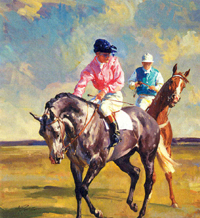
Review: In the Frame by Dick Francis

Book info:
Form: pdf e-book
Genre: crime mystery, thriller
Target audience: adults

I was encouraged to read this one by an excellent review of Heidenkind - thank you very much for the inspiration!
Synopsis

When Charles Todd visits his cousin, Donald, he lands unexpectedly right in the middle of a major crisis: a burgled house, Donald's young wife, Regina, brutally murdered, Donald himself prostrated by grief, almost at his wit's end. What's even worse the police inspector instead of looking for a murderer starts accusing Donald of orchestrating the whole burglary to profit financially from it and help his ailing firm. Charles is outraged by their approach but what can be done? Especially that shocked Donald doesn't even think of defending himself efficiently.

Returning to London Todd, who earns his living as a painter specialising in horses, is hired by Maisie to immortalize her burned house on canvass (not a horse, I know, but still an income). Chatting with that lady he almost has a sense of déjà vu: Maisie, like his cousin, has visited Australia recently, she, like his cousin, brought back a Munnings painting bought for a very reasonable price in an obscure, little art gallery and now she lost her house and almost all her belongings. Just a coincidence? Or maybe those two tragedies are somehow connected? Also in the case of Maisie the insurers are giving the victim a lot of grief, suspecting foul play.  When Todd decides to investigate, Maisie is only too willing to assist him financially.

With her money, Charles is able to go to Australia and start sniffing around. He is helped by Jik, his old university friend, also a painter, and his wife, Sarah who live in Melbourne. Soon enough they trail a set of clues only to realize that someone is trailing them. What will they discover?

What I liked

I liked the characterization in this novel, I really liked it a lot. It was done in really great way (and yes, I felt like repeating myself). Charles (or rather Todd, he hated being called Charles in fact)  is a painter and he talks, thinks and breathes his passion. If he watches somebody he can describe them very accurately afterwards, he can tell you what ingredients are in particular paint colours, he can distinguish between a fake and an original just looking at the paint brushes; you don't doubt for one second that he is the real thing. The same can be said about his friend Jik - although he is a man of a completely different temperament and style, he and Todd understand each other perfectly well mainly because they share the same way of thinking.

It was a nice change that Todd wasn't made to fall in love during his investigation. Well, he kind of fell for Sarah but he controlled his feelings like an adult, responsible person. No insta-love or insta-lust - it made the novel even better. At least I got the feeling that the relationships between Jik, Sarah and Charles were natural and real.

What's more, I loved the narration style - smooth, elegant, unaffected, peppered with funny dialogues and situations in the right moments, teaching you a thing or two about art as well. In fact I was surprised when I found out that Francis was not a painter but a retired jockey; the man definitely knew a lot about painting and must have had an artisitc soul.

It is a crime story and I am glad to say that the whole mystery was nicely done, not very difficult but also not so easy to solve. Sometimes Todd reminded me of Sweeney Todd the Demon Barber of Fleet Street - they shared the same passion in pursuing the justice. It is a compliment of a kind I suppose ;).

What I didn't like

I admit that Charles Todd was a bit too lucky from time to time, especially for a total rookie of a private investigator who encoutered very ruthless and agressive criminals on his path. It was his first case, after all! I was also surprised a bit that such a big, efficient criminal organization like the one he discovered didn't have a plant inside the police forces. However, those are minor quibbles.

Final verdict

One of better murder mysteries I've read for a long time even if it felt a bit dated. I will gladly take another Francis book.


Thursday, 14 February 2013

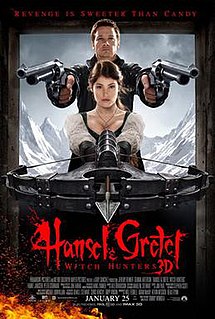
Movie review: Hansel and Gretel Witch Hunters by Tommy Wirkola

Directed by Tommy Wirkola
Screenplay: Tommy Wirkola, Dante Harper
Release date: 2013
Genre: Action/Horror/Comedy/Fairy tale

Cast:
Hansel: Jeremy Rennel
Gretel: Gemma Arterton
Dark witch Muriel: Famke Janssen
Mina: Pihla Viitala
Edward the troll : Derek Mears


Synopsis
You remember, I bet, one of the most popular Grimm fairy tales, Hansel and Gretel? Two kids abandoned by their parents in the middle of a forest who found a cottage made of sweets and a horrible witch inside? They outsmarted her and  shoved her into the fire.

Now they are back: still toghether, more lethal than before, wearing leather jackets and latex pants. Hunting witches for money - that's what they do the best.


One day they are hired by Mayor Englemann from Augsburg to find and rescue several children abducted by witches. When they arrive, they prevent Sheriff Berringer from executing Mina, a young woman accused of witchcraft. Berringer hires trackers for the same mission, hoping to regain the respect of the Mayor. However, all but one of the party are killed that night by the powerful grand witch Muriel, who sends the surviving member back to the town tavern to explode as a warning to the locals. Hansel and Gretel, with the help of the Mayor's deputy Jackson, capture a witch and interrogate her. They discover that the witches are preparing for the ritual of Blood Moon, which requires sacrificing six boys and six girls, each born on a separate month. Will our witch hunters manage to save them on time? What other secrets will be unveiled, concerning their own life? Who they can trust?


My impressions

Tommy Wirkola asked himself what  became of Hansel and Gretel when they grew up. The answer seemed such a simple one: obviously they became witch hunters. Such an elegant solution. What about the rest? Well...

First let me tell you that I love different adaptations and renderings of classic fairy tales so I was very eager to watch this one, especially as the director wanted to go several steps further than the actual fairy tale. He also did his best to entertain the wider audience.The project was filmed in Germany and featured an international cast and crew. There's enough action, killing and gore to satisfy any gung ho movie-goer. Our Gretel is a buxom beauty, not afraid to show her assets; Hansel has a bit of romance with Mina, a girl he helped to save from the lynching mob and she isn't exactly a shy virgin as well. Still while watching the movie I got a distinct impression everything was somehow a fake and, after a while, if I laughed it was out of sheer embarassment. 'Style over substance' is a good description of this one; I suppose it is always nice if you can switch off your brain and just let the narration take you whenever it is going...I admit I am not good at that.

Candy cottage in the shape of...the Sauron's eye?
So what disturbed me the most? The movie was very uneven in tone, never even trying to reach those deeper meanings of the fairy tale it was based on. It was shallow. We got some great fighting scenes but also a generic German town full of dumb, fake inhabitants. The pair of protagonists used firearms and machine guns (and pray where did their ammunition come from?) but they didn't know how to locate each other in case of emergency; you must admit that running like mad across the forest shouting 'HANSEL' is hardly a good way to solve that problem. Especially that you know that a very evil witch and a band of equally evil mercenaries are set loose in the vicinity. Hansel was a diabetic as a result of his former childhood ordeal and needed to take a regular shot of insulin every day BUT we are never shown where that insulin  is bought, how it is created and, most of all, how it is stored (if you don't know - insulin MUST be stored in a fridge or it becomes useless!).

None of the witches had any backstory: they just seemed to exist for ornamental purposes and to be turned into mincemeat of course. Nobody even tried to explain what had made these women turn to dark witchcraft, risking their lives, apart from the obvious perks: donning tons of Goth make-up, very well-done I grant it, fancy, artfully torn clothes and flying  brooms... Would you die for a chance to paint your face or fly your broom though? I don't think so. Overall the baddies were as thin as a sheet of paper so no pleasant surprises there.

Isn't he lovely?
I had high hopes considering Edward the troll. I did enjoy a possibility that he might somehow turn into (don't laugh at me now) a crush of Gretel. He was strong, he was sweet and caring, his heart and fists were on the right side. And on the left. Anyway where they should be. Unfortunately my imagination was thwarted again by the ugly schematic movie cliches: Edward apparently was cast as a troll version of a King-Kong: he did save Gretel and she said 'thank you' very nicely but then...it fizzled out brecause monsters cannot be your love interests.

An interesting tidbit: at the end Gretel was allowed two more or less permanent admirers but Hansel remained alone. I wonder why. To draw the ladies to the sequel (perish the thought)?

Final verdict

Was it really eighty-eight minutes of trash? More or less yes. Still  it puts forth one sound message: kids, avoid overindulging in sweets, especially if you see candy that doubles as drywall and other building elements. And remember, there is no such thing as 'free candy'. However, if you have a problem with dark witches don't hire Hansel and Gretel - they are very expensive amateurs. They don't even know how to distinguish between a dark witch and a white witch. Pathetic.


Enhanced by Zemanta

Tuesday, 12 February 2013

Reviewing a Classic St. Valentine's Day Special Edition: Romeo and Juliet by Will Shakespeare

 St Valentine's Day is approaching fast- it is such a unique occassion for a sworn anti-romantic reviewer! Let me indulge myself and present a rant about my least favourite Shakespeare play, 'Romeo and Juliet'.

A bit of backstory first (and if you don't like backstories a.k.a. nerdspeak please, have a coffee ans skip the next section).

Romeo and Juliet belongs to a tradition of tragic romances stretching back to antiquity. Yes, even back then some people were just stupid and accordingly they wrote stupid books which were devoured by...you know who. The stupid, the curious, the idle.  Anyway its plot is based on an Italian tale, translated into verse as The Tragical History of Romeus and Juliet by Arthur Brooke in 1562 and retold in prose in Palace of Pleasure by William Painter in 1567. Romeus LOL! 

Allegedly Shakespeare borrowed heavily from both but he wasn't a total copycat. He added and/or developed plot along with supporting characters, particularly Mercutio and Paris. Believed to have been written between 1591 and 1595, the play was first published in a quarto version in 1597. This text was of poor quality, and later editions corrected it, bringing it more in line with Shakespeare's original. Shakespeare's use of dramatic structure, especially effects such as switching between comedy and tragedy to heighten tension, his expansion of minor characters, and his use of sub-plots to embellish the story, has been praised as an early sign of his dramatic skill. The play ascribes different poetic forms to different characters, sometimes changing the form as the character develops. Romeo, for example, grows more adept at the sonnet over the course of the play. In my humble opinion he should have grown more adept at reasoning but it's just me. 

Ok...ready for a blow-by-blow analysis of this hot-air kitsch production?
Good.

Charlotte and Susan Cushman (the Cushman siste...
Charlotte and Susan Cushman (the Cushman sisters) in Shakespeare's Romeo and Juliet in 1846 (Photo credit: Wikipedia)
Let's start easy, with the simplest question possible.
Is Romeo and Juliet really a romantic love story?


IS IT ?

NO.
It is a story of two insipid children who have too much free time and too much money but no sensible hobby or interest to occupy their brains with. So they decide to fall in love with the first passable person they see. Romantic? Hardly.


Have you heard this saying: an idle mind is the devil's playground or workshop? Romeo and Juliet are two perfect showcases.They married young without their parent’s consent and without properly knowing each other and died because they were too stupid to step back and think for half a second.
Two "star-cross'd lovers" indeed.
Well, perhaps back then the lack of brains qualified as "star-cross'd", who knows...

Let's face it: they were worth each other, at least that much is true.

Romeo was a young, easily impressionable fool. He began the play lovesick over Rosaline and within an act he was mooning over younger Juliet as if you suddenly pushed a button. His beloved girl wasn’t much better. She glanced at a handsome boy at a party, found out that he is one of her family's enemies and was suddenly head over heels for him and vowing her love on a balcony at night. Risking a serious pulmonary inflammation (yes, I am sure you remember the balcony scene . Ridiculous.). No sense of responsibility whatsoever, no critical thinking, no ordinary decency, just insta-love. 

So, a fickle, immature 15-year-old boy and a startlingly childish 13 year old girl agree to get married in secret, having known each other all of six hours. SIX HOURS people! They’re young, I know, but still plenty of young people prove time and again that they can take reasonable, surprisingly mature decisions so no excuses. Neither Romeo nor Juliet had any sense to talk to anybody older and wiser than themselves because, obviously, they knew everything better and yes, they were in love and the secrecy surrounding their feelings seemed to be the whole point. Teens love secrets, right?


Then you have a suddden case of a bum rash, tight britches and hot tempers with the whole duel and killing. Outraged Tybalt challenges Romeo, Romeo refuses, Mercutio fights instead and is mortally wounded so Romeo slays Tybalt out of grief, guilt and revenge… Bob’s your uncle, Amanda’s your aunt Sally's your sister and EVERYONE JUST DEFIED THE PRINCE!!!A very stupid thing to do if you plan a secret marriage AND you want to defy your entire family as well!

Romeo is exiled, but of course first he has to spend the night and consummate his marriage with Juliet…does it really need commenting (of course it does) ? It is not romance, it is rutting of a pair of short-sighted teenagers on bubbling hormones! No adult supervision! No responsibility! Where are the chastity belts when you really need them? Will Shakespeare you should be ashamed of yourself!

Then Capulet goes off the deep end, telling Juliet she WILL marry Paris or else be drowned. Come on… the dude started the play saying she was too young to marry and then, when she seems grief stricken, he forces her to get married as a kind of remedy? Perhaps he had actually glimpsed Romeo leaving her room in the morning... Her mom was no wiser, rejecting her just because Juliet wanted to postpone the date. Small wonder poor girl had no brains - it seems she was doomed from the very inception...Still drowning is NOT NICE even if your victim is your own stupid daughter.

So Juliet goes to the Friar for help and like any good man of the faith, he comes up with some inefficiently grandiose plan that at no step involves being honest and talking with those who care the most. Instead he gives her a “drug” that puts her in a deep coma for 42 hours. I recognize the fact that daddy Capulet probably would have drown her for sure had she come out and told him – “hey daddy, I love you to death but I really can’t marry Paris because... well, you remember that dude, Romeo? The one who got exiled because he'd killed my cousin Tyb? Good riddance by the way, Tybald was never exactly an asset if you ask me so Romeo did us practically a favour...actually you know, I and Romeo kind of...yea…sort of...ummm...anyhoo here's my wedding ring. Pretty, isn't it?”


But at least she went to an adult this time – this is what children are supposed to do when they are faced with a problem they cannot handle themselves – and somehow the friar manages to be just as childish in his handling of the situation as the kids are. Or maybe even more childish, all things considered. Since when you can solve a problem, any problem, with drugs ? Whenever I think of it the depression makes me melt...


And of course we all know what happened then…a string of bad luck which Shakespeare loved so much. Romeo doesn’t get the message in time (how could he even dream of getting it in time is beyond me), he goes to the crypt with his draught of poison, kills Paris, poisons himself, only to have Juliet wake seconds later to find him dead and kill herself… and THEN the families reconcile. I don’t know about you, but having the secondary characters learn something from the deaths of two completely naïve children is not what I call a satisfying ending. I see no real love in this story nor much sense or any other value apart from sheer shock value. Let's face it, it's obvious Will loved making people shout and cry in shock. Then he counted the proceeds and smiled. Probably like that:
Yes, I DID it again!
Whan can be said? The Prince’s ending words are the only part of this that rings true: For never was a story of more woe than this of Juliet and her Romeo. Hear, hear my Prince. Even a good editor wouldn't be able to improve much; mind you this horrible, senseless play is read by innocent children and teenagers at school with the full approval of the adults.

Now I ask you, dear Readers: is it ok?

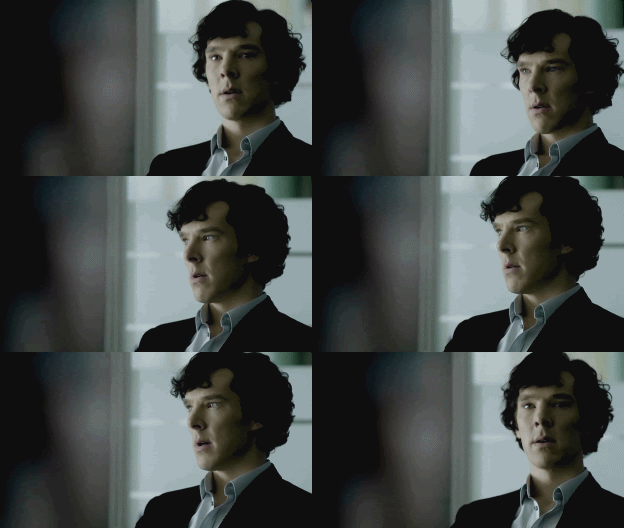
Sherlock, what would you say?


Is it ok, dr. Watson?


Gentlemen, I completely agree.

ETA: if you want to know what I really think of St. Valentine's Day please follow this link to one of my older essays. ;)
Enhanced by Zemanta