
Friday, 15 March 2013

Blue Moon...Is It Real?


What is a Blue Moon?

I am pretty sure you've heard the phrase, “until a blue moon” or "once a blue moon". It  developed in the 19th century, meaning 'never', or at least 'extremely unlikely'. It's been now and then used in titles of many songs and UF novels among other things because let's face it, the idea is visually attractive. Is a blue moon just a  fiction or a metaphor? You might be surprised but, after all, blue moons do occur still the whole matter is a bit tricky.

There are in fact two definitions for a blue moon. According to the more recent definition, a blue moon is the second full moon in a calendar month. For a blue moon to occur, the first of the full moons must appear at or near the beginning of the month so that the second will fall within the same month (the average span between two moons is 29.5 days). The full Moon on Aug. 31, 2012, was an example of this type of blue moon - it was the second full moon in one month.

The Other Kind of Blue Moon

The older definition, which is recorded in early issues of the Maine Farmer's Almanac, states that the blue moon is the third full moon in a season that has four full moons. Why would one want to identify the third full moon in a season of four full moons? The answer is complex, and has to do with the Christian ecclesiastical calendar.

Today we usually mark the beginning of the seasons when the Sun's celestial longitude passes 0° (spring), 90° (summer), 180° (autumn), and 270° (winter). The Sun appears to move along the ecliptic at a variable rate because of the Earth's not-quite-circular orbit, so the seasons defined this way are not equal in duration. Another approach uses the dynamical mean Sun or fictitious mean Sun — imaginary bodies that move along the ecliptic and the celestial equator, respectively, at a constant rate and produces seasons of equal length. The Maine almanac defines the seasons using this alternative method.

The almanac also follows certain rules laid down as part of the Gregorian calendar reform in 1582. The ecclesiastical vernal (spring) equinox always falls on March 21st, regardless of the position of the Sun. Lent begins on Ash Wednesday, 46 days before Easter, and must contain the Lenten Moon, considered to be the last full Moon of winter. The first full Moon of spring is called the Egg Moon (or Easter Moon, or Paschal Moon) and must fall within the week before Easter.

Some years have an extra full moon—13 instead of 12. Since the identity of the moons was important in the ecclesiastical calendar (the Paschal Moon, for example, used to be crucial for determining the date of Easter), a year with a 13th moon skewed the calendar, since there were names for only 12 moons. By identifying the extra, 13th moon as a blue moon, the ecclesiastical calendar was able to stay on track.

How Often Does a Blue Moon Occur?

Over the next 20 years there will be about 15 blue moons, with an almost equal number of both types of blue moons occurring. No blue moon of any kind will occur in the years 2014, and 2017.
Two full moons in one month may occur in any month out of the year except for February, which is shorter than the lunar cycle.

The other, older blue moon event, which happens when there are four full moons in a season, last occurred in May 2008 and  on Nov. 21, 2010. Since this type of blue moon is reckoned according to the seasons, it can only happen in certain months - February, May, August, or November, about a month before the equinox or the solstice.

At last we have the "Maine rule" for Blue Moons: Seasonal Moon names are assigned near the spring equinox in accordance with the ecclesiastical rules for determining the dates of Easter and Lent. The beginnings of summer, fall, and winter are determined by the dynamical mean Sun. When a season contains four full Moons, the third is called a Blue Moon.

Why is the third full Moon identified as the extra one in a season with four? Because only then will the names of the other full Moons, such as the Moon Before Yule and the Moon After Yule, fall at the proper times relative to the solstices and equinoxes.

Once in a Blue Moon

"Blue moon" appears to have been a colloquial expression long before it developed its calendrical senses. According to the Oxford English Dictionary, the first reference to a blue moon comes from a proverb recorded in 1528:

If they say the moon is blue,
We must believe that it is true.

Saying the moon was blue was equivalent to saying the moon was made of green (or cream) cheese; it indicated an obvious absurdity. In the 19th century, the phrase until a blue moon developed, meaning "never." The phrase, once in a blue moon today has come to mean "every now and then" or "rarely"—whether it gained that meaning through association with the lunar event remains uncertain.
(Information Please® Database, © 2007 Pearson Education, Inc. All rights reserved.)

Can the Moon really turn blue?

Yes it can turn blue, in the eye of the beholder of course, but not everywhere and it can be seldom witnessed.

The key to a literal blue moon is having in the air lots of particles slightly wider than the wavelength of red light (0.7 micron)–and no other sizes present. This is rare, but volcanoes sometimes spit out such clouds, as do forest fires.

For example in 1883, an Indonesian volcano named Krakatoa exploded. Scientists liken the blast to a 100-megaton nuclear bomb. Fully 600 km away, people heard the noise as loud as a cannon shot. Plumes of ash rose to the very top of Earth’s atmosphere and it was the reason why the moon temporarily turned blue. Some of the ash-clouds were filled with particles about 1 micron (one millionth of a meter) wide – the right size to strongly scatter red light, while allowing other colors to pass. White moonbeams shining through the clouds emerged blue, and sometimes green.

So, will you ever see a blue moon? In astronomical terms, it is quite possible. If you hope to see a full moon which is the actual color blue, that is less likely unless you live in a country with an active volcano or with a forest fire season.

(Info from Nick Greene at about.com)
http://www.infoplease.com/spot/bluemoon1.html
http://www.skyandtelescope.com/observing/objects/moon/3304131.html?page=1&c=y


Wednesday, 13 March 2013

Rivers of London/ Midnight Riot (Peter Grant #1) by Ben Aaronovitch

Form: e-book, mobi format
Genre: Urban fantasy, crime mystery
Target audience: older YA and adults

Synopsis:

Peter Grant wants to become a real police officer but his plans seem to be thwarted even before his career starts for good. His superior, not impressed by Peter's efforts, plans to assign him to the Case Progression Unit, where the biggest threat he’ll face is a paper cut, a power failure or eternal boredom and a spare tyre around your belly. Still Peter feels his fate might change soon. First he sees and talks to a ghost. Then he gets under the wings of Detective Chief Inspector Thomas Nightingale, a one-man magical law and order enforcement squad. Not one moment too soon. As a wave of brutal and bizarre murders engulfs the city, Peter is plunged into a world where gods and goddesses mingle with mortals and a long-dead evil is making a comeback on a rising tide of magic. He won't be bored but will he survive?

What I liked:

“Fuck me, I thought. I can do magic.” 

The sense of humour of our dear Peter was impeccable although sometimes rather uncouth. Maybe it is so  because  he lives in London, a vibrant big city where you rub your elbows with strange and not necessary kind creatures from all over the world. Like all those pesky tourists. Anyway the level of geekiness, science and the dry British jokes aimed at practically everyone and everything, from African mothers and policemen to Polish kitchen aids and cockney blue collar workers, was really high.

“Conflict resolution,' said Nightingale. 'Is this what they teach at Hendon these days?'
'Yes, sir,' I said. 'But don't worry, they also teach us how to beat people with phone books and the ten best ways to plant evidence.” 


Anybody firmly rooted in pop-culture and modern world will like and appreciate the divagating of Peter, although, from time to time, sad, mean purists wearing unfashionable, square glasses might say the boy is a tad too misogynist/undereducated/violence-prone specimen of a Londoner. He doesn't know Latin or Greek after all and he got just those measly Cs while passing his Science A levels. Pathetic, isn't it? Hardly a role model for the younger generation.

“Carved above the lintel were the words SCIENTIA POTESTAS EST. Science points east, I wondered? Science is portentous, yes? Science protests too much. Scientific potatoes rule. Had I stumbled on the lair of dangerous plant geneticists?”

Ben Aaronovitch's love for London is big, wild and contagious. I can relate. It is a city I felt immediately at home so it was a big advantage that London plays an important role in this story, being treated with deference. It is way more than just a setting. You can't stay indifferent after reading such a passage:
A traditional Punch and Judy booth.
A traditional Punch and Judy booth. (Photo credit: Wikipedia)

"Being a seasoned Londoner, Martin gave the body the "London once-over" - a quick glance to determine whether this was a drunk, a crazy or a human being in distress. The fact that it was entirely possible for someone to be all three simultaneously is why good-Samaritanism in London is considered an extreme sport - like BASE jumping or crocodile wrestling."

A nice quote, isn't it? Perhaps you can say that about every big city and its inhabitants but I find it especially true for London for reason or reasons unknown. Perhaps it is a matter of the climate. Or the Punch and Judy show. Or the famous British tea more often than not superseded by fine Brazillian coffee. Yeah..

What I didn't like:

First let me tell you that I don't appreciate the double title of the book. Rivers of London made sense; why wasn't it good enough for the American editor? Search me. Maybe because they were at a loss what rivers of what London the author meant? Maybe at first glance they took this novel for one of quaint hydrology textbooks or a guide for the fans of riverspotting? (If you ask me riverspotting would make far more sense than trainspotting. At least a river is almost always there so you can 'spot' it as long as you want to. And take a picture. Just saying.)

When it comes to the adventures of darling Peter...the plot was hardly surprising or innovative. A good sense of humor is not a band aid you can slap over a pile of plot construction problems; a wise-cracking hero or not, when he repeats the steps of practically all other heroes, featured in similar books  you find yourself yawning after a moment or two. On the verge of his manhood he discovers he is a wizard? Just like Harry Potter only a bit later. He gets an older mentor? Albus Dumbledore, anyone? He gets into serious trouble and finds himself all on his lonesome? Yeah...

Also the water spirits or gods and godesses of Thames and its tributaries seemed ordinary, almost surprisingly normal. No, it wasn't exactly a pleasant surprise. Why introduce a bunch of supernatural characters when a bunch of ordinary Londoners would do as well if not actually better?

Finally one of my pet peeves when it comes to fantasy: time travelling. So you can do it without major consequences but in another dimension and it might take a vampire bite or two? Not persuaded, sorry.

Final verdict:

A very promising beginning of an urban fantasy series; still I hope the next book will be better. Because it can be better, right? 
Enhanced by Zemanta

Monday, 11 March 2013

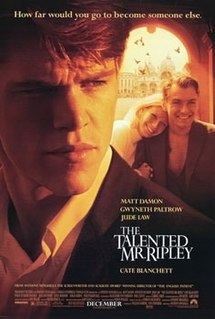
Two Movies Duel Review: Catch Me If You Can vs. The Talented Mr. Ripley


Two Movies Duel Review

Catch Me If You Can vs. The Talented Mr. Ripley

1. Presentation of the opponents (a.k.a synopsis)

The Talented Mr. Ripley: Tom Ripley is a handsome young underachiever without any formal education, living in a basement and working as a lavatory attendant. However he is also a 'quick study' - intelligent, bright, perceptive, musically talented. He can do very accurate impressions of other people, he can forge signatures and he is a consumate liar. One day he borrows a Princeton jacket to play piano at a private garden party. When a wealthy father of a recent Princeton grad chats Tom up, Tom pretends to know the son and is soon offered $1,000 to go to Italy to convince prodigal Dickie Greenleaf to return home and start earining his keep. In Italy, Tom simply attaches himself to Dickie and to Marge, Dickie's cultured fiancée, with a tenacity of a boa constrictor. He pretends to love jazz and is soon harboring homoerotic hopes as he soaks in borrowed luxury of his lovely host. He also tells Dickie the truth about his real mission - it seems those two might become fast friends if not something more. Soon enough, though, Dickie becomes bored with Tom's company and lets him know that he is not welcome anymore in his Italian house. Tom, who likes his new life far better than the old one, is not a person you can get rid of easily. Sensing that Dickie is about to cut him loose, he decides to take the matters into his own hands - he thinks that it's better to be a fake somebody than a real nobody and with his many talents he decides to change his identity...and contiune the 'dolce vita'. At his rich friend's father expense.

Catch Me If You Can: Frank Abagnale lives with his parents in New Rochelle, New York. He is a bright, handsome teenager with a penchant for dramatics and a father who uses the boy as a prop in his many con schemes, giving invaluable life lessons how to chat up a woman and manipulate a banker. Small wonder one day Frank uses his talents pretending to be a substitute French teacher (his mom is French so he knows the language far better than his peers) in a new school. When his parents divorce anguished Frank runs away and starts a life full of windfall profits, occasional luxury, constant deceit and danger. He becomes an expert in forging checks and different confidence scams, tricking mainly banks and Pan Am airlines. Still, despite a string of casual lovers (all those lovely stewardesses and tellers!) the kid feels more and more alone and alienated. Not to mention the fact that a certain FBI agent called Carl Hanratty keeps following Frank doggedly hoping that one day he'll finally catch him. The real 'hide-and-seek' tournament begins...who will be better?

2. Round one: reality check

Tom Ripley is a fictional character from a series of psychological novels penned by Patricia Highsmith. He lives roughly at the same time as Frank - perhaps a decade earlier. He is three-dimensional and well-rounded, at least in the movie.

Frank Abagnale is a real person with an unusual career - before his 19th birthday, he successfully conned millions of dollars worth of checks as a Pan Am pilot, doctor, and Louisiana parish prosecutor. He escaped from police custody twice before he was 21 years old. He served fewer than five years in prison before starting to work for the federal government. He is currently a consultant and lecturer for the FBI academy and field offices. Facts are always stranger than fiction - nobody could have imagined such a hero!

Tom: 1 point
Frank: 2 points

3. Round two: likeability factor

Both our heroes are handsome, gifted and intelligent. Both are poor underdogs, they have to fight for a better life and both want to achieve something more than your ordinary Mr. Smith. What's the difference between them?

Tom's personality screams 'pathology' at every turn. Let's face it, this guy is a born con man with a distended ego only matched by his ambitions - he wants to make a career and do it painlessly and very fast. He thinks he is entitled to it. Yes, he tries to be honest at first but unfortunately he's chosen the wrong recipient - Dickie is not better than his guest: vain, self-centered, with low boredom threshold, thinking that the whole world should belong to him and has been created for his amuzement only. Such an attitude enhances Tom's expectations to a realy insane degree, making him a fully-fledged deviant and a murderer, unable to trust anybody and completely lonely as a result. He proves he  also has a talent for ruining his life.

Frank is also a bit full of himself but a) he is a bit younger than Tom so more malleable b) he seems to be more intelligent. After a while Frank sees clearly that a metaphorical 'diet' consisting of sweets and cakes (so his unlawful spoils) is nothing healthy or nothing that will last. Deep down he yearns for a bit of normality - safety, love, family. He also never hurts anybody personally (at least not in the movie), quite the opposite - he cons big corporations and companies, the police, the banks but not innocent people. Finally he earns sympathy even from his pursuer and nemesis, Carl, the FBI agent.

Tom: 0.5 of a point
Frank: 2 points

4. Round three: the setting

The Talented Mr. Ripley is set mainly in Italy - in Rome, Milan and Venice but also in the country. I loved it - it was a visual feast!

Catch Me If You Can takes the viewer in a journey round America and Europe but we rarelly see more than the interiors: airports, banks, hotels and such. Nice but definitely less impressive.

Tom: 2 points
Frank: 1 point

5. Round four: the ending

Tom ends up killing again and again (not saying who, it would be a spoiler) and fighting his inner demons to no end. I admit it was sad but also so very real - let's face it, when you cross certain limits you might not return to a land of psychological stability ever again.

Frank finds a real career, the safety and stabilization he sought. He marries and lives happily ever after. I liked that evening far less althoug it was mood-lifting and optimistic. Why? Well, don't get me wrong, I am perfectly happy the real Frank ended better off than Tom but I bet it was only because he was just very very lucky. More often than not forgers and fraudsters ruin their life as efficiently as murderers.

Tom: 2 points
Frank: 1.5 points

Duel results:

Tom: 5.5 points. Not bad for a fictional psychopath :)
Frank: 6.5 points. Real life heroes rule and win!!!


How do you like my new movie review formula? I don't promise to do it often but if you know some movies which, in your opinion, simply beg for being compared do let me know!

Friday, 8 March 2013

Review: Haunt Me Still (Kate Stanley #2) by Jennifer Lee Carrell

Book info:
Form: pdf e-book
Genre: historical mystery/thriller
Target audience: fans of the genre, no matter the age
Synopsis
Kate Stanley, Jennifer Lee Carrell's dauntless Shakespearean scholar-turned- director, is catapulted into a new production of Macbeth, showcasing a fabled collection of objects relating both to the play and the historical Scottish king for whom it is named.Still the Bard's witch-haunted play is famously cursed, its reputation for malevolence so strong that many actors refuse to quote or even name the play aloud unless on stage. Are they right or is it just a bit of superstition?

As rehearsals begin at the foot of Scotland's Dunsinnan Hill, a perfect location for such a play, it doesn't take long for the curse to stir. But is it really a curse?A trench atop Dunsinnan Hill is found filled with blood, and a severed human thumb turns up among the props. Kate begins sleepwalking, waking early one morning alone atop the hill, her hands smeared with blood.

She has no memory of how she got there, but later that day a local woman is found dead on the hill in circumstances that suggest not just ritual murder but ancient pagan sacrifice. With the police more focused on Kate as a suspect than as a possible future victim, she and Ben find themselves in a desperate race to discover a lost version of Macbeth, said to contain rituals of witchcraft aimed at conjuring demonic forces to gain forbidden knowledge.
What I liked:
I could sum it up this way: I liked the second novel far better because there was less Dan Brown-ish antics, more Shakespeare. Macbeth is one of my favourite plays and indeed it is a bit creepy so it worked really fine -especially when combined with the creepiness, the Scottish castles and the Edinburgh festival. I appreciated the location far more than the jumps across continents from the previous novel.

Kate Stanley, our protagonist gets sucked into a bizarre twist of events that ends up with blood on her hands…literally. She must find the lost manuscript of Macbeth which might include secret rituals of old pagan witchcraft in order to save an innocent teenage girl’s life. This manuscript was supposed to have been used in early shows of Macbeth where the mere reading of it supposedly brought real unearthly demons to the stage. Kate feels a little more human in this sequel; looking at her as a woman who essentially throws herself into a mystery as a "rebound relationship" is an interesting concept and one that works considering how intellectual Kate is supposed to be. Anyway I was really relieved that she wasn't 'an item' with Ben in this book and the fact that the author gave him another casual lover was only too natural.

Indeed the best parts of this novel were, in my opinion, the interludes around Dr John Dee, the Elizabethan polymath and occultist. The parallels between theatre and the occult were interesting: the performance as ritual; players summoning and conjuring the semblance of gods, Kings and heroes from the past; the dangerous nature of the Renaissance stage. I did love the explanation of the possible inspirations for Shakespeare's story - with the Lady of Arran and the Samhain festival - such ancient, multi-faceted backgrounds are always a welcome addition. Once again you can tell Carrell knows her stuff.Let me also tell you that the warning about crackpot academics was entertaining...particularly to someone who writes essays and has to avoid dangers of using personal websites in research.
What I didn't like
As a thriller, this book did not work: I cared little for Kate or Lady Nairn's problems so the plot held no thrill. There was no twist to surprise me. The most absurd point occurred almost exactly half the way through. Out of thin air and a propos of nothing, Lady Nairn mentions that she has an evil niece, Carrie Douglas. Ta-dah! The bunny is out of the hat and jumping around happily! Enjoy the sight while you still can, boys and girls!

Later the same good lady hands over an iPod containing a digital copy of a lost performance ofMacbeth. There's no explanation of how she got it and how it was registered. And it just happens to have a vital clue in it. Ehem...right. Paint me curious or rather I should say: "Double, double toil and trouble, Fire burn and cauldron bubble."

Finally the least likeable character in the whole book: Lily. Oh Sweet Goddess give me patience. I hate it when teenagers in novels are whiny, stupid, and mostly useless at everything but getting themselves and others into trouble. Lily is all three and what she gets in the end? A REWARD. Stupidity rewarded is not what I like in my fiction or real life.
Final verdict
I liked this one far better than the first part.No, it wasn't a perfect novel, far from it but, overall, the Macbeth outweighed the predictability for me. If you like Shakespeare and find the superstitions of the theatre fascinating this book might be right for you.
Enhanced by Zemanta

Tuesday, 5 March 2013

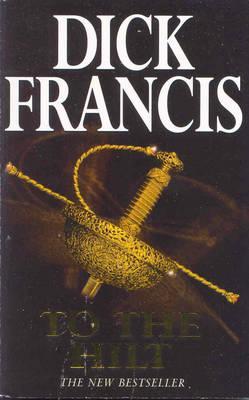
Review: To The Hilt by Dick Francis

Book info: 
Form: pdf
Genre: crime mystery, contemporary fiction
Target audience: more or less everyone who likes the genre

Synopsis
“Some are born weird, some achieve it, others have weirdness thrust upon them.” 

Alexander Kinloch, despite being a nephew of a Scottish earl, prefers living alone in a very modest hut in the middle of the mountains. He doesn't appreciate civilisation, just peace and quiet which allow him to paint. Unfortunately all good things come to an end. One day four backpackers find a way to his stony  lair. These are not normal tourists, though - shouting viciously "where is it?" they attack Al, beat him black and blue, demolish his abode and depart, leaving poor man barely alive. Who sent them? What were they really looking for? How could they be found again and brought to justice?

This event drags Al back to the 'normal' world - to his mother, a posh lady living comfortably in London, his ailing step-father, an owner of a local brewery who's recovering from a heart attack, his wife, Emily, left by Al after barely six months of marriage, and the hustle and bustle of everyday's business.

Each of these people have some serious troubles which seem to be connected to Alexander's unpleasant beating. Millions of pounds are missing from his stepfather's business. The earl struggles to protect his family's famous heirlooms. A valuable racehorse is under threat and Emily is the only person who can help and save it. When his stepfather names Alexander to be his power of attorney during the convalescence (instead of his daughter), an all-out family feud begins to boil over. Then comes the first ugly death and the end of all Alexander's doubts whether he actually should get mixed into all of this. For the honour of the Kinlochs he will face the strangers again ... up to the hilt...

What I liked:

The main character is another of Dick Francis's painters who has to find a solution to a crime before the baddies get him and his folk. Once again the characteristic was done splendidly. Al is a solitary excentric with a great sense of humour but rather poor social skills whose intelligence make him even more solitary among 'normal', ordinary people. His stolid, sometimes unexpectedly funny narration is the best part of the book and the more you find about Al the more you want to know.

Of course there was a racing event in the background and an embezzlement involved - two features so characteristic for Francis novels. Here also one of baddies, Al's step-sister, Patsy, drew my attention. It was a delightful woman, full of vices, greedy and rather beautiful who thrived organizing things. I loved the way the author developed her character from a vicious, overly jealous witch, hovering constantly over her weak daddy like a harpy, into...well, if I told you I would have to spoil you. :) Let me just say that Patsy, contrary to other baddies, will surprise you at the end. Personally I love such twists.

I loved the references to the legends of King Arthur: the golden 'chalice' which plenty of people desire to find, the sword (or rather its hilt) which needs protection, the 'damsel in distress' who needs rescuing and those women who are more like Morgan le Fay - independent, agressive, dangerous and cunning. It was all very well done, perfectly mixed with contemporary reality, and the main character served like a kind of 'adapter' for all the sides involved and, of course, a perfect knight. :) A feature to notice: Al doesn't have to be freakishly strong/gifted at martial arts or excessivelly agressive to be a formidable opponent.

What I didn't like:

I admit the mystery was a bit predictable and the main hero, despite some beatings and broken ribs, still a tad too lucky (and indeed, Mr. Francis likes having his heroes beaten up rather often ;P how very sadistic of him)... The ending I found overly sweet: a perfect fairy tale HEA for almost every 'white hat' around. Especially a certain scene made me laugh: when an elderly and very educated lady called Zoe found her portrait and was so taken with it that she abandoned instantly her 'sacred' quest for a rare and precious, historical artifact...well, undeniably some portraits can make a great effect on people but every infatuation has its limits.

Final verdict:

An author you can get addicted to. I would compare Francis novels to very comfortable slippers you love wearing when, after encountering all those wrong books in unexpected places, you are dead tired and sad. They are comfort reads. I will revisit these stories for sure and I might dig for some new ones to read soon.

Sunday, 3 March 2013

Review: Even White Trash Zombies Get the Blues (White Trash Zombie/ Angel Crawford #2) by Diana Rowland

Book info:
Form: pdf e-book
Genre: Urban fantasy with zombies
Target audience: adults

Synopsis


Angel Crawford is finally starting to get used to life as a brain-eating zombie. Let's face it, more brains can only improve your life, right? Still, like in real life, Angel's old  problems are returning to haunt her. Her felony record keeps complicating her prospects, more zombie hunters are popping up in her neighbourhood, and she’s beginning to wonder if her hunky cop-boyfriend, Marcus, is actually involved with the zombie mafia. Yeah, you read it right—the zombie mafia. They are influential, rich and they want to monopolize the future market for artificial brains ;).

Throw in a secret lab and a lot of conspiracy, and Angel’s going to need all of her brainpower—and maybe a brain smoothie or two as well—in order to get through it without falling apart. Will her relationship with Marcus survive as well? Will he start to appreciate Angel for who she really is?
What I liked:
Let me start with the cover, created by Dan Dos Santos, one of my favourite UF cover artists. This one is really special. Even if I hadn't heard anything about the book, the cover itself would have made me pick it immediately - rather an exception than the rule, believe me. It is the perfect mix of bad-ass and vulnerable in a completely unexpected scene (are there any other covers, UF or otherwise, that feature a depressed punk-chick on a toilet in a grubby bathroom, smoking a fag? Look at her shoes for heaven's sake and at her knee-length socks! Done to perfection!). Dan Dos Santos won a silver medal fromSpectrum medals for his cover art for Diana Rowland's My Life as a White Trash Zombie and now he proves he really deserved it - this one is as good if not better.

What about the book itself? It is a sequel and as such I didn't expect a lot of fireworks. I was wrong. How nice it is to be wrong from time to time! What I liked the best? Characters development of the main heroine - it was simply unique.

Firstly she develops a believable and quite moving relationship with her father. They got mad at each other every now and then but it is obvious they were trying to change and improve, appreciating all the time that they are still family.It addted the humane depth to Angel's character - I was so pleased she wasn't made another orphan girl, so conveniently deprived of any parents or siblings, left to rely on friends and boyfriends!

Speaking about boyfriends...Marcus Ivanov, the zombie cop was behaving in an outrageous manner and finally Angel started questioning where they stood. Let me just say she was perfectly right! I really enjoy the fact that somebody dared to show in an UF novel that the real relationship is about something more than just fancying a handsome boy or girl or going to bed and having good sex! Angel really scored a lot of points breaking up temporarily with Marcus (not saying more, it is already a bit spoilerish) and asserting herself when faced with his posh family and acquaintance.She may be an uneducated chick but she is sure as hell clever and should be in the CSI department instead of being the skullcracker of the morgue.

Now a bit about the baddies. Ed Quinn the zombie serial killer appears again and secret zombie factions make this book full of both a great action adventure and a great character development story because no, Ed is not a straightforward baddie and not every zombie is good either. For example one Pietro Ivanov a badass zombie mobster. I found him quite fascinating as he was investing in a new research to find the protein zombies's parasite need to survive to create new "fake brains". He did it to control the numbers of brains in his zombie faction and it was just a brilliant idea even if a sinister one.

Overall I liked Rowland's innovative take on zombies and her explanation why brains keep them from rotting, give them superhuman abilities, and a longer life. Further on, the creation process of a new zombie was rather..ehem...bloody interesting. The mothering aspect and the population control was a very clever addition and certainly nothing I expected or predicted so full points for world building.

What I didn't like

The mystery seemed to be a little over the top but it was still a fun ride. I would be even more happy with this one if more baddies were so nicely three-dimensional as poor Ed; unfortunately it was not the case. There were also some threads unfinished and some themes I would really like to know more about and now I have to wait for another installment.

Final verdict:

It is perhaps not a perfect novel but it remains a well-told story following the trials and tribulations of a young woman trying to get a grip on her life. Plus zombies. Normally I don't like them in my fantasy but for Angel and her likes I am more than willing to make an exception.
What's more I am happy to tell you that Mrs. Rowland's writing technique is improving dramatically, especially if you compare it to some of her earlier "...of a demon" novels. I am most definitely eager to read the next book in the series!

Friday, 1 March 2013

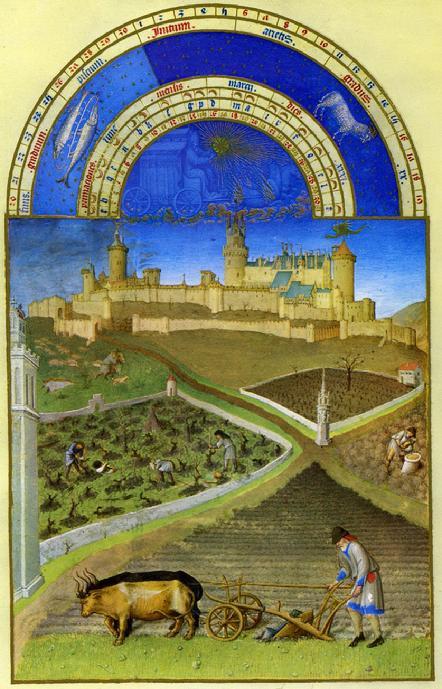
Les Très Riches Heures du duc de Berry by brothers Limbourg - March


The Lusignan Castle of the Duc de Berry crowns the landscape parallel with the horizontal line of the oxen, plough and the peasant in the foreground. The road running from the two bottom corners divides the middle distance into four parts and the fields created in this way are further separated diagonally by low stone walls. Due to slight irregularities and to tiny details which absorb the spectator's attention and to the fact that the viewpoint is not in the centre but slightly to the left, this system of lines does not appear to be arid. Now my favourite detail: the dragon flying towards the castle. It was supposed to recall to his contemporaries the legend of the lady of the castle and its builder, Melusine.

Elianas, king of Albany (Scotland) was recently widowed and to divert his attention from the loss of his wife he amused himself hunting. One day, wilst at the chase he went to a spring to quench his thirst. As he approached he heard the voice of a woman singing and as he approached he saw a mysterious, fey, girl who was named Pressine. Though Elianas enquired of her as to who she was she would neiter tell him of her ancestry nor from whence she came. But, after some time the fair woman bestowed her hand upon him, on the condition that he should never visit her at the time of her lying-in. She gave birth to three daughters, Mélusine, Meliot and Palatine. Nathas, the king's son by a former wife, hastened to convey the joyful tidings to his father, who, without reflection, flew to the chamber of the queen, and entered as she was bathing her daughters. Pressina, on seeing him, cried out that he had broken his word. She cursed him and declared that her descendants, with the help of her sister, the Queen of the Lost Island, would avenge her. Then she disappeared, taking her daughters with her to the Lost Island.

The Island of the Lost was so called because it was only by chance any, even those who had repeatedly visited it, could find it. Here she reared her children, taking them every morning to a high mountain, from which Albany might be seen, and telling them that but for their father's breach of promise they might have lived happily in the distant land which they beheld. When the children were fifteen years of age, Melusine asked her mother particularly of what their father had been guilty. On being informed of the truth of the matter she conceived a design for being avenged on him. Engaging her sisters to join in her plans, they set out for Albany. Once there they they took the king and all his wealth, and by dint of her charms she shut her father away in an inaccessible part of the Brandebois mountains. On telling their mother what they had done she flew into a rage because they had taken vengeance without her. Pressine laid curses upon them all, with the worst of all reserved for Mélusine as the instigator of the plot. Meliot was to be imprisoned in an Armenian castle, Palatine in a mountain together with her father, while Mélusine was cursed to become a 'serpent from the waist down' every Saturday. This would be her fate until she met a man who would marry her under the condition that he never saw her on a Saturday. Like mother like daughter.

Mélusine left the Lost Island and began roaming the world where she passed through the Black Forest, and that of Ardennes, and at last she arrived in the forest of Colombiers, in Poitou, where all the fays of the neighborhood came before her, telling her they had been waiting for her to reign in that place. It just so happened at this time that Raimond de Lusignan, having accidentally killed the count, his uncle, with a deflected blow from his boar-spear was wandering that night in the forest of Colombiers. He arrived at a fountain that rose at the foot of a high rock. The local people called it the Fountain of Thirst, or the Fountain of the Fays, on account of the many marvelous things which had happened near it.

Raimond reached the fountain at the time when three ladies were diverting themselves there by the light of the moon — the principal one being Mélusine. Of course, her preternatural beauty and her impeccable manners quickly won Raimond's heart. She soothed him, concealed the deed he had done and married him on condition that he never try to find out what she did every Saturday- if he breached his oath he would forever be deprived of she who he loved so much. From her great wealth she created for him the castle of Lusignan right next to the Fountain of Thirst, where they had first seen each other.

Ten boys were born of their union but all were afflicted with strange physical defects. For example, one of Urian's eyes was in the middle of his cheek, and Geoffrey had a very long eye-tooth, which was why he came to be nicknamed Geoffrey Big-Tooth. But still Raymond's love for his beautiful wife remained unshaken.


Raymond walks in on his wife, Melusine, in her...
Raymond walks in on his wife, Melusine, in her bath and discovers she has the lower body of a serpent. Illustration from the Jean d'Arras work, Le livre de Mélusine (The Book of Melusine), 1478. (Photo credit: Wikipedia)


But one day Raimond could no longer contain his curiosity. For he had noticed that each of Mélusine's absences coincided with the apparently magical building of a castle, a monastery or a church. So he followed his wife into the cave to which she withdrew every Saturday. There he saw Mélusine in her true form: 'for the ovely form of Melusina ended below the waist where it became serpentine with scales of grey and sky-blue mixed with white bathing in a green marble tub'. Quite a sight you must admit ;). But it was not horror that seized him at the sight, it was infinite anguish at the reflection that through his breach of faith he might lose his lovely wife forever. When she realised she had been found out Mélusine wept and stretched out her arms, which turned into wings; finally, she disappeared into the air, uttering these words: 'One thing will I say unto thee; that thou, and those who for more than a hundred years shall succeed thee, shall know that whenever I am seen to hover over the fair castle of Lusignan, then will it be certain that in that very year the castle will get a new lord; and though people may not perceive me in the air, yet they will see me by the Fountain of Thirst; and thus shall it be so long as the castle stand in honor and flourishing — especially on the Friday before the lord of the castle shall die."

Source:

Enhanced by Zemanta