
Thursday, 14 February 2013

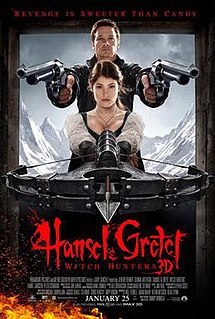
Movie review: Hansel and Gretel Witch Hunters by Tommy Wirkola

Directed by Tommy Wirkola
Screenplay: Tommy Wirkola, Dante Harper
Release date: 2013
Genre: Action/Horror/Comedy/Fairy tale

Cast:
Hansel: Jeremy Rennel
Gretel: Gemma Arterton
Dark witch Muriel: Famke Janssen
Mina: Pihla Viitala
Edward the troll : Derek Mears


Synopsis
You remember, I bet, one of the most popular Grimm fairy tales, Hansel and Gretel? Two kids abandoned by their parents in the middle of a forest who found a cottage made of sweets and a horrible witch inside? They outsmarted her and  shoved her into the fire.

Now they are back: still toghether, more lethal than before, wearing leather jackets and latex pants. Hunting witches for money - that's what they do the best.


One day they are hired by Mayor Englemann from Augsburg to find and rescue several children abducted by witches. When they arrive, they prevent Sheriff Berringer from executing Mina, a young woman accused of witchcraft. Berringer hires trackers for the same mission, hoping to regain the respect of the Mayor. However, all but one of the party are killed that night by the powerful grand witch Muriel, who sends the surviving member back to the town tavern to explode as a warning to the locals. Hansel and Gretel, with the help of the Mayor's deputy Jackson, capture a witch and interrogate her. They discover that the witches are preparing for the ritual of Blood Moon, which requires sacrificing six boys and six girls, each born on a separate month. Will our witch hunters manage to save them on time? What other secrets will be unveiled, concerning their own life? Who they can trust?


My impressions

Tommy Wirkola asked himself what  became of Hansel and Gretel when they grew up. The answer seemed such a simple one: obviously they became witch hunters. Such an elegant solution. What about the rest? Well...

First let me tell you that I love different adaptations and renderings of classic fairy tales so I was very eager to watch this one, especially as the director wanted to go several steps further than the actual fairy tale. He also did his best to entertain the wider audience.The project was filmed in Germany and featured an international cast and crew. There's enough action, killing and gore to satisfy any gung ho movie-goer. Our Gretel is a buxom beauty, not afraid to show her assets; Hansel has a bit of romance with Mina, a girl he helped to save from the lynching mob and she isn't exactly a shy virgin as well. Still while watching the movie I got a distinct impression everything was somehow a fake and, after a while, if I laughed it was out of sheer embarassment. 'Style over substance' is a good description of this one; I suppose it is always nice if you can switch off your brain and just let the narration take you whenever it is going...I admit I am not good at that.
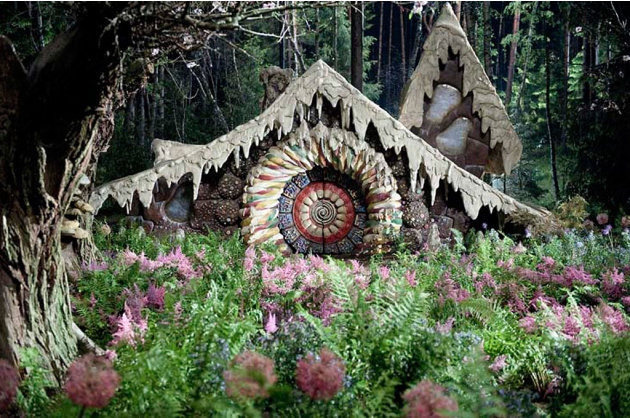
Candy cottage in the shape of...the Sauron's eye?
So what disturbed me the most? The movie was very uneven in tone, never even trying to reach those deeper meanings of the fairy tale it was based on. It was shallow. We got some great fighting scenes but also a generic German town full of dumb, fake inhabitants. The pair of protagonists used firearms and machine guns (and pray where did their ammunition come from?) but they didn't know how to locate each other in case of emergency; you must admit that running like mad across the forest shouting 'HANSEL' is hardly a good way to solve that problem. Especially that you know that a very evil witch and a band of equally evil mercenaries are set loose in the vicinity. Hansel was a diabetic as a result of his former childhood ordeal and needed to take a regular shot of insulin every day BUT we are never shown where that insulin  is bought, how it is created and, most of all, how it is stored (if you don't know - insulin MUST be stored in a fridge or it becomes useless!).

None of the witches had any backstory: they just seemed to exist for ornamental purposes and to be turned into mincemeat of course. Nobody even tried to explain what had made these women turn to dark witchcraft, risking their lives, apart from the obvious perks: donning tons of Goth make-up, very well-done I grant it, fancy, artfully torn clothes and flying  brooms... Would you die for a chance to paint your face or fly your broom though? I don't think so. Overall the baddies were as thin as a sheet of paper so no pleasant surprises there.

Isn't he lovely?
I had high hopes considering Edward the troll. I did enjoy a possibility that he might somehow turn into (don't laugh at me now) a crush of Gretel. He was strong, he was sweet and caring, his heart and fists were on the right side. And on the left. Anyway where they should be. Unfortunately my imagination was thwarted again by the ugly schematic movie cliches: Edward apparently was cast as a troll version of a King-Kong: he did save Gretel and she said 'thank you' very nicely but then...it fizzled out brecause monsters cannot be your love interests.

An interesting tidbit: at the end Gretel was allowed two more or less permanent admirers but Hansel remained alone. I wonder why. To draw the ladies to the sequel (perish the thought)?

Final verdict

Was it really eighty-eight minutes of trash? More or less yes. Still  it puts forth one sound message: kids, avoid overindulging in sweets, especially if you see candy that doubles as drywall and other building elements. And remember, there is no such thing as 'free candy'. However, if you have a problem with dark witches don't hire Hansel and Gretel - they are very expensive amateurs. They don't even know how to distinguish between a dark witch and a white witch. Pathetic.


Enhanced by Zemanta

Tuesday, 12 February 2013

Reviewing a Classic St. Valentine's Day Special Edition: Romeo and Juliet by Will Shakespeare

 St Valentine's Day is approaching fast- it is such a unique occassion for a sworn anti-romantic reviewer! Let me indulge myself and present a rant about my least favourite Shakespeare play, 'Romeo and Juliet'.

A bit of backstory first (and if you don't like backstories a.k.a. nerdspeak please, have a coffee ans skip the next section).

Romeo and Juliet belongs to a tradition of tragic romances stretching back to antiquity. Yes, even back then some people were just stupid and accordingly they wrote stupid books which were devoured by...you know who. The stupid, the curious, the idle.  Anyway its plot is based on an Italian tale, translated into verse as The Tragical History of Romeus and Juliet by Arthur Brooke in 1562 and retold in prose in Palace of Pleasure by William Painter in 1567. Romeus LOL! 

Allegedly Shakespeare borrowed heavily from both but he wasn't a total copycat. He added and/or developed plot along with supporting characters, particularly Mercutio and Paris. Believed to have been written between 1591 and 1595, the play was first published in a quarto version in 1597. This text was of poor quality, and later editions corrected it, bringing it more in line with Shakespeare's original. Shakespeare's use of dramatic structure, especially effects such as switching between comedy and tragedy to heighten tension, his expansion of minor characters, and his use of sub-plots to embellish the story, has been praised as an early sign of his dramatic skill. The play ascribes different poetic forms to different characters, sometimes changing the form as the character develops. Romeo, for example, grows more adept at the sonnet over the course of the play. In my humble opinion he should have grown more adept at reasoning but it's just me. 

Ok...ready for a blow-by-blow analysis of this hot-air kitsch production?
Good.

Charlotte and Susan Cushman (the Cushman siste...
Charlotte and Susan Cushman (the Cushman sisters) in Shakespeare's Romeo and Juliet in 1846 (Photo credit: Wikipedia)
Let's start easy, with the simplest question possible.
Is Romeo and Juliet really a romantic love story?


IS IT ?

NO.
It is a story of two insipid children who have too much free time and too much money but no sensible hobby or interest to occupy their brains with. So they decide to fall in love with the first passable person they see. Romantic? Hardly.


Have you heard this saying: an idle mind is the devil's playground or workshop? Romeo and Juliet are two perfect showcases.They married young without their parent’s consent and without properly knowing each other and died because they were too stupid to step back and think for half a second.
Two "star-cross'd lovers" indeed.
Well, perhaps back then the lack of brains qualified as "star-cross'd", who knows...

Let's face it: they were worth each other, at least that much is true.

Romeo was a young, easily impressionable fool. He began the play lovesick over Rosaline and within an act he was mooning over younger Juliet as if you suddenly pushed a button. His beloved girl wasn’t much better. She glanced at a handsome boy at a party, found out that he is one of her family's enemies and was suddenly head over heels for him and vowing her love on a balcony at night. Risking a serious pulmonary inflammation (yes, I am sure you remember the balcony scene . Ridiculous.). No sense of responsibility whatsoever, no critical thinking, no ordinary decency, just insta-love. 

So, a fickle, immature 15-year-old boy and a startlingly childish 13 year old girl agree to get married in secret, having known each other all of six hours. SIX HOURS people! They’re young, I know, but still plenty of young people prove time and again that they can take reasonable, surprisingly mature decisions so no excuses. Neither Romeo nor Juliet had any sense to talk to anybody older and wiser than themselves because, obviously, they knew everything better and yes, they were in love and the secrecy surrounding their feelings seemed to be the whole point. Teens love secrets, right?


Then you have a suddden case of a bum rash, tight britches and hot tempers with the whole duel and killing. Outraged Tybalt challenges Romeo, Romeo refuses, Mercutio fights instead and is mortally wounded so Romeo slays Tybalt out of grief, guilt and revenge… Bob’s your uncle, Amanda’s your aunt Sally's your sister and EVERYONE JUST DEFIED THE PRINCE!!!A very stupid thing to do if you plan a secret marriage AND you want to defy your entire family as well!

Romeo is exiled, but of course first he has to spend the night and consummate his marriage with Juliet…does it really need commenting (of course it does) ? It is not romance, it is rutting of a pair of short-sighted teenagers on bubbling hormones! No adult supervision! No responsibility! Where are the chastity belts when you really need them? Will Shakespeare you should be ashamed of yourself!

Then Capulet goes off the deep end, telling Juliet she WILL marry Paris or else be drowned. Come on… the dude started the play saying she was too young to marry and then, when she seems grief stricken, he forces her to get married as a kind of remedy? Perhaps he had actually glimpsed Romeo leaving her room in the morning... Her mom was no wiser, rejecting her just because Juliet wanted to postpone the date. Small wonder poor girl had no brains - it seems she was doomed from the very inception...Still drowning is NOT NICE even if your victim is your own stupid daughter.

So Juliet goes to the Friar for help and like any good man of the faith, he comes up with some inefficiently grandiose plan that at no step involves being honest and talking with those who care the most. Instead he gives her a “drug” that puts her in a deep coma for 42 hours. I recognize the fact that daddy Capulet probably would have drown her for sure had she come out and told him – “hey daddy, I love you to death but I really can’t marry Paris because... well, you remember that dude, Romeo? The one who got exiled because he'd killed my cousin Tyb? Good riddance by the way, Tybald was never exactly an asset if you ask me so Romeo did us practically a favour...actually you know, I and Romeo kind of...yea…sort of...ummm...anyhoo here's my wedding ring. Pretty, isn't it?”


But at least she went to an adult this time – this is what children are supposed to do when they are faced with a problem they cannot handle themselves – and somehow the friar manages to be just as childish in his handling of the situation as the kids are. Or maybe even more childish, all things considered. Since when you can solve a problem, any problem, with drugs ? Whenever I think of it the depression makes me melt...


And of course we all know what happened then…a string of bad luck which Shakespeare loved so much. Romeo doesn’t get the message in time (how could he even dream of getting it in time is beyond me), he goes to the crypt with his draught of poison, kills Paris, poisons himself, only to have Juliet wake seconds later to find him dead and kill herself… and THEN the families reconcile. I don’t know about you, but having the secondary characters learn something from the deaths of two completely naïve children is not what I call a satisfying ending. I see no real love in this story nor much sense or any other value apart from sheer shock value. Let's face it, it's obvious Will loved making people shout and cry in shock. Then he counted the proceeds and smiled. Probably like that:
Yes, I DID it again!
Whan can be said? The Prince’s ending words are the only part of this that rings true: For never was a story of more woe than this of Juliet and her Romeo. Hear, hear my Prince. Even a good editor wouldn't be able to improve much; mind you this horrible, senseless play is read by innocent children and teenagers at school with the full approval of the adults.

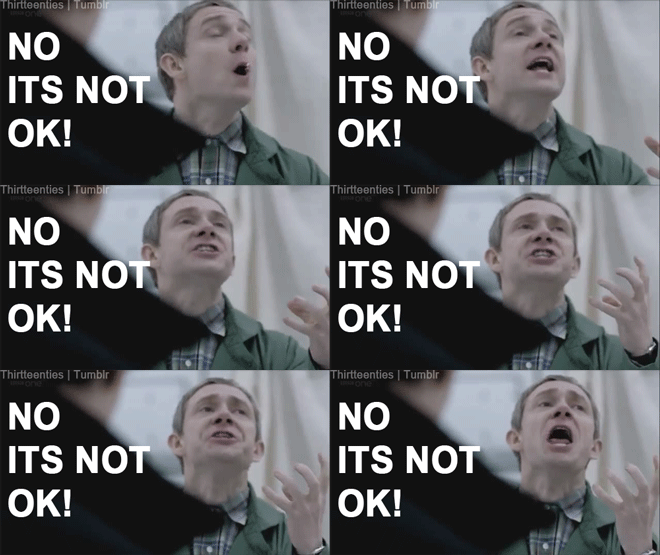
Now I ask you, dear Readers: is it ok?

Sherlock, what would you say?


Is it ok, dr. Watson?


Gentlemen, I completely agree.

ETA: if you want to know what I really think of St. Valentine's Day please follow this link to one of my older essays. ;)
Enhanced by Zemanta

Monday, 11 February 2013

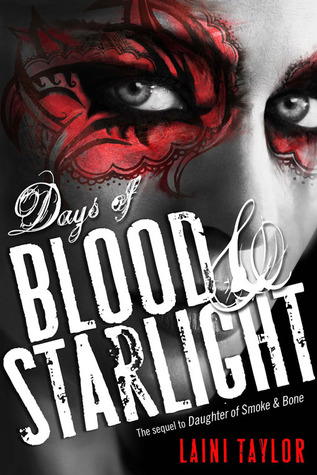
Review: Days of Blood & Starlight (Daughter of Smoke and Bone #2) by Laini Taylor

Book info:
Form: pdf, e-book
Genre: YA fantasy, angels and demons, paranormal romance
Target audience: YA

My review of the first part you can find here

Synopsis (from Goodreads):

Once upon a time, an angel and a devil fell in love and dared to imagine a world free of bloodshed and war.This is not that world.

Art student and monster's apprentice Karou finally has the answers she has always sought. She knows who she is—and what she is. But with this knowledge comes another truth she would give anything to undo: She loved the enemy and he betrayed her, and a world suffered for it.
In this stunning sequel to the highly acclaimed Daughter of Smoke & Bone, Karou must decide how far she'll go to avenge her people. Filled with heartbreak and beauty, secrets and impossible choices, Days of Blood & Starlight finds Karou and Akiva on opposing sides as an age-old war stirs back to life.

While Karou and her allies build a monstrous army in a land of dust and starlight, Akiva wages a different sort of battle: a battle for redemption. For hope.

But can any hope be salvaged from the ashes of their broken dream?


What I liked:

Not much...the curse of the second book, eh? Firstly let me assure you that angels and demons/chimaeras are and act as just ordinary guys and gals in this series which was a kind of relief. If you keep it in mind all the time you'll be fine. I was also rather pleased that the author didn't forget about humans and Prague although there was less of it than in the first part. I also appreciate that Laini Taylor tried to show the ugliness of the war and politics.

Liraz and Hazael I found the most likeable characters. Their change of heart and reticence to kill the chimaera felt real in comparison to Akiva's fickle compassion towards Karou's kin.

What I didn't like:

The romance between Karou and Akiva made me yawning too many times. Let's face it, the author continues with a Romeo and Juliet cliche at practically every turn PLUS a comedy of errors, not my favourite plot device either.  Karou behaves like your average befuddled teenager - she  struggles and is shamed and digs deep to find her inner strength again. But watching her struggle is boring because it is also predictable. 

I thought Mik and Zuzana were pretty pointless characters. I don't even know why Zuzana had a POV, as she could add little to the story. I guess her romance with Mik was supposed to sweeten a bit the lack of hot scenes between Karou and her beloved but I didn't really care about either of them.

I was also surprised that one of secondary characers was named Festival. I swallowed Madrigal in the previous part because it was a less common noun but Festival, honestly? Can't you think of a more original, fresher name without so many ordinary connections?

Still my main carping and the thing that disturbed me the most during reading was the lack of intelligence among practically all characters. Karou is being deceived by the simplest trick on Earth and, although she now remembers her previous life and experience, she can't see through it, at least until the truth bangs her on her head. Akiva is an angel and a seasoned warrior, far older than Karou, but he behaves exactly as a teen boy would: he dithers and doubts his girl not seeing the obvious, he lets his superior to manipulate him into an assassination and then he has to bear very painful consequences. Honestly, has anybody out there heard about strategy and planning? 

The baddies are no good either. Thiago, the leader of the Demons, is crudely cunning but not intelligent enough to hide his 'scorched earth policy' guerrilla war from Karou or at least find a good excuse for it. Finally in the end happens something which looks like a big plot hole: (spoiler, highlight to read) another chimaera guy called Ziri takes the control over the body of dead Thiago, killed by Karou during a rape attempt, in order to hide the killing from other chimaeras and let Karou live. Excuse me? How exactly it could happen, without a resurectionist, a necklace, magic, and so on? How come we haven't been told about it before?

Final verdict:

I liked the first part far better. I fear in the last installment love will simply have to conquer all, especially the common sense, interesting narration and logic. Perhaps sweet but so boring...

Enhanced by Zemanta

Saturday, 9 February 2013

Movie review: Young Adult by Jason Reitman


Directed by Jason Reitman
Written by Diablo Cody
Release date: 2011
Genre: comedy-drama

Cast:
Mavis Gary - Charlize Theron
Buddy Slade - Patrick Wilson
Beth Slade - Elizabeth Reaser
Matt Freehauf - Patton Oswald

Synopsis:

Mavis Gary, a divorced, 37-year-old ghost writer of young adult novels, is living with her dog, a tiny Pomeranian called Dulce, in Minneapolis. She escaped her backwater hometown and she's made a career. Although plenty of people would say she was successful, she is not happy with her life.
In fact she is nearing a complete meltdown: with the scary forty looming over her  she is dating all the wrong guys if dating at all, drinking heavily in her free time. What's more she is on deadline with her editor to finish the last book of the soon-to-be-cancelled and evidently declining series so she might lose her job soon.

One day she gets a mass e-mail; it's from her former high school sweetheart Buddy Slade, announcing the birth of his daughter. Desperate Mavis believes it is a sign she and Buddy are meant to be together again. After all these years he contacted her, right? So what it was an e-mail sent to practically all other friends as well?  It means deep down he must still care, doesn't it?

 Without thinking long about it she packs her suitcase, her laptop and her lap dog and leaves for Mercury, Minn., the hometown she hates, to reclaim her life with the old flame. She tells herself Buddy needs to be saved from his mundane suburban existence because it must be even worse than her own, right? And she will be his white knight.

Upon arriving she reconnects with a former classmate she barely remembers, Matt Freehauf, a disabled misfit who distills homemade bourbon in the garage of the house he shares with his sister. Then she accidentally stumbles upon her own mother she didn't intend to visit at all, all the time claiming that she is here only because she has to oversee a real estate deal. Finally she meets Buddy and his wife, Beth, who is a drummer in the local 'mom rock band'. When Mavis attends the concert of Beth's band, the other moms are resentful of  her  - they remember her as the "psychotic prom queen bitch". Let's face it, nothing's changed, Mavis proves them right at every turn.When Beth wants to stay out longer after the concert Mavis offers to drive the drunk Buddy home. On the lawn they share a kiss that is quickly broken up when a babysitter witnesses it. The next day, after an awkward encounter with her parents, Mavis is invited to Buddy's daughter's naming ceremony during which she declares her love for him. Will it be a new beginning or an end? 

My impressions:

With the book market swamped with YA high school drama novels about prom queens and their crushes I was really curious to meet one of their authors even if a fictional one. I wasn't disappointed. Mavis is someone you often want to throttle, a spoiled princess who used to have it all and now can't come to terms with her failure. She drinks a lot, pulls at her hair when distressed and seems generally unconcerned with other people. When she writes her inane series she writes mainly about herself, or rather about a girl she would love to be, trying to forget that her real life is in tatters and she hardly ever acts her age. When she makes a decision it is usually a young-adult decision and her pathological inability to let go of the past is pulling her down at every turn.

Mavis earned my interest not because the film attempted to create sympathy but rather because her ideas and her actions were completely understandable in regards to how she has been groomed to see the world. It is a tale of stunted development and I admit Theron was a comic force of nature, presenting a bitingly witty performance. She gave her character considerable density and humanity despite her monstrous aspects. Usually in fiction female characters are judged as 'unworthy' (read: 'bitches') if they exhibit the slightest bit of selfish impulse and/or self-interest, and/or if they show the slight amount of characteristics which may be classified as 'unsympathetic'. Mavis is a 'super-bitch' but her raw honesty and outrageous comments are actually her biggest assets. While there is a certain intensity in watching Mavis barrel towards her inevitable confrontation and failure, it creates a sense of dread more than gleeful anticipation.

Matt was an intriguing foil for Mavis. He was the voice of reason, warning her time and again as she attempted to seduce Buddy, and he ended up falling into the high school role of almost asexual sidekick. He was pathetic, that's true, but in a lovable way and in the end he came across as a bigger, stronger man than Buddy himself. The film seems to forgive him his mental arrest, almost as if he had no other choice. Perhaps he didn't. I was also pleased that the director wasn't tempted to (spoiler, highlight to read) make of Matt another serious love interest of Mavis.

What's interesting about this particular narrative is how much it resembles the plot line of any number of male-driven romantic melodramas. If you read one of them you know them all: a hometown boy made good comes back to his birthplace and a) realizes what he's missing all along and b) rekindles a romance with his childhood sweetheart who of course was the right girl for him but he was blind. Young Adult skews these absurd fantasies showing that sometimes it is not only too late to enter the same river twice but also it is hardly wise to try. There is an undercurrent of sadness that flows through the movie, which in turn makes its pitch-black comic tone all the more potent. 

Final verdict:

I found this movie very funny, often sad and a little bit scathing, but I didn't feel dirtied coming out of it. In fact it’s a film I'll be happy to revisit. When big-studio comedies lull us with smiles and fairy tales this one makes you laugh because it shows harsh truth. Bitter-sweet truth, without easy, miracle solutions but still.


Thursday, 7 February 2013

Review: Twelve (The Danilov Quintet 01) by Jasper Kent

Book info:
Form: pdf
Genre: dark fantasy, historical fiction, Napoleonic wars,classic vampire story
Target audience: adults

Synopsis: 

On 12th June 1812, Napoleon's massive Grande Armee forded the River Niemen and by doing so crossed the proverbial Rubicon - the invasion of Russia had begun. In the face of superior numbers and tactics, the imperial Russian army began its fast retreat. But a handful of Russian officers - veterans of Borodino - are charged with trying to slow the enemy's inexorable march on Moscow. Indeed, one of their number has already set the wheels of resistance in motion, having summoned the help of a band of mercenaries from the outermost fringes of Christian Europe, Wallachia. They know everything about harrassing and defeating an enemy far more powerful than you and they are highly efficient.

The mercenaries are compared to the once-feared Russian secret police - the Oprichniki - and the name sticks. As rumours of plague travelling west from the Black Sea reach the Russians, the Oprichniki - but twelve in number - arrive. Preferring to work alone, and at night, the twelve prove brutally, shockingly effective against the French. But one amongst the Russians, Aleksei Ivanovich Danilov, is unnerved by the Oprichniki's ruthlessness. As he comes to understand the true, horrific nature of these strangers, he wonders at the nightmare they've unleashed in their midst...

What I liked:

Oprichniki, painting by Nikolai Nevrev.
Oprichniki, painting by Nikolai Nevrev. (Photo credit: Wikipedia)
The Napoleonic Wars, especially the disastroud and ill-guided invasion of Russia, are always a very colourful canvass for any novel; personally I like that period very much. This book didn't disappoint me either. Although I found some minor historical errors (like the narrator speaking of Poland which officially didn't exist at that time - just the ephemeral Grand Duchy of Warsaw, created by the Napoleon to appease the Poles and make them join his army). Ok, I know, it is not a historical novel and by the way who cares...just some weirdos like me.

The pace was fairly slow at the start, as the narrator focuses often on his private life and thoughts. At just over the midpoint, about 270 pages in, the book becomes faster and there was one twist at the very end which was a complete surprise to me.

Now about the voordalak (vampires). I am happy to say these are closer to the older image of a vamp so as far from your Twilight, sparkling, non-human-blood drinking, emotionally tortured vampires as a lap dog is from a wild wolf. The vampires in Twelve  are also not your average paranormal romance dudes, those exceptionally handsome and lustful, picking-up-the-best-babes-and-giving-them-the-best-sex-experience-ever-for-a-sip-or-two types . They are sadistic killers and parasites, having all the compassion and subtlety of a Jack the Ripper. They must drink blood to stay alive but they are not kind to their food sources. Getting the most satisfaction from the extreme emotional states of terror and despair in their victims (even other vampires) they will plan out their hunting and then they spend hours in performing the act to heighten their own enjoyment. In other words they were truly horrible monsters which fitted well the Russia and the ugly war around them. It was also nice that the author didn't hesitate to get back to the original themes of "Dracula", exploring such philosophical questions as what it means to be human, how you become a monster, what it means to be a loyal friend or a traitor etc.

Now a bit about the main character and the narrator, Aleksei Ivanovich Danilov. He is a complex hero, one of these flawed ones, not completely likeable to say the least of it but very real and completely honest which warmed me to him significantly. Although I admit that his moral compass was sometimes totally off he was an interesting man to follow around. Aleksei is a professional soldier and spy, thus not far away from mass murderers such as vampires. There's a huge war going on, and people are dying like flies anyway. The survivors commit horrible attrocities out of hunger and low morals, not to mention the harsh Russian winter. It is only too natural that, despite his initial hatred towards the Oprichniki, soon enough Aleksei starts asking himself whether these monsters are really worse than your average human being. 

Aleksei is married and has a young son; still, while lingering in Moskow, he enters an illicit relationship with a prostitute called Domnikiia or Dominique. Their relationship quickly exceeds the ordinary transaction turning into a proper affair or maybe even something more serious. It was funny that Dominique caught his eye because of her alleged likeness to the second wife of Napoleon, Marie Louise, the daughter of Francis I, emperor of Austria. Somehow Aleksey's  pangs of conscience, not very acute to begin with, were significantly diminishing with every death he witnessed and every enemy he killed. You might think that immoral or wrong but it was also very close to reality - especially during a war, when nobody was sure what the next day might bring. I have to admit I also appreciated the fact that Aleksei never turned into one of those annoyingly tortured heroes, being teared apart by his morality and urges. Once again, you might not like the fact that the hero had both a wife and a mistress and basically considered it ok but personally I found it in perfect accordance with that era and its often hypocritical mores.

Finally let me tell you that one of the vampires, Iuda, definitely deserved more attention that he got and I hope that he will be featured in the next installment. Why? Spoiler  highlight to read: Iuda is not a actually a vampire, just a very sick human sadist who pretends to be  one to indulge himself. I do wonder how he managed to dupe  his vampire companions, his boss and our brave Lyosha as well.

What I didn't like:

I grant it, the book was first published in January 2009. Still the fact that the main character for almost half of the novel tried to solve a big 'mystery' of Oprichniki  must seem a bit silly for any reader of fantasy. Even the fact that Aleksei emphasised every now and then that he was above folk fairy tales and other such absurdities didn't explain it well. All the clues were there from the very beginning - the novel starts with a Russian tale which immediately lets you know that there will be some paranormal elements involved. Then we are told that the creepy mercenaries came from Wallachia (Romania nowadays), leaving a trail of death in their wake, they operated only at night and slept during the day, they didn't want any money, always a surprising thing for a mercenary, their leader called himself 'Zmyeevich' so a son of a serpent, an adder or a dragon...honestly when I come to think about it there were actually too many clues around to make it half a decent secret.

Napoleons retreat from Moscow
Napoleons retreat from Moscow (Photo credit: Wikipedia)
Also I have to add that sometimes I was rather baffled by the powers of the Oprichniki. One moment they are pronounced to be worth more than ten ordinary soldiers - very stealthy, very deadly, freakishly strong and fast. The next moment Aleksei is able to finish off two of them at the same time and we are told that, in fact, it is easy to kill a vampire, providing you are prepared and you know what to do...hmmm. Still his other comrades were never as lucky or as skilled as him although they knew what they were dealing with...

The final showdown I found  a little too convenient for  Aleksei as well - it was one of these blatant cases of ‘being able to have your cake and eat it'. Still knowing that there are more installment coming I can forgive it.

Final verdict:

If you like historical fiction set in the 19th century, and  you have nothing against classic vampire mythology, this  romp where the odds are stacked against your hero at every turn might be up your valley.I will definitely give a try to the next book in the series despite the shortcomings of the first part.
Enhanced by Zemanta

Monday, 4 February 2013

Losing It by Cora Carmack

Sometimes I don't feel like reviewing a book and any help is very welcome. I asked my friendly old computer to do the job this time because let's face it - the book seemed a bit mechanical to me. Here you got the result - my first computer - generated review. Enjoy!


DIM W% 4  : REM reserve 4 bytes of memory, pointed TO by INTEGER variable W%
> ?W% = 42  : REM store constant 42; equivalent of 'POKE W%, 42'
> PRINT ?W% : REM PRINT the byte pointed TO by W%; equivalent of 'PRINT PEEK(W%)'


Hel-lo. This is an old computer, COM-MOD-ORE 64, speaking. I was asked to read and review a book. New adult book. 


Input material: LOSING IT. Author: Cora Carmack. Source: a sadistic reader. SCRATCH. A curious reader.
trrrrrrrrrrrrrrrrrrrrrrrrrrrrrrrrrrrrrrrrrrrrrrrrrrrrrrrrrrrrrrrrrrrrrrrrrrrrrrrrrrrrrrrrrrrrrrrrrrrrrrrrrrrrrrrrrrrrrrrrrrrrrrrrrrrtrtrtrrrrrrrrr

Output ready to be displayed:

TTTTTrrrrrrrrrrrrrrrrrrrrrrrrrrrrrrrrrrrrrrrrrrrrrrrrrrrrrrrrttttrrrrrrrrrrrrrrrrrrrrrrrrrrrrrrrrrrrrrrrrrttttrrrrrrrrrrrrrrrrrrrrrrrrrrrrrrr
Display:BOOT,DVERIFY

Main characters:

BLISS EDWARDS
sex: female
age: 22
social status: a virgin and ashamed of it. SCRATCH. Mortified of it.
biggest problem: how to get laid without getting laid and how to look hot without looking slutty
possible solution: non-exitent due to fatal logic errors
occupation: theatre student - part time, control freak - full time, idiot - 24/7
brain cells: 3 (?)
my assessment: go jump into a lake you ho.TRAP, RESTORE, a bland heroine without any depth or reason. Another Bella Swan just older but equally stupid.

GARRICK TAYLOR
sex: male
age: between 23 and 30, not precised
social status: drop dead handsome guy with a motorcycle, miraculously single with a real BRITISH ACCENT whatever it means
biggest problem: how to get laid. Period.
possible solution: reading Shakespeare in a club full of skimpily clad females in heat. Shakespeare always draws bitches.
occupation: theatre professor - part time, student snatcher full time, cat stroker in the evenings
brain cells: 3 (?)
my assessment: instantly forgetable, too-pretty-to-be-true theatre geek without one original thought in his head.

Plot:
They meet in a pub. They fall in lust. They kiss. They almost make out. She runs away naked. Some more complications. He is her teacher she is his Juliet. They kiss. She is unsure. He is horny. They kiss. They grope and kiss. Something about theatre. They kiss. Friends meddle. They kiss. She acquires a cat. She is ill. He takes care of her. They finally go to bed together. They kiss. She wants more. They kiss. The cat. They have sex. And kiss. Cat. Kiss. No chemistry. Kissssssssssssss

ttttttttttttttttttttrrrrrrrrrrrrrrrrrrrrrrrrrrrtrtrtrtrrrrrrrrrrrrrrrrrrrrrrrrrrrrrrrrrrrrrrrrrrrrrrrrrrrrrrrrrrrrrrrrrrrrrrrrrrrrrrrrrtttttt

Break for a Pac - man game

Back to action

Conclusions:

Faked lust
Faked intensity
Faked forbidden love
Faked passion
Failed to keep me interested.
Faked male character with blond hair falling into crystal blue eyes.
Really idiotic female character - no fake.
No spark. I repeat no spark.

Statistics:

Funny quotes: 4 %
Rubbish content: 90%
Fake drama: 5%
Complete and utter rubish: 1%
Dialogues: wooden 99%
Narration style: wooden 100% mechanical 100%

Recommended to: none. Machines, stay away. Might be deadly for your motherboards. Humans: stay away. You might be a victim of a permanent brain damage. Thank you. Have a nice day.

ttttttttttttttttrrrrrrrrrrrrrrrrrrrrrrrrrtttttttttttttttttttttttttrrrrrrrrrrrrrrrrrrrrrrrrrrrrrrrrrrrrrrrrrrrrrrrrrrrrrrttttt


Enhanced by Zemanta

Friday, 1 February 2013

Movie Review: The Beasts of the Southern Wild by Benh Zeitlin

Directed by Benh Zeitlin
Screenplay by Lucy Alibar, Benh Zeitlin
Date of release: 2012
Genre: magical reality

Cast:
Hushpuppy: Quvenzhané Wallis
Wink : Dwight Henry
Jean Battiste: Levy Easterly

Synopsis:

“Once there was a Hushpuppy,” the narrator (Hushpuppy herself) informs us at the very beginning. This 5-year-old (?) girl, living in tough circumstances in a stretch of Louisiana bayou called the Bathtub, very much resembles your average heroine of a fairy tale. She is cute, she believes in a kind of magic, her mum has disappeared and she wishes her back. There is more of it but not exactly fairy-tale-ish anymore.

Her father, Wink, is a dying man in dire straits, bequeathing all his wordly posessions — mainly squalid trailers and old, rusty oil drums - but also an ethos, a tribe and a way of life to his resourceful and rebellious, although very young daughter. And if the girl is vulnerable, she is also powerful, her temperament a tough alloy of innocence, stubbornness and guile. Hushpuppy is searching for her mother, and also trying to save a world threatened by natural disaster, mythic beasts and well-meaning but soulless government authorities.Her epic struggle is in part a girl’s attempt to grapple with loss and danger using the tools she finds in her emotional and cognitive arsenal: courage, empathy and imagination. 

What I liked:

Beasts of the Southern Wild is a fantastical, emotionally powerful journey. Its magic is that it does not worry too much about distinguishing among the real and fantastic elements of this quest, or inviting the viewer to sort them into different levels of meaning. We are presented the world as a child might experience it. Of course it may be possible to surmise, in retrospect, that the aurochs, the mythic beasts, freed from the Arctic ice, are symbolic, that Hushpuppy’s bittersweet meeting with her mother is a dream (or a case of mistaken identity) and that the actual world this child inhabits is more full of weeping than she can understand. Still the filmmaker comes from a perspective of great empathy and considerable skill. I appreciate such an approach.

What I didn't like:

Have you heard about powerty porn? It isn't anything new; if you've  ever seen one of those  kitsch (in my very humble opinion) portraits of hungry, dishevelled children painted by Bartolomé Esteban Murillo you might understand better what I mean (one of those is shown below).
Glamourized poverty by Murillo

Glamourized powerty in the movie
 I suppose this movie might be a great example of such a trend as it tries to present the unreal, beautiful life of utter poverty which doesn't exist and an unreal, idealized community, full of people who are nice, wretchedly destitute, idle drunkards and proud of it. They think their way of life is not only interesting,  good for children and for themselves, but also something worth preserving and cultivating. I was waiting and waiting for them to wake up at some point - in vain. Really, sometimes their blindness made me very angry because, let's face it, what future are they going to pass to the band of kids they take care of? A five-year-old girl might think her hovel of a house is the best place on Earth but any adult would be able to tell her otherwise, even her dear papa, who, while dying, doesn't think how to ensure a good home for his beautiful little daughter. What a senseless waste.

Final verdict:

It was a good story but it took me three evenings to finish watching it. Why? No, not because it was very long. Approximately after half an hour I felt so drained and depressed I had to stop the movie and start doing something else. Accordingly I am in two minds about this one. On the one hand it was definitely something fresh and original, perhaps even the most original 2012 film around. The little actress, Quvenzhané Wallis, was a joy to watch - this girl really has a smile to charm fish out of water. On the other hand, having experienced relative powerty myself, I can see neither glamour nor advantages of such a state and the movie offered nothing whatsoever to make you think little Hushpuppy would be better off than her dear daddy or his band of friends. It is not an ending I look forward to in my stories.


Enhanced by Zemanta