Saturday, 15 December 2012

Silent Saturday - Winter Landscape with Iceskaters by Hendrick Avercamp

One of the reasons why I adore  Dutch Golden Age landscapes and cityscapes :)
Click to enlarge.
Here you go. Just for you, Heidenkind!

Monday, 10 December 2012

Review: The Duchess War by Courtney Milan (Brothers Sinister 01)

Book info:
Form: pdf
Genre: historical romance 
Target audience: adults

Synopsis:

Once upon a time there was a girl who resembled a mouse. She was small and quiet, her hair was dark blond or light brown – in short mousy – she had no wealth or great education, she had no family, she had to scrape a living. Still she had brains and it was one of her most important secrets. When she fell in love, it all became a game for her, a game she wanted to win at all cost because it was one of those opportunities which shouldn't have happened. Not to her anyway.

If you ever watched a mouse you would know that little rodent can be surprisingly fast, resourceful and clever. Calling somebody a mouse is, in fact, a compliment. Some mice outsmart cats. Our heroine – Wilhelmina Pursling or Minevra Lane, depending on who was asking – certainly was determined to outsmart somebody far stronger and more formidable than herself. Her opponent was Robert Blaisdell Duke of Clermont a handsome, rich and  influential young man every lady of the ton would desire to catch, if not for herself then for her daughter. A man who knew nothing about tactics or chess. A man who was supposed to think that women are just empty, spoiled dolls to be dressed up or down and displayed in a ballroom or in a bedroom.

“I’m winning,” he announced. “You can’t bore me into a surrender.”
“You probably think battles are won with cannons and brave speeches
and fearless charges.” She smoothed her skirts as she spoke. “They’re not.
Wars are won by dint of having adequate shoe leather. They’re won by
boys who make shells in munitions factories, by supply trains shielded
from enemy eyes. Wars are won by careful attendance to boring detail. If
you wait to see the cavalry charge, Your Grace, you’ll have already lost.”
He blinked. “You’re trying to make me back down. It won’t work.”

So he defies Minnie’s careful, bland plans. He brings his friends and tries to defend himself better. If you can’t win you should call a truce – always a better option than losing, right?

What I liked:

An aristocrat and a nobody…there are so many romance novels with such a pair of characters. He is usually a duke or a count, she is your ordinary miss from the country with shadows in her past. The male lead is made into a kind of a rake, a drunk or a gambler – until he falls in love with the right girl of course. She in turn is more often than not somebody in dire need of a strong male arm and quid, a biddable, quiet person; perhaps not exactly stupid, with a sense of humour even, but also not especially intrepid or clever. How very cliché. However the novel by Milan is always different.

Robert Alan Graydon Blaisdell the Duke of Clermont is a man with a mission – he wants to prove that he is better than his late father. He doesn’t gamble, he doesn’t drink, he doesn’t whore, he wants to make amends to those who have been hurt by his unscrupulous parent. He befriends his half brother born of rape and a cousin with a scientific mind and a great sense of humour. He visits spinning mills and wants to improve the living conditions of the working class. Not your ordinary romance hero, right?

Minnie is poor and has very few choices available but she makes use of her brain and strives to find the right path, thinking about the future of those she loves and cares for. She takes a lot of risky decision hoping one of them might be the right one. She is a chess player and a strategist even when she doesn’t play chess anymore.

Robert and Minnie both had horrible fathers who tried to exploit them mercilessly. Will they be able to trust each other? It is, I suppose, the main issue between them – lack of trust, weak attempts at breaking the protecting barriers which were supposed to shelter them from the outside world and in fact, imprisoned them. Robert doesn’t believe somebody might actually love him without strings attached. Minnie cannot believe she might be worth something at all, because after her childhood drama she became ‘nothing’. Even after their marriage (and it is not difficult to guess they will marry) they must overcome their demons together which was kind of sweet.

Also some secondary characters, like Robert's mom, Sebastian Malheur and Violet were a joy to meet. I am looking forward to reading about them more in the next installments!


What I didn’t like:

It was a story written by Courtney Milan and yet, and yet… it wasn’t completely faultless. I think my expectations were set too high mainly due to the previous novels, some of them really excellent. Don’t get me wrong, it was still a great historical romance book but I really missed that clever strategy promised on the cover, a more convoluted plot, like a good game of chess. I expected Minnie to think more before she acted, to plan before she took a decision. She was at war but she behaved more like a befuddled conscript soldier than a general. I missed chess terms as well – after all our heroine was supposed to be somebody like an international chess master and a child prodigy too so it would be natural for her to think using a chess board and terms involved with that game. Instead too often she thought like your ordinary country miss, without entering those boring details she talked about at the beginning (see my quote above). Those close to her also have difficulties with realizing that Minnie deserves something better, really unnerving. Her great-aunt says:

 “Men look for many kinds of wives,” Eliza finally said. “Pretty,
vivacious wives. Wealthy, indulgent ones. Highborn, prideful ladies.” She
bit her lip. “I don’t want you hurt, Minnie. But it is my duty to make you
face the truth. Nobody is looking for a shy, clever girl whose father died
halfway through his sentence of hard labor.”

Minnie’s friend, Lydia, annoyed me a bit, being just a bland sidekick with (nothing new, really) trust issues and just one good scene, involving several glasses of punch. Overall there was not enough funny, cynical moments which made the previous novels so enjoyable (still shortening Wilhelmina to Hell did crack me up!).

Final verdict:

The Duchess War was a good novel, highly readable and fun but, in my humble opinion, not the best Milan book I’ve ever read. I am still a fan and I'm looking forward to reading the rest of the series (this one is the first and there is a prequel available as well) hoping that the next ones will be better - I know they can be so. Like Unraveled and Unclaimed which I adored to no end. Of course as far as a romance novel can be adored by me. ;p
Enhanced by Zemanta

Saturday, 8 December 2012

Review: My Sore Hush-a-Bye by Renata F. Barcelos

Book info:
Form:pdf
Genre: psychological fiction
Target audience: adults and older teenagers

A copy of this novel for reviewing purposes was sent to me free of charge by the author  - thank you very much Renata for being so patient with me !  That fact, of course,  didn't influence my review in any way. 

Synopsis:

Camille Marie Jones seems to be just your average, shy, dark-skinned teenager who lives with her uncle Bob and have problems with bullies at school. Still the more you get to know her the more you think something is wrong with her and uncle Bob and all their little happy home. Why Bob never lets Camille go and play with her peers? Why they never watch news, just old, black-and-white movies? Why they listen only to old songs of David Bowie and Mama Cass?  Why he gives her a bath although she is approaching maturity?

One of few Camille shcool friends, Ashley, disappears. Camille thinks she knows what happened to the girl but she doesn't want to tell anybody because it would mean the end of her little world. However the end is approaching soon anyway - uncle Bob has procured a new girl called Giselle and is spending more and more time with her. Camille feels unwanted, jealous and old. Yes, you read it right - OLD. Out of sheer depair she does something unthinkable - she phones her mum - and all the hell breaks loose.

What I liked:

It was a novel told in the first person limited narrative voice which sent shivers down my spine. Camille was such a shy, sweet girl, somebody who deserved something better than a false household with a creepy uncle. From the very beginning I felt uneasy reading about their relationship and I was right.

Still the best feature of this book was the psychological construction of the main character. I don't know whether Ms Barcelos is a psychologist but if she is not, she is clearly somebody gifted in this area. Camille's reactions and thoughts were so incredibly right that from time to time I felt as if I read a report of a real person, describing real events. It was weird but in a positive way. It made me curious and I found the novel very readable, finishing it during one evening.

Uncle Bob was also a three-dimensional character, a baddie I would love to meet more often in fiction (not in real time though, really creepy).

 What I didn't like:

I admit that sometimes the narration was flowing too slow for my liking but these were only short fragments. I think it would be better if the author decided to add another narrative voice (the whole novel is rather short so it would be perfectly doable) - that of uncle Bob or Ashley, Camille's friend, making the book more complex.

Final verdict:

A very good psychological novel about physical and psychological abuse. Incredible characterization and a great story!!! Thank you for the opportunity to read and review it!


Thursday, 6 December 2012

Review: Dope by Sara Gran


Book info:
Genre: crime story noir/thriller
Target audience: adults
Form: pdf

Synopsis:

1950s, New York City, light ages before the famous ‘no tolerance’ policy of Mayor Giuliani. Josephine Flannigan, 36,  tries to make her living as a former heroin addict. She is a skilled con artist, a shrewd shoplifter and, generally, whatever anybody wants her to be providing they pay cash. She doesn’t do drugs and she doesn’t sell herself, anything else is negotiable. She must be clever and flexible - in such a seedy, dangerous, crime-ridden city she is lucky she’s survived to her third decade at all. As she hasn’t been shooting up for two years she looks ‘great’, with shiny hair, clearer complexion and a more rounded figure. Still paying her rent every single month is a challenge – she has no education and no steady position so money is tight; occasional odd jobs (like stealing a ring at Tiffany for breakfast ;p ) are hardly very profitable, fences never pay you much - the competition is too fierce.

Fortunately one of her ‘friends’ recommends Joe’s skills to the Nelsons, a respectable suburban couple. Their eighteen-year old daughter, Nadine, has abruptly disappeared with a wrong kind of boyfriend. Josephine recognized him instantly with a shudder as a ruthless pimp and a drug dealer called Jerry McFall. As Nadine has been a drug fiend for some time now (that’s why she dropped out of Barnard College) it seems Joey is the best person to find her, far better than any police officer of a PI – after all she knows that milieu like the back of her hand. What’s more the anxious parents offer her $1,000 upfront and then another thousand if she brings Nadine home in one piece. A sweet deal and easy buck? Not really.

Josephine embarks on an odyssey through New York’s underworld which is a bit like a sentimental but a very dangerous journey to her – she reconnects with many of her old friends and must constantly fight off the temptation to return to drugs. After a while she starts to care about the absent girl in spite of herself, maybe because the girl is as vulnerable as herself and maybe because Joe misses her younger sister, Shelley. Shelley, now a popular ads model and a budding actress, managed to make a stunning career considering her background, mainly because of Joe’s devotion and support; however, she doesn’t need the older sister anymore and she is even ashamed of her. Let’s face it, she aspires to be upper class and a former prostitute and drug addict of a sister not exactly helps that image. Business is business.

 Will Josephine be able to find Nadine on time to prevent the worst? Will the money be worth her efforts? Or maybe it is not such a great chance at all and somebody is simply framing her for murder? You know that old saying: if something looks or sounds too good it is most likely too good to be true…

What I liked:

There is nothing romanticized about the story you get in this novel and its heroine, mauled by her sad experience. The slums are not just providing a colourful background – they are described with gritty vividness, really the worst places to visit, full of brutal, despairing, desolate people who see no end of their problems and have no future. Josephine is not a princess who managed to come unscathed from hell, quite the opposite in fact; as the narrator she honestly admits from the beginning that she has been leading horrible life since her childhood with alcoholic, unstable mother and a younger sister to feed and protect from the worst.

Raised rough in Hell’s Kitchen, Josephine never expected much from life. She has scraped by, pulling small cons, shoplifting, whoring when times were particularly bad— then doing just about anything to get enough for her next fix. Still she never feels sorry for herself and the way she treats her sister, now apparently doing much better than poor Joe has ever done, is very touching. Almost as touching as Joe’s heroic efforts to find a rich brat from a ‘good’ house even when it is obvious nobody really cares what’s happened to Nadine. Making Josephine persevere the author showed that her heroine really deserved better than being labeled 'white trash'. It is even more impressing that at first Joe admits her annoyance at Nadine, a girl who had every advantage like a loving family and money, and managed to screw up her life royally just for fun. She says chillingly:

“She wanted her walk on the wild side and now she was getting it. So let her see what The Life was like. Let her lose her looks from getting hit in the face too many times . Let her lose a few teeth and all of her pride and all her charm school manners. Her college education wouldn't do her any good out here.”

 It really takes a lot of backbone and character integrity to keep looking for and helping somebody you’ve envied so much; such qualities made Joey a compelling character and it was really shown, not told.

Now about the style. Sara Gran writes with a lot of reserve which only adds force to her narration. There are no infodumps or boring fragments in this novel – with every new person Josephine encounters on her path there is the promise of a whole new interesting story just waiting to be told to a willing listener. There are no redundant secondary characters either. The baddie is really bad – a female boxer and a pimp plus a crooked drug dealer, is there anything better for your negative character…I mean anything worse? There is another baddie, as ugly as Jerry but I can say no more, it would be a major spoiler.

What I didn’t like:

The ending. I wanted a HEA for Josephine very badly but, unfortunately, the author decided otherwise – she  suggested a much more real but pretty painful outcome. Still a suggestion is not a fact, right? I would love to read a sequel in which Joey has a bit more luck and finds her much-deserved stability, maybe even happiness.

Final verdict:

One of better noir mystery novels I’ve read this year with a funny, intelligent heroine and interesting settings. Still it is definitely not a novel for somebody who likes happy endings – be warned, the final several pages are pretty heart-rending in a dark, brutal way.

Tuesday, 4 December 2012

Movie review: Inception directed by Christopher Nolan

I was reminded about this movie by Heidenkind - go and check the rest of her non-holiday movies list - thanks a lot! I owe you again!

Release year: 2010
Written by Christopher Nolan
Genre: sci-fi thriller
Cast:
Dom Cobb: Leonardo di Caprio
Arthur: Joseph Gordon-Levitt
Ariadne: Ellen Page
Mallorie "Mal" Cobb - Marion Cotillard
Saito - Ken Watanabe
Robert Fisher - Cillian Murphy


Synopsis:

Where is the safest place for your secrets? If you say ‘in my own head’ this movie can actually make you change your mind.
Cover of "Inception"
Cover of Inception

Dom Cobb is a skilled extractor – a thief who can navigate people’s mind in their sleep and find out the secrets they are hiding while sharing their dream. Sometimes he must create a dream within a dream to reach the information he needs and with every layer of the sleep the whole process gets trickier. Still he is one of the best and he works with a team of other professionals, called architects. Architects are responsible for creating the right scenery of a given dream, designing it from scratch. Every single detail of fictional reality must be in perfect accordance with the locations known to their victims. Cobb and his colleagues earn a lot of money, being usually hired by powerful corporations and super-rich tycoons; still because of that not exactly lawful profession Cobb has also plenty of enemies and can’t return home to live with his two children - in America he is a fugitive from justice, officially accused of murdering his wife, Mal.

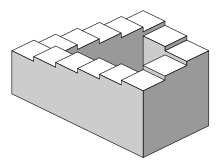
Penrose stairs are incorporated into the film as an example of the impossible objects that can be created in lucid dream worlds.
One of his victims, a very wealthy businessman called Saito, after an almost-successful session of dream-sharing and stealing, makes Cobb an offer he cannot refuse. Using his influence Saito will make it possible for Cobb to return home, his criminal records wiped clean permanently, but in return Cobb must try something even more difficult than extraction, an inception. Inception is the exact opposite of what Cobb’s been doing – instead of stealing a secret from somebody’s mind you plant a new idea inside their brain. It is a very complex process - you need a lot of psychological skills and knowledge about your victim because if they don’t accept that idea as their own they will remove it from their head in no time. Some partners of Cobb actually think an inception is impossible but Cobb knows it can be done. In fact he did it once and it was so successful that  he has been regretting the results every single day ever since. Still, as he misses his children very much he decides to make a deal with Saito.

Saito wants Cobb to invade the mind of Robert Fisher who is soon going to heir his father’s empire, Fisher-Monroe energy conglomerate. Fisher-Monroe is the major rival of Saito’s corporation and they can no longer compete with it in successfully. Cobb is supposed to plant an idea of splitting up the company in the head of the young successor – no mean feat because it is the very move any sensible owner would oppose. How to make Robert accept such a notion? Is it possible at all? Saito and Cobb think so. After all subconscious is motivated by emotions not reason, right?


The 11-ring labyrinth at Chartres Cathedral

Now Dom has to create a new team - including a good forger and the best architect he can find. That’s how he meets Ariadne, an architecture student who is more gifted than himself when it comes to designing a dream. Her task will be creating labyrinths – the equivalents of every layer of their victim's  consciousness;  first she must be trained by Cobb how to navigate a dream. 

Ariadne proves to be a very intelligent, quick-learning pupil but also one who is seriously concerned about Cobb’s state of mind. Right after their first session of dream-sharing she realizes Cobb cannot design his own dreams anymore because his late wife keeps revisiting and destroying them and he cannot keep her out for a reason or two. Will that weak spot jeopardize his last and most important mission? Should people from his own team trust him? Can you be killed inside your dream? What happens when you choose not to return? If you are curious, you must watch this movie to the very end. ;p

What I liked:

I refused to watch this one for a very long time because of Leonardo Di Caprio. Yes, I don't like this actor but this time I was pleasantly surprised. He played decently well and he was given the main role in one of the most intelligent sci-fi movies I’ve seen for a long time, the lucky devil. I loved the theory behind dream-sharing, all these projections of your subconsciousness, and the fact that the deeper inside the dreamland you were the more  the time slowed down around you and the quicker your brain worked. It was an elegant solution. I also appreciated it that they didn’t forget about our natural defense mechanism - as soon as you realize somebody is messing with your dream your projections become aggressive, trying to eliminate the intruder from your brain.  After some training you can even arm your projections and hurt the invader. Of course being hurt in your dream doesn’t mean anything when you wake up but still you can feel the pain without any problem. And you never should recreate the places that really exist in your mind because it can stir your memories and lose the grasp between what’s real and what is a dream. Oh and you need a personal totem, something unique and heavy which will help you realize whether you are inside a dream or not. Nice isn’t it? I could talk about it forever.

I also loved all those Minotaur’s labyrinth analogies because the myth itself is compelling. It is evident that Cobb represents Theseus, the founder-king of Athens who volunteered to go to Crete in order to free his people from a bloody offering of seven young men and severn maidens made every 'Great' year (so every seven solar years) to appease Minotaur. Minotaur was a half-bull half-man, living in a labyrinth build by Daedal in Knossoss, the son of Queen Pasifae, sired by a bull sent by Poseidon as a revenge.
Reproduction fresco on reconstucted wall at Pa...
Reproduction fresco on reconstucted wall at Palace of Minos, Knossos, Crete. Some glass reflections present (Photo credit: Wikipedia)

After he ascended the throne of Crete, Minos competed with his brothers to rule. Minos prayed to Poseidon to send him a snow-white bull, as a sign of support. He was to kill the bull to show honor to Poseidon but decided to keep it instead because of its beauty. He thought Poseidon would not care if he kept the white bull and sacrificed one of his own, an inferior animal. To punish Minos, Aphrodite made Pasiphaë, Minos' wife, fall deeply in love with the bull from the sea.  Pasiphaë had the archetypal craftsman Daedalus make a hollow wooden cow, and climbed inside it in order to mate with the white bull. The offspring was the monstrous Minotaur.Everybody knew it was a madness sent by the Gods so neither the unhappy Queen nor her monster of a son were punished. Pasiphaë nursed him in his infancy, but he grew and became ferocious, being the unnatural offspring of man and beast, he had no natural source of nourishment and thus devoured man for sustenance. Minos, after getting advice from the oracle at Delphi, had Daedalus construct a gigantic labyrinth to hold the Minotaur. Its location was near Minos' palace in Knossos.

Mal, Cobb’s wife represents the beast itself, she is something created against your own will. Being dead, she is just a projection of her husband's mind. It means Cobb carries the beast inside his head – a feeling or an idea that he is guilty and he cannot pardon himself enough to let Mal go. While Theseus was just led by the thread of Ariadne (the princess never entered the labyrinth but she was the half-sister of the beast), Cobb is accompanied by Ariadne herself and she is the only one who questions his problems and forces him to fight them. Will he get his catharsis, though, while he leaves Ariadne behind? In the myth, while Theseus and the rest of the crew fell asleep on the beach Athena waked the prince and told him to leave early, leaving Ariadne and her sister, Phaedra, on the beach.  Stricken with distress, Theseus forgot to put up the white sails instead of the black ones, so his father committed suicide. It was explained that  Dionysus later saw Ariadne crying out for Theseus and took pity on her and married her.In the movie Ariadne never becomes romantically involved with Cobb but still she is the closest to him, understanding him much better than any other member of his team.

What I didn't like:

Only after watching the movie for the second time I noticed some ambiguities concerning the main plot. Why exactly Cobb couldn't invade the brain of some American prosecutors to make them fix his little law problem? He had the skills, he had the team...was it more difficult than revealing corporate secrets? Somehow I don't think so. Also the ending left me wondering: did he or didn't he succeed? Fortunately some Interned browsing later I managed to answer my own question. ALMOST.

Final verdict: 

An intelligent sci-fi movie without rubbery monsters or tons of blood and slime. It will entertain you and it will make you think. If you get bored in December watch it one evening - you won't regret it.

Ok, spoilers ahead - the section below should be read only by people who have actually seen the movie and they wonder: how it really ended?


Those of you who've seen the movie know that in the final scene, Cobb is reunited with his children. Or is he? Did that scene happen in real life or just in his dreams?

Speaking to Clothes on Film (yes, there is a site devoted to that topic), Jeffrey Kurland, Inception costume designer, revealed the following:

COF: How much does costume reflect the inner machinations of the plot, particularly in a film such as Inception? For example, Cobb's children are wearing the same clothes at the end of the story as they are in his dream 'memory' throughout the film. Is there something to be interpreted here?

JK: Costume design reflects greatly on the movement of the plot, most significantly through character development. Character development is at the forefront of costume design. The characters move the story along and with the director and the actor the costume designer helps to set the film's emotional tone in a visual way. In a more physical sense the costumes' style and color help to keep the story on track, keeping a check on time and place.

On to the second part of your question, the children's clothing is different in the final scene... look again...

So Cobb DID get home again ... right?

What do YOU think?


Enhanced by Zemanta

Monday, 3 December 2012

A description of my December miniature and why I chose February?


Les Très Riches Heures du duc de Berry -  février or February by brothers Limbourgh.

Illumination on vellum


It is a very charming, peaceful scene, suffused  with a great atmosphere of a winter afternoon. What's more it is one of these miniatures which show the life of lower classes from 15th century - a rarity indeed! It is also a very athmospheric picture, appropriate for this time of the year. I decided to do a bit of an analysis this time and bear with me, I haven't done it for ages :).

In the foreground you see a fenced-in small farm with the main house on the left, a barn with sheep in the center and, on the right, four beehives and a dovecote - everything you need to make your living. Behind the main house there is a granary with a smal cupola- so many sheep have to be fed a lot of hay in the winter and they had to store it somewhere, grain for bread too. A flock of dark birds (crows or dark pigeons?) are feeding greedily nest to the barn.Noticeably there are no cows or horses around, maybe indicating that it is one of poorer farms because these were more expensive animals, harder to feed throughout winter than sheep.

The painter cleverly removed one of the walls so we can peek inside the house.
In the foreground a woman, presumably the mistress of the house, and two other people, probably a boy and a girl, are warming themselves in front of a fire. The woman lifts her deep blue dress and a white shift, showing bare legs clad in sturdy shoes, so do her companions; they want to get as much warmth as possible. The woman is looking at an animal, lying near her feet, presumably a house pet kept to catch mice (a marten? a stoat? a dog? It looks like a white marten, it is certainly not a cat but I need help here) .

Now when I come to think about it I am pretty sure the woman is the wife. Her head is covered by a dark headscarf, meaning she is married, and she occupies the best place before the fire. She's done her washing and now she has to rest a bit. The fact that she didn't hesitate to bare her legs might mean just one thing: the pair in the background belong to her family, most propably being her children. Exposing yourself like that before your male servants would be unthinkable.

 Outside, a man with bundles of sticks at his feet cuts down a tree with an ax, while another walks in the snow, blowing on his hands to warm up despite the fact that his upper body and the head are enveloped in a kind of grey-white cloak or a blanket. Just looking at him you can tell how cold it is. A third man in the background drives a donkey, loaded with wood, towards the neighboring village, which is  visible just because of snow-covered roofs and the high, pointed spire of a church.The sky is leaden grey - probably more snow is coming soon.

So where is the master of the house, the husband? My bet is on the man with the donkey. He left his wife comfortable before the fire with younger kids ('sit here, honey dear, I'll be back in no time but no, I can't take you with me, you wouldn't want to catch ague, would you?'), sent two older sons to do outside work ('animals need feeding, you lazy monsters, and logging can't wait as well, move!) but he himself didn't want to bore to death at home any longer. He had a business to attend to, right? He  is going to sell wood on the local market, earn some extra income and maybe visit a tavern or two to drink warm beer, chat with people and listen to the news.

Now compare that quiet but compelling scene with the December painting: hunting the boar.Yuck!


Enhanced by Zemanta

Saturday, 1 December 2012

Review: Sleight of Hand (Bite Back series 01) by Mark Henwick

A copy of this novel for reviewing purposes was sent to me free of charge by the author via Blodeuedd - thank you very much !  That fact, of course,  didn't influence my review in any way. 

Book info:
Form: pdf
Genre: urban fantasy, paranormal fiction, crime mystery
Target audience: adults

Synopsis:

Amber Farrell is not your ordinary PI. She has been very well trained in one of the US Army super secret units. Unfortunately now the Army don’t want to have anything to do with her although they watch her carefully. She was a cop. Now most cops distrust her. All because of a bloody incident in the South American jungle. She was bitten by something strange and she survived against all odds; now she doesn’t know what to do with her life which is simply slipping out of her hands.

It is not a big secret what she is becoming: a vampire. However even as your average vampire aspirant she is still unusual. The whole process is taking her longer for one thing and she doesn’t seem to need a mentor. She can also identify other vampires by their coppery smell.

As a self-employed PI Amber is doing not very well, but soon she is given a very profitable job. Her new client is Jenniffer Kingslund, a rich local businesswoman with a bunch of problems of her own: normal and paranormal. All of them seem to revolve around one undeveloped location of Jennifer: Silver Hills. Will Amber be able to help her? What will it take?

What I liked:

You might say it is just another paranormal fiction series with a mixture of everyday life in a big American city (Denver) and different fantasy creatures like vamps and werewolves but it was highly readable.

The world building was interesting, especially concerning the Athanate or vampires. The author tried to outline their existence in a fresh way (if it is possible at all with vampires swamping popular literature) and I appreciated his efforts. The criminal mystery actually was overshadowed by that thread, at least for me.

Amber is a highly-trained woman but her proficiency in martial arts and using conventional weapons didn’t come from thin air. It is one of my pet peeves – a more or less ordinary chica is turned into a vampire and in the matter of seconds, practically as soon as she touches a sword, she becomes a warrior extraordinaire. Here at least the author gave his heroine a proper background, making her exploits far more believable.

Also I truly enjoyed the fact that this novel didn’t feature either insta-love between the main lead and, say, a devastatingly handsome vampire master (ugh!) or an ugly love triangle. Amber is a sensible girl who knows her priorities and keeps her desires in check, concerning both her male and female acquaintances. I hope the author will continue that course.

Finally some secondary characters like Bian, the Vietnamese vampiress who likes Goth girls, Tullah, Amber’s secretary and her mother were really nice to read about.

What I didn’t like:

The biggest problem I had concerned my relating or rather not relating to the main heroine, Amber Farrell. Don’t get me wrong – I like kick-ass women who never pull their punches and make a career on their own, without needing a strong man by their side, vampire or otherwise. Still…whenever I felt I finally knew what made her tick I was led astray by her actions again and again. Let me be more precise: Amber is not a badly-constructed character but she is neither here nor there, a work in progress.

Sometimes she acts like a straight adult woman, sometimes – like a young gung ho man from a Bond movie. She kisses both men and women. For some period of time she is a kind of live-in girlfriend of Jen but without fully realizing the implications of her status. She publicly dances with her for heavens’ sake and still she never bothers to ask herself what others might think of it. When her sister is angry at her she is simply surprised. Although she is half way into becoming a vampire she hates most of vampires and is afraid of her own future as one. Still she doesn’t look for the answers – not really, taking into account the fact that she is an investigator – and when it comes to werewolves she doesn’t have any trust issues or problems…

I understand that it is just the first part of a whole series. Perhaps with hindsight everything would have become perfectly reasonable but reading the first part I sometimes found myself wondering whether Amber is a she or a he or a person somewhere in between. I bet there might be several explanations of such a character construction. First: it was done deliberately by the author for reason or reasons unknown, to be revealed later. Second: male authors, even very good ones, sometimes have difficulties getting into a female mind and their heroines come across as tomboys at best, hermaphrodites in the middle, something misshapen a cat might drag in at worst. Creating a complex character is never easy. In my opinion the jury is out when it comes to Ms Farrell. Her background (a stint in special forces, another one as a cop) definitely would predestine her to be a bit less feminine than your ordinary vampire chick and it’s fine by me but I wish she found her inner core, spoke with herself and took a mature, informed decision about her preferences – rather sooner than later.

Cover art:

Nice but a bit misleading. I mean vampires are far more prominent than werewolves in this one so what is that doggy doing here?

Final verdict:

An interesting beginning of another urban fantasy series and a nice debut. I wish Amber and her author all the best!