Thursday, 6 December 2012

Review: Dope by Sara Gran


Book info:
Genre: crime story noir/thriller
Target audience: adults
Form: pdf

Synopsis:

1950s, New York City, light ages before the famous ‘no tolerance’ policy of Mayor Giuliani. Josephine Flannigan, 36,  tries to make her living as a former heroin addict. She is a skilled con artist, a shrewd shoplifter and, generally, whatever anybody wants her to be providing they pay cash. She doesn’t do drugs and she doesn’t sell herself, anything else is negotiable. She must be clever and flexible - in such a seedy, dangerous, crime-ridden city she is lucky she’s survived to her third decade at all. As she hasn’t been shooting up for two years she looks ‘great’, with shiny hair, clearer complexion and a more rounded figure. Still paying her rent every single month is a challenge – she has no education and no steady position so money is tight; occasional odd jobs (like stealing a ring at Tiffany for breakfast ;p ) are hardly very profitable, fences never pay you much - the competition is too fierce.

Fortunately one of her ‘friends’ recommends Joe’s skills to the Nelsons, a respectable suburban couple. Their eighteen-year old daughter, Nadine, has abruptly disappeared with a wrong kind of boyfriend. Josephine recognized him instantly with a shudder as a ruthless pimp and a drug dealer called Jerry McFall. As Nadine has been a drug fiend for some time now (that’s why she dropped out of Barnard College) it seems Joey is the best person to find her, far better than any police officer of a PI – after all she knows that milieu like the back of her hand. What’s more the anxious parents offer her $1,000 upfront and then another thousand if she brings Nadine home in one piece. A sweet deal and easy buck? Not really.

Josephine embarks on an odyssey through New York’s underworld which is a bit like a sentimental but a very dangerous journey to her – she reconnects with many of her old friends and must constantly fight off the temptation to return to drugs. After a while she starts to care about the absent girl in spite of herself, maybe because the girl is as vulnerable as herself and maybe because Joe misses her younger sister, Shelley. Shelley, now a popular ads model and a budding actress, managed to make a stunning career considering her background, mainly because of Joe’s devotion and support; however, she doesn’t need the older sister anymore and she is even ashamed of her. Let’s face it, she aspires to be upper class and a former prostitute and drug addict of a sister not exactly helps that image. Business is business.

 Will Josephine be able to find Nadine on time to prevent the worst? Will the money be worth her efforts? Or maybe it is not such a great chance at all and somebody is simply framing her for murder? You know that old saying: if something looks or sounds too good it is most likely too good to be true…

What I liked:

There is nothing romanticized about the story you get in this novel and its heroine, mauled by her sad experience. The slums are not just providing a colourful background – they are described with gritty vividness, really the worst places to visit, full of brutal, despairing, desolate people who see no end of their problems and have no future. Josephine is not a princess who managed to come unscathed from hell, quite the opposite in fact; as the narrator she honestly admits from the beginning that she has been leading horrible life since her childhood with alcoholic, unstable mother and a younger sister to feed and protect from the worst.

Raised rough in Hell’s Kitchen, Josephine never expected much from life. She has scraped by, pulling small cons, shoplifting, whoring when times were particularly bad— then doing just about anything to get enough for her next fix. Still she never feels sorry for herself and the way she treats her sister, now apparently doing much better than poor Joe has ever done, is very touching. Almost as touching as Joe’s heroic efforts to find a rich brat from a ‘good’ house even when it is obvious nobody really cares what’s happened to Nadine. Making Josephine persevere the author showed that her heroine really deserved better than being labeled 'white trash'. It is even more impressing that at first Joe admits her annoyance at Nadine, a girl who had every advantage like a loving family and money, and managed to screw up her life royally just for fun. She says chillingly:

“She wanted her walk on the wild side and now she was getting it. So let her see what The Life was like. Let her lose her looks from getting hit in the face too many times . Let her lose a few teeth and all of her pride and all her charm school manners. Her college education wouldn't do her any good out here.”

 It really takes a lot of backbone and character integrity to keep looking for and helping somebody you’ve envied so much; such qualities made Joey a compelling character and it was really shown, not told.

Now about the style. Sara Gran writes with a lot of reserve which only adds force to her narration. There are no infodumps or boring fragments in this novel – with every new person Josephine encounters on her path there is the promise of a whole new interesting story just waiting to be told to a willing listener. There are no redundant secondary characters either. The baddie is really bad – a female boxer and a pimp plus a crooked drug dealer, is there anything better for your negative character…I mean anything worse? There is another baddie, as ugly as Jerry but I can say no more, it would be a major spoiler.

What I didn’t like:

The ending. I wanted a HEA for Josephine very badly but, unfortunately, the author decided otherwise – she  suggested a much more real but pretty painful outcome. Still a suggestion is not a fact, right? I would love to read a sequel in which Joey has a bit more luck and finds her much-deserved stability, maybe even happiness.

Final verdict:

One of better noir mystery novels I’ve read this year with a funny, intelligent heroine and interesting settings. Still it is definitely not a novel for somebody who likes happy endings – be warned, the final several pages are pretty heart-rending in a dark, brutal way.

Tuesday, 4 December 2012

Movie review: Inception directed by Christopher Nolan

I was reminded about this movie by Heidenkind - go and check the rest of her non-holiday movies list - thanks a lot! I owe you again!

Release year: 2010
Written by Christopher Nolan
Genre: sci-fi thriller
Cast:
Dom Cobb: Leonardo di Caprio
Arthur: Joseph Gordon-Levitt
Ariadne: Ellen Page
Mallorie "Mal" Cobb - Marion Cotillard
Saito - Ken Watanabe
Robert Fisher - Cillian Murphy


Synopsis:

Where is the safest place for your secrets? If you say ‘in my own head’ this movie can actually make you change your mind.
Cover of "Inception"
Cover of Inception

Dom Cobb is a skilled extractor – a thief who can navigate people’s mind in their sleep and find out the secrets they are hiding while sharing their dream. Sometimes he must create a dream within a dream to reach the information he needs and with every layer of the sleep the whole process gets trickier. Still he is one of the best and he works with a team of other professionals, called architects. Architects are responsible for creating the right scenery of a given dream, designing it from scratch. Every single detail of fictional reality must be in perfect accordance with the locations known to their victims. Cobb and his colleagues earn a lot of money, being usually hired by powerful corporations and super-rich tycoons; still because of that not exactly lawful profession Cobb has also plenty of enemies and can’t return home to live with his two children - in America he is a fugitive from justice, officially accused of murdering his wife, Mal.

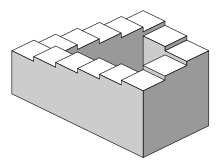
Penrose stairs are incorporated into the film as an example of the impossible objects that can be created in lucid dream worlds.
One of his victims, a very wealthy businessman called Saito, after an almost-successful session of dream-sharing and stealing, makes Cobb an offer he cannot refuse. Using his influence Saito will make it possible for Cobb to return home, his criminal records wiped clean permanently, but in return Cobb must try something even more difficult than extraction, an inception. Inception is the exact opposite of what Cobb’s been doing – instead of stealing a secret from somebody’s mind you plant a new idea inside their brain. It is a very complex process - you need a lot of psychological skills and knowledge about your victim because if they don’t accept that idea as their own they will remove it from their head in no time. Some partners of Cobb actually think an inception is impossible but Cobb knows it can be done. In fact he did it once and it was so successful that  he has been regretting the results every single day ever since. Still, as he misses his children very much he decides to make a deal with Saito.

Saito wants Cobb to invade the mind of Robert Fisher who is soon going to heir his father’s empire, Fisher-Monroe energy conglomerate. Fisher-Monroe is the major rival of Saito’s corporation and they can no longer compete with it in successfully. Cobb is supposed to plant an idea of splitting up the company in the head of the young successor – no mean feat because it is the very move any sensible owner would oppose. How to make Robert accept such a notion? Is it possible at all? Saito and Cobb think so. After all subconscious is motivated by emotions not reason, right?


The 11-ring labyrinth at Chartres Cathedral

Now Dom has to create a new team - including a good forger and the best architect he can find. That’s how he meets Ariadne, an architecture student who is more gifted than himself when it comes to designing a dream. Her task will be creating labyrinths – the equivalents of every layer of their victim's  consciousness;  first she must be trained by Cobb how to navigate a dream. 

Ariadne proves to be a very intelligent, quick-learning pupil but also one who is seriously concerned about Cobb’s state of mind. Right after their first session of dream-sharing she realizes Cobb cannot design his own dreams anymore because his late wife keeps revisiting and destroying them and he cannot keep her out for a reason or two. Will that weak spot jeopardize his last and most important mission? Should people from his own team trust him? Can you be killed inside your dream? What happens when you choose not to return? If you are curious, you must watch this movie to the very end. ;p

What I liked:

I refused to watch this one for a very long time because of Leonardo Di Caprio. Yes, I don't like this actor but this time I was pleasantly surprised. He played decently well and he was given the main role in one of the most intelligent sci-fi movies I’ve seen for a long time, the lucky devil. I loved the theory behind dream-sharing, all these projections of your subconsciousness, and the fact that the deeper inside the dreamland you were the more  the time slowed down around you and the quicker your brain worked. It was an elegant solution. I also appreciated it that they didn’t forget about our natural defense mechanism - as soon as you realize somebody is messing with your dream your projections become aggressive, trying to eliminate the intruder from your brain.  After some training you can even arm your projections and hurt the invader. Of course being hurt in your dream doesn’t mean anything when you wake up but still you can feel the pain without any problem. And you never should recreate the places that really exist in your mind because it can stir your memories and lose the grasp between what’s real and what is a dream. Oh and you need a personal totem, something unique and heavy which will help you realize whether you are inside a dream or not. Nice isn’t it? I could talk about it forever.

I also loved all those Minotaur’s labyrinth analogies because the myth itself is compelling. It is evident that Cobb represents Theseus, the founder-king of Athens who volunteered to go to Crete in order to free his people from a bloody offering of seven young men and severn maidens made every 'Great' year (so every seven solar years) to appease Minotaur. Minotaur was a half-bull half-man, living in a labyrinth build by Daedal in Knossoss, the son of Queen Pasifae, sired by a bull sent by Poseidon as a revenge.
Reproduction fresco on reconstucted wall at Pa...
Reproduction fresco on reconstucted wall at Palace of Minos, Knossos, Crete. Some glass reflections present (Photo credit: Wikipedia)

After he ascended the throne of Crete, Minos competed with his brothers to rule. Minos prayed to Poseidon to send him a snow-white bull, as a sign of support. He was to kill the bull to show honor to Poseidon but decided to keep it instead because of its beauty. He thought Poseidon would not care if he kept the white bull and sacrificed one of his own, an inferior animal. To punish Minos, Aphrodite made Pasiphaë, Minos' wife, fall deeply in love with the bull from the sea.  Pasiphaë had the archetypal craftsman Daedalus make a hollow wooden cow, and climbed inside it in order to mate with the white bull. The offspring was the monstrous Minotaur.Everybody knew it was a madness sent by the Gods so neither the unhappy Queen nor her monster of a son were punished. Pasiphaë nursed him in his infancy, but he grew and became ferocious, being the unnatural offspring of man and beast, he had no natural source of nourishment and thus devoured man for sustenance. Minos, after getting advice from the oracle at Delphi, had Daedalus construct a gigantic labyrinth to hold the Minotaur. Its location was near Minos' palace in Knossos.

Mal, Cobb’s wife represents the beast itself, she is something created against your own will. Being dead, she is just a projection of her husband's mind. It means Cobb carries the beast inside his head – a feeling or an idea that he is guilty and he cannot pardon himself enough to let Mal go. While Theseus was just led by the thread of Ariadne (the princess never entered the labyrinth but she was the half-sister of the beast), Cobb is accompanied by Ariadne herself and she is the only one who questions his problems and forces him to fight them. Will he get his catharsis, though, while he leaves Ariadne behind? In the myth, while Theseus and the rest of the crew fell asleep on the beach Athena waked the prince and told him to leave early, leaving Ariadne and her sister, Phaedra, on the beach.  Stricken with distress, Theseus forgot to put up the white sails instead of the black ones, so his father committed suicide. It was explained that  Dionysus later saw Ariadne crying out for Theseus and took pity on her and married her.In the movie Ariadne never becomes romantically involved with Cobb but still she is the closest to him, understanding him much better than any other member of his team.

What I didn't like:

Only after watching the movie for the second time I noticed some ambiguities concerning the main plot. Why exactly Cobb couldn't invade the brain of some American prosecutors to make them fix his little law problem? He had the skills, he had the team...was it more difficult than revealing corporate secrets? Somehow I don't think so. Also the ending left me wondering: did he or didn't he succeed? Fortunately some Interned browsing later I managed to answer my own question. ALMOST.

Final verdict: 

An intelligent sci-fi movie without rubbery monsters or tons of blood and slime. It will entertain you and it will make you think. If you get bored in December watch it one evening - you won't regret it.

Ok, spoilers ahead - the section below should be read only by people who have actually seen the movie and they wonder: how it really ended?


Those of you who've seen the movie know that in the final scene, Cobb is reunited with his children. Or is he? Did that scene happen in real life or just in his dreams?

Speaking to Clothes on Film (yes, there is a site devoted to that topic), Jeffrey Kurland, Inception costume designer, revealed the following:

COF: How much does costume reflect the inner machinations of the plot, particularly in a film such as Inception? For example, Cobb's children are wearing the same clothes at the end of the story as they are in his dream 'memory' throughout the film. Is there something to be interpreted here?

JK: Costume design reflects greatly on the movement of the plot, most significantly through character development. Character development is at the forefront of costume design. The characters move the story along and with the director and the actor the costume designer helps to set the film's emotional tone in a visual way. In a more physical sense the costumes' style and color help to keep the story on track, keeping a check on time and place.

On to the second part of your question, the children's clothing is different in the final scene... look again...

So Cobb DID get home again ... right?

What do YOU think?


Enhanced by Zemanta

Monday, 3 December 2012

A description of my December miniature and why I chose February?


Les Très Riches Heures du duc de Berry -  février or February by brothers Limbourgh.

Illumination on vellum


It is a very charming, peaceful scene, suffused  with a great atmosphere of a winter afternoon. What's more it is one of these miniatures which show the life of lower classes from 15th century - a rarity indeed! It is also a very athmospheric picture, appropriate for this time of the year. I decided to do a bit of an analysis this time and bear with me, I haven't done it for ages :).

In the foreground you see a fenced-in small farm with the main house on the left, a barn with sheep in the center and, on the right, four beehives and a dovecote - everything you need to make your living. Behind the main house there is a granary with a smal cupola- so many sheep have to be fed a lot of hay in the winter and they had to store it somewhere, grain for bread too. A flock of dark birds (crows or dark pigeons?) are feeding greedily nest to the barn.Noticeably there are no cows or horses around, maybe indicating that it is one of poorer farms because these were more expensive animals, harder to feed throughout winter than sheep.

The painter cleverly removed one of the walls so we can peek inside the house.
In the foreground a woman, presumably the mistress of the house, and two other people, probably a boy and a girl, are warming themselves in front of a fire. The woman lifts her deep blue dress and a white shift, showing bare legs clad in sturdy shoes, so do her companions; they want to get as much warmth as possible. The woman is looking at an animal, lying near her feet, presumably a house pet kept to catch mice (a marten? a stoat? a dog? It looks like a white marten, it is certainly not a cat but I need help here) .

Now when I come to think about it I am pretty sure the woman is the wife. Her head is covered by a dark headscarf, meaning she is married, and she occupies the best place before the fire. She's done her washing and now she has to rest a bit. The fact that she didn't hesitate to bare her legs might mean just one thing: the pair in the background belong to her family, most propably being her children. Exposing yourself like that before your male servants would be unthinkable.

 Outside, a man with bundles of sticks at his feet cuts down a tree with an ax, while another walks in the snow, blowing on his hands to warm up despite the fact that his upper body and the head are enveloped in a kind of grey-white cloak or a blanket. Just looking at him you can tell how cold it is. A third man in the background drives a donkey, loaded with wood, towards the neighboring village, which is  visible just because of snow-covered roofs and the high, pointed spire of a church.The sky is leaden grey - probably more snow is coming soon.

So where is the master of the house, the husband? My bet is on the man with the donkey. He left his wife comfortable before the fire with younger kids ('sit here, honey dear, I'll be back in no time but no, I can't take you with me, you wouldn't want to catch ague, would you?'), sent two older sons to do outside work ('animals need feeding, you lazy monsters, and logging can't wait as well, move!) but he himself didn't want to bore to death at home any longer. He had a business to attend to, right? He  is going to sell wood on the local market, earn some extra income and maybe visit a tavern or two to drink warm beer, chat with people and listen to the news.

Now compare that quiet but compelling scene with the December painting: hunting the boar.Yuck!


Enhanced by Zemanta

Saturday, 1 December 2012

Review: Sleight of Hand (Bite Back series 01) by Mark Henwick

A copy of this novel for reviewing purposes was sent to me free of charge by the author via Blodeuedd - thank you very much !  That fact, of course,  didn't influence my review in any way. 

Book info:
Form: pdf
Genre: urban fantasy, paranormal fiction, crime mystery
Target audience: adults

Synopsis:

Amber Farrell is not your ordinary PI. She has been very well trained in one of the US Army super secret units. Unfortunately now the Army don’t want to have anything to do with her although they watch her carefully. She was a cop. Now most cops distrust her. All because of a bloody incident in the South American jungle. She was bitten by something strange and she survived against all odds; now she doesn’t know what to do with her life which is simply slipping out of her hands.

It is not a big secret what she is becoming: a vampire. However even as your average vampire aspirant she is still unusual. The whole process is taking her longer for one thing and she doesn’t seem to need a mentor. She can also identify other vampires by their coppery smell.

As a self-employed PI Amber is doing not very well, but soon she is given a very profitable job. Her new client is Jenniffer Kingslund, a rich local businesswoman with a bunch of problems of her own: normal and paranormal. All of them seem to revolve around one undeveloped location of Jennifer: Silver Hills. Will Amber be able to help her? What will it take?

What I liked:

You might say it is just another paranormal fiction series with a mixture of everyday life in a big American city (Denver) and different fantasy creatures like vamps and werewolves but it was highly readable.

The world building was interesting, especially concerning the Athanate or vampires. The author tried to outline their existence in a fresh way (if it is possible at all with vampires swamping popular literature) and I appreciated his efforts. The criminal mystery actually was overshadowed by that thread, at least for me.

Amber is a highly-trained woman but her proficiency in martial arts and using conventional weapons didn’t come from thin air. It is one of my pet peeves – a more or less ordinary chica is turned into a vampire and in the matter of seconds, practically as soon as she touches a sword, she becomes a warrior extraordinaire. Here at least the author gave his heroine a proper background, making her exploits far more believable.

Also I truly enjoyed the fact that this novel didn’t feature either insta-love between the main lead and, say, a devastatingly handsome vampire master (ugh!) or an ugly love triangle. Amber is a sensible girl who knows her priorities and keeps her desires in check, concerning both her male and female acquaintances. I hope the author will continue that course.

Finally some secondary characters like Bian, the Vietnamese vampiress who likes Goth girls, Tullah, Amber’s secretary and her mother were really nice to read about.

What I didn’t like:

The biggest problem I had concerned my relating or rather not relating to the main heroine, Amber Farrell. Don’t get me wrong – I like kick-ass women who never pull their punches and make a career on their own, without needing a strong man by their side, vampire or otherwise. Still…whenever I felt I finally knew what made her tick I was led astray by her actions again and again. Let me be more precise: Amber is not a badly-constructed character but she is neither here nor there, a work in progress.

Sometimes she acts like a straight adult woman, sometimes – like a young gung ho man from a Bond movie. She kisses both men and women. For some period of time she is a kind of live-in girlfriend of Jen but without fully realizing the implications of her status. She publicly dances with her for heavens’ sake and still she never bothers to ask herself what others might think of it. When her sister is angry at her she is simply surprised. Although she is half way into becoming a vampire she hates most of vampires and is afraid of her own future as one. Still she doesn’t look for the answers – not really, taking into account the fact that she is an investigator – and when it comes to werewolves she doesn’t have any trust issues or problems…

I understand that it is just the first part of a whole series. Perhaps with hindsight everything would have become perfectly reasonable but reading the first part I sometimes found myself wondering whether Amber is a she or a he or a person somewhere in between. I bet there might be several explanations of such a character construction. First: it was done deliberately by the author for reason or reasons unknown, to be revealed later. Second: male authors, even very good ones, sometimes have difficulties getting into a female mind and their heroines come across as tomboys at best, hermaphrodites in the middle, something misshapen a cat might drag in at worst. Creating a complex character is never easy. In my opinion the jury is out when it comes to Ms Farrell. Her background (a stint in special forces, another one as a cop) definitely would predestine her to be a bit less feminine than your ordinary vampire chick and it’s fine by me but I wish she found her inner core, spoke with herself and took a mature, informed decision about her preferences – rather sooner than later.

Cover art:

Nice but a bit misleading. I mean vampires are far more prominent than werewolves in this one so what is that doggy doing here?

Final verdict:

An interesting beginning of another urban fantasy series and a nice debut. I wish Amber and her author all the best!

Thursday, 29 November 2012

NaNoWriMo 2012 - my impressions

Yes, I did it! I managed to write 50,000 words in roughly 30 days! I am so happy!!!

It wasn't easy. It wasn't problem-free but it was and is doable!

What did I produce?
A 50k+ story. With a proper beginning and a proper ending and plenty of typos. It is about a young magician called Vakr who gets involved in an affair that exceeds his expecations but makes him stronger. 1st person limited narration.

Is it readable/publishable?
No. I weren't able to edit much. I am pretty sure it is a horrible story but I did try to eliminate any inconsistencies.

What did I learn?
How to plan your writing in order to be effective. How to be disciplined about the amount of words you have to write a given day. How to sketch some scenes beforehand and fill them in later. How to go with the flow of the story, let your characters decide from time to time although you had planned it differently.

Will I be willing to repeat that experience?
YES. It was fun and it was worth my effort. Still I am happy I finished it. Demanding like hell.

If you have participated this year (it is not over yet) or previous years let me know about your experiences.

Tuesday, 27 November 2012

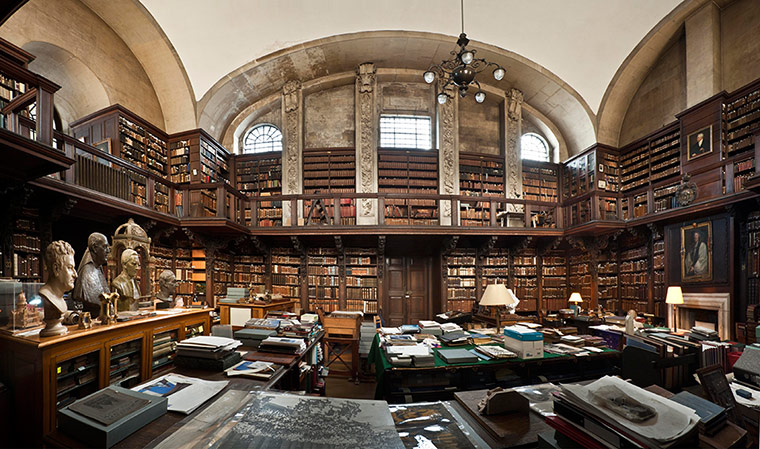
The Most Fascinating Libraries of the World 09 - St. Paul's Cathedral Library, London

I visited a friend's blog one day and I was literary blown over by a picture of one of the most fascinating libraries around - Trinity College Library in Dublin, Ireland. It also gave me an idea of a series of posts about the best, the most beautiful, the strangest and the biggest libraries there are. The libraries that can make you drool, where you would be able to spend an indefinite period of time without noticing, where you would like to live and die till the end of the world (if they only served coffee and cake that is). Perhaps you can't visit them all but what is the Internet for? I'll try to illustrate my posts as well as it is only possible, providing, I hope, a nice tour for every visitor around. Enjoy!


By the way, if you want to admire other great libraries, presented by me in this series, search this blog using 'libraries of the world' tag and you'll find them all.

St.Paul's Cathedral Library, London
(thanks, Tasha/Heidenkind from Truth Beauty, Freedom and Books blog, for the tip!)


History (from the official website)

The library's collection was almost completely destroyed in the Great Fire of London. Lists surviving from 1313 onwards give a picture of the pre-fire library. Wren's library chamber was restocked by the Commissioners for rebuilding St Paul's: they bought collections, including valuable Bibles and liturgical texts, and were fortunate to receive a generous bequest in 1712 of nearly two thousand volumes from the library of Henry Compton, late Bishop of London. In 1783 the library of John Mangey, Vicar of Dunmow and Prebendary of St Paul's, was added. In the nineteenth century large collections of ecclesiastical tracts and pamphlets were brought in and improvements made to the library's holdings of sermons preached in the Cathedral and at Paul's Cross.


The subject strength of the historical collections lies in theology, church history and patristics. Current acquisitions are restricted to major works on the history of the Church in England, on Wren and the building of the Cathedral, the Church in the City, and 'alumni' material.

Access to the cathedral Library

The library of Dean and Chapter is normally open to researchers by prior appointment on Mondays and Tuesdays, and on Fridays in the afternoons only. It is sometimes possible to arrange for library material to be made available at other times.

For enquiries relating to the library please contact the Librarian Joseph Wisdom .


Cathedral archives

The Cathedral library retains little archival material. The archive of Dean and Chapter, and the smaller archives of the College of Minor Canons, and of the Cathedral (Choir) School are deposited at Guildhall Library.


Saturday, 24 November 2012

La Voisin or a 17th century self-made woman à la française


As the title suggests it will be a story of one intrepid woman who lived in the 17th century France. She didn’t have any wealth or titles to her name. Despite that fact she managed to educate herself and find a good, high-profile job or rather create one. In fact she was far more successful than her husband and she was able to cater for the needs of all her household. She became a very prominent figure in Paris, feared and visited
Catherine Deshayes, "La Voisin", 17th-century print of her portrait held by a winged devil (so you know at once she is bad). (Photo credit: Wikipedia)
even by those rich and mighty. Still her job wasn’t exactly respectful – I would call it demanding and dangerous. No, she wasn’t a prostitute. She was a fortuneteller and a poisoner. Her name is Catherine Monvoisin, née Deshayes, but she was better known as "La Voisin".


Nobody knows when Catherine was born. At that times children from lower classes weren’t registered at all, especially girls. It was most probably around 1640. You also won’t be able to find anything about her childhood or youth. Her public life started with a marriage to one Antoine Monvoisin, a jeweler with a shop at Pont-Marie in Paris. Antoine wasn’t a great businessman – soon enough he was ruined. Catherine decided to take things into her own hands – she started practicing chiromancy, face-reading and midwifery to support her family. Some say she specialized mainly in performing abortions.

There are several conclusions to be drawn from that facts. First is that Catherine must have had a real gift of reading people’s characters. She said that she developed the talent God had given her and, allegedly, she had been taught the art of fortune telling from the age of nine. It is known that she actively studied methods of physiology but without being a natural psychologist she would have never achieved so much. She was clever enough to spend a lot of money to provide the right atmosphere which would make her clients more inclined to believe in her authority and the prophecies provided. For example she acquired a special robe of crimson red velvet embroidered with eagles in gold for an exorbitant price of 1500 livres to perform in because her sessions were a kind of performance, no doubt of it.

In order to give you some notion how exorbitant a price it really was compare it to the expenses of one Aubert de la Chesnaye a merchant, fur-trader, seigneur, financier, member of the Conseil Souverain of New France who lived in the same period. Soon after his arrival in the colony La Chesnaye began to acquire land. In 1659 he purchased for 1,000 livres 70 acres on Coteau Sainte-Geneviève, one of the colony’s most favoured sites for agriculture by virtue of its proximity to Quebec, and a lot on Rue du Sault-au-Matelot in Lower Town where he built a spacious home in the 1660s. La Voisin seemed to aim really high, feeling the need to spend more on a robe.

During her work as a fortune teller, she noticed the similarities between her customers wishes about their future: almost all wanted to have someone fall in love with them, that someone would die so that they might inherit, or that their spouses would die, so that they might marry someone else. Her clients were her masters and she knew how to be flexible and meet their expectations. Initially, she told her clients that their will would be true if it was also the will of God. Then, she started to recommend to her clients some actions: to visit the church of some particular saint; eventually, she was selling them amulets and recommend magical practices of various kinds. She started to sell aphrodisiacs to those who wished for people to fall in love with them, and poison to those who wished for someone to die. The bones of toads, teeth of moles, Spanish flies, iron filings, human blood and mummy, or the dust of human remains, were among the alleged ingredients of the love powders concocted by La Voisin. Apparently not all her clients wanted to visit a church or believed in divine interventions so she was arranging black masses where they could pray to the Devil. It was only a matter of money.

Of course La Voisin hardly worked alone although her unlucky husband seemed to be content to keep to the background. Catherine found other, more skilled professionals, to cooperate with and soon enough she had a large network of colleagues and assistants, among them Adam Lesage, who was one of her lovers and performed allegedly magical tasks; the reneged priests Étienne Guibourg and abbé Mariotte, who officiated at the black masses; and poisoners like Catherine Trianon as La Voisin was not particularly skilled in that area and her clients, recruiting from those privileged, influential and rich, were more and more demanding. She had also an extensive network of associates and had been able to place young girls among the ladies-in-waiting at the royal court to spy for her.

That way Catherine had made a real fortune from her business. Among her noted clients were countess de Soissons, duchess de Bouillon; Comtesse de Gramont ("la belle Hamilton"), François-Henri de Montmorency, duc de Luxembourg, princesse Marie Louise Charlotte de Tingry, marchioness Benigne d'Alluye, countess Claude Marie du Roure, count de Clermont-Lodéve, countess Jacqueline de Polignac, duchess Antoinette de Vivonne, Marquis Louis de Cessac, Marquis Antoine de Feuquieres and Marechal de la Ferthe. La Voisin resided at Villeneuve-sur-Gravois, where she received her clients. Like a good businesswoman she tended to them all day and them she entertained them at parties with violin music in her gardens at night. The house also included a furnace, allegedly for the bodies of dead babies, who were then buried in the garden.

Officially La Voisin was a religious woman although it’s hard to say whether she truly believed in God or just pretended to do so in order to deflect any accusations and make a part of her clientele more comfortable with her services. Anyway she regularly attended the church of the Jansenist abbé de Sant-Amour, principal at the Paris University. On the other hand she was also interested in science and alchemy and financed several private projects and enterprises, some of them made by con artists who tried to fool money out of her. Privately it is said her glamorous life was also a stressful one - she suffered from alcoholism. It must have been a high-stress and high-risk career, full of unexpected pitfalls. For example in 1665/66, her fortune telling was questioned by the priests of Saint Vincent de Paul's order, the Congregation of the Mission, but La Voisin defended herself successfully before the professors at the Sorbonne. She proved to be one intelligent lady but it was hardly the end of her problems.

The death of the king's sister-in-law, the Duchesse d'Orléans, had been falsely attributed to poison, and the crimes of Madame de Brinvilliers (executed in 1676) and her accomplices were still fresh in the public mind. In parallel, a riot took place where people accused witches of abducting children for the black masses, and priests reported that a growing number of people were confessing to poisoning in their confessions. In 1677, the fortune teller Magdelaine de La Grange was arrested for poisoning, and claimed that she had information about crimes of high importance. It led to the arrest of the successful fortune teller and poisoner Marie Bosse and Marie Vigoreux in January 1679. All these events made the police aware that there existed a network of fortune tellers in Paris who dealt with the distribution of poison. They started to look for other members of that network but I suppose nobody could predict that they would be dealing with an attempted regicide soon.

Madame de Montespan
The most important client of La Voisin was Madame de Montespan, the official royal mistress to King Louis XIV of France. She was also her downfall. In 1667, Montespan hired La Voisin to arrange a black mass, allegedly celebrated in a house in Rue de la Tannerie. Adam Lesage and abbé Mariotte officiated, while Montespan prayed to win the love of the king. The same year, Montespan became the official mistress of the king, and after this, she employed La Voisin whenever a problem occurred in her relationship with Louis. As you can guess, she could practically take it for granted that sooner or later there would be problems.

In 1673, when the king's interest in Montespan seemed to deteriorate, she again turned to La Voisin, who provided a series of black masses officiated by Etienne Guibourg. Allegedly on a least one occasion, Montespan herself acted as the human altar during the mass. I don’t doubt the royal mistress was a great client but she was also too ambitious for her own sake. In 1677 she made clear that if the king should abandon her, she would have him killed. When the King entered in to a relationship with Angélique de Fontanges in 1679, Montespan called for La Voisin and asked her to have both the king and Fontages poisoned. La Voisin hesitated, but was eventually convinced or blackmailed to agree. At the house of her colleague, Catherine Trianon, La Voisin came with a plan to kill the king together with other fellow poisoners, Bertrand and Romani, the last being also the fiancé of her daughter. Trianon was unwilling to participate and tried to make her change her mind by constructing an ill-fated fortune for her, but Voisin refused to listen to her. Perhaps she was in a very tight corner and I suppose she knew the best how worthless these fortunes were. The group decided to murder the king by poisoning a petition which was to be delivered to his own hands.

The 5 March 1679, La Voisin visited the royal court in Saint-Germain to deliver the petition. At that day, however, there were too many petitioners and the king did not take them in his hands, which made her return without having delivered it. Upon her return to her home in Paris, she handed the petition to her daughter and asked her to burn it, which she also did. The next day, she made plans to visit Catherine Trianon after mass, allegedly to plan the next murder attempt upon Louis XIV.

The 12 March 1679, La Voisin was arrested outside Notre-Dame de Bonne-Nouvelle after having heard mass, just before her appointed meeting at Catherine Trianon. In April 1679, a commission appointed to inquire into the subject and to prosecute the offenders met for the first time. Its proceedings, including some suppressed in the official records, are preserved in the notes of one of the official court reporters, Gabriel Nicolas de la Reynie.
Louis XIV

At the arrest of La Voisin, her maid Margot stated that the persecution would mean the end of a number of people of all positions of society. Still the commission didn’t hesitate to arrest Marguerite Monvoisin, the only daughter of La Voisin, Guibourg, Lesage, Bertrand, Romain and the rest of her network of her associates. La Voisin was kept at Vincennes, were she was subjected to questioning. On 27 December 1679, Louis XIV issued an order that the whole network should be exterminated by all methods regardless of the rank, gender or age of those involved.

La Voisin confessed to the crimes she was accused of and described the development of her career. She was never subjected to torture: a formal order was issued giving permission to the use of torture, but it was made clear that the order was not to be put in effect, and consequently it was never made use of. The reason it suggested to be the fear that she might give away the names of influential people if she was questioned under torture. La Voisin never mentioned the names of any of her clients during the interviews. She once mentioned to the guards, that the question she feared most was that they should ask her about her visits at the royal court. It is likely that she was referring to Montespan as her client and her attempt of murdering the king, and that she feared that such a confession should result in her execution for regicide. Other sources state that, after being held a year, she was subjected to three days of intense torture during which her legs were systematically crushed. Still she did not confess.

Her list of clients, the arranging of the black masses, her connection to Montespan and the murder attempt on the king was not to be revealed until after her death, when it was stated by her daughter and confirmed by the uncontaminated testimonies of the other accused.

La Voisin was convicted of witchcraft and was burned in public on the Place de Grève in Paris the 22 February 1680. In July, her daughter Marguerite Monvoisin revealed her connection to Montespan, which was confirmed by the statements of the other accused. This caused the monarch to eventually close the investigation, despite his earlier threats, seal the testimonies and place the remaining accused outside of the public justice system by imprisoning them under a lettre de cachet (a letter under the sovereign's seal, often authorizing imprisonment without trial; literally: letter with a seal)

After many years of stories circulating throughout Europe of witches, Satanists, and black masses, largely believed to have been created by the imaginations of Inquisitors, the case of La Voisin appears to have been the first real registering of events that began to conform to the rumors. It would, of course, not be the last. Still La Voisin seems to me firstly and foremostly a successful businesswoman and a clever psychologist who was destroyed by her own ambition, not an evil witch.


 
La Voisin and her organisation is portrayed in a novel by Judith Merkle Riley: The Oracle Glass (1994), which was reviewed by Blodeuedd not so long ago.


Enhanced by Zemanta