
Thursday, 1 November 2012

Movie review: Girl with A Pearl Earring directed by Peter Webber


Release year: 2003
Screenplay: Olivia Hetreed


Cast:

Griet: Scarlett Johansson
Johannes Vermeer van Delft – Colin Firth
Catharina Vermeer, wife of Johannes – Essie Davis
Pieter, young butcher – Cilian Murphy
Maria Thins (mother-in- law of Vermeer) – Judy Parfitt
Pieter Van Ruijven (rich patron of Vermeer) – Tom Wilkinson) 


Synopsis:

Griet is a shy girl living in the Dutch Republic in 1665. Her father, a Delft ware painter, has recently gone blind so he is unable to work any longer. Consequently, Griet is sent to work as a maid in the unhappy, chaotic and impoverished household of the painter Johannes Vermeer where everything depends on the productivity of the master of the house. Who is rather slow in his 'production'. He is an artist, right? Still he has six brats, a wife and a mother-in-law under one roof; the seventh bundle of joy is on its way...

Griet works hard, almost wordlessly, as she occupies the lowest position in a harsh hierarchy, where even one of the Vermeer's children, the devilish Cornelia, treats her spitefully. On a routine shopping trip outside the house Griet meets a butcher's son, Pieter, who is quickly taken with her. However the girl is slow to return his affections. I might risk stating she has other problems on her mind.

As Griet cleans Vermeer's studio they become casually acquainted. Vermeer starts to appreciate Griet’s company, he even gives her lessons in mixing paints and other tasks, taking care to keep this secret from his thin-lipped wife, who would react very jealously if she found out that her husband was spending more time with Griet than with his own constantly enlarging family. In contrast, Vermeer's pragmatic mother-in-law, Maria Thins, sees Griet as useful to Vermeer's career because the girl can make the arduous work of finishing a painting quicker. Vermeer's rich patron Van Ruijven notices Griet on a visit to the Vermeer household and asks the painter if he will give her up to him to work in his own house, a situation which ruined a previous serving girl. Vermeer refuses, but accepts a commission to paint a portrait of Griet for Van Ruijven. 

A merry company and one busy servant girl...


As Vermeer secretly works on the painting, which is going to become one of the most recognizable portraits of the world, Catharina's growing jealousy of Griet becomes apparent. While Griet suffers through her fascination with Vermeer and his masterful work, she also has to fend off Van Ruijven's attempt to rape her. Soon afterwards, Catharina's mother summons Griet, hands over her daughter's pearl earrings and instructs Griet to finish the painting while Catharina is away for the day. At the final painting session Vermeer pierces Griet's earlobe so she can wear one of the pearl earrings for the portrait. Frustrated girl goes out, looks for Pieter and gives the boy a very tangible proof of her affections. Pieter proposes marriage, but she sadly turns him down. Then Griet returns the earrings to Catharina's mother.

Catharina discovers that Griet used her earrings; furious she accuses her mother of complicity and orders Vermeer to show her the painting he and Griet have been working on. Heartbroken that Vermeer does not consider her worthy of being painted that way, Catharina tries but fails to destroy the painting, then banishes Griet from the house forever. Vermeer cannot find the strength to object so Griet is forced to leave the house.

Later, Griet is visited by the cook from the house, who comes bearing a gift: a sealed packet containing the blue headscarf she wore in the painting, which is wrapped around Catharina's pearl earrings.

My impressions: 

Life sucks and life of a penniless girl sucks doubly. Unfortunately some films which are supposed to be good, intelligent and interesting sometimes suck too. If I had to assess this movie in three words I would say: beautiful, athmospheric, dull. Hadn’t I read the novel of Tracy Chevalier it was based on before watching I doubt I would have understoood the plot or enjoyed it at all.

This movie had all the makings of a big, fat hit – it tells beautifully a mesmerizing story (although fictional) of creating one of the greatest and the most mysterious portraits in the history of art; a portrait which is as famous as Mona Lisa but, at least according to me, far more beautiful. The cast is strong, the location- wonderful, the costumes – awesomely realistic, some scenes absolutely breathtaking…still overall the film is also emotionally disengaging. Almost strangely so. 

Yes, my dear, it's art and you have to suffer...no excuses.

Firstly I am sad to say there is very little character development or character at all, in every aspect of the film. Firth's Vermeer is never explored properly; he is simply a man that likes to paint and does it better than others. The movie never tries to explain what moves him or what he is thinking regarding Griet, his art, his family, his patron or anything else. Furthermore, his associations with his wife, children and mother-in-law are never given much treatment; in the first few minutes we are handed the obvious fact that things are not too well in the household but we don’t know why. There is just one pointer – too little money, too many kids to feed – but the director never explores the fact that Vermeer became a Catholic as an adult and he married into money but couldn’t keep the fortune, let alone enlarge it. 

Mother-in-law doing business...the only sensible person
in the whole household.

I suppose too much was deducted from the original story, written by Ms Chevalier. Only if you read the book you would know that Griet was chosen by Vermeer deliberately (I don’t want to spoil you here so I won’t say anything else) and you would know the meaning of several symbols, scattered around the movie helter-skelter, like that huge compass rose, adorning a square where Griet stands twice, thinking and deciding what to do with her young life. Only the book would convey the real meaning behind the painted tile Griet gets from her father as a good-bye gift and why the fact that it was broken by the evil Cornelia was so meaningful for the poor maid. Also the book provides a much finer, far more nuanced ending than the movie where Griet’s resolution of her situation is handled clumsily, almost as an afterthought. Once again in the ultimate clash between the book and the movie the latter loses spectacularly although nominally it should have much more to offer.

Final verdict: 

Visually it is undoubtedly a feast but when it comes to the plot you can feel as if you were in the middle of a desert. Do yourself a favour and read the book by Tracy Chevalier first – although that novel is not perfect either after the lecture everything in the movie will really make far more sense. You can even enjoy it like the portrait of our beautiful unknown...





Wednesday, 31 October 2012

Halloween


A cat strolling... is there a better symbol to mark the single night in the year when, according to old Celtic beliefs, spirits and the dead can cross over into the world of the living? No matter whether you celebrate it or not, have a wonderful day! And night!

Do you feel like reading a scary story? Here is a link to my old essay about witch hunt - enjoy!

Monday, 29 October 2012

Review: Enshadowed (Nevermore 02) by Kelly Creagh

Book info:
Form: pdf file
Genre Poe-related fantasy romance
Target audience: YA


Synopsis:

It is the sequel of Nevermore, reviewed by me not so long ago. If you haven’t read the first part and you are spoiler-sensitive, please omit this section.

Isobel returned home from ‘Poeland’ and had to destroy Varen’s notebook in order to break the link between that place and her reality. However she was tricked by Reynolds to believe Varen returned as well when in fact he got stuck there as a slave of Lilith, an ancient demoness. Now Isobel wants to do everything in her power to find her way back and help Varen return. Still, is she really up to the task?

Juggling cheerleader duties, the final year of her high school and her family, more and more worried, Isobel finds it hard to have one calm day or night. She is tortured by visions of Varen, she still meets Pinfeathers, one of the dreadful Nocs from Poeland, and her former boyfriend, Brad, is now just a life-weary cripple. A trip to a Baltimore’s cemetery where Poe was buried, seems to be her only chance. There, in the early morning hours of Poe's birthday, a mysterious stranger known only as the "Poe Toaster" will make his annual homage at the legendary poet's grave. Only the Poe Toaster holds the key to the way between worlds. Will she make it on time? Will she know how to fight the demonic Lilith? Will Varen be the same person she fell in love with?

What I liked:

You know the curse of the sequels? It is very difficult to write the second part of a series as good as the first one. Ms Creagh took a risk and wrote it differently. I admit it was brave of her.

The Poe-themed world building was still one of the highlights here, along with the further information about Lilith, provided by Isobel's best friend, Gwen. I also enjoyed a truly original take on the Nocs, demonic ghouls which can disperse into a mist but are quite fragile otherwise. The narrative reveals  many wonderful details about Varen and his dream world. And I was perfectly happy with the fact that Isobel’s family was still there, trying to understand and help her as much as they could and/or were allowed by Isobel herself.

What I didn’t like:

Unfortunately I must say a book almost without Varen was 100% worse than the first novel with him playing an active part. Also the fact that the story is still narrated by Isobel herself started to grate on my nerves as that girl too often had nothing interesting to say. Small wonder – you see, she doesn’t like reading.

And here I hit my main grievance: Isobel. Or rather her attitude towards life, Varen, her family, books and finding info therein. Overall her attitude, full stop.

Ok, she is depressed, she can’t confide in anybody apart from Gwen and even Gwen is not to be trusted with everything. However let me ask a simple question: why? Would it be such a big mistake to tell your family what you feel and why? Would it hurt to mention some alternate reality and the fact that your boyfriend might be imprisoned and tortured there? By the way Isobel’s obstinacy to see that her beloved might be at least partially guilty of anything was surprising. Let’s face it,  Varen failed to connect appropriately with humanity at large and hence  he actively sought the understanding companionship of a soul-sucking demoness, go figure! The problem here is not that he's being made to face the consequences of his actions, but rather that Isobel seems utterly blind to his being at fault at all. She wants to stop Lilith from ever hurting anyone ever again, but what if they, like Varen, want her to be summoned? What then!?

Now a bit about reading. Imagine that your boyfriend is imprisoned in a kind of alternate universe which is somehow connected to the works of a particular author. You love your boyfriend dearly and you would do anything to set him free; wouldn’t reading a bio of that author along with the majority (if not all) of his collected works be your absolute priority? Meanwhile Isobel never takes a book into her hand. Most of important information she gets because a) she was told b) somebody has read it to her (often Gwen) c) she overheard it, accidentally or not d) she dreamt about it. Really, is reading so difficult to swallow?

My last carping and a warning: this novel ends with a big cliffie: (a spoiler, highlight to read or skip) Isobel wakes up in an ICU and she observes her own failed resuscitation. Still the reader, like her, is not sure whether she really dies. Varen seems to be responsible for her fatal injuries – he was acting under Lilith’s compulsion. I hate clffies.

Final verdict:


I am a bit torn: on the one hand I would like to know how this story ends and whether there has been a method in this madness. On the other hand I’m afraid the third book might be a waste of time because nothing, literally NOT ONE SINGLE THING prepared Iso to deal with Lilith and her realm, the biggest obstacle being Isobel herself. I am not sure the author can come up with a trick good enough to sound believable or real.

"A word to the wise… cover your mirrors. 
That’s how they find you."


Enhanced by Zemanta

Review: Lord of Scoundrels (Scroundels 03) by Loretta Chase


Form: pdf file, e-book
Genre: regency historical romance
Target audience: adult women

Synopsis:

He is an inveterate rake with a lot of money. An ugly, dark beast with a big nose and big…everything else. Intimidating, admired and feared whenever he chooses to be.  She is a beauty and a proper lady but from an impoverished family. If he wants something he buys it immediately. She has a nose for business but she doesn’t necessarily want to get married. They fall in lust. He wants her but so far he’s been avoiding ladies like plague so he hardly knows what hit him. He ruins her reputation but not because he wanted to, as she thinks. She shots him. They marry. They fall in love. She learns about his by-blow. He is afraid he might lose her but it might be far more complicated than that. Will they stay together? Yes, they will. End of the story.

What I liked:

Overall I hate romances as a genre but I admit there are exceptions. Loretta Chase’s book is one of them. Why? First of all this author uses thorough characterization which always in my eyes constitutes a redeeming quality.You would think other romance writers should know it as well. Well, most of them don’t. Chase knows how to construct characters who break the standard romance novel stereotype which is another big advantage.

For example in this one you are presented the title Lord of Scoundrels not only as a ready-made, brutal rake extraordinaire but also as a lonely, rejected, ugly child who had to fight his way into other people’s hearts. A child who had to learn early how to mask his fear and weaknesses with brutality, laughter and disdain. Such a well-thought-out background, even if a bit simplistic and also a bit spurious, makes you warm even to a cold-blooded scoundrel, in other words a prime jackass material. You see, he’s been traumatized so you kind of understand Dain's sexist, obstinate view of women. Somebody has to be blamed.

Our heroine, Jessica Trent, is prepared very well to take control and tame the ‘Beast’ – she comes from a big family and has dealt with unruly boys all her life (once again the background presented by the author helps us understanding how come a proper miss knew such deft methods).

In fact the story begins when Jessica has to intervene in order to save her stupid brother, Bertie, from a complete ruin. That nitwit has got himself deep into debts trying to emulate the lifestyle of his idol, Sebastian Ballister the Marquess of Dain, the title scoundrel. If Bertie sinks, he will drag down his sister as well so our intrepid girl decides to confront the source of her brother’s idiocy. I was thoroughly enchanted by Jessica's refreshing and realistic acceptance of her attraction to Dain. These two quickly find a common tongue – their sparring is fun, with plenty of chemistry and sparks flying around. These two are more than a match for each other and their sense of humour suited me perfectly. Just not to sound groundless let me quote one excerpt here:

“With the world securely in order, Dain was able to devote the leisurely bath time to editing his mental dictionary. He removed his wife from the general category labeled "Females" and gave her a section of her own. He made a note that she didn't find him revolting, and proposed several explanations: (a) bad eyesight and faulty hearing, (b)a defect in a portion of her otherwise sound intellect, (c) an inherited Trent eccentricity, or (d) an act of God. Since the Almighty had not done him a single act of kindness in at least twenty-five years, Dain thought it was about bloody time, but he thanked his Heavenly Father all the same, and promised to be as good as he was capable of being.”

Jess also provides a very nice definition of romance which suited me very well:

"In my dictionary, romance is not maudlin, treacly sentiment," she said. "It is a curry, spiced with excitement and humor and a healthy dollop of cynicism." She lowered her lashes. "I think you will eventually make a fine curry, Dain―with a few minor seasoning adjustments."

To sum this section up the beauty of this story is that long after I've closed the book, I still could remember those small episodes and funny dialogues - describing them in more detail here would be spoiling the story - that just seem so real, a feature usually non-existent in other romance novels.

What I didn’t like:

I admit the plot, construction-wise, was so-so: predictable, artificially divided into two parts (before and after the marriage), with some unnecessary complications (the icon) and redundant characters like Charity Graves, the mother of Dain’s illegitimate son. However I grant it, there was one good twist: (spoiler, highlight to read or skip) the heroine shooting her love interest to get him cornered and force him to make the right decision was unexpected.

Some descriptions of sex scenes made me smirk or even laugh out loud and not for a good reason. I don’t know, maybe this book just aged badly (it was released in 1995) or maybe it’s just me but I found them inadvertently funny instead of steamy with sentences like these:

"He trailed his tongue over one sleek eyebrow" (oh goodness, you will get some furballs my dear tomcat!)  or "Yes, Kill me, Jess. Do it again."
 Correct me if I am mistaken but I suppose you can die only once, unless you are James Bond…

I also admit that the use of a dialect (Phelps, one of Dain’s servant is responsible for it) sometimes made me to question my sanity and my own comprehension of the English language. How would you understand such a beauty:

"Nuss give it to you when your ma run off, 'n you was sick some'at fierce from it"

There were also several annoying repetition in the text - for example after reading it you know, intimately, how both characters smell because the author took pains to tell you so every chapter or two using always the same set of words. Considering how relatively short the story is, it's not like I'd forget these details. A good edit could remove a lot of those repetitions or change them a bit so the narrative is more bearable.

Finally let me only register my profound surprise that such a whoring bastard like Sebastian Ballister the Marquess of Dain never caught any of these unpleasant diseases…

Final verdict:

It was a good read. Not earth shattering or steam-up-my-glasses but good. Still, all you, romance lovers, be warned: this praise comes from an unromantic girl. Lord of Scoundrels is a strange romance. It might not fit in your perception of the genre. It is also hardly a faultless book but those are rarities indeed.

Thursday, 25 October 2012

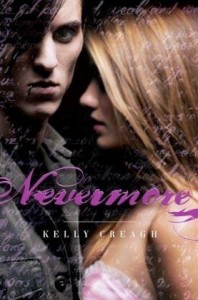
Review: Nevermore by Kelly Creagh


Book info:
Form: pdf file, e-book
Genre: Poe-inspired fantasy/romance
Target audience: YA

Synopsis: 


What can a blonde cheerleader extraordinaire and a Goth oddball wearing eyeliner have in common? They attend the same school and they’ve just paired for an English literature project by a mean professor. Neither Isobel Lanley nor Varen Nethers are exactly thrilled – he perceives her as a pink Barbie doll without brains, she thinks he drinks blood and sleeps in a coffin just to shock people and prove he can. Still both of them need a good grade and so they decide to work on that project and it starts their big adventure with Edgar Alan Poe and the world of dark fantasy resembling a bit the court of Unseelie, dark faeries from Irish mythology of the Daoine Sidhe.

Yes, they fall in love in-between – Isobel finds herself making excuses and lying just to be with Varen a little bit longer (unfortunately we don’t know what Varen thinks because the novel is narrated from Isobel’s POV). Steadily pulled away from her old circle of friends and a possessive football player of a boyfriend she ventures deeper and deeper into the dream world, seeing and talking to strange creature nobody can see or hear. She meets a man called Reynolds but is he real? Why does he look as if he jumped straight from another era? Will he help her to explore the mystery around Varen and his black notebook he carries whenever he goes?


What I liked:

Firstly let me say that the blurb didn’t make me warm up to this novel. Nevermore had the potential to be incredible, but also incredibly bad. First of all it is the first part of another YA series grrrr. Unfinished series to add (double grrrr but don’t let your dog hear you). Secondly a cheerleader girl is more often than not somebody I wouldn’t like to meet or read about – for plethora of reasons. Yes, plethora – one of these words your ordinary cheerleader from different YA stories would  confuse with a fancy, old musical instrument from France.  Still I, like most people in their right mind, love and appreciate poems and stories of Edgar Allan Poe and I have been informed that the male hero is a Goth kid who loves Poe to no end. What’s more I’ve been assured by my dear Heidenking in her great review that this book doesn’t feature any vampires, werewolves or angels, fallen or otherwise,  so I decided to give this one a chance.
Edgar Allan Poe
Cover of Edgar Allan Poe
yeah, chicks dig moustache

I have to admit I didn’t expect to be caught in the story as much as I did. I ended up reading the book in two sittings without noticing the passing hours. Why? Oh it is such a page-turner for YA and adult readers because the author cleverly and skillfully weaves many known facts about Poe’s life and mysterious death into the plot. She relates Poe’s works with the mysteries of a haunted ‘dreamland’ similar to the domain of elves from Jonathan Strange & Mr. Norrell by Suzanna Clarke (if you read and liked the magical aspect of that one you will enjoy Nevermore as well – different epoch, similar athmosphere) AND then she adds a well-know high school plot to it.

I’d also add the character setting to the number of advantages. Isobel is at first just your ordinary empty-headed cheerleader but then she shows her mettle confronting all the stereotypes and tropes – she starts reading Poe (ok, skimming more like, not being an avid reader and Poe not being a very easy author to read), she dares dump her boyfriend, she almost turns her entire life inside out just to find out more about Varen. 

I loved especially one short, funny scene when Isobel, visiting Varen’s house and looking at his childhood photo, discovers something truly shocking about him:

“You're really a blond," she said, her tone just short of accusatory.

"And if you tell anyone, I will come to you in the night and smote your everlasting soul.” 

As her world begins to unravel around her, Isobel discovers that dreams, like words, hold more power than she ever imagined, and that the most frightening realities are those of the mind. Now she must find a way to reach Varen before he is consumed by the shadows of his own nightmares – a very ambitious task for a cheerleader or a teenage girl I suppose.

The best part is that neither Isobel nor Varen are perfect creatures, both are textured and layered. Ms. Creagh takes her time building these characters, starting with initial mutual dislike, and slowly peeling back the layers of their personalities. Varen is a classic young Severus Snape (a character from Harry Potter series) – a gifted boy, alienated at school and with an abusive parent to boot. He is also much more: he works in an ice-ream parlour, (yeah, actually selling ice-cream; can you imagine Snape doing that?) he dyes his hair and drives along in a vintage Jaguar (very cool!). Still, compared to intrepid Isobel, he seems too preoccupied with his reading, writing and Goth persona to be a truly active character; finally he falls into a not very manly category of damsel in distress (but I told you the author is playing with tropes and stereotypes, right?)

 What I didn’t like:

 Even though I'd looked forward to Isobel's exploration through the Poeland (I really couldn't restrain myself, 'Poeland' is so...right), but it turns out the progress of Isobel's learning more about Poe  is a rather rushy one, Isobel's own opinion on neither the author nor his works, is largely missing. We only got to see her read through The Masque of the Red Death then commented on it and there's no more mention of her opinion on Poe's works. I understand that she is not a reading type but I suppose if your fate and the fate of your beloved depends on information from books you should be far more committed to reading and finding stuff; still dear Isobel always acts as if she expected somebody to explain her everything (a fairy theory for dummies on Youtube,  not longer than 3 minutes, would definitely fit her better) and when nobody wants to do it she sulks. As a result she lands in that alternate reality, chased by ghouls and nocs (a kind of demons), completely unprepared and the fact that she actually manages to pull through comes as a major miracle.

Let me also carp about the role of adults. Unfortunately here the author decided to stick to the well-known patters. Although parents exist in this one, they are either too busy or completely out of touch with their kids and the reality for different reasons. As a result when the main lead has a problem she can talk to a friend or to her reflection in the mirror. I wish I read a book which author dared change that, showing a parent who not only cares but also knows how to show it and can actually impress their progeny with his/her knowledge.

My wishes for next parts.


I found Varen too vague a character to dominate the book (and I wish he DID dominate), there are so many things about him we don't know, e.g. his family's background, the reason why he had such a bad relationship with his dad, how he discovered Poe and became the way he was now, how he found a job in that bookstore and ice-cream parlour etc. After finishing Nevermore I'd very much love to learn more about him. Also some questions about Poeland simply beg for a creative answer – e.g why some people get trapped there and some can return to the land of living?

Final verdict:

Kelly Creagh's Nevermore is a very ambitious and interesting Young Adult novel which manages to bring  mystery and dark fantasy to life. Overall it is a worthy read not only for teen Poe's and/or Goth's fans. I'm looking forward to the sequel although, being spoiled and all, I know it is not as good as the first part. Maybe the third book will straighten things up nicely? I am definitely willing to give the author the benefit of the doubt.

A good idea for an alternative cover version

Enhanced by Zemanta

Monday, 22 October 2012

Review: The Girl in the Steel Corset by Kady Cross (Steampunk Chronicles #01)

Book info:
Form: pdf file
Genre: steampunk-flavoured romance/adventure
Target audience: YA

Synopsis:

1897, Victorian England.16-year-old Finley Jayne is convinced she’s a freak. No normal girl has a darker side that makes her capable of knocking out a full-grown man or throwing him across the room. Is that monster inside her an ally or her biggest enemy? How has she ended up like that?  Who knows. One thing is true – it is the only option left to Finley. Only Griffin King, a young peer of the realm, sees the magical darkness inside her as something good, something that means she’s special . . . that she’s one of “them”, a gang of freaks of nature or maybe people who’s just got to another evolution stage. Still difference is not always a good, acceptable thing especially when somebody equally gifted tries to use it to take over the whole country and maybe even the whole world.

What I liked:

It started like a YA novel full of great ideas, taken from different books. As Journey to the Centre of the Earth by Jules Verne and The Strange Case of Dr Jekyll and Mr Hyde by R.L. Stevenson are two of them (I read and liked them both) I decided to give it a try. Finley also seemed like a heroine with some spine – unfortunately she had to crash into Griffin King too soon and then her potential was somehow diminishing with every page. I was on board with the whole Jekyll/Hyde dichotomy and the battle for good and evil going on inside of her but it ended in no time.

Also the cover is very nice.

What I didn’t like:

My first carping is that, in my humble opinion, the author couldn’t decide how steampunky this novel should be. Ok, there are automatons, bionic people and other fantastic aether devices but they never get into the spotlight, not truly – that’s why I wouldn’t call this book ‘steampunk’, it just comes with a steampunk flavour. In real steampunk novels the love is always in the details– it’s not just about shoving in some wheels, engines and corsets, you have to create the entire world in all its depth and intricacies. Here random devices make appearances for no apparent reason as if the author was afraid she can bore her female readers with too many technical elements. Well, if you write about  kick-ass heroines and their female side-kicks who are also technical whizzes you surely must be aware such types exist in real life as well. So who is your real audience?

What’s more the scientific aspect hasn’t been researched well or rather it was mixed with the ordinary religious beliefs: correct me if I am mistaken but either there is a ‘spirit world’ with the souls of the departed (so human beings have a soul and there is God, Heaven, Hell etc) or there are just those particles of life, the Organites, found in the core of the Earth by Griffin’s father, which make it possible to cure all illnesses, enhance your natural talents and even resurrect freshly deceased if only applied in copious amounts by somebody skilled (so no soul is needed, right? No soul = no creator, just evolution). Either or. Meanwhile Ms Cross tries to sell us on both. Which is not exactly the best idea from my point of view.

My second remark: the plot and the narration style. The book was very predicable and a bit boring. The first crime the author committed is too much telling instead of showing. The next - a bland bunch of characters. A baddie starts as a big, strong, bogeyman and ends up a broken creature, almost hopelessly weak without any mechanical help. Finley’s little problem also is resolved with childish ease (I did expect it go far worse and somehow it didn’t); her dual nature seemed nothing else but a device which had to justify the fact she had two boyfriends. By the way if you have to have a duke in the book please, do your research, and call him something nice and probable, not Griffin King. ‘King’ sounds spurious even to teenage American readers and believe it or not, some of them know European history and peerage pretty well. I know, it might come as a surprise but still…

And here we hit my third major complaint: two love triangles would be bad enough in any YA book but here, additionally one element of the main triangle (Griffin-Finley-Jack), Jack Dandy was simply misconstrued. He was supposed to be that epitome of bad boy: dark, lean, handsome, ruthless, criminally-inclined, street-wise, mysterious, irresistible. Instead he was a sissy who danced around Finley like a well-trained circus poodle and never even dared to kiss her. We also weren’t told anything about his nefarious exploits which seemed a bit strange to me as well – such a big criminal mastermind and not even one juicy burglary? No fisticuffs? He seemed to exist just to mangle Queen’s English, buy Finley that gorgeous fancy dress and provide useful info to Griffin. Booooring.

Finally, imagine it or not, one of the major criminal mysteries (the identity of the killer of Felix, the rakish son of the employer of Finley, beaten to a pulp by her at the beginning because of a rape attempt) is left unresolved and even forgotten. No character mentions it, nobody wonders what happened to that obnoxious type and it seemed so important to all of them at first...

Final verdict:

I know it’s the first in a planned trilogy but on its own, “The Girl in the Steel Corset” felt like a novel half-done. I admit the ideas were great but it is also another example of a book which significant potential was sadly squandered. It was not the YA Steampunk entertainment I was hoping for and it made me definitely unwilling to continue the series.

Saturday, 20 October 2012