Tuesday, 14 February 2012

Review: Secrets of an Accidental Duchess by Jennifer Haymore

Today I have a perfect St Valentine's Day treat for you all! Once again welcome Rameau  who kindly agreed to publish her another splendid review as a guest post on my blog - the rest of her work can be found on Goodreads . This time she tackles a genre which I rarely feature here - a historical romance of a very pinky kind. Well, look at this cover and you can easily guess what to expect. I admit I hate romances  as much as I hate pink- amI right, though, or just prejudiced?

This is the first time I've heard of Jennifer Haymore, and had I known what to expect I most likely would have passed the opportunity to read her work. This isn't going to be a positive review. 

The title is misleading. There really weren't that many secrets this accidental duchess had and the ones there were, were revealed quite quickly and not  in a timely fashion. 

There really should be a series warning for all unsuspecting readers. Not that I was one of them. I knew I was jumping in in the middle of a series, but that wasn't the problem. The problem was the extensive character gallery I was expected to familiarise myself with immediately. To this moment I wouldn't be able to name and place all the important side characters. I barely remember the main characters, but that has more to do with the poor characterisations or lack thereof. More about that later. 

From the very start I realised that Haymore's writing style wasn't for me. I happen to think there's a difference between detailed and florid–one of which is good and the other one isn't–I thought she crossed that line, although, it did get slightly better when action overtook the moment. 

Speaking of things that were better than expected, the sex scenes were a positive surprise. Despite the fact that the her happiness was dependent on his orgasm, there was nothing too awkward or unintentionally hilarious. I found these scenes quite titillating, which is a first in a professionally published work for a while. 

Having said that, I still think there was more passion between Max and his rival Fenwicke than there ever was between Max and Olivia. That's because of the characterisations. Max and Olivia both felt so flat and uninteresting in comparison that over the top evil Fenwicke appeared to the only three dimensional character in the book. I could have handled the brutality and the abuse described, had it been properly addressed and not been reduced to a mere plot device. Fenwicke was nothing more than a ploy to create drama and angst where none was needed as the relationship between Max and Olivia had its existing inner tensions. 

What's worse, neither Fenwicke or his victims were addressed with enough care or attention, but they were quickly dismissed as their part in the storyline expired. 

I could dwell on the idiocy of the two main characters exhibited throughout and especially towards the end of this book, but suffice to say that there's a reason why I shelved this book under the too-stupid-to-live category. I'm not just talking about the contradiction between a gentleman willing to seduce a virgin but reluctant to fight dirty when being attacked by a mob, I'm talking about the lack of pure survival instinct. He'd rather beat up a man in his weakened state than run to save her life. 

I'm aware that my generation nor that the one of my parents'–or their parents'–invented sex, but to read about sisters–one of which is an unmarried virgin–talk about contraception sounded too modern to fit the time to me. There was also another instance, when Olivia was asking Max to give her space, that felt out of place in this historical setting. 

Also as detail orientated as the author is, I was surprised how easily Olivia could wolf down her meal despite the injury to her throat. 

I received a copy of this book from the publisher through NetGalley.

Monday, 13 February 2012

Monday can be fun...but usually isn't # 06


Hi everybody!

It's Monday, it's 13th of February, how are you doing? 


I know, it is not easy to survive St. Valentine's Day. Let's hope these cartoons and jokes will help!


500 Valentine Cards 

Mike walked into a post office just before Valentine's day, he couldn't help noticing a middle-aged, balding man standing in a corner sticking "Love" stamps on bright pink envelopes with hearts all over them.  Then the man got out a bottle of Channel perfume from his pocket and started spraying scent over the envelopes.
By now Mike's curiosity had got the better of him, and so I asked the man why he was sending all those cards.  The man replied, "I'm sending out 500 Valentine cards signed, 'Guess who?'"
"But why?" asked Mike.
"I'm a divorce lawyer," the man replied.


A request

Phil, a smart and handsome young man, dressed in the latest fashion, walked into a local pub on St. Valentine's Day.  After a while he noticed a pretty, well-dressed woman gazing at him without blinking her big, brown eyes. Phil felt flattered so he walked up to the woman and said in his deepest, most seductive voice, 'I'll do anything you wish, beautiful lady, for just £10 but on one condition.' 
The woman appeared to be trapped in the moment, still gazing at him beseechingly. She asked as if in a trance, 'What's your condition?'
Phil answered, 'Tell me your wish in just three words.' 
There was a long pause. Finally the woman sighed, opened her purse, counted out the money and handed it to the man along with her address.  She then looked deeply into his eyes again and whispered, 'Clean my house.'


Saturday, 11 February 2012

Friday, 10 February 2012

Review: Riyria Revelations series by Michael J. Sullivan, books 1-6 (or 1-3, Orbit edition)


The series has had two editions and, as it might be confusing, I am giving you the full list of the titles.
The first edition, published as six books by AMI and Ridan Publishing (these books are now out of print) consists of the following parts: 
  • The Crown Conspiracy,
  •  Avempartha, 
  • Nyphron Rising, 
  • The Emerald Storm, 
  • Wintertide, 
  •  Percepliquis, 

The Orbit version (most likely to be found in bookshops nowadays) consists of three books: 
  • Theft of Swords (1-2),  
  • Rise of Empire (3-4) 
  •  Heir of Novron (5-6)

Synopsis:

A classic fantasy story, full of great characters who have to save humanity and discover a lot about themselves in the process. You see? It must be a nice series if its summary can be included in one sentence!

What I liked:

A bunch of incredible baddies

I really mean ‘incredible’ here – three-dimensional, shadowy, complex and sometimes even funny. Take Sauly aka Maurice Saldur, the bishop and head of Nyphron Church in Melengar. He looks and often behaves like your average depiction of Gandalf from LOTR  but even the most vicious sea snake would envy him the poison. This man is capable of anything and I suppose his “benign granddad” looks were meticulously cultivated over the years.  The best bit – he thinks he is more or less ok. Well, as the old saying says prisons are full of innocent people. Sauly would never admit to any wrongdoing which shows that his conscience is non-existent.

The other specimen: Archibald Ballantyne Earl of Chadwick. I loved  sweet,  ambitious, cowardly Archie! Not only he was handsome and self-centered, he also managed to fall in love with only the proper girls – the most advantageous candidates at the moment. Every aristocratic father would be proud of him. The best bit - he seemed to be genuinely infatuated with his latest choice (not saying who, find out on your own) and he died as a result of his cheek. Really, who would invent a better way of getting rid of a baddie? Make him fall in love and get him killed because of that!

Finally Magnus the treacherous dwarf who almost got Royce killed twice – no mean feat – and then finally found out a bit about friendship and loyalty and redeemed himself.

How the series develops and ends

As you progress it becomes obvious this particular story was carefully planned from the beginning to the very end and maybe because of that  the author was able to end it on a high note. Fear not, the mysteries will make sense, questions will be answered, characters will receive their dues and loose ends will be tied up leaving you more or less satisfied. Actually each book reveals a little of the whole picture but only when you know everything it is possible to appreciate how it seamlessly works together. Well, you might actually regret the fact that the end came so quickly. Mind you the plot of  every of these six  books is fairly stand-alone – a truly difficult thing to achieve in a series.

 I complained in my review of the first book that the characterization was a bit lacking. I am happy to say it improved greatly in the next installments, especially when it comes to the pair of main protagonists, Hadrian and Royce. Well, especially Royce.

Female characters

I liked most of them with one exception (more about her in the third section of my review). Fantasy books often presents females following some well-worn templates. Usually we get a pretty princess, worth fighting for, a servant who is useful and faithful but not especially pretty, a witch who is devious and clever but not especially nice etc. Here every female character comes with an unsuspected twist.

Arista is a princess but she is also a witch who must learn more advanced ropes on her own; she is not especially pretty and she must go through a lot to reemerge as an independent woman. Yes, she still needs that male arm to rescue her from time to time and  give her more strength but, as far as princesses go, she remains independent - she thinks on her own, she plans her own future, she decides what is good and bad for her.  I really liked Arista from the beginning, even when she was just a lonely girl sitting in her high tower, wondering how to make lesser magic work.

Thrace/Modina starts as a simple village girl but then she transforms; it takes a lot of pain but she manages to turn into a compassionate leader. She might have lost her innocence and ingenuity on the way but I liked her strength and I found the whole transformation rather believable, especially for a fantasy book.

Amilia also starts low - as a scullery maid - but then she provides Modina a much-needed support in crucial moments. She  finds her knight in the shining armour in the process which was kind of sweet. She might be the weakest of those three, never exceeding her ‘friendly servant’ capacity, but still rather likeable. Overall not bad – I managed to say something good about three out of four female leads in this series! I can sometimes surprise myself!

Male protagonists:

Well, they are complicated as well, especially Royce who seems to be the most shadowy type, full of surprises, not all of them nice. It is sometimes difficult to call him 'protagonist' at all but it worked for me just fine. Hadrian provided a nice contrast to Royce, showing him that the better side of human nature still exist.

What I didn’t like:

The elves

For most of the series, like five books, elves are spoken about, hardly seen and not heard at all. Ok, there was one exception – a short scene between Royce and Ren, a half-breed which had been treated with kindness by the thief and found a way to show his gratitude in return.  Throughout the books I kept wondering why elves were such a dirty secret (while it was logically explained, you can understand it only at the very end). They are presented as a race of very intelligent beings who could live for a very long time, their culture was so sophisticated and still most humans had only harsh words for them or half-breeds. It was actually strange any half-breeds existed at all, taking all this negative attitude into consideration. 

Only in the last book we learn that elves can be brutal and murderous, that it’s either them or us and the future of mankind is endangered while they live. Well, pity because I would love to see them cooperate with humans – I am sure it could be arranged,  if not for those pure breeds then at least for those with mixed blood.  By the way the whole elf destruction routine felt  over the top – not only were they trying to kill literary every last human but their methods seemed a bit haphazard, especially keeping in mind how powerful they were supposed to be.

Gwendolyn DeLancy

The romantic interest of Royce is indeed my major complaint. She is a former prostitute and a successful businesswoman, owning Medford House (a brothel) and The Rose and Thorn Tavern.  Reading the books it seems Miss DeLancy’s main occupation is to take care of Royce whenever he happens to be close – our good Gwen predict his future, feeds and pampers him and sleeps with him (but it is only hinted in a very delicate way). She is so good and sweet that she becomes annoying after a short while. The fact that she is also a person who knows everything the best doesn't help either. You know, she has a gift of Sight and I hate those ‘know-it-all’ seer types. BTW how come Gwen was able to predict Royce’s future while her compatriot seer almost lost her life while being coerced to do the same thing?

Overall whenever I read a scene with Gwen, it always put me in a blood-thirsty mood. Call it a hunch but I never believed in Royce’s and her ‘happily ever after’, especially when she told him that she had already chosen names for their future children (sic!). As a result I couldn’t wait for her to die. She was simply too flimsy as a character and too cloyingly sweet as a woman not to mention the fact that we never saw her in the role of a 'madam' or a prostitute. The scene of her death was the only one which I read with interest as it showed another aspect of Royce’s dark personality. Finally this saintly whore (an oxymoron, I know, but I couldn't restrain myself) was put to a good use. A pity it came so late – if I had anything to say I would get rid of Gwen earlier and I would pair Royce with an elf or a half-breed. If I sound callous and unladylike well, I do admit I like dark fantasy.

Final verdict:

Despite my carping above I enjoyed this series very much and I would love to reread it after some time. I recommend it very strongly to fans of good, classic fantasy or just a good, consistent story. A warning: this series is highly addictive, buy or borrow all the books if possible or you will regret it later (like me).

Tuesday, 7 February 2012

Review: The Discovery of Jeanne Baret by Glynis Ridley


Genre: non-fiction, historical
Target audience: adults
Book form: paperback, 291 pages


 This book was provided by the author's publisher via my lady Blodeuedd's excellent blog in return for an honest review. I haven't been compensated for writing the said review in any way and the fact that the book came free of charge didn't influence me either.   

Synopsis (excerpts from Amazon.com):

The year was 1765. Eminent botanist Philibert Commerson had just been appointed to a grand new expedition: the first French circumnavigation of the world. As the ships’ official naturalist, Commerson would seek out resources—medicines, spices, timber, food—that could give the French an edge in the ever-accelerating race for empire.

Jeanne Baret, Commerson’s young mistress, housekeeper and collaborator, was desperate not to be left behind. She disguised herself as a teenage boy and signed on as his assistant. The journey made the twenty-six-year-old, known to her shipmates as “Jean” rather than “Jeanne,” the first woman to ever sail around the globe. Yet so little is known about this extraordinary woman, whose accomplishments were considered to be subversive, even impossible for someone of her sex and class.
            
When the ships made landfall and the secret lovers disembarked to explore, Baret carried heavy wooden field presses and bulky optical instruments over beaches and hills, impressing observers on the ships’ decks with her obvious strength and stamina. Less obvious were the strips of linen wound tight around her upper body and the months she had spent perfecting her masculine disguise in the streets and marketplaces of Paris.
            
In The Discovery of Jeanne Baret, Glynis Ridley unravels the conflicting accounts recorded by Baret’s crewmates to piece together the real story: how Baret’s identity was in fact widely suspected within just a couple of weeks of embarking, and the painful consequences of those suspicions; the newly discovered notebook, written in Baret’s own hand, that proves her scientific acumen; and the thousands of specimens she collected, most famously the showy vine bougainvillea.
 
What I liked:

This book is definitely a very well-researched position which presents plenty of interesting facts concerning life and habits of people living in the 18th century in France and abroad. Although the main emphasis is on the ethnobotanical tradition and, more generally, French scientists and thinkers such as Jean le Rond d’Alembert, Denis Diderot, Jean-Jacques Rousseau and Voltaire, the ordinary people and their fates are mentioned often as well, especially women.

The narrative voice of Ms Ridley is quiet and pleasant although you really must take your time to get into the book. When you finally find the right rhythm, though, you can find such interesting historical tidbits as a short history of the coffee trade, and a fresh look into the situation of women in France prior to the Great Revolution (I didn’t know that they were not allowed to rent a flat on their own or stay on a ship for longer than just a moment – it was the law mind you!)

Overall, if you are a girl/woman living in Europe or in the USA, after reading this book you might stop complaining about your life for a significant period of time. The fates of women used to be much, much worse, especially poor, uneducated women who, like Jeanne, gave birth to an illegitimate child.

What I didn’t like:

With a title like that, I expected the book would be more focused on the main heroine, Jeanne Baret, who was the first woman to make a tour around the world on a ship. In other words, I expected a portrait, perhaps with some other people close to her and  plants in the background. What I got was a full-scale landscape, teeming with different people, plants, breathtaking vistas, ships, cities, and even animals. The heroine was a bit lost in the middle of all these goodies and, in my opinion, the whole book suffered because of that.

Don’t get me wrong – we still get to know plenty about Jeanne, her family and her profession. However, it is a bit too diluted; as soon as you start getting interested in the story of this strong and undoubtedly very brave woman the author throws your way one digression after the other; even if these are interesting per se, they dwarf poor Jeanne and her ordeal, making the book bland as a result

Final verdict

I feel Jeanne Baret’s life deserves our full attention – I suppose she would be a great heroine of a truly gripping fictional story. Let me use this section to tell you why I think so.

This peasant female botanist was literate in times when 90% of women couldn’t read and write but still she couldn’t support herself without relying on Philibert Commerson. She became his mistress but also she helped him in his career, teaching him about plants and their properties. She had to give up their child to an orphanage most likely because the boy would be an obstacle to Commerson’s plans. Then she did what she could to be able to accompany him during a three-year long journey -  she took every risk possible.


She worked very hard during circumnavigating the globe – harder than plenty of men around her, definitely harder than her official employer and secret lover. She had to conceal her sex while living on a rather small ship full of men (the crew was over 100 people). She had to take care of Commerson’s ailing leg and the plants they gathered together. In return she was constantly watched, manhandled from time to time and finally gang-raped by the crew at least once during the journey. Her selfish employer failed to help or defend her. After Commerson’s death, she was left high and dry - far from home, with just clothes on her back, with no money or connections to ensure her a safe return. Commerson's house in Paris with everything inside, so also Jeanne's personal effects, has been impounded. And you know what? Miraculously, she still found her happily ever after – married a soldier, returned with him to France and made a life together.

Was her time with Commerson a complete waste and failure? No. He taught her independence and she used that knowledge – after returning to France she dared petition the appropriate ministry and she received her outstanding wages – a lump sum which made it possible to buy a house and some land. I love such endings!


Enhanced by Zemanta

Monday, 6 February 2012

Musical Monday 6 of February


Welcome to Musical Monday! 

I don't know about you but I cannot imagine a proper carnival ball without a waltz. Here is one of my favourites: composed by Aram Khachaturian as a suite from M.Lermontov's drama "Masquerade". 


Enjoy!


Thursday, 2 February 2012

The masquerade - Venetian carnival and masks

Carnival is a festival traditionally held in Catholic and, to a lesser extent, Eastern Orthodox societies. The word carnival most likely comes from the Latin carnem levare or carnemlevarium which means to take away or remove meat. Other scholars argue for the origin from the Roman name for the festival of the Navigium Isidis (ship of Isis), where the image of Isis was carried to the sea-shore to bless the start of the sailing season, accompanied by smaller boats and a parade of masks. No matter who is right, the carnival was officially a religious event at first but soon its character changed. 

 The Lent period of the Liturgical year Church calendar, being the six weeks directly before Easter, was marked by fasting and other pious or penitential practices. Traditionally during Lent no parties or other celebrations were held, and people refrained from eating rich foods, such as meat, dairy, fats and sugar. The forty days of Lent, recalling the Gospel accounts of the forty days that Jesus spent in the wilderness, serve to mark an annual time of turning. In the days before Lent, all rich food and drink had to be disposed of – so eaten up. The consumption of this, in a giant party that involved the whole community, is thought to be the origin of Carnival. Some carnival traditions undoubtedly date back to pre-Christian times. The ancient Roman festivals of Saturnalia and Bacchanalia may possibly have been absorbed into the Italian Carnival. The Saturnalia, in turn, may be based on the Greek Dionysia and Oriental festivals.

While medieval pageants and festivals were church-sanctioned celebrations, carnival was also a manifestation of medieval folk culture. Some of the best-known traditions are carnival parades and masquerade balls with the participants disguised and covered by masks. These were first recorded in medieval Italy and the carnival of Venice was for a long time the most famous carnival in Europe. There could be no carnival without a mask, though.

 The first documented mention of the Carnival of Venice occurs in 1092 but the first mention of the wearing of carnival masks was made in 1268. The Venetian law makes noted of masked men who threw scented eggs at ladies during the carnival. The law prohibited this practice.

I took these photos at the 2010 Carnevale in V...
Contemporary Venetian carnival scene via Wikipedia
 The main purpose of the Venetian mask in the early centuries was to hide and protect the identity of the mask-wearer in order to avoid discovery during indecent activities, but as the severe social rules of the Serenissima Venetian Republic were created, it gradually changed into a symbol of disobedience and freedom. The purpose of the mask was to act as a barrier to keep somebody's identity unknown. The mask would permit the wearer to act more freely in cases where he or she wanted to interact with other members of the society outside the bounds of identity and everyday convention. It was useful for a variety of purposes, some of them illicit or criminal, others just personal, such as dates. Masks were mostly favored by the upper class so that they could go out freely and mingle without being recognized. Those who went out to act promiscuously, gamble, wanted to avoid creditors, or live a life of begging on the streets due to being impoverished by these creditors, strived to evade the scorned look.

Wearing a mask, however, was restricted to certain timing of the year due to new laws implemented in the 14th century by the Venetian Government in order to stop the moral decline of the Venetian people (it seems it is a recurring problem no matter what era). From the day after Christmas until Shrove Tuesday (marking the beginning and the end of the Venetian Carnevale), masks were allowed to be worn, but not during religious feasts. Along with these days, masks were worn during the two week of Ascension, as well as halfway through June and during official banquets and other celebrations of the Serenissima Republic. The laws stated that it was forbidden to masquerade at night, it was forbidden for men to enter convents dressed as women (and you can guess for what purpose), and it was forbidden for masqueraders to carry arms and enter churches.

 In 1797, when Venice came under the reign of King of Austria, the practice of wearing masks during celebrations was declared forbidden. The masks were not used again until 1979 when a group of undergraduate students revitalized the custom of Venetian masks to earn money by selling them to tourists. Since then, Venetian masks have become the signature of Venice and an integral part of the modern Venetian Carnevale. They are often characterized by their ornate design, featuring bright colours such as gold or silver and the use of complex decorations in the baroque style.
Italiano: Maschere veneziane - Baùta
Classic Bauta mask via Wikipedia

 The most common mask types 

 The Bauta

 Bauta (sometimes referred as baùtta) is a mask which covers the whole face, with a stubborn chin line, no mouth, and lots of gilding. The mask has a square jaw line often pointed and tilted upwards to enable the wearer to talk, eat and drink easily without having to remove the mask thereby preserving their anonymity. The Bauta was often accompanied by a red cape and a tricorn hat. It was worn by men. In 18th century, the Bauta had become a standardized society mask and disguise regulated by the Venetian government. It was obligatory to wear it at certain political decision-making events when all citizens were required to act anonymously as peers. Only citizens had the right to use the Bauta. Its role was similar to the anonymizing processes invented to guarantee general, direct, free, equal and secret ballots in modern democracies. Today the Bauta and the Moretta styles are sometimes blended.

Nice but mute -
the moretta mask
 The Moretta (Servetta Muta) 

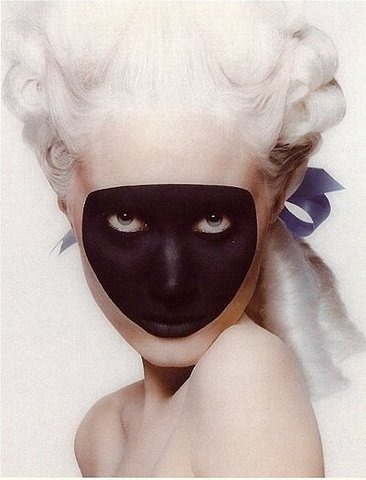
 The Moretta mask is one of the most traditional designs of Venetian female masks. Originating in France it was quickly taken up by the fashion conscious Venetian women. It is a dark colored mask (hence the name, moretta meaning “a little black one”) depicting intrigue. The Moretta mask was oval in shape with no mouth opening, just eye holes. Traditionally the mask was worn with a veil so giving total anonymity to its wearer. Originally it was made of black velvet the features are expressionless. The mask was held in place by biting on a special button sewn on the inside of the mask using front teeth so rendering the wearer mute. This is why the Moretta mask is also called the Servetta Muta meaning mute maid servant.

The lack of verbal communication this mask imposed meant that Venetian women had to use their body language a lot. It encouraged coquettish behavior; the tilt of the head, the fluttering of eye lashes, the touch of a hand all became an intricate part of flirtation. Its expressionless face meant that the female wearer had to use her body much as a mime artist would today. When worn, the Moretta mask accentuated all the attributes that Venetians considered to be the height of desirability and femininity. In an era where women's views were seen as unimportant and where the women were judged on their physical attributes alone the mask accentuated the soft feminine lines of the female face but made its wearer unable to speak, eat and/or drink. It really speaks volumes about the treatment of women in the Venetian society.

 The Moretta mask was worn to gambling houses, for affairs and when visiting convents where vows of silence were observed. Its popularity was short lived as by 1760 it had disappeared.. Thankfully todays Moretta masks are designed with ribbon ties to secure it. They can be crafted from leather, cloth or paper mache. Most are still blank in either black or white as tradition dictates. The leather Moretta masks are probably the most comfortable, allowing the skin to breath and molding to the shape of the wearers face.

Columbina mask - for those vain and pretty
 Columbina 

 The Columbina (also known as Columbine and Columbino) is a half mask often highly decorated with gold, silver, crystals and feathers. It is held up to the face by a baton or tied with ribbon as with most other Venetian masks. The columbine was popularized by an early actress in the Commedia dell'arte of the same name. It is said it was designed for her because she, being a vain woman like many actresses, did not wish to have her beautiful face covered completely.

 Medico Della Peste (The Plague Doctor) 

English: Medico Della Peste - "plague doc...
Medico Della Peste mask via Wikipedia
 The Medico Della Peste with its long beak is one of the most bizarre and recognisable of the Venetian masks. The striking design has a macabre history originating from 17th century French physician Charles de Lorme who adopted the mask together with other sanitary precautions while treating plague victims. It is a full face mask, most often white, with curved eye holes and a hollow beak. The mask is covered with crystal discs to create a bespectacled effect.

 Today, the masks are often more decorative. The doctors who followed de Lorme's example wore the usual black hat and long black cloak as well as the mask, white gloves and a stick (to move patients without having to come into physical contact). They hoped these precautions would prevent them contracting the disease. Those who wear the plague doctor mask often also wear the associated clothing of the plague doctor. The popularity of the Medico della Peste among carnivale celebrants can be seen as a “memento mori” (remember about death). This mask is perhaps the most enigmatic and distinguishable of all Venetian masks. It is typically worn with a black hat and a cloak by men.

 Volto (Larva) 

A modern volto mask with a headdress
 The classic larva, also called the volto mask, is mainly white. It covers the whole face but it often has individual facial features. It is worn with a tricorn and cloak. It is thought the word "larva" comes from the Latin meaning "mask" or "ghost". Like the bauta, the shape of the mask allowed the wearer to breathe, drink, and speak easily without having to remove the mask completely. The volto was made of fine wax cloth and so was light and comfortable to wear, making it ideal for a night of socializing and dancing.

Now I suppose you are well-prepared for  your masquerade - enjoy!


Sources:


Enhanced by Zemanta